
Step-by-Step Workplace Screening Guide for Employers
A legally defensible workplace screening process follows one ordered sequence: define your policy, extend a conditional offer, obtain standalone FCRA authorization, collect the specimen, send it to an accredited lab, route non-negatives through a Medical Review Officer (MRO), then adjudicate and trigger FCRA adverse action if needed. Skipping or reordering any step creates legal exposure under the FCRA, EEOC guidelines, or DOT 49 CFR Part 40.
Your immediate HR checklist for this week:
- Assign a policy owner and draft or update your written screening policy with role tiers
- Script your conditional-offer language so no screening begins before the offer is extended
- Create a standalone FCRA disclosure and authorization form, separate from all onboarding paperwork
- Order your test kits or lab requisitions from a SAMHSA/CLIA/CAP-accredited vendor
- Document your chain-of-custody procedure and train the collector
Responsibility map:
| Step | Owner |
|---|---|
| Policy design and role tiering | HR Director / Legal |
| Conditional offer scripting | Hiring Manager + HR |
| FCRA disclosure and authorization | HR |
| Specimen collection and ID verification | Vendor / Collector |
| Lab screening and confirmatory testing | Accredited Lab |
| MRO review of non-negatives | Medical Review Officer |
| Adjudication and adverse action | HR + Legal |
Table of Contents
- What does a step-by-step workplace screening workflow look like?
- How do you choose the right test type and specimen for each role?
- What U.S. legal requirements must your screening process meet?
- How should you handle a non-negative result?
- What operational practices reduce errors and speed up hiring?
- What templates and resources do you need to implement this?
- Countrywidetesting makes compliant workplace screening straightforward
- Key Takeaways
- A note on getting this right
- Useful sources and further reading
What does a step-by-step workplace screening workflow look like?
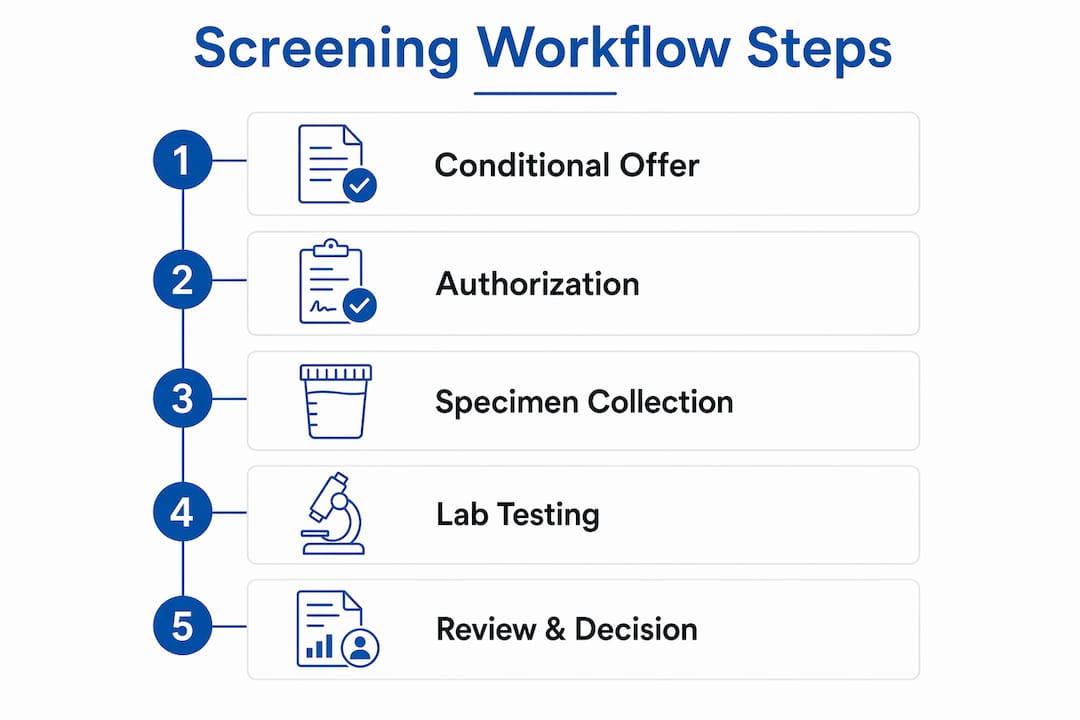
A well-run drug screening workflow moves through eight phases, each with a clear owner and expected timeline.
- Define your screening policy and role tiers. Document which checks apply to which job categories. Written policies that map checks to role risk are your primary defense against disparate-impact claims.
- Extend a conditional offer first. Background checks and drug screens should follow the offer, not precede it, to align with EEOC guidance and ban-the-box rules.
- Obtain standalone FCRA disclosure and written authorization. Hand the candidate a separate consent form before ordering any consumer report or drug screen through a third-party vendor.
- Order collection and verify identity. The collector confirms government-issued ID before any specimen is taken.
- Lab screening and confirmatory flow. The initial screen uses an immunoassay. A non-negative triggers confirmatory testing via GC/MS or LC-MS/MS at the same or a reference lab.
- MRO review for non-negatives. The MRO contacts the donor, reviews legitimate medical explanations, and issues a verified result. The employer receives only that verified result, not the underlying medical data.
- Individualized assessment and adverse action. If the verified result supports a negative hiring decision, follow the two-step FCRA adverse-action sequence.
- Onboard or refer. A verified negative clears the candidate for onboarding. A confirmed positive triggers documentation, referral options, and final adverse action.
Timing expectations: Many negative drug screens return within 1–3 business days; confirmatory testing and MRO review can extend that timeline. Build at least five additional business days into your schedule for the pre-adverse waiting period.
DOT flag: If the role is safety-sensitive and covered by 49 CFR Part 40, you must use the DOT-specified five-panel and follow Part 40 collection and MRO rules. Non-DOT testing under your own authority may run in parallel but cannot substitute for the federal panel.
How do you choose the right test type and specimen for each role?
Not every role needs every check. Scope your test selection to job risk, regulatory requirements, and local law.
Screening strategy by role category
| Role category | Recommended strategy | Typical panel |
|---|---|---|
| General office / administrative | Basic pre-employment screen | 5-panel urine |
| Safety-sensitive (DOT-covered) | DOT-mandated federal screen | 5-panel urine (Part 40) |
| Safety-sensitive (non-DOT) | Employer policy screen | 10-panel urine or oral fluid |
| Post-incident / reasonable suspicion | Rapid on-site + lab confirmation | 5- or 10-panel, any specimen |
| Patient care / healthcare | Expanded panel, random program | 10-panel or hair |
For a detailed side-by-side comparison, see 5-panel vs. 10-panel drug test trade-offs and common drug panels for HR managers.
Specimen type pros and cons
- Urine: Most widely accepted, required for DOT testing. Detection window roughly 1–3 days for most substances (longer for cannabis). Easy to collect, lab-validated.
- Oral fluid (saliva): Shorter detection window (24–48 hours for most substances), better for recent use and observed collection. Increasingly accepted for non-DOT programs.
- Hair: Longest detection window (up to 90 days). Useful for pre-employment and random programs where pattern of use matters more than recent impairment.
- Blood: Most accurate for current impairment but invasive and rarely used outside post-incident or forensic contexts.
Pro Tip: For workplace alcohol screening, breath or saliva tests measure current impairment; urine alcohol is not a reliable impairment indicator and should not substitute for a breath alcohol test in safety-sensitive programs.
What U.S. legal requirements must your screening process meet?
FCRA requirements
- Provide a standalone written disclosure and obtain written authorization before ordering any consumer report. Embedding consent in onboarding paperwork is the most common, and most costly, FCRA mistake.
- If a consumer reporting agency (CRA) compiles the report, follow the two-step adverse-action process: pre-adverse notice first, then final adverse action after the waiting period.
DOT requirements
DOT-covered employers must use the five-panel specified in 49 CFR Part 40 and cannot substitute a non-DOT panel. Part 40 also governs collector training, chain-of-custody forms, and MRO qualifications.
EEOC validation and anti-discrimination
EEOC guidance requires that all selection procedures be job-related and applied uniformly. For criminal history, conduct an individualized assessment before any adverse decision. Ban-the-box laws in many jurisdictions push that assessment to the post-conditional-offer stage.
Lab accreditation and chain-of-custody
Labs must hold SAMHSA, CLIA, or CAP accreditation. The MRO, not the employer, holds the detailed medical result. Employers receive only the verified outcome.
Pro Tip: Keep your FCRA disclosure and authorization form in a separate file from all other onboarding documents. Auditors and plaintiffs’ attorneys look for that separation first.
| Legal requirement | Key action | Governing authority |
|---|---|---|
| Standalone FCRA disclosure | Separate form, pre-screen | CFPB / FTC |
| Conditional offer timing | Screen after offer | EEOC / ban-the-box laws |
| DOT five-panel | Mandatory for covered roles | FMCSA / DOT Part 40 |
| Lab accreditation | SAMHSA/CLIA/CAP | SAMHSA / CMS |
| MRO verification | Verified result only to employer | DOT / HIPAA |
How should you handle a non-negative result?
The sequence matters as much as the decision itself.
- Initial non-negative screen reported by the lab to the MRO, not directly to you.
- Confirmatory testing via GC/MS or LC-MS/MS on the same specimen.
- MRO review: The MRO contacts the donor to explore legitimate medical explanations. Only after that review does the MRO issue a verified result.
- Employer receives verified result (negative, confirmed positive, or test not performed).
- Pre-adverse action notice: Send the candidate a packet containing the full consumer report, A Summary of Your Rights Under the FCRA, and any applicable state notices. Do this before any adverse decision.
- Waiting period: Allow at least five business days for the candidate to dispute the result or provide additional information.
- Final adverse action letter: If no dispute resolves the matter, issue the final adverse action notice with required language.
Sample pre-adverse notice language: Sample final adverse action language: If the candidate disputes and the MRO or lab confirms the result stands, proceed with the final notice. If the dispute reveals a lab error, the result must be corrected before any adverse action.
What operational practices reduce errors and speed up hiring?
Vendor evaluation checklist
- Proof of SAMHSA, CLIA, or CAP accreditation for the processing lab
- MRO access included or clearly contracted
- Documented chain-of-custody process with tamper-evident seals and transfer logs
- Data security certifications and breach notification procedures
- Turnaround SLAs in writing (target: 1–3 business days for negatives)
- Adverse-action support materials available on request
Verify vendor credentials including accreditation proof and whether the provider supports required adverse-action materials before signing any contract.
Cost and timeline expectations
Urine screens typically run in the lower end of the cost range for workplace drug testing; hair tests cost more and take longer. Confirmatory testing adds time and cost but is non-negotiable for any adverse employment decision. Build those timelines into your offer-letter contingency language.
Rescreening policy
Safety-sensitive roles should include a random testing program at a frequency that meets or exceeds regulatory minimums. Post-incident and reasonable-suspicion testing should be triggered by documented behavioral observations, not informal reports.
What templates and resources do you need to implement this?
A complete employee screening checklist for HR should include these documents, stored in your ATS or a secured HR drive:
| Template | Suggested file name | Storage location |
|---|---|---|
| Written screening policy | Screening_Policy_[Year].pdf |
HR policy library |
| Standalone FCRA disclosure | FCRA_Disclosure_Auth.pdf |
Offer packet folder |
| Authorization form | Candidate_Authorization.pdf |
Offer packet folder |
| Individualized assessment worksheet | Adjudication_Matrix.xlsx |
HR compliance folder |
| Pre-adverse action notice | PreAdverse_Notice_Template.docx |
HR compliance folder |
| Final adverse action letter | FinalAdverse_Letter_Template.docx |
HR compliance folder |
| Chain-of-custody log | COC_Log_[Date].pdf |
Vendor / lab file |
One-page operational checklist for your ATS:
- [ ] Conditional offer extended and documented
- [ ] Standalone FCRA disclosure signed and filed separately
- [ ] Test kit ordered or lab requisition submitted
- [ ] Collector confirmed candidate ID
- [ ] Chain-of-custody form completed and sealed
- [ ] Lab result received by MRO
- [ ] Verified result received by HR
- [ ] Pre-adverse packet sent (if applicable)
- [ ] Five-business-day waiting period observed
- [ ] Final adverse action issued or candidate cleared for onboarding
An adjudication matrix template that maps offense categories, time elapsed, and role risk helps HR apply individualized assessments consistently. For a deeper operational reference, the complete employer drug screening guide from Countrywidetesting covers timeline management and documentation in detail.
Countrywidetesting makes compliant workplace screening straightforward
Running a legally sound screening program means having a supplier whose lab partnerships are already certified and whose ordering process is built for employer compliance.
Countrywidetesting offers lab-based drug testing services backed by SAMHSA-, CLIA-, and CAP-accredited partner labs, with MRO workflows built into the process. You can order urine and oral fluid test kits directly online, request lab test bundles for pre-employment or random programs, or submit an enterprise quote request for high-volume or custom panel needs. Every order ships with chain-of-custody documentation, and results flow through MRO review before reaching your HR team. For employers building or updating a drug testing compliance program, that combination of certified labs, MRO access, and straightforward online ordering removes the coordination burden. Visit the lab testing services page to review available panels and get a quote for your program.
Key Takeaways
A compliant workplace screening process requires a conditional offer before any screen, a standalone FCRA authorization form, MRO-verified results, and a two-step adverse-action sequence before any negative hiring decision.
| Point | Details |
|---|---|
| Conditional offer comes first | Never begin screening before extending a written conditional offer to avoid EEOC and ban-the-box liability. |
| Standalone FCRA form is mandatory | The disclosure and authorization must be a separate document, not embedded in onboarding paperwork. |
| MRO handles all non-negatives | Employers receive only the MRO-verified result; detailed medical data stays with the MRO and lab. |
| Two-step adverse action is required | Send the pre-adverse packet, observe the five-business-day waiting period, then issue the final notice. |
| Countrywidetesting for compliant kits | Countrywidetesting provides SAMHSA/CLIA/CAP-accredited lab testing and urine/oral fluid kits with MRO workflows. |
A note on getting this right
Most employers treat workplace screening as a checkbox. The ones who avoid litigation treat it as a decision-support system: each check is scoped to a specific job risk, documented in a written policy, and executed through a chain of custody that leaves no gaps. The legal framework around screening, particularly FCRA adverse action and EEOC individualized assessment, exists precisely because blanket, undocumented screening harms candidates and exposes employers. The employers who build the workflow correctly from the start spend far less time in disputes and far more time onboarding the right people.
If you are building or auditing your program and want guidance on enterprise ordering, custom panels, or compliance review, the Countrywidetesting team is available to help you scope a solution that fits your roles and your risk profile.
Useful sources and further reading
- DOT 49 CFR Part 40 — Federal procedures for transportation workplace drug and alcohol testing
- EEOC: Employment tests and selection procedures — Validation, job-relatedness, and uniform application guidance
- EEOC: Consideration of arrest and conviction records — Individualized assessment and ban-the-box guidance
- CFPB: FCRA compliance guidance — Standalone disclosure, authorization, and adverse-action requirements
- Countrywidetesting: Drug testing compliance guide for HR — FCRA, state nuances, and adverse-action procedures
- Countrywidetesting: Step-by-step drug screening workflow — Operational checklist and templates for HR managers
- Countrywidetesting: Lab testing services — SAMHSA/CLIA/CAP-accredited lab panels and employer ordering
This article provides general information about U.S. workplace screening practices and is not legal advice. Confirm current federal and state requirements with qualified legal counsel or the relevant regulatory authority for your specific situation.