
Specimen Validity Testing: What Employers and Clinicians Need to Know
Specimen validity testing (SVT) is the set of laboratory checks that verify a urine drug-test sample has not been diluted, substituted, or chemically adulterated before results are reported. Every regulated workplace drug testing program depends on it. Without SVT, a donor who drinks excessive water, submits synthetic urine, or adds a chemical adulterant can defeat an otherwise accurate drug screen. When a specimen is flagged, the standard response is a chain-of-custody review, confirmatory testing, and often a directly observed recollection.
Key immediate actions when a specimen is flagged:
- Review the chain-of-custody form for documentation gaps or temperature anomalies.
- Refer the result to a Medical Review Officer (MRO) before any disciplinary action.
- Order confirmatory testing (GC/MS) if adulteration or substitution is suspected.
- Schedule a directly observed recollection when the MRO determines it is warranted.
SVT became a formal requirement in federal workplace testing programs when the Urine Mandatory Guidelines were updated in 2004 to address growing specimen subversion. Since then, it has been a standard part of any credible drug testing program.
Key Takeaways
Specimen validity testing is the laboratory process that determines whether a urine drug-test sample is genuine, using creatinine, specific gravity, pH, and oxidant assays to detect dilution, substitution, or adulteration before a drug result is reported.
| Point | Details |
|---|---|
| SVT uses six core markers | Temperature, creatinine, SG, pH, oxidant assays, and visual inspection each target a different tampering method. |
| Numeric flags don’t prove intent | A dilute or substituted result requires MRO review; medical causes must be ruled out before any adverse action. |
| Method accuracy varies significantly | Dipstick SG agrees with refractometer only — of the time; regulated programs should use automated analyzers. |
| Tampering is more common in court settings | Five-year prevalence varies by program type, with dilution dominating both workplace and court specimens. |
| Countrywidetesting offers accredited lab SVT | Orders include standard SVT panels, GC/MS confirmation, and chain-of-custody documentation through certified labs. |
Table of Contents
- What does specimen validity testing actually measure?
- How labs categorize SVT results and what the thresholds mean
- Which instruments labs use to measure SVT markers
- Can labs reliably detect synthetic urine and commercial adulterants?
- Collection-site practices that reduce tampering risk
- Medical and physiological reasons a specimen can flag without tampering
- How storage and handling affect specimen integrity
- What the research shows about tampering prevalence and method accuracy
- What your lab report actually says and what to do next
- What accreditation standards tell you about a lab’s SVT reliability
- An editorial perspective on what SVT gets right and where programs fall short
- Countrywidetesting connects you to accredited SVT lab services
- Sources
What does specimen validity testing actually measure?
Labs measure six core markers during SVT. Each one targets a different tampering method, and together they give a complete picture of whether a sample is genuine human urine collected under normal conditions.
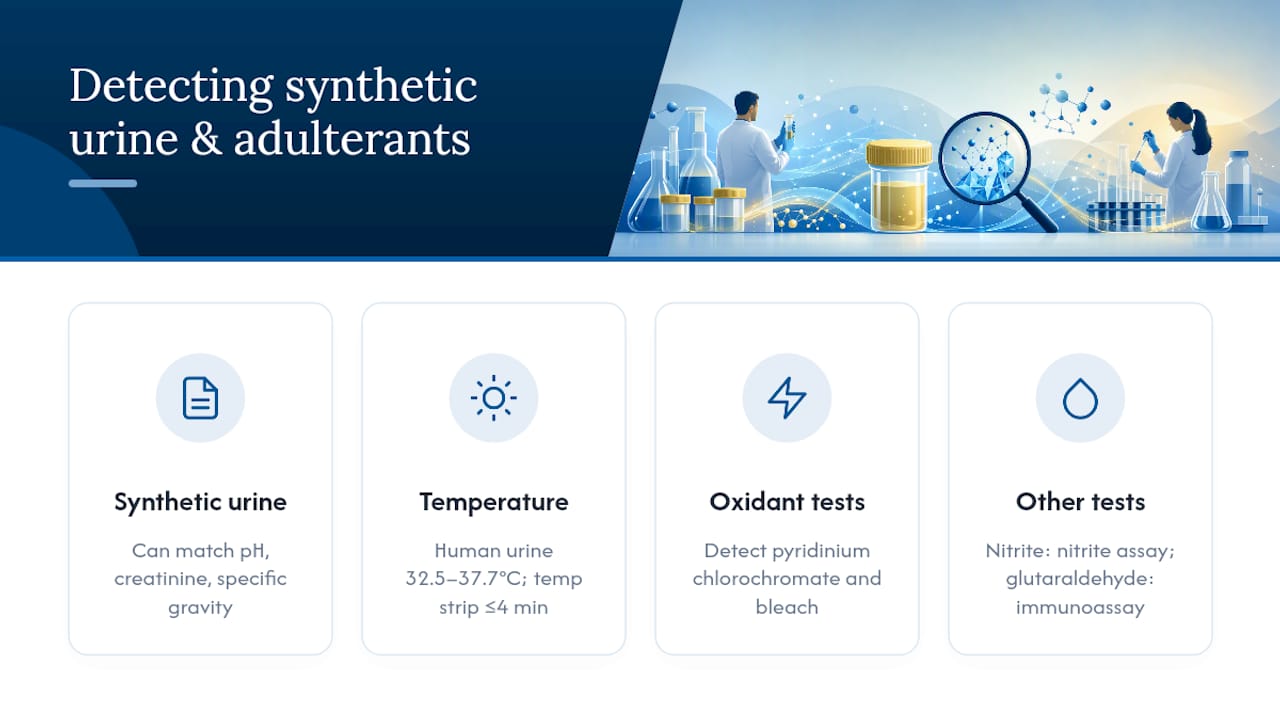
Temperature is the first check and happens at the collection site, not the lab. Fresh human urine falls between 32.5°C and 37.7°C (90.5°F–99.8°F). A reading outside that window, within four minutes of collection, is an immediate red flag for substitution.
Creatinine is a metabolic waste product present in all normal human urine. Labs measure it in milligrams per deciliter (mg/dL). Very low creatinine suggests dilution or substitution. Under SAMHSA-aligned SVT protocols, creatinine is the first marker measured in the lab workflow.
Specific gravity (SG) measures the concentration of dissolved solutes in urine. Labs run SG conditionally, typically when creatinine falls below 20 mg/dL. Normal human urine SG ranges from about 1.003 to 1.030. Values outside that range, especially at the extremes, indicate dilution or substitution.
pH reflects the acid-base balance of the specimen. Normal urine pH runs from roughly 4.5 to 8.5. A result below 3 or above 11 suggests chemical adulteration, since no physiological process produces urine that extreme.
Oxidant, nitrite, and glutaraldehyde assays detect specific adulterant chemicals. Products containing pyridinium chlorochromate (sold under names like Urine Luck), bleach, or nitrite-based additives are identified through these assays. Glutaraldehyde, a preservative sometimes added to mask drug metabolites, requires its own targeted test.
Visual inspection catches obvious substitution. Unusual color, cloudiness, or the complete absence of any odor can indicate a non-human sample. This check happens at the collection site and takes seconds.
Pro Tip: Labs combine these markers rather than relying on any single result. A specimen with borderline creatinine but normal SG and pH tells a different story than one with low creatinine, low SG, and neutral pH simultaneously.
How labs categorize SVT results and what the thresholds mean
Labs classify every specimen into one of four categories based on the marker results. Understanding these categories helps employers, clinicians, and donors interpret a lab report accurately.
| Category | Typical Criteria | What It Means |
|---|---|---|
| Dilute | Creatinine 2–20 mg/dL and SG 1.001–1.003 | Specimen is too dilute to be normal; may be intentional or physiological |
| Substituted | Creatinine <2 mg/dL and SG <1.001 or >1.020 | Specimen is not consistent with normal human urine |
| Adulterated | pH <3 or >11, or oxidant/nitrite/glutaraldehyde above cutoffs | A foreign chemical has been added to the specimen |
| Invalid | Conflicting or uninterpretable results; no valid SVT conclusion possible | Cannot be reported; recollection is typically required |
The lab workflow that produces these categories follows a defined sequence. Clinical labs typically measure creatinine first, then run SG by refractometer if creatinine is below 20 mg/dL, and add pH and oxidant testing to classify the specimen. When creatinine is below 2 mg/dL and SG is below 1.001 or above 1.020 on two separate aliquots, the specimen is reported as substituted.
A critical point that employers often miss: a numeric flag does not prove intent.
- A dilute result can reflect excessive water intake before collection, diuretic medications, or a kidney condition.
- A substituted result is analytically definitive but still requires MRO review before any adverse action.
- An adulterated result is the strongest indicator of intentional tampering, but confirmatory GC/MS testing is still the standard next step.
- An invalid result triggers recollection under observation, not automatic discipline.
Typical lab actions after an abnormal SVT result include MRO review, GC/MS confirmatory testing, and documented observed recollection when the MRO determines it is appropriate.
Which instruments labs use to measure SVT markers
The accuracy of SVT depends heavily on which measurement method a lab uses. Three main approaches exist for specific gravity and pH, and they are not equally reliable.
Dipsticks are colorimetric test strips that give a quick, semi-quantitative result. They are useful for rapid screening at the collection site but carry meaningful error rates. Research comparing measurement methods found that refractometer-to-dipstick methods for specific gravity show significantly lower agreement with refractometer measurements, indicating greater variability and reduced reliability., which means roughly one in three readings could differ between the two methods.
Refractometers measure how light bends through the specimen to calculate SG. They are more accurate than dipsticks and are the standard for conditional SG testing when creatinine is low.
Automated chemistry analyzers run creatinine, SG, and pH simultaneously on large batches of specimens. They reduce human error, improve reproducibility, and are the standard in high-volume certified labs. For oxidant assays, automated methods also correlate well with dipstick oxidant checks while offering faster turnaround and better documentation.
GC/MS (gas chromatography-mass spectrometry) is the gold standard for confirmatory testing. It identifies specific drug metabolites and can also characterize unusual chemical compounds in adulterated specimens. GC/MS is not part of the initial SVT screen but is required to confirm a positive drug result or to characterize a suspected adulterant when the initial assay is inconclusive.
- Dipsticks: fast, low cost, lower accuracy — appropriate for collection-site screening only.
- Refractometers: reliable for SG, standard for conditional testing.
- Automated analyzers: highest consistency, required for regulated programs.
- GC/MS: confirmatory only, not a screening tool.
Can labs reliably detect synthetic urine and commercial adulterants?
The short answer is: sometimes, and it depends on the product and the protocol. High-quality synthetic urine is specifically formulated to match human urine’s pH, creatinine concentration, and specific gravity. Standard SVT panels measure exactly those markers, so a well-made synthetic product can pass the chemical checks.
Temperature is where synthetic urine most often fails. Human urine exits the body between 32.5°C and 37.7°C. Synthetic products must be pre-warmed and kept in that range during transport to the collection site — a logistical challenge that collectors can catch with a simple temperature strip read within four minutes of collection. Collection-site temperature checks and visual inspection remain the most effective immediate defenses against substitution, even when chemical SVT is performed afterward.
For chemical adulterants, the picture is clearer. Oxidant assays reliably detect pyridinium chlorochromate and bleach. Nitrite assays catch nitrite-based products. Glutaraldehyde requires a dedicated immunoassay because standard oxidant tests do not detect it. When a specimen tests positive for an adulterant, the pattern of marker results matters: a specimen with normal creatinine and SG but an elevated oxidant reading is more consistent with adulteration than with any physiological cause.
When synthetic urine or a specific adulterant is suspected, labs can run additional biomarker testing (such as uric acid or urea, which are present in human urine but absent from many synthetic products) or send the specimen for GC/MS characterization. Specialized proprietary assays targeting synthetic urine markers are also available at some certified labs.
Pro Tip: If a specimen passes standard SVT but the temperature was not within range at collection, document the temperature discrepancy on the chain-of-custody form. That notation alone can support an MRO’s decision to require an observed recollection.
Collection-site practices that reduce tampering risk
The lab can only work with what the collection site sends. Rigorous collection procedures are the first and often most effective line of defense against specimen tampering.
Core collection-site steps:
- Check specimen temperature within four minutes of collection using a temperature strip on the collection cup.
- Conduct a visual inspection for unusual color, clarity, or absence of odor.
- Secure all water sources in the collection area (tape faucets, add bluing agent to toilet water).
- Remove outerwear and empty pockets before the donor enters the collection area.
- Prohibit bags, purses, and personal items in the collection room.
- Complete the chain-of-custody form immediately, noting temperature, time, and any anomalies.
When to require directly observed collection:
- The donor’s temperature reading is outside the 32.5°C–37.7°C range.
- The MRO has determined a previous specimen was substituted or adulterated.
- The collection site has documented evidence of tampering attempt (e.g., a hidden container found on the donor).
- Federal testing regulations specifically require observation for that collection type (e.g., return-to-duty or follow-up testing under DOT rules).
Direct observation must be conducted by a same-gender collector and applied consistently to avoid discrimination claims. Document the reason for observation on the chain-of-custody form.
Chain-of-custody documentation is what makes SVT results legally defensible. Every transfer of the specimen, from collection cup to shipping container to lab receipt, must be recorded with the collector’s signature, date, and time. A gap in that record can invalidate an otherwise valid result in a legal or regulatory proceeding.
Medical and physiological reasons a specimen can flag without tampering
A dilute or unusual SVT result does not automatically mean the donor tampered with the sample. Several common, entirely benign conditions produce the same marker patterns that SVT flags.
Excessive fluid intake before a collection is the most frequent cause of a dilute result. Athletes, outdoor workers, and people on high-fluid diets can produce urine with creatinine below 20 mg/dL and SG below 1.003 without any intent to manipulate the test. Diuretic medications, including common blood pressure drugs like hydrochlorothiazide and furosemide, have the same effect. Kidney conditions that impair concentration ability, such as chronic kidney disease or diabetes insipidus, can produce persistently dilute urine regardless of fluid intake.
Unusual pH readings can stem from diet (high-protein diets lower pH; vegetarian diets raise it), urinary tract infections (bacterial metabolism raises pH), or certain medications. A pH of 4.5 in a healthy person eating a high-protein diet is not suspicious. A pH of 2.8 is.
Low creatinine or SG suggests dilution but does not on its own prove intentional tampering; various physiological and medication causes exist. This is why MRO review is mandatory before any adverse employment action. The MRO’s job is to evaluate the result in the context of the donor’s medical history, current medications, and any documentation the donor provides.
If a donor offers a medical explanation for a dilute result, the MRO can request provider notes or medical records. When the explanation is plausible and documented, the result may be reported as a negative dilute rather than a refusal or violation. When no explanation is forthcoming and the result is extreme, an observed recollection is the standard next step.
How storage and handling affect specimen integrity
SVT assesses chemical integrity at or shortly after collection, which means handling in the first few hours matters more than most employers realize. Fresh urine temperature at collection should fall between 32.5°C and 37.7°C (90.5°F–99.8°F), and that window closes within about four minutes of voiding.
After collection, bacterial growth is the primary threat to marker stability. Bacteria metabolize creatinine and alter pH over time, particularly at room temperature. A specimen left unrefrigerated for several hours can show a measurably lower creatinine and a higher pH than it had at collection, which can push a borderline result into a flagged category or, conversely, mask an initially abnormal reading.
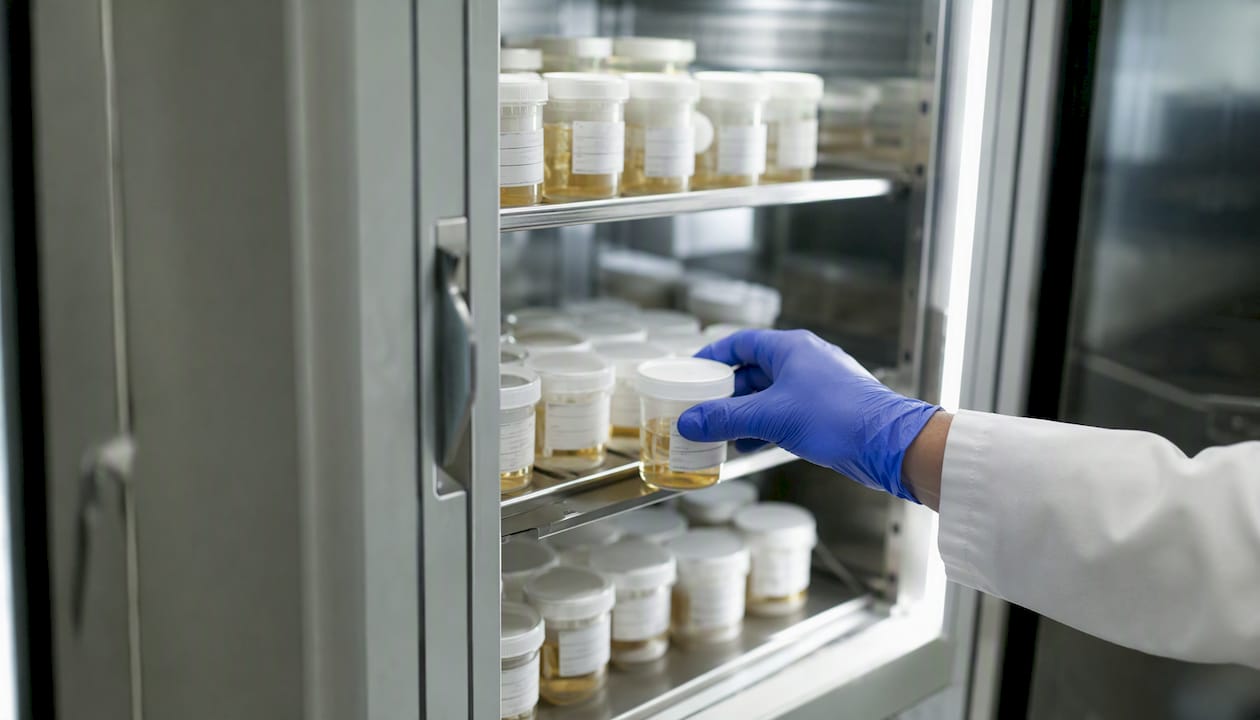
Pro Tip: Specimens should be refrigerated at 2°C–8°C if they cannot reach the lab within 24 hours. Freezing is appropriate for longer storage but requires a controlled thaw before analysis to avoid marker degradation.
Practical handling recommendations:
- Seal the specimen container immediately after collection and apply the tamper-evident label before the donor leaves the collection area.
- Ship specimens to the lab the same day when possible, using a temperature-controlled courier if ambient temperatures are extreme.
- Log the time between collection and lab receipt on the chain-of-custody form.
- Flag any specimen that arrives at the lab outside the expected temperature range or with a broken seal for MRO review before analysis.
Delays in processing do not automatically invalidate a specimen, but they must be documented. A lab that receives a specimen 72 hours after collection with no temperature log has less evidentiary support for its SVT results than one that received the same specimen within 24 hours with a complete cold-chain record.
What the research shows about tampering prevalence and method accuracy
The empirical picture of how common tampering actually is, and how well different measurement methods compare, comes primarily from a large five-year study of 21,696 urine specimens covering both workplace and court-ordered testing populations.
Key finding: Over a five-year study period, tampering prevalence was found to be notably higher in court specimens than in workplace specimens. Dilution was the dominant tampering method, accounting for roughly 89% of tampered workplace specimens and about 95% of tampered court specimens.
That prevalence gap between workplace and court settings reflects the higher-stakes nature of court-ordered testing, where donors face legal consequences rather than employment consequences. It also suggests that collection protocols in court settings may warrant stricter controls.
On method accuracy, the same body of research and a separate method-comparison study produced the following agreement rates:
The practical implication: dipsticks are a reasonable collection-site screening tool, but labs running regulated programs should use refractometers or automated analyzers for SG and calibrated instruments for pH.
Study limitations worth noting: the 21,696-specimen dataset comes from a specific geographic and program context, and tampering rates in other populations or industries may differ. Labs using different analytical platforms may also see different agreement rates than those reported.
Building longitudinal baseline profiles for repeat participants is one practical response to these limitations. When a lab tracks a donor’s creatinine and SG across multiple collections, a sudden shift becomes much easier to identify as anomalous, even when the absolute value stays within the “normal” range.
What your lab report actually says and what to do next
Lab reports use specific terminology that can be confusing if you have not seen it before. Here is what the most common notations mean and what typically follows each one.
- “Dilute”: Creatinine and SG are low but above substitution cutoffs. May be physiological or intentional. MRO reviews; employer typically requires a second collection, often observed.
- “Substituted”: Creatinine and SG are at levels inconsistent with normal human urine. MRO reviews for medical explanation; if none, reported as a refusal to test under federal guidelines.
- “Adulterated”: A foreign substance is present. MRO reviews; typically reported as a refusal to test. GC/MS confirmation is standard.
- “Invalid”: Results are uninterpretable or internally contradictory. Recollection under direct observation is required. No adverse action is taken on an invalid result alone.
- “Indistinguishable from water”: Creatinine is essentially zero and SG is at or near 1.000. Reported as substituted.
- “Possible adulteration”: One marker is abnormal but not definitively conclusive. Lab may request additional testing or flag for MRO review.
If you are a donor who receives an unexpected result, you have the right to ask for the MRO’s contact information and to provide medical documentation that explains the finding. You can also request that the split specimen (the second aliquot retained by the lab) be sent to a different certified lab for independent confirmation. That right exists under federal testing guidelines and many state programs.
Employers and clinicians should treat every flagged result as a starting point for MRO review, not a final conclusion. Understanding the terminology before a result arrives makes the process faster and less stressful for everyone involved.
What accreditation standards tell you about a lab’s SVT reliability
Not every lab that offers drug testing is equipped to run legally defensible SVT. The accreditation and regulatory signals below are the clearest indicators of a lab’s competence and compliance.
SAMHSA (Substance Abuse and Mental Health Services Administration) sets the federal Mandatory Guidelines for Workplace Drug Testing Programs. Labs certified under SAMHSA’s National Laboratory Certification Program (NLCP) are required to run SVT as part of every federal workplace test. If your program is subject to DOT, NRC, or other federal agency rules, SAMHSA-certified labs are not optional.
CLIA (Clinical Laboratory Improvement Amendments) certification from the Centers for Medicare and Medicaid Services establishes minimum quality standards for any lab performing testing on human specimens. CLIA certification is a baseline requirement, not a differentiator.
CAP (College of American Pathologists) accreditation goes further than CLIA, requiring on-site inspections, proficiency testing, and peer review. CAP-accredited labs are generally considered the highest standard for clinical and forensic testing.
ISO 15189 is the international standard for medical laboratory quality and competence. Some labs hold both CAP and ISO 15189 accreditation, which signals a commitment to quality management beyond domestic requirements.
When evaluating a lab, ask for its current accreditation certificates, its SVT test menu with method descriptions, its turnaround time commitments, and its confirmatory GC/MS capability. A lab that cannot provide clear answers to those questions is not the right partner for a regulated testing program. Certified labs play a critical role in protecting both employers and employees when results are challenged.
An editorial perspective on what SVT gets right and where programs fall short
The science behind specimen validity testing is solid. The weak points are almost always procedural, not analytical.
Most SVT failures in workplace programs trace back to collection-site gaps: a temperature strip not read in time, a chain-of-custody form with a missing signature, or a collector who did not secure the water source. The lab can run a perfect creatinine and SG analysis on a specimen that was already compromised before it left the collection room. No amount of analytical sophistication fixes a broken collection protocol.
The other underappreciated issue is the gap between what SVT can detect and what it can prove. A substituted result is analytically definitive. It tells you the specimen is not normal human urine. What it cannot tell you is whether the donor brought synthetic urine, whether a collection error occurred, or whether a rare medical condition is responsible. That distinction matters enormously in a legal or disciplinary context, and it is exactly why MRO review exists. Programs that skip MRO review to save time or money are exposing themselves to significant legal liability.
The research on method agreement rates reinforces a practical point that gets lost in procurement decisions: the instrument a lab uses for SG and pH measurement is not a minor detail. A lab relying on dipsticks for specific gravity in a regulated program is operating with a method that agrees with the refractometer standard only about two-thirds of the time. That is not a rounding error. It is a structural accuracy problem that affects every borderline result.
Countrywidetesting connects you to accredited SVT lab services
Countrywidetesting works with SAMHSA-aligned, CLIA- and CAP-certified laboratories to provide urine drug testing with full specimen validity testing built into every lab-based order. Whether you are an employer building a compliant workplace program, a clinician ordering confirmatory testing, or an individual who needs a legally defensible result, the process starts with a single order online.
Lab-based urine testing through Countrywidetesting includes creatinine, specific gravity, pH, and oxidant assay panels as standard, with GC/MS confirmatory testing available for flagged specimens. Collection supplies, chain-of-custody documentation, and access to MRO review are part of the service. You can place an order for laboratory drug testing services directly through the site, or contact the support team for custom program quotes and compliance questions.
Sources
The following sources informed the thresholds, prevalence data, and method-comparison figures in this article.
- An Introduction to Specimen Validity Testing in Workplace Drug Testing
- Urine specimen validity test for drug abuse testing in workplace and court settings
- Specimen Validity Test | Thermo Fisher Scientific - US
- Comparison of different methods used in drugs of abuse for specific gravity and pH measurement (DeGruyter/Brill)
- Adulteration and dilution checks (UNC School of Government course materials)