
Screening Panels Explained: Types, Purpose, and Impact
TL;DR:
- Screening panels group related tests to evaluate multiple substances or conditions efficiently in a single assessment. They vary by purpose, including drug testing, genetic screening, and legal review, and must comply with strict quality standards. Proper handling and confirmation of results are essential to avoid legal and operational risks.
A screening panel is a predefined set of tests or evaluations designed to detect drugs, health conditions, or legal issues in a single, coordinated assessment. Employers rely on them to maintain safe workplaces. Clinicians use them to catch disease risk early. Courts in roughly 16 US states require them before a medical malpractice case can proceed. This explanation of screening panels covers what they are, how they work across employment, health, and legal settings, and what the results actually mean for you or your organization. Understanding the structure behind these panels makes every step of the process easier to navigate.
What is the purpose of screening panels?
A screening panel groups related tests together so that multiple conditions or substances can be evaluated at once, rather than one at a time. This approach, called multiplexing, reduces redundant testing and cuts the time and cost of getting a complete picture. A liver function panel, for example, measures several enzymes and proteins simultaneously instead of requiring separate draws for each marker.
The core purpose differs by context, but the logic stays the same. In employment drug testing, a panel screens for multiple controlled substances in a single urine or oral fluid sample. In clinical settings, panels group tests by organ system, such as kidney function or lipid metabolism, to give clinicians a full metabolic snapshot. In legal settings, a medical malpractice screening panel is a peer review group that evaluates whether a claim has merit before it reaches a courtroom.
Multiplexing panel tests reduce redundant testing by evaluating interconnected pathways, enhancing efficiency and diagnostic clarity. That efficiency matters most when speed and accuracy both count, such as pre-employment screening or urgent clinical triage.
Pro Tip: When ordering a panel for employment purposes, confirm that the laboratory holds SAMHSA or CAP certification. Certified labs follow standardized cutoff levels that protect both the employer and the person being tested.
What are the common types of screening panels?
Screening panels fall into three broad categories: drug testing panels, genetic screening panels, and medical malpractice review panels. Each serves a different population and follows different regulatory rules.

Drug testing panels
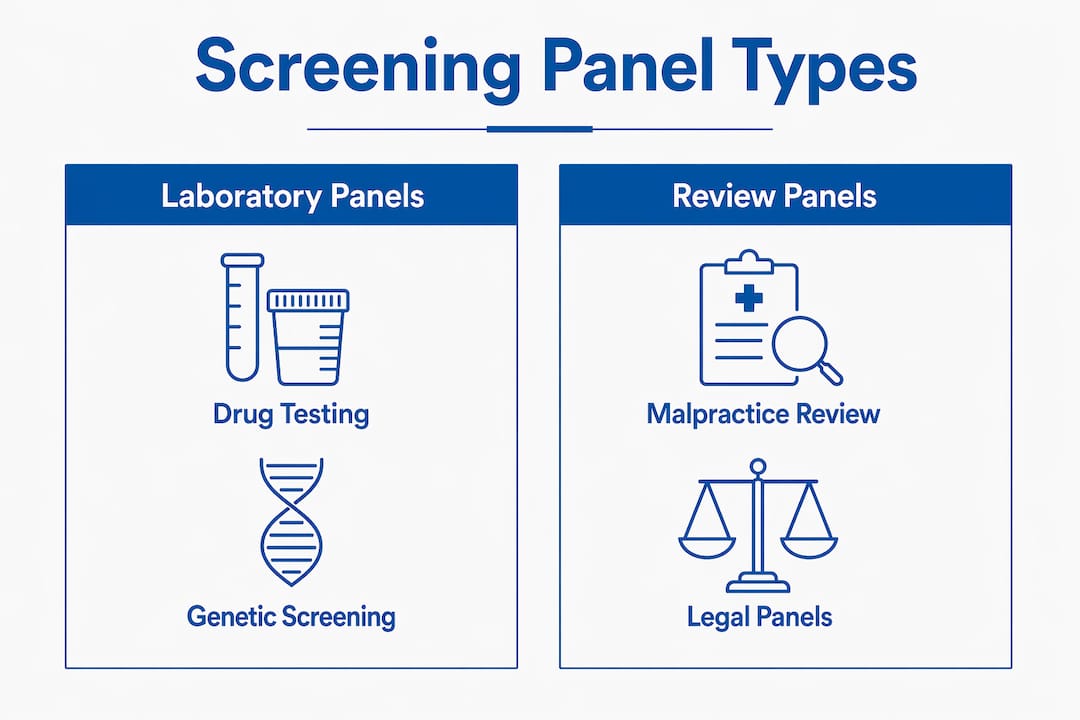
Drug testing panels are the most common type in employment and legal settings. They are defined by the number of substances they screen for. A standard 5-panel test covers marijuana, cocaine, opiates, amphetamines, and phencyclidine (PCP). Larger panels add substances like benzodiazepines, barbiturates, methadone, propoxyphene, and extended opioids. The 5-panel vs. 10-panel choice depends on the industry, the role, and the regulatory requirements that apply to the employer.
Common drug panel sizes and their typical uses:
- 5-panel: Federal workplace testing programs, general employment screening
- 10-panel: Safety-sensitive roles, transportation, and healthcare
- 12-panel: Broader workplace programs covering prescription drug misuse
- Extended panels: Legal, forensic, or clinical settings requiring comprehensive coverage
The 12-panel at-home cup test is a practical example of a consumer-grade panel that mirrors the scope used in many workplace programs.
Genetic screening panels
Genetic panels sequence a targeted set of genes associated with a specific disease or carrier status. Gene panel sequencing offers faster and more cost-effective results than whole-genome sequencing by focusing only on clinically relevant genes. The tradeoff is that rare or structural variants outside the panel’s scope can be missed.
Patient preferences for panel size vary considerably. Research shows that 40.8% of participants chose a small genetic carrier screening panel, 33.1% chose a large panel, and 26% chose a medium panel. That spread signals that no single panel size fits every patient, and flexible offerings matter. Genetic panels must follow guidelines from ACMG (American College of Medical Genetics and Genomics), AMP (Association for Molecular Pathology), and CAP (College of American Pathologists) to meet quality standards.
Medical malpractice review panels
Medical malpractice screening panels are peer review bodies, not laboratory tests. They consist of medical and legal professionals who evaluate whether a malpractice claim has enough merit to proceed to trial. Around 16 US states require these panels before a lawsuit can be filed in court, affecting roughly one-third of US jurisdictions. Panel opinions are admissible as evidence and carry significant weight with juries.
| Panel type | Primary purpose | Typical setting | Key users |
|---|---|---|---|
| Drug testing panel | Detect controlled substances | Employment, legal, clinical | Employers, courts, clinicians |
| Genetic screening panel | Identify disease risk or carrier status | Clinical, reproductive health | Patients, genetic counselors |
| Medical malpractice panel | Evaluate claim merit before trial | Legal proceedings | Attorneys, courts, medical experts |
How do screening panels impact individuals and organizations?
The practical effects of a screening panel depend heavily on which side of the test you are on.
For individuals
- Early detection. Health screening panels catch conditions like elevated cholesterol or impaired kidney function before symptoms appear, giving you time to act.
- Risk of overdiagnosis. Screening can identify conditions that would never cause symptoms or harm during a person’s lifetime. That leads to unnecessary anxiety and sometimes unnecessary treatment.
- False positives. No test is perfect. A positive result on an initial screen requires confirmation testing before any action is taken. Skipping confirmation is a procedural error that can have serious consequences.
- Privacy considerations. Genetic panels in particular generate sensitive data. Informed consent and clear data-handling policies are non-negotiable before testing begins.
- Legal deadlines. If you are involved in a malpractice claim in a state that mandates a screening panel, missing the filing deadline can result in your lawsuit being dismissed outright.
Pro Tip: Before submitting a malpractice claim, check whether your state requires a mandatory screening panel and confirm the exact filing window. Missing that step can end a valid case before it starts.
For employers and organizations
Employers use drug screening panels to meet regulatory requirements, reduce workplace accidents, and limit liability. The common drug panels for HR managers vary by industry, but the compliance logic is consistent: a documented, standardized panel protects the organization if a result is ever challenged. Cost efficiency is a real benefit too. Testing for ten substances in one panel costs far less than running ten separate tests.
Organizations in safety-sensitive industries, such as transportation or construction, often face federal mandates that specify exactly which substances must be included in their panels. Deviating from those requirements creates compliance risk. Partnering with a certified lab that understands workplace safety and compliance requirements removes most of that risk.
What standards guide the design and use of screening panels?
Regulatory and scientific standards exist to make sure screening panels produce results that are accurate, ethical, and worth acting on.
Key standards and principles that govern screening panel design:
- CAP certification: The College of American Pathologists certifies laboratories that meet rigorous quality standards. CAP-certified labs follow standardized protocols for sample handling, testing, and reporting.
- ACMG and AMP guidelines: These govern genetic panel design, variant classification, and reporting of incidental findings in clinical genetics.
- SAMHSA standards: The Substance Abuse and Mental Health Services Administration sets cutoff levels and chain-of-custody requirements for federally mandated workplace drug testing.
- Net benefit requirement: The UK National Screening Committee requires that screening must do more good than harm and meet high evidence standards before being recommended for population health programs. This principle applies broadly, not just in the UK.
- Targeted vs. population screening: Targeted screening focuses on high-risk groups defined by factors like age, genetics, or behavior, while population screening applies to broad demographics. Each pathway follows different regulatory rules and requires different evidence thresholds.
Ethical requirements run alongside technical standards. Informed consent is mandatory before genetic testing. Results must be communicated clearly, and incidental findings (results outside the panel’s original scope) require a defined protocol for disclosure. Fertility-related genetic screening, for example, often involves a referral pathway that a GP or specialist manages before testing begins, as outlined in GP referral processes for specialized panels.
What I’ve learned from watching organizations get screening panels wrong
The biggest mistake I see is treating a screening panel as a checkbox rather than a decision. Organizations pick a 5-panel test because it is the cheapest option, without checking whether their industry or state requires broader coverage. Individuals submit malpractice claims without verifying whether their state mandates a review panel first. Both errors are avoidable and both are costly.
The second pattern I notice is mishandling positive results. A preliminary positive on an immunoassay screen is not a confirmed positive. It is a signal that requires a follow-up confirmation test, typically gas chromatography-mass spectrometry (GC-MS) or liquid chromatography-mass spectrometry (LC-MS). Employers who act on an unconfirmed result expose themselves to legal liability. Individuals who do not request confirmation lose the chance to correct a false positive.
Genetic panels carry a different kind of complexity. Patients often choose panel size based on anxiety rather than clinical need. A small panel feels less overwhelming, but it may miss variants that a larger panel would catch. The right panel size is a clinical decision, not an emotional one. The best outcomes come when the person being tested has a clear conversation with a qualified counselor before the panel is ordered.
The organizations that handle screening panels well share one trait: they treat the process as a system, not a single event. They know which standards apply, they use certified labs, they have a written protocol for handling results, and they communicate clearly with the people being tested. That combination is what separates a defensible screening program from a liability.
— Alan
Countrywidetesting’s drug screening panel services
Countrywidetesting works with SAMHSA-compliant, CAP-certified, and CLIA-licensed laboratories to deliver drug screening panels for individuals, employers, and organizations across the country.
Whether you need a standard 5-panel urine test or a broader multi-substance screen, Countrywidetesting offers lab testing services that meet federal and state compliance requirements. Results are processed through certified labs with documented chain-of-custody protocols, so every result stands up to scrutiny. The platform serves both one-time individual needs and ongoing employer programs, with options that scale to the size and complexity of your screening requirements.
Key Takeaways
Screening panels are the most efficient way to evaluate multiple substances, conditions, or legal claims in a single structured process, and choosing the wrong panel or skipping required steps creates real legal and operational risk.
| Point | Details |
|---|---|
| Panels group related tests | Multiplexing evaluates multiple substances or conditions at once, cutting cost and time. |
| Three main types exist | Drug testing, genetic screening, and medical malpractice review panels each serve distinct purposes. |
| Standards govern quality | CAP, SAMHSA, ACMG, and AMP guidelines define how panels must be designed and administered. |
| False positives require confirmation | A preliminary positive must be confirmed by GC-MS or LC-MS before any action is taken. |
| Legal panels carry hard deadlines | Skipping a mandated malpractice panel or missing its deadline can result in case dismissal. |
FAQ
What are screening panels used for?
Screening panels detect drugs, assess health conditions, or evaluate legal claims by grouping related tests into one coordinated assessment. They are used in employment, clinical, genetic, and legal settings.
How does a drug screening panel work?
A urine or oral fluid sample is tested against a defined list of substances using immunoassay technology. Any preliminary positive result requires confirmation through a secondary method such as GC-MS before a result is considered confirmed.
What is the difference between a 5-panel and a 10-panel drug test?
A 5-panel test screens for five substances: marijuana, cocaine, opiates, amphetamines, and PCP. A 10-panel adds benzodiazepines, barbiturates, methadone, propoxyphene, and extended opioids, making it suited for safety-sensitive or healthcare roles.
Do all US states require medical malpractice screening panels?
No. Around 16 US states mandate that malpractice claims go through a screening panel before reaching court. Skipping this step in a state that requires it can lead to automatic case dismissal.
What standards apply to genetic screening panels?
Genetic panels must follow ACMG, AMP, and CAP guidelines covering variant classification, analytical sensitivity, and the handling of incidental findings. Labs must also meet CLIA certification requirements for clinical testing.