
The Role of MRO in Drug Testing: A Complete Guide
What does a Medical Review Officer actually do in drug testing?
A Medical Review Officer, or MRO, is a licensed physician holding an M.D. or D.O. degree who serves as the independent gatekeeper between a laboratory’s raw results and the final verified outcome reported to an employer. The role exists because a positive lab result does not automatically mean someone used drugs illegally. Prescription medications, certain medical conditions, and collection irregularities can all produce non-negative results that require a trained physician’s judgment before any action is taken.
The MRO’s core responsibilities include:
- Receiving and reviewing all laboratory drug test results, including negatives, positives, and invalid findings
- Conducting medical interviews with donors when results are non-negative
- Determining whether a legitimate medical explanation exists for any confirmed positive, adulterated, substituted, or invalid result
- Reviewing the Custody and Control Form (CCF) for documentation errors that could affect result validity
- Reporting verified results confidentially to the designated employer representative (DER)
- Maintaining records and protecting the privacy of all drug testing information throughout the process
Federal oversight comes from two primary bodies. The Department of Transportation mandates MRO involvement for all safety-sensitive transportation employees under 49 CFR Part 40. The Substance Abuse and Mental Health Services Administration (SAMHSA) publishes the Mandatory Guidelines for Federal Workplace Drug Testing Programs, which define MRO qualifications and procedures for federal agency testing.
How the MRO drug testing process works from lab to final result
The MRO review process is more layered than most employers realize. It begins the moment a laboratory transmits results and ends only after the MRO has made a verified determination and reported it through the proper channels.
Step 1: Administrative review of documents
Before anything else, the MRO examines the MRO copy of the Federal CCF. This means checking for missing signatures, broken seals, collection errors, and any discrepancy that could compromise the specimen’s integrity. A missing or incorrect entry on the CCF is not a minor clerical issue. Under federal guidelines, certain documentation failures are grounds for test cancellation.
Step 2: Handling negative results
Negative results do not require the MRO to contact the donor. Staff working under the MRO’s direct supervision may review and report these results, but the MRO must personally audit at least 5% of negative results to verify that staff are performing the review correctly.
Step 3: Contacting the donor for non-negative results
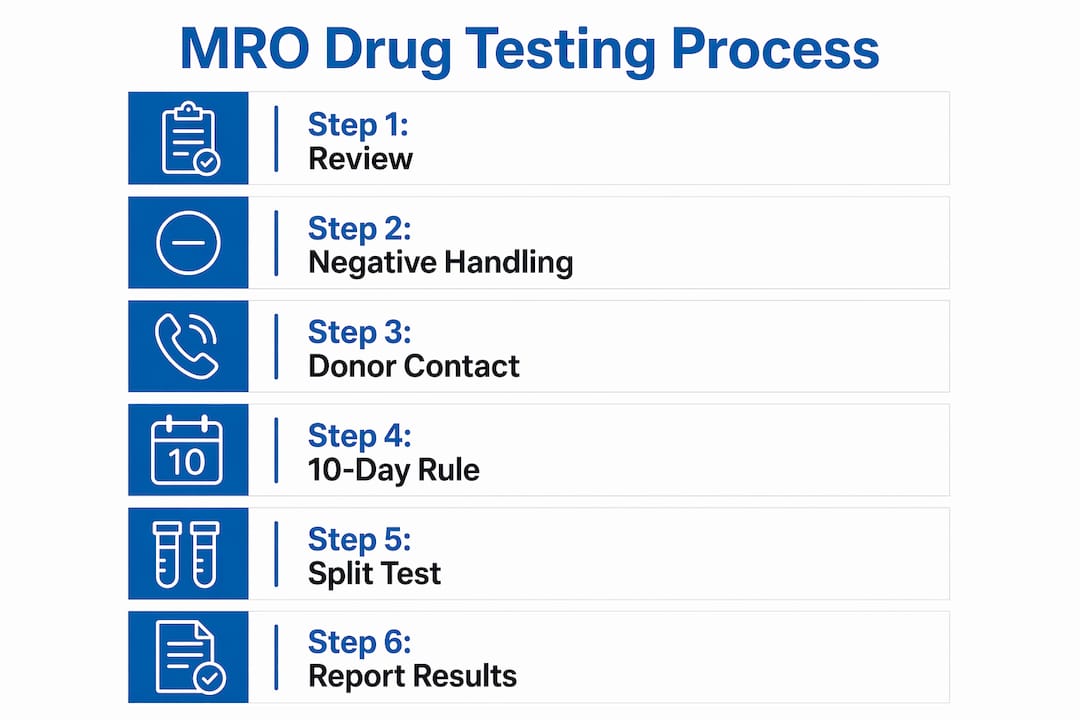
When a result comes back positive, adulterated, substituted, or invalid, the MRO must personally conduct a medical interview with the donor. The purpose is to determine whether a valid prescription, medical condition, or other legitimate explanation accounts for the result. The MRO contacts the donor directly, not through the employer, to protect the privacy of any medical information disclosed.

Step 4: The 10-day rule
If the MRO cannot reach the donor after making reasonable documented attempts, federal regulations set a 10-day window for contact. After that period, the MRO may report a “non-contact positive” result. Every attempt must be documented.
Step 5: Split specimen testing
Donors who receive a verified positive result have the right to request testing of the split specimen, known as Bottle B. If the split specimen does not confirm the primary result, the MRO cancels the test entirely. This safeguard exists specifically to protect donors from errors in the original collection or analysis.
Step 6: Reporting verified results
Once the MRO reaches a determination, the verified result goes to the employer’s designated representative, not to supervisors, HR generalists, or anyone outside the authorized chain. The FMCSA and other DOT modal agencies require this reporting to be timely and confidential.
What qualifications and ethical standards must an MRO meet?
The bar for becoming an MRO is deliberately high. Federal regulations and SAMHSA’s Mandatory Guidelines require a specific combination of medical licensure, specialized training, and ongoing certification that goes well beyond a general medical degree.
Licensure and core knowledge requirements:
- Current M.D. or D.O. license in good standing
- Demonstrated knowledge of pharmacology and toxicology as they relate to illicit and prescription drug use
- Training in federal specimen collection procedures and chain of custody requirements
- Familiarity with HHS Mandatory Guidelines and DOT 49 CFR Part 40 regulations
- Understanding of how to interpret laboratory result categories: negative, positive, adulterated, substituted, invalid, and rejected for testing
Certification and continuing education:
MROs must pass an initial examination administered by a nationally recognized certifying body or an HHS-approved subspecialty board. Recertification is required at least every five years, and MROs must complete updated training before any revisions to the Mandatory Guidelines take effect. This keeps practicing MROs current with regulatory changes rather than relying on knowledge from their initial certification alone.
Ethical and conflict-of-interest rules:
An MRO cannot be an employee, agent, or financial stakeholder of any laboratory or instrumented initial test facility (IITF) for which they review results. They cannot have any financial arrangement with a lab that could influence their reporting. These prohibitions exist to prevent any scenario where an MRO might overlook a testing problem because of a financial relationship with the facility that produced the result.
Pro Tip: If you are an employer building a drug testing program, ask any MRO service provider to confirm their certifying body and recertification date. A certified MRO should be able to provide this without hesitation.
Common misconceptions about what an MRO can and cannot do
Misunderstandings about the MRO’s role are surprisingly common, even among HR professionals who run drug testing programs regularly. Clearing these up protects both employers and employees from acting on faulty assumptions.
- “The MRO calls every donor.” Not true. The MRO only contacts donors when a result is non-negative. If a test comes back negative, the donor never hears from the MRO at all.
- “A positive lab result means the employee failed.” A lab result is not a final determination. The MRO evaluates the result in full medical context, and a confirmed positive can be verified as negative if a legitimate prescription or medical explanation exists.
- “The MRO works for the employer.” The MRO is independent of both the employer and the employee. Federal regulations explicitly require this neutrality. The MRO’s obligation is to the accuracy of the process, not to either party’s preferred outcome.
- “The MRO can change any result they want.” Result changes are permitted only under strictly regulated conditions, such as when a split specimen fails to confirm the primary result or when a valid medical explanation is documented and verified.
- “The MRO performs the lab analysis.” The MRO does not conduct laboratory testing. Their function is to interpret results in a medical context, not to run the chemical analysis that produces them.
- “Medical information shared with the MRO goes to the employer.” Confidentiality rules prevent the MRO from disclosing the specific medical details a donor provides. The employer receives only the verified result, not the underlying medical explanation.
Understanding these distinctions matters practically. An employer who assumes a non-negative lab result is automatically a termination trigger, without waiting for MRO verification, risks acting on an unverified result and exposing the organization to legal liability. The MRO review step is not a formality.
For HR professionals managing workplace drug testing compliance, knowing exactly where the MRO fits in the workflow prevents costly procedural errors.
The regulatory framework that governs MROs in the United States
The legal foundation for MRO involvement in drug testing is primarily federal, though the regulations extend across multiple agencies and industries. Understanding this framework helps employers know when an MRO is legally required and what standards apply.
49 CFR Part 40 is the central regulatory document. Published by the Department of Transportation, it governs all drug and alcohol testing for safety-sensitive transportation employees, including those regulated by the Federal Motor Carrier Safety Administration (FMCSA), Federal Aviation Administration (FAA), Federal Railroad Administration (FRA), Federal Transit Administration (FTA), and Pipeline and Hazardous Materials Safety Administration (PHMSA). Part 40 defines the entire MRO workflow, from qualifications and contact procedures to reporting timelines and confidentiality requirements.
SAMHSA’s Mandatory Guidelines apply to federal agency workplace drug testing programs. These guidelines set the standards for specimen collection, laboratory certification, and MRO qualifications that federal agencies must follow. SAMHSA also publishes the list of HHS-approved MRO certifying organizations in the Federal Register each year.
Key legal protections built into the regulatory framework include:
- Donors have the right to request split specimen testing after a verified positive result
- Employers cannot instruct an MRO on how to verify or report results
- MROs must report testing problems to regulatory authorities, including DOT’s Office of Drug and Alcohol Policy and Compliance (ODAPC), when issues arise
- Chain of custody documentation must meet federal standards, and any break in that chain can trigger test cancellation
- Verified results must flow to the designated employer representative, not to unauthorized parties
For employers in non-DOT industries, MRO involvement is not always federally mandated, but it remains a best practice. Using a certified MRO for any lab-based drug testing program adds a layer of legal defensibility that self-administered programs cannot replicate. Employers who want to understand how chain of custody requirements intersect with MRO review will find that the two are inseparable in any federally regulated program.
How MROs protect the accuracy and fairness of drug test outcomes
The quality assurance function of an MRO is what separates a defensible drug testing program from one that is vulnerable to legal challenge. Every step the MRO takes is designed to catch errors before they become wrongful adverse actions.
Pro Tip: Document every stage of your drug testing process, from collection through MRO verification. If a result is ever challenged, a complete paper trail showing proper chain of custody and MRO review is your strongest defense.
The MRO’s quality assurance work covers several distinct areas:
- Chain of custody review: The MRO checks the CCF for missing signatures, unsealed specimens, incorrect collection site information, and any other documentation gap that could indicate a compromised specimen.
- Donor interviews: When a result is non-negative, the medical interview gives the donor a confidential opportunity to present prescription records or medical documentation. This step catches false positives from legally prescribed medications, including stimulants used for ADHD, opioids prescribed after surgery, and other drugs that appear on standard panels. For a closer look at how prescription medications affect test results, the ADHD medication and false positives issue is a practical example of why MRO review matters.
- Test cancellation authority: When chain of custody is broken or a split specimen does not confirm the primary result, the MRO has the authority to cancel the test. A cancelled test is neither positive nor negative and cannot be used as the basis for an adverse employment action.
- Oversight of negative result reviews: The MRO personally audits at least 5% of negative results reviewed by staff, with particular attention to any specimen that required corrective action during the review process.
- Error monitoring and corrective action: The MRO tracks the frequency of errors across collection sites and laboratories, then notifies responsible parties when patterns emerge. This systemic oversight prevents recurring problems from affecting future tests.
- Impartial verification: Because the MRO operates independently of both the employer and the laboratory, the verified result carries credibility that a direct employer review could never provide.
The combination of medical expertise, regulatory authority, and structural independence is what makes the MRO function work. No other participant in the drug testing process occupies the same position.
Key Takeaways
The MRO is the independent physician who stands between a raw laboratory result and any employment action, ensuring every verified outcome is medically sound and legally defensible.
| Point | Details |
|---|---|
| MRO independence is mandatory | Federal regulations prohibit MROs from having financial ties to the labs whose results they review. |
| Positive lab results are not automatic failures | The MRO evaluates medical history and prescriptions before verifying any positive result. |
| The 10-day contact rule applies | MROs must document all contact attempts within 10 days before reporting a non-contact positive. |
| MROs audit at least 5% of negatives | Personal review of negative results by the MRO ensures staff are performing the process correctly. |
| Test cancellation protects donors | A broken chain of custody or a failed split specimen test results in cancellation, not a positive verdict. |
Ready to build a compliant drug testing program?
Countrywidetesting partners with SAMHSA-certified, CAP- and CLIA-accredited laboratories to deliver drug testing services that meet federal standards from collection through verified reporting. Whether you need lab-based drug testing services for a DOT-regulated workforce or a reliable screening solution for general employment, Countrywidetesting gives you the infrastructure to test with confidence. Every result processed through our network follows the chain of custody and documentation standards that MRO review depends on.