
Avoid DOT Liability: Remote Worker Drug Testing for U.S. HR
Yes, you can generally drug-test remote employees, as long as the testing is role-justified and follows federal and state rules. DOT-covered positions have stricter, in-person collection requirements, and several states protect off-duty cannabis use, so the rules shift by location. Your first move: identify the employee’s work-state and the role’s actual risk level before you schedule anything.
TL;DR:
- Remote employee drug testing must be role-justified, compliant with federal and state laws, and use certified laboratories, reviewed MRO, and documented chain-of-custody.
- In-person collection is required for DOT-covered safety-sensitive roles, while virtual observation is forbidden for regulated positions, limiting options like mail-in kits for these workers.
- Testing triggers include pre-employment screening, random selection for safety roles, reasonable suspicion based on clear observations, and post-accident or return-to-duty testing, with remote-specific signs such as slurred speech or missed deadlines.
- Policies should specify role-based triggers, legal protections in certain states, confidentiality rules, and mandates for documentation, with counsel review recommended before implementation.
- Building a compliant remote testing program involves coordinating local labs, mobile collectors, virtual methods where legal, and detailed workflows that support multi-state operations.
Table of Contents
- What Laws Govern Remote Worker Drug Testing?
- When Should You Test a Remote Employee?
- How Do You Collect Samples From Distributed Employees?
- What Should a Remote-Worker Testing Policy Include?
- How Does Countrywidetesting Support Remote Testing Programs?
- Why Proportionate Policies Beat Blanket Testing
- Get Your Remote Testing Program Compliant
- Where to Verify the Rules Yourself
- Sources
- FAQ
What Laws Govern Remote Worker Drug Testing?
Federal rules set the floor, but state law often decides what you can actually enforce. If you employ someone in a safety-sensitive transportation role, the Department of Transportation’s 49 CFR Part 40 requires in-person, physically observed collection. DOT guidance explicitly rules out virtual observation for these employees, remote work arrangement or not. That single fact eliminates telehealth and mail-in options for anyone covered by DOT testing rules.
Outside DOT territory, state law usually governs, and it varies more than most HR teams expect. Some states restrict random testing to safety-sensitive jobs. Others protect employees from termination over off-duty cannabis use even where the drug remains federally illegal. A worker logging in from Colorado operates under different rules than one logging in from Texas, and the employee’s actual work-state, not your company’s headquarters, typically controls.
Before you draft anything, confirm these three trust signals are built into your program:
- Use of SAMHSA-certified laboratories for sample analysis
- Medical Review Officer (MRO) review of every non-negative result before it reaches HR
- A documented chain-of-custody, digital or paper, for every specimen collected
Skipping any of these three turns a routine test into a legal liability if a result is ever challenged.
When Should You Test a Remote Employee?
Not every role justifies the same testing approach, and treating every remote hire identically invites both legal risk and recruiting friction. Start with a role-based risk assessment: does this position involve driving, operating equipment, handling controlled substances, or making safety-critical decisions? If not, blanket random testing is harder to defend and often unnecessary.
From there, four triggers cover most legitimate use cases:
- Pre-employment screening, tied to a conditional job offer, with turnaround expectations of roughly 48 hours to five business days depending on the candidate’s location and specimen type.
- Random testing, reserved for safety-sensitive roles where random selection is legally supported.
- Reasonable suspicion, based on documented, specific observations, not vague gut feelings.
- Post-accident and return-to-duty testing, scheduled as soon as safely possible after an incident.
Reasonable suspicion looks different on a video call than it does in an office hallway. Slurred speech during a client meeting, a sudden and unexplained drop in output, or repeated missed deadlines from a previously reliable employee are the kinds of remote-specific signs that hold up under scrutiny, provided a manager documents the date, time, and specific behavior observed.
Pro Tip: Never rely on a single manager’s impression. Have a second trained observer confirm the reasonable-suspicion signs and co-sign the documentation before you request a test.
How Do You Collect Samples From Distributed Employees?
Testing someone who works 200 miles from your nearest office is a logistics problem as much as a legal one, and the right collection method depends on the role, the state, and how fast you need results.
In-person clinic collection remains the gold standard for DOT-covered employees and any role where you need maximum legal defensibility. It relies on local collection-site networks, which work well in metro areas but can add a day or two of scheduling lag in rural regions.
Mobile collector dispatch sends a certified collector to the employee’s home or a nearby co-working space. This option fits executives, post-accident situations, and rural employees who would otherwise drive hours to the nearest clinic.
Telehealth-observed oral-fluid collection lets an employee complete a saliva swab under live video supervision. It’s efficient and comfortable for the employee, but only where state law permits virtual observation, and DOT explicitly forbids it for regulated positions.
Mail-in kits work for lower-stakes screening but carry real limits on defensibility unless paired with laboratory confirmation and MRO review. A kit that never touches a certified lab is a screening tool, not a legally enforceable drug test.
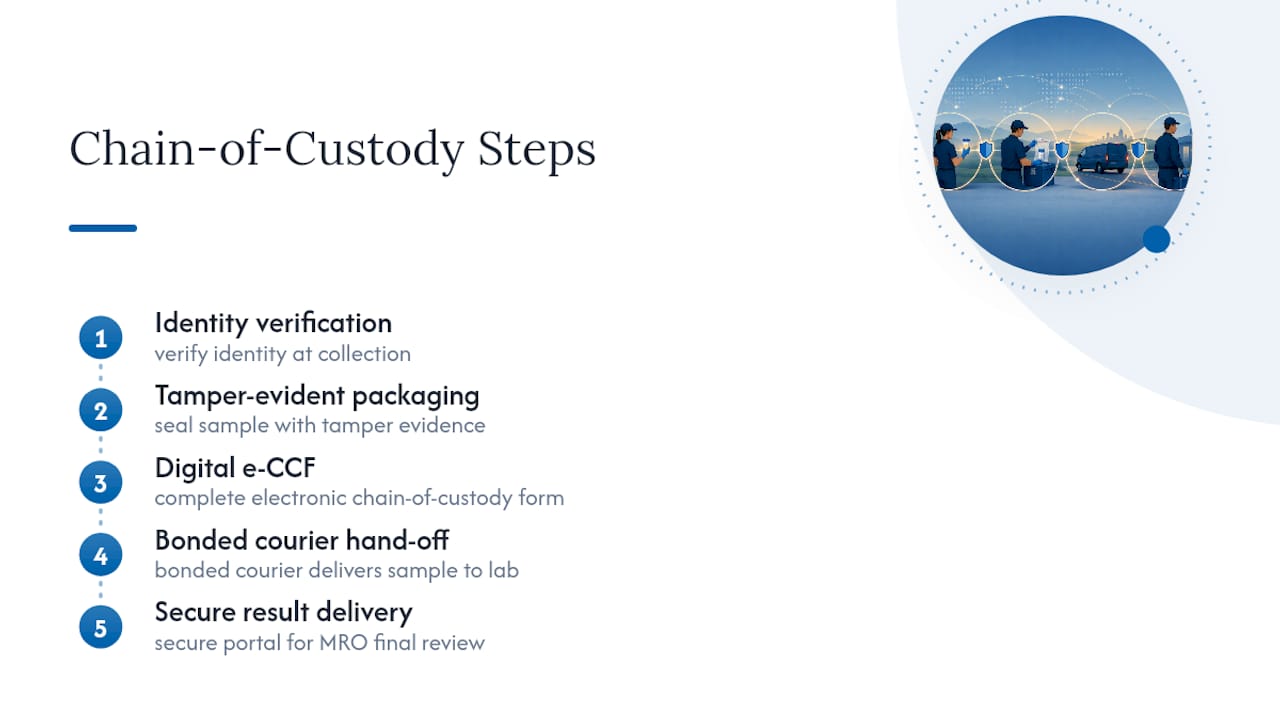
Whichever method you choose, chain-of-custody discipline is what makes the result usable. That means identity verification at collection, tamper-evident packaging, a digital chain-of-custody form (e-CCF), bonded courier hand-off to the lab, and a secure result portal for the MRO’s final call.
Remote work doesn’t erase the business case for any of this. Employees struggling with substance use perform at roughly 67% of their potential and cost employers close to $7,000 a year in non-accident-related costs, according to Occupational Health & Safety. That math holds whether the employee sits in a cubicle or a home office. Vendor platforms have responded by building coordinated multi-state workflows that combine virtual observation where legal, mobile dispatch, e-CCF, and bonded courier logistics into a single defensible process.
What Should a Remote-Worker Testing Policy Include?
A written policy is what separates a defensible program from a legal exposure waiting to happen. Build yours around these elements:
- Covered roles and the specific triggers that apply to each (pre-employment, random, reasonable suspicion, post-accident, return-to-duty).
- Exceptions for DOT-covered positions and any state where off-duty use of a legal substance is protected.
- Conditional offer language spelling out testing timelines, who covers the cost, and refusal consequences.
- Confidentiality and recordkeeping rules that limit who sees results and how long they’re retained.
Operationally, three decisions matter most:
- Choose a testing vendor based on lab accreditation, chain-of-custody practices, and MRO services, not just price.
- Build scheduling windows that account for rural employees who may need extra days to reach a collection site.
- Document every testing decision and have counsel review the policy before rollout, especially in states with prescriptive testing statutes.
For refusals, treat a missed or declined test the same as a positive result under most policies, and say so explicitly in writing. Positive results should route through the MRO first; only a confirmed, MRO-reviewed positive triggers disciplinary action or a return-to-duty process. Ready-made policy clause examples can shortcut the drafting process considerably.
How Does Countrywidetesting Support Remote Testing Programs?
Countrywidetesting partners with laboratories that meet SAMHSA, ISO, CLIA, and CAP standards, covering both urine and mouth swab test formats for employer programs. That gives HR teams a documented paper trail if a result is ever disputed.
The practical pieces of a remote-testing program are available in one place:
- Lab testing services for confirmatory analysis and MRO-reviewed results
- Employer and federal drug testing programs built around compliance requirements
- Mail-in kits for lower-stakes or geographically dispersed screening needs
- Step-by-step workflow guidance mapped to chain-of-custody and MRO processes
Why Proportionate Policies Beat Blanket Testing
The instinct to test everyone, constantly, misreads what actually protects a company. A policy that targets safety-sensitive roles and documented triggers holds up better in a dispute than one that tests every remote hire on principle, and it costs you less in recruiting friction. The trade-off is real: broader testing feels safer on paper, but it drives away qualified candidates in tight labor markets without meaningfully improving safety outcomes.
What actually works is documentation. Write down why a role is covered, get counsel to review the policy against your employees’ work-states, and tell your team plainly what triggers a test and why. Transparency isn’t a legal nicety here. It’s the difference between a policy people trust and one they resent.
— Alan
Get Your Remote Testing Program Compliant
Building a defensible remote-testing program means coordinating labs, collectors, and paperwork across states, which is exactly where a lot of HR teams lose momentum. This vendor offers access to compliant lab partnerships, employer and federal testing programs, and mail-in kits through a single vendor relationship.
Whether you need a one-time pre-employment screen for a new remote hire or a full random-testing program for a distributed safety-sensitive team, the Lab Testing Services page walks through what’s available for employer accounts, and you can request a custom quote for multi-state programs. If your policy calls for lower-stakes mail-in screening, the Phamatech Urine Lab Confirmation Mail-In Drug Test pairs a mail-in collection with actual lab confirmation, so results hold up if challenged. Reach out through the main site to talk through your specific role mix and state footprint before you finalize your policy.
Where to Verify the Rules Yourself
Check these primary sources before finalizing any policy, and loop in employment counsel for state-specific questions:
- SAMHSA workplace drug testing resources for lab certification and federal standards
- FMCSA/DOT guidance for transportation-industry collection rules
- EEOC guidance on medical inquiries and privacy protections
Sources
- Changing Times, Changing Workplaces — Occupational Health & Safety
- FMCSA: COVID-19 drug & alcohol testing guidance
- SAMHSA workplace drug testing resources
- EEOC enforcement guidance: disability-related inquiries and medical examinations
- Remote & distributed workforce screening — BlueHive
FAQ
Do Remote Jobs Drug-Test You?
Many remote employers still test, particularly for safety-sensitive roles, pre-employment screening, or positions covered by federal DOT rules. Whether a specific remote job tests you depends on the role, the employer’s policy, and the state where you work.
What Are the Mandatory Guidelines for Workplace Drug Testing in the United States?
There’s no single federal mandate covering all private employers; instead, DOT-regulated positions must follow 49 CFR Part 40, while other employers follow a mix of state law and their own written policy. Any program should use SAMHSA-certified labs and MRO review to stay defensible.
How Long Do You Have to Avoid Drugs to Pass a Drug Test?
Detection windows vary by substance and specimen type; oral fluid tests typically detect recent use within a shorter window than urine tests, while hair follicle testing can detect use going back weeks. Because windows differ so much by drug class, check the specimen-specific detection guide relevant to the test your employer uses rather than relying on a single rule of thumb.
Does a Health Insurance Provider Ever Drug-Test Remote Employees?
Health insurance providers, like most large employers, generally set their own drug-testing policies rather than following an industry-wide standard, and practices vary by employer and role. If you’re unsure what applies to you, your employer’s HR department or employee handbook is the authoritative source, not general assumptions about the industry.