
U.S. HR: 7 Step Safety Sensitive Drug Testing Compliance for DOT
DOT-regulated safety-sensitive roles require federally mandated drug and alcohol testing under 49 CFR Part 40 and the HHS Mandatory Guidelines. That means pre-employment, random, post-accident, reasonable suspicion, return-to-duty, and follow-up testing, all run through certified labs with Medical Review Officer oversight. If a test comes back positive, Substance Abuse Professional evaluation controls the path back to work. Your first move: confirm which of your roles actually fall under DOT jurisdiction.
TL;DR:
- Only employees in specific transportation roles regulated by DOT agencies are subject to federally mandated drug and alcohol testing; check your particular modal list.
- Testing must follow strict procedures for specimen collection, testing, documentation, and reporting, with confirmed positive results leading to employee removal and SAP evaluation.
- Accurate, certified labs and a single point of contact for results are crucial to ensure legal defensibility and compliance during audits or disputes.
- Testing procedures and thresholds vary slightly across DOT modes, requiring tailored policies for each sector’s specific triggers and rules.
- Current advances include fentanyl detection in tests and oral fluid specimens, but employers must verify vendor capabilities and lab accreditation at each renewal.
Table of Contents
- Who Counts as a Safety-Sensitive Employee?
- When Federal Rules Require a Drug or Alcohol Test
- What Specimens and Test Methods Are Actually Authorized
- The Written Policy, Consent, and Legal Guardrails You Need
- The Compliant Path After a Positive Result or Refusal
- Vetting Labs, MROs, and Chain of Custody
- Reasonable Suspicion in the Field: What Actually Holds Up
- Your 30 to 90 Day Compliance Audit Checklist
- How Countrywidetesting Supports a Compliant Testing Program
- Privacy Rights, Legal Exposure, and Where Employers Get Sued
- How Testing Rules Shift Across DOT Modes
- Where Drug Testing Technology Is Heading
- Medical Marijuana and Safety-Sensitive Roles: No Federal Exception
- Does Safety-Sensitive Testing Actually Reduce Incidents?
- Get Compliant Lab Testing and MRO-Ready Results
- An HR Practitioner’s Take on Fair, Defensible Testing
- Sources
Who Counts as a Safety-Sensitive Employee?
Not every job with risk attached qualifies as safety-sensitive under federal law. The designation comes from specific DOT modal agencies, each covering a distinct transportation sector, and each maintains its own list of covered functions.
The six DOT operating administrations break down like this:
- FAA — pilots, flight attendants, air traffic controllers, aircraft maintenance personnel
- FMCSA — commercial drivers requiring a CDL who operate vehicles over 26,001 pounds or transport hazardous materials
- FRA — locomotive engineers, conductors, train dispatchers, and signal maintainers
- FTA — bus operators, subway operators, and maintenance workers who perform safety-critical functions on mass transit systems
- PHMSA — pipeline operators and maintenance crews handling hazardous liquids and gas
- USCG — merchant mariners serving on commercial vessels
Together, these categories cover roughly 6.5 million transportation employees nationwide. Designation is agency-specific, so a warehouse forklift operator isn’t automatically covered just because the job feels dangerous. That said, many private employers voluntarily extend safety-sensitive testing policies to non-DOT roles like heavy equipment operators, crane operators, or armed security staff, often because insurance carriers or state contracts require it. Check your modal agency’s employee list before assuming coverage either way.
When Federal Rules Require a Drug or Alcohol Test
Each required testing occasion carries its own trigger and paperwork trail. Miss a step and the whole test can be thrown out during an audit or a legal challenge.
- Pre-employment and transfer testing. Anyone entering a safety-sensitive position needs a negative drug test result before starting duty. Written consent is mandatory, and if the applicant previously held a DOT safety-sensitive job elsewhere, you’re required to request their prior two years of testing records before they perform safety-sensitive functions for you.
- Random testing. Selection has to use a scientifically valid method, essentially a computer-generated random number system applied to the whole DOT-covered pool, not to whichever names come to mind. Testing dates must be unannounced and spread reasonably throughout the year, and FMCSA sets a minimum annual testing rate that agencies adjust based on industry-wide positive rates.
- Post-accident testing. This applies only when an accident meets specific criteria (a fatality, or citations tied to injury or disabling damage) and must happen within strict time windows, 2 hours for alcohol and 32 hours for drugs under FMCSA rules.
- Reasonable suspicion testing. A trained supervisor must document specific, contemporaneous observations before ordering this test. It’s distinct from post-accident testing because it’s triggered by behavior, not an incident.
- Return-to-duty and follow-up testing. After a violation, the employee must test negative before resuming safety-sensitive work, then submit to at least six unannounced follow-up tests over the next 12 months.
What Specimens and Test Methods Are Actually Authorized
DOT testing doesn’t leave room for shortcuts on specimen type or device choice, and getting this wrong invalidates results even when the underlying test would have been accurate.
For drugs, DOT-regulated tests require urine specimens; oral fluid testing is authorized under the regulations but requires labs and collection sites to meet separate certification standards that many providers are still building out. For alcohol, employers use a breath test (EBT) or a saliva-based screening device, with EBT required for confirmation of any screening result of 0.02 or higher.
A few procedural details trip up employers constantly:
- Instant-result devices are not authorized for DOT testing, full stop. On-site rapid cups and dipstick tests might be fine for a non-DOT internal policy, but they can’t produce an official DOT result.
- HHS updated its authorized drug panels in 2025, adding fentanyl to both urine and oral fluid testing with specific initial and confirmatory cutoff levels. Confirm your lab can assay for it at the required threshold.
- Every non-negative screening result requires confirmatory testing at a certified lab using gas or liquid chromatography, not just a repeat of the initial screen.
- Alcohol confirmation testing requires a 15-minute waiting period after the initial screen, and if you’re ordering both a drug and alcohol test on the same person, the alcohol test needs to happen first or the sequence can void the whole event.
The Written Policy, Consent, and Legal Guardrails You Need
A compliant safety-sensitive testing program rests on paperwork that holds up under scrutiny, not just good intentions. Employers who skip the documentation step are the ones who lose arbitration cases and EEOC complaints.
Your written policy needs to spell out:
- Which positions are designated safety-sensitive and why
- Every testing circumstance that applies (pre-employment, random, post-accident, reasonable suspicion, return-to-duty, follow-up)
- Consequences for a positive result or a refusal to test
- How employee consent is obtained and documented before every test
If your workforce is unionized, none of this gets implemented unilaterally. Testing policies and procedures typically require bargaining under the NLRA, and skipping that step invites a grievance that can stall your entire program.
The Americans with Disabilities Act also limits how you handle results. A positive test itself isn’t a protected medical inquiry, but the follow-up conversation can veer into ADA territory fast if you’re not careful about what you ask and who has access to results.
Pro Tip: Route every test result through a single point of contact, ideally your MRO liaison, rather than letting multiple supervisors see raw lab data. It cuts your disclosure risk dramatically and keeps records defensible if a dispute ever reaches litigation.
Retention matters too. DOT requires specific record-keeping periods depending on the record type, some documents for one year, verified positives and refusals for five years, and you’re required to report annual testing data through your agency’s Management Information System when your covered workforce crosses certain size thresholds.
The Compliant Path After a Positive Result or Refusal
A verified positive or a refusal to test triggers a sequence that’s largely dictated by regulation, not employer discretion. Getting this sequence wrong is one of the fastest ways to end up in front of an arbitrator.
- Remove the employee from safety-sensitive duties immediately. This happens the moment you have a verified positive or refusal, not after a hearing or an internal review.
- Let the MRO complete verification first. A lab’s non-negative screening result isn’t final; a certified Medical Review Officer reviews it, contacts the employee, and considers any legitimate medical explanation before verifying it as positive. The employee also has the right to request testing of the split specimen at a second certified lab.
- Refer the employee to a Substance Abuse Professional. The SAP conducts a face-to-face evaluation and recommends treatment or education. This step is mandatory before any return-to-duty test can happen.
- Confirm return-to-duty testing and the follow-up schedule. The employee needs a negative return-to-duty result before resuming safety-sensitive functions, followed by a minimum of six unannounced tests over 12 months, which the SAP can extend up to 60 months.
Vetting Labs, MROs, and Chain of Custody
Your testing program is only as defensible as the lab and MRO behind it. A cheap vendor that cuts corners on certification becomes your legal liability the moment a result gets challenged.
Look for these credentials before signing a contract:
- SAMHSA/HHS-certified laboratory status, confirmed against the current published certification list, not just a vendor’s self-description
- CLIA certification and CAP accreditation for quality control and testing consistency
- Instrument capability for the current HHS panel, including fentanyl detection at required cutoffs
- An independent MRO relationship, since a lab that also employs your MRO creates a conflict of interest concern during disputes
Ask every collector and lab to document the full chain of custody: specimen seals, custody-and-control forms, temperature verification at collection, and a documented transfer trail from collection site to lab to storage. DOT’s roughly 6.5 million covered employees generate a testing volume large enough that even minor documentation gaps at scale become statistically likely to surface during a compliance review.
Reasonable Suspicion in the Field: What Actually Holds Up
A reasonable-suspicion referral needs to rest on specific, documented observations made by a trained supervisor, not a gut feeling. The standard is “contemporaneous and articulable,” meaning the supervisor writes down what they saw at the time, not after the fact.
Qualifying observations include slurred speech, unsteady gait, the smell of alcohol, dilated or constricted pupils, or erratic behavior witnessed directly by the supervisor. What doesn’t qualify: rumors from coworkers, off-duty conduct with no on-duty connection, or a supervisor’s suspicion with nothing specific to point to.
FMCSA guidance requires at least one hour of drug-specific and one hour of alcohol-specific training for supervisors who can make these calls. Document every observation on a standardized form immediately, before the testing decision, and keep two trained supervisors’ signatures whenever your policy allows it.
Your 30 to 90 Day Compliance Audit Checklist
Running through this sequence over the next quarter closes most of the gaps that show up during a DOT audit or an employee legal challenge.
- Audit every position against your relevant DOT modal agency’s safety-sensitive definition and update your covered-roles list.
- Revise your written policy to reflect current testing occasions, consequences, and consent language.
- Confirm your random-testing rate meets the current annual minimum and that selection uses a verified random method.
- Verify your lab’s SAMHSA certification and your MRO’s credentials directly, not through vendor marketing claims.
- Build a current SAP contact list before you need one; scrambling to find one after a positive result costs you compliance time.
- Schedule supervisor training on reasonable-suspicion observation and documentation.
- Review your record retention system against DOT’s required timelines and MIS reporting triggers.
Pro Tip: Run a mock chain-of-custody review with your lab once a year, even if you’ve never had a dispute. Finding the paperwork gap yourself beats an auditor finding it for you.
How Countrywidetesting Supports a Compliant Testing Program
Countrywidetesting partners with SAMHSA/HHS-capable laboratories aligned with CLIA, CAP, and ISO standards, giving employers a direct path to lab-confirmed results without vetting a vendor network from scratch. The lab testing services support urine and oral fluid specimen types, MRO-ready reporting, and enterprise onboarding for organizations building or refreshing a DOT-compliant program. For custom volume needs or federal contract requirements, Countrywidetesting works with employers directly to scope a testing solution matched to their covered workforce size and industry.
Privacy Rights, Legal Exposure, and Where Employers Get Sued
Drug testing sits at an uneasy intersection between an employer’s safety obligations and an employee’s reasonable expectation of privacy. Courts have generally upheld DOT-mandated testing programs precisely because they’re federally required, not employer-invented, which gives them a stronger legal footing than voluntary company policies covering the same roles.
Where employers run into trouble is usually procedural, not conceptual. Improper specimen handling, disclosure of results to people without a need to know, or testing outside the specific circumstances your policy authorizes all create grounds for a privacy claim or a wrongful-termination suit. State laws add another layer: several states restrict how and when private employers can test, require advance notice of testing policies, or limit the consequences employers can impose for a first positive result. DOT-mandated testing generally preempts conflicting state restrictions for covered positions, but non-DOT roles you’ve voluntarily designated as safety-sensitive don’t get that same shield.
The ADA further constrains post-test conduct. A positive result triggering questions about prescription medication use, disability status, or medical history without a clear, job-related justification opens the door to a discrimination claim. The safest posture is narrow disclosure: results go to the MRO and a designated employer contact, nowhere else, and any follow-up conversation stays limited to fitness for safety-sensitive duty.
How Testing Rules Shift Across DOT Modes
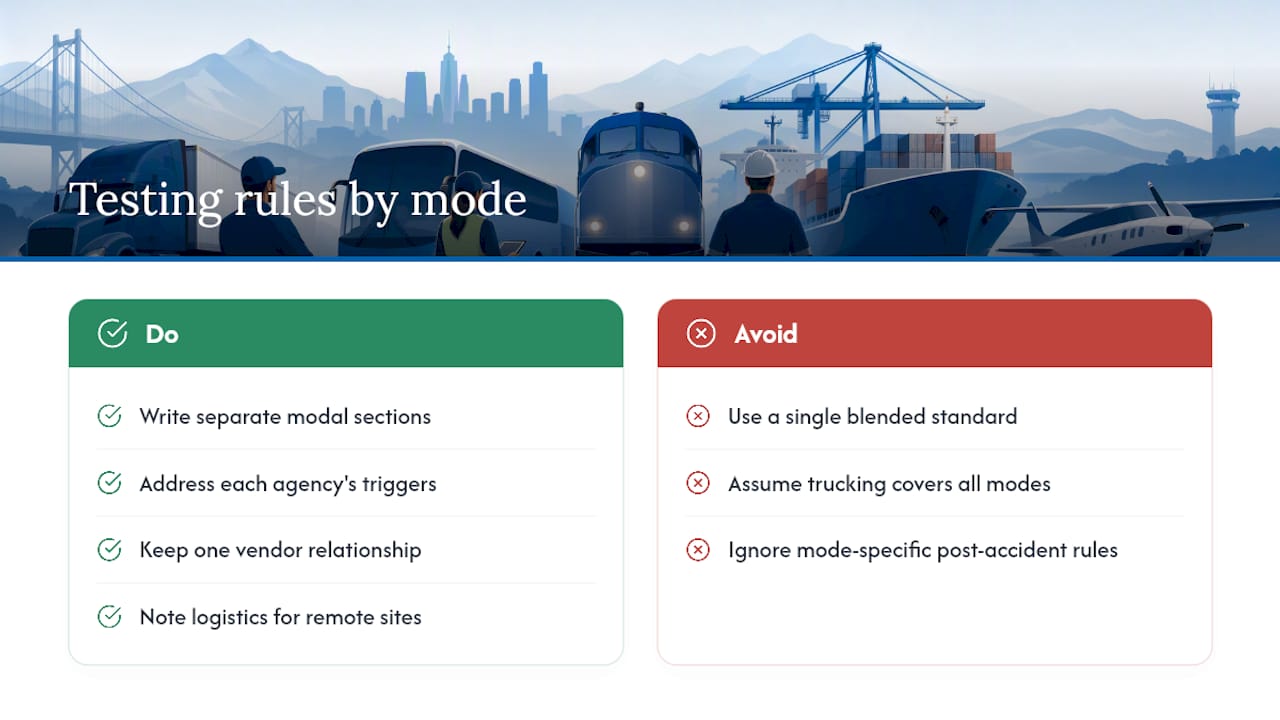
The core Part 40 procedures apply uniformly, but each modal agency layers on its own thresholds and operational quirks, which is why a compliance approach built for trucking doesn’t automatically transfer to aviation or rail.
FMCSA sets its random testing rate annually based on industry-wide positive rates and covers roughly 32 million commercial driver’s license holders, though only those in safety-sensitive functions face the actual testing pool. FAA testing extends beyond pilots to maintenance technicians and dispatchers, with post-accident criteria tied to National Transportation Safety Board investigation triggers rather than FMCSA’s citation-based thresholds. FRA’s rules for railroads include testing circumstances specific to signal and train control incidents that don’t exist in trucking or aviation frameworks. FTA-covered transit agencies often layer local transit authority policies on top of federal minimums, particularly around random testing rates in high-risk urban systems. PHMSA’s pipeline testing population is smaller but concentrated in remote operational sites, which creates real logistics challenges for post-accident testing windows. The Coast Guard applies its rules to vessels operating in U.S. waters, with testing circumstances tied to marine casualties rather than roadway or rail incidents.
For employers operating across multiple modes, running one testing vendor relationship still works, but your written policy needs separate sections addressing each modal agency’s specific triggers rather than a single blended standard.
Where Drug Testing Technology Is Heading
Laboratory science keeps outpacing what many employer policies account for, and the gap matters because using outdated methodology can undermine a test’s legal defensibility even when the result itself is accurate.
The 2025 HHS panel update adding fentanyl reflects exactly this kind of shift, driven by changes in what’s actually circulating in the illicit drug supply rather than a routine schedule update. Labs now need mass spectrometry instrumentation sensitive enough to detect fentanyl at the specified cutoff, which not every certified lab had built out before the rule took effect.
Oral fluid collection technology has also matured enough that DOT authorized it as a specimen option, offering faster, less invasive collection than urine, though certification standards for oral fluid labs and collection devices are still catching up to the urine testing infrastructure that’s been in place for decades. Meanwhile, instant on-site devices keep improving in accuracy for non-DOT screening purposes, but they remain barred from official DOT results, a gap that trips up employers who assume better technology automatically means broader authorization.
The practical implication for HR: never assume your current lab or collection vendor has adopted every regulatory update automatically. Confirm panel capabilities and specimen certifications at each contract renewal, not just at initial vendor selection.
Medical Marijuana and Safety-Sensitive Roles: No Federal Exception
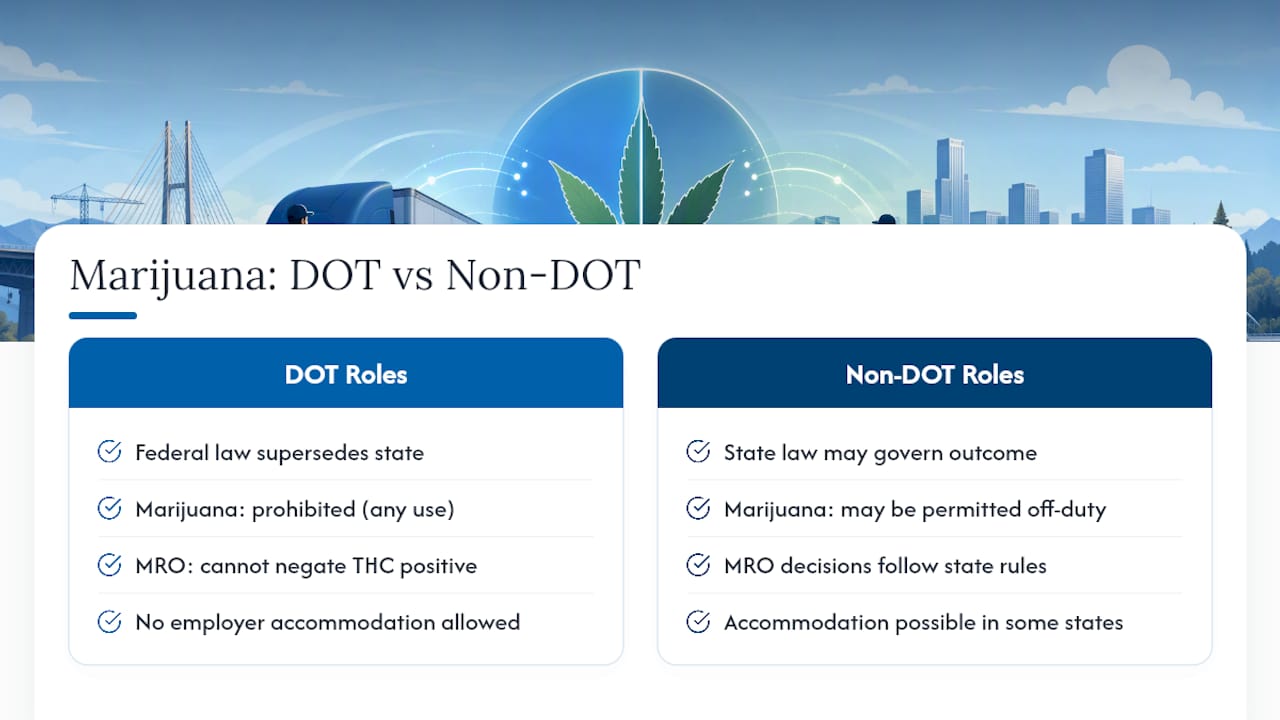
Federal law draws a hard line here that surprises a lot of employers in states with legal medical marijuana programs. DOT-regulated safety-sensitive employees cannot use marijuana, medical or otherwise, and a positive THC result cannot be excused by a state medical marijuana card. Marijuana remains a Schedule I controlled substance under federal law, and DOT’s Part 40 guidance explicitly states that MROs cannot verify a positive marijuana test as negative based on a medical recommendation or state authorization.
This creates real tension for employees in states where medical or recreational marijuana is legal. An employee can hold a valid state medical card and still face mandatory removal from safety-sensitive duty, SAP evaluation, and the full return-to-duty process after a positive DOT test. Employers can’t grant an accommodation that would let a DOT-covered employee test positive and remain in a safety-sensitive role. That’s not a matter of employer discretion; it’s a federal preemption issue.
For non-DOT positions your organization has voluntarily designated as safety-sensitive, you have more latitude, but it’s genuinely complicated. Some states require accommodation of off-duty medical marijuana use for non-safety-sensitive roles, and a handful extend similar protections even where safety is a factor, so state-specific legal review matters before finalizing a policy for these roles. The safest approach: keep your DOT policy strictly aligned with federal rules, and get counsel involved before extending or denying any accommodation for state-legal marijuana use in non-DOT safety-sensitive positions.
Does Safety-Sensitive Testing Actually Reduce Incidents?
The case for testing rests heavily on the scale of coverage and the structure of the programs themselves. DOT’s testing framework applies to roughly 6.5 million transportation employees, a population large enough that random testing’s deterrent effect, catching a smaller share of users while discouraging a much larger share from using at all, is baked into the frequency requirements set by each modal agency.
The random-testing design itself reflects this logic. Rates are adjusted based on industry-wide positive results reported through agency MIS data, rising when positive rates climb and easing when they fall. That responsiveness is the whole point of random testing as a deterrent mechanism rather than a pure detection tool: it’s built to catch outliers while making non-random shifts to catch everyone else feel unpredictable enough to discourage use in the first place.
What the data doesn’t offer is a clean, universally agreed-upon causal number connecting testing programs to accident rates, since so many other safety variables (training, equipment, fatigue rules) move alongside testing policy. What’s clear is that the regulatory floor keeps rising, not falling. Fentanyl’s addition to the authorized testing panels signals that federal agencies see current programs as a baseline to expand, not a settled standard, as drug use patterns among the workforce continue shifting.
Get Compliant Lab Testing and MRO-Ready Results
Countrywidetesting connects employers directly with certified laboratories built to handle DOT-mandated specimen types, current HHS panels, and MRO-ready reporting, without the vendor-vetting slog most compliance officers dread. Every result routes through documented chain-of-custody procedures designed to hold up if a test result is ever challenged.
If you’re building or refreshing a safety-sensitive testing program, start with a quote for lab testing services tailored to your covered workforce size and industry. For organizations onboarding an entire fleet or facility roster, Countrywidetesting’s team can scope enterprise logistics, from collection site coordination to ongoing random-selection support, so your compliance calendar doesn’t depend on chasing down a vendor every time a rule changes. Reach out through Countrywidetesting to get a program built around your actual regulatory footprint, not a generic template.
An HR Practitioner’s Take on Fair, Defensible Testing
The programs that hold up under scrutiny aren’t the strictest ones; they’re the most consistently documented ones. Employees rarely challenge a positive result. They challenge inconsistent process. Keep one centralized MRO and lab record system, and keep your SAP contact list current before you need it, not after.
— Alan
Sources
- Mandatory Guidelines for Federal Workplace Drug Testing Programs—Authorized testing panels
- Implementation Guidelines for Alcohol and Drug Regulations - Chapter 5 | FMCSA