
2026 Fentanyl Update: Make U.S. Healthcare Drug Testing Defensible
U.S. healthcare employers may implement drug testing programs, but they must align with SAMHSA/DOT rules, state marijuana laws, and due-process safeguards. Start by adopting a written policy, identifying which roles are safety-sensitive, and contracting with an accredited lab and a Medical Review Officer before you collect a single specimen.
TL;DR:
- Healthcare employers should ensure drug testing panels are updated to include fentanyl and synthetic opioids as per 2025 federal guidelines.
- Tests should be role-specific, with higher risk roles requiring more comprehensive panels, such as 10- or 12-panel urine tests, especially for narcotics access.
- Testing should be triggered only by appropriate reasons, with automation for random selection and documented suspicion to avoid legal discrimination claims.
- Confirmatory testing must use GC-MS or LC-MS/MS after initial immunoassay screening to ensure result accuracy and defend against false positives.
- Policies must account for state marijuana laws, focusing on impairment rather than lawful off-duty use, especially in medical cannabis-legal states.
Table of Contents
- Federal Rules Behind Healthcare Worker Drug Testing
- Choosing Specimen Types and Panels for Medical Staff
- When to Test: Triggers and Program Design
- Chain of Custody, Confirmatory Testing, and the MRO Role
- Building a Policy That Holds Up Under Scrutiny
- Role Risk and State Marijuana Law: Tailoring the Policy
- How Countrywidetesting Supports Compliant Programs
- Drug Testing Results and Healthcare Licensing Consequences
- Prevention Programs and Employee Assistance in Healthcare
- Legal Risk Areas and Recent Rulings to Watch
- Handling a Positive Result: Return-to-Work and Rehabilitation
- Why Compliance Beats Convenience Here
- Get Your Testing Program Lab-Ready
- Where to Verify These Rules Yourself
- Sources
Federal Rules Behind Healthcare Worker Drug Testing
Most hospitals and clinics aren’t federally mandated to test, but once you choose to, federal frameworks shape how you do it. The SAMHSA Mandatory Guidelines set the technical standard nearly every accredited lab in the country follows, even for employers outside the federally regulated workforce. If your organization employs commercial drivers, such as ambulance staff, DOT rules apply on top of your general policy, adding mandatory random testing rates and specific collection procedures.
The 2025 Federal Register update to the Mandatory Guidelines revised authorized urine and oral fluid panels and added fentanyl, with its own initial and confirmatory cutoffs. Any healthcare employer updating a panel in 2026 should verify their lab has adopted these revised cutoffs, not the older analyte list.
Two other federal layers matter just as much:
- The ADA and EEOC limit medical inquiries and require testing policies to apply evenhandedly, since disability discrimination claims often follow inconsistent enforcement.
- FMLA protections can intersect with a positive result when the underlying condition involves a medical treatment plan, so HR needs a process for distinguishing prescribed medication use from misuse.
Pro Tip: Before finalizing your panel, check whether your state restricts pre-offer inquiries or protects off-duty medical cannabis use. State law is frequently stricter than federal baseline rules, and it’s the layer that trips up most healthcare employers.
Choosing Specimen Types and Panels for Medical Staff
Urine remains the workhorse specimen for healthcare employee drug screening because it balances cost, detection window, and lab familiarity. Oral fluid has gained ground for observed collections and shorter detection windows, useful for reasonable-suspicion or post-accident scenarios where recent use matters more than a multi-day history. Hair testing extends the detection window over several weeks but costs more and isn’t practical for time-sensitive decisions like pre-employment onboarding. Blood testing is rare outside clinical or forensic settings due to its invasiveness and narrow detection window.
Panel size should track role risk, not default to whatever’s cheapest:
- A 5-panel urine test covers the classic categories: amphetamines, cocaine, opiates, PCP, and THC.
- A 10-panel adds benzodiazepines, barbiturates, methadone, methaqualone, and propoxyphene, catching a broader range of prescription misuse.
- A 12-panel typically layers in additional opioids and, increasingly, fentanyl given its inclusion in the 2025 federal panel update.
For staff with narcotics access, a 10 or 12-panel that explicitly captures fentanyl and other synthetic opioids is the more defensible choice. Front-desk or non-clinical roles rarely need that depth, and over-testing low-risk positions invites cost without a corresponding safety benefit.
When to Test: Triggers and Program Design
Testing occasions in healthcare fall into five categories, each with different legal guardrails.
- Pre-employment. Test only after a conditional offer, and confirm your state’s timing and notice rules before scheduling collection.
- Random. Use an objective, computer-generated selection method. Randomization software or vendor-managed programs reduce the risk of disparate-impact claims tied to manual or supervisor-driven selection.
- Reasonable suspicion. Require documented, observable indicators (slurred speech, odor, erratic behavior) and train at least two supervisors to corroborate before ordering a test.
- Post-accident. Test as close to the incident as your policy specifies, since delayed collection weakens the causal link between substance use and the event.
- Return-to-duty. Require a negative confirmed result plus, often, a follow-up testing schedule before reinstating an employee who tested positive previously.
Pro Tip: Random selection is where most defensible programs fail quietly. If a supervisor can hand-pick who gets tested “at random,” you’ve built a discrimination claim into your own policy. Automate it.
Chain of Custody, Confirmatory Testing, and the MRO Role
A specimen is only as trustworthy as the paperwork attached to it. Chain-of-custody forms document every hand-off from collection to lab analysis, and any gap in that chain can make a positive result indefensible in a grievance or lawsuit.
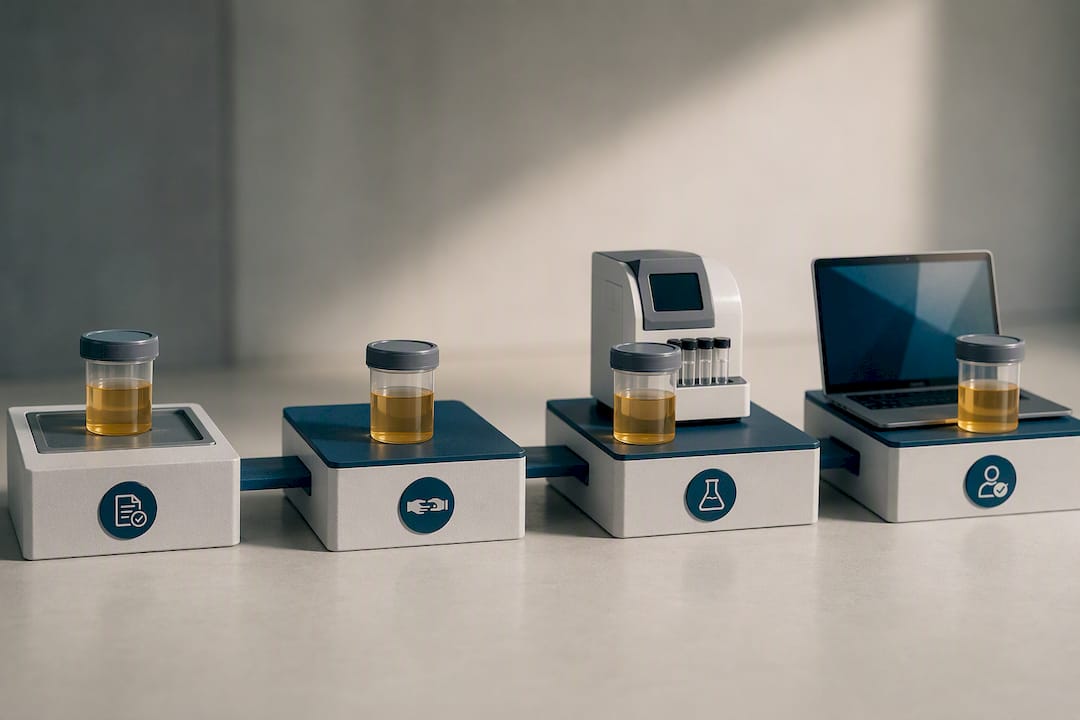
Initial screening uses immunoassay technology, fast and inexpensive, but prone to false positives from cross-reactive substances. That’s why clinical and lab guidance.pdf) is unambiguous: any non-negative screen requires confirmation through GC-MS or LC-MS/MS before an employer takes adverse action.
Confirmatory results route to a Medical Review Officer, a licensed physician trained to:
- Contact the employee confidentially to rule out valid prescriptions or medical explanations.
- Distinguish legitimate metabolite cross-reactivity from actual substance misuse.
- Report a verified positive, negative, or refusal-to-test result to the employer, without disclosing the underlying medical conversation.
Turnaround for lab-based confirmatory testing typically runs a few business days after the initial screen flags non-negative. Employers should build that window into onboarding timelines rather than assuming same-day results.
Building a Policy That Holds Up Under Scrutiny
A written policy is the single strongest defense against a wrongful-termination or discrimination claim, and it needs specific clauses, not vague references to “company standards.” At minimum, spell out the scope of covered roles, every testing trigger, the consent process, confidentiality protections, the MRO review workflow, an appeals mechanism, disciplinary outcomes, and how accommodation requests get handled.
Operationally, HR should:
- Vet lab and collection-site vendors for SAMHSA, CLIA, or CAP accreditation before signing a contract.
- Train collectors and supervisors on chain-of-custody procedures and reasonable-suspicion documentation.
- Maintain secure, access-limited records consistent with HIPAA handling requirements for test results.
- Audit enforcement periodically to confirm the policy is applied the same way across departments and shift levels.
Pro Tip: The fastest way to lose a legal challenge isn’t a bad policy. It’s an inconsistently enforced good one. If Nursing gets tested for reasonable suspicion and Radiology doesn’t, under the same observed behavior, that gap becomes the plaintiff’s exhibit A.
A drug testing compliance guide built for 2026 rule changes can help HR teams cross-check policy language against current federal panel updates before rolling out revisions.
Role Risk and State Marijuana Law: Tailoring the Policy
Not every position in a hospital carries the same testing rationale. Staff who administer medication or handle controlled substances, think nurses, anesthesiologists, and pharmacy technicians, are commonly treated as safety-sensitive because impairment on the job creates direct patient risk. That classification supports broader panels and, in many programs, random testing that wouldn’t be justified for administrative staff.
State marijuana and medical cannabis laws complicate THC testing specifically. In states where cannabis use is legal or medically protected, blanket termination for a positive THC result, absent evidence of on-the-job impairment, increasingly invites legal challenge. A more defensible approach:
- Frame policy language around impairment and safety-sensitive function rather than off-duty legal use.
- Apply the same THC standard consistently across comparable roles.
- Document the specific safety rationale tied to controlled-substance access when applying stricter standards.
Because these carveouts vary by state and shift constantly, HR should consult employment counsel before finalizing role-based language, particularly for any policy touching medical cannabis accommodation requests.
How Countrywidetesting Supports Compliant Programs
The platform works with laboratories that meet recognized accreditation standards, helping employers demonstrate result reliability. It offers multi-panel urine and oral-swab kits alongside access to certified lab testing services, so HR teams can match specimen type and panel size to actual role risk instead of a one-size-fits-all default.
Operationally, that support may include streamlined ordering routing specimens to accredited labs, reporting formats compatible with MRO review to maintain confirmation steps, and options for retail-purchased kits and custom enterprise testing arrangements.
Drug Testing Results and Healthcare Licensing Consequences
A positive confirmed test doesn’t just affect employment status. It can trigger a separate reporting obligation to the state licensing board that governs a nurse, physician, or pharmacist’s credential. Most state boards of nursing and medicine require licensees, or their employers, to report substance-related incidents, and a confirmed positive tied to on-duty impairment or diversion of controlled substances often opens a board investigation independent of whatever the employer decides internally.
That investigation can result in a range of outcomes: a confidential monitoring agreement, practice restrictions, suspension, or in serious diversion cases, revocation. Many boards operate alternative-to-discipline programs that let a licensee retain their credential while completing monitored treatment, provided they self-report or come forward before a patient-safety incident occurs.
HR’s role here is narrower than it might seem. Employers generally aren’t responsible for adjudicating licensing consequences, but they are often required to notify the relevant board when policy violations involve controlled-substance diversion, and failing to do so can create separate liability for the organization. Building that notification trigger into your policy, tied to specific violation categories rather than every positive result, keeps the process predictable and legally sound.
Prevention Programs and Employee Assistance in Healthcare
Testing catches problems after they exist. Prevention and treatment access are what actually reduce how often that happens. A functioning Employee Assistance Program gives staff a confidential path to seek help before a violation occurs, and healthcare employers that pair EAP access with clear, non-punitive self-referral language tend to see more voluntary disclosures than those relying on testing alone.
Practical prevention steps worth building into a program:
- Publicize EAP access during onboarding, not buried in a handbook appendix nobody reads.
- Train supervisors to recognize early warning signs, not just the acute impairment signs relevant to reasonable-suspicion testing.
- Point employees toward resources like Findtreatment when a self-referral or return-to-duty plan requires outside treatment.
- Separate the EAP referral pathway from disciplinary tracking so employees don’t fear termination for seeking help before a violation occurs.
Given how much controlled-substance access healthcare roles carry, a credible prevention program is as much a patient-safety measure as an HR one. Diversion by an impaired staff member risks the employee’s license and the patient in front of them.
Legal Risk Areas and Recent Rulings to Watch
Most litigation around healthcare drug testing clusters around three fact patterns: inconsistent enforcement across similar roles, medical inquiries that stray into ADA-protected territory, and testing procedures that ignore state cannabis protections. Courts have generally sided with employers when a policy is written, applied uniformly, and tied to a documented safety rationale, and sided with employees when enforcement looks selective or the underlying justification is thin.
The ADA angle deserves particular attention. The EEOC’s guidance makes clear that drug testing itself isn’t a prohibited medical inquiry, but follow-up questions about prescription medications or treatment history can cross that line if not handled carefully through the MRO process rather than directly by HR or a supervisor.
State-level cannabis litigation is the fastest-moving area right now. Several states have enacted or strengthened protections against adverse action based solely on off-duty cannabis use, and healthcare employers operating across multiple states increasingly need location-specific policy addenda rather than one national standard. Because this area shifts state by state and year by year, treat any specific court ruling as a reason to consult employment counsel rather than a rule you can apply nationally without review.
Handling a Positive Result: Return-to-Work and Rehabilitation
A confirmed positive doesn’t have to end in termination, and for many healthcare employers it shouldn’t, given how much investment sits in a trained clinical staff member. The more defensible path runs through a structured return-to-work process rather than an automatic firing policy applied inconsistently.
That process generally includes:
- Immediate removal from safety-sensitive duties pending MRO confirmation and a fitness-for-duty evaluation.
- A last-chance or return-to-duty agreement outlining conditions, treatment completion, follow-up testing schedule, and consequences for a second violation.
- Confirmed negative return-to-duty test before reinstatement, consistent with the specimen and panel standards used for the original violation.
- Follow-up testing at intervals defined by the agreement, often extending six months to a year.
Individualized, risk-based frequency rather than a rigid blanket schedule tends to hold up better under scrutiny, since it mirrors clinical guidance on treatment monitoring rather than an arbitrary corporate standard. Document every step, since the paper trail supporting a return-to-work decision is exactly what protects the organization if a second incident occurs and the employee challenges termination.
Why Compliance Beats Convenience Here
The biggest mistake I see in healthcare drug testing programs isn’t a missing policy. It’s a policy copied from a generic HR template five years ago that nobody’s updated since fentanyl got added to federal panels. That gap matters more in healthcare than almost any other industry, because the population being tested has direct access to the exact substances driving the overdose crisis.
The conventional advice, “just test everyone the same way,” sounds fair but falls apart under real scrutiny. Role-based testing isn’t a workaround. It’s what actually holds up when a terminated employee’s attorney asks why a housekeeping staffer and a nurse anesthetist face identical random-testing odds despite wildly different access to controlled substances.
What I’d prioritize first: get your panels current with the 2025 federal fentanyl update, confirm your lab and MRO relationship is actually accredited rather than assumed to be, and rewrite any policy language that treats THC positives the same in every state. Those three fixes close more legal exposure than any amount of testing volume ever will.
— Alan
Get Your Testing Program Lab-Ready
This platform can serve as a starting point for healthcare employers seeking certified results without building a lab relationship from scratch. Unlike generic retail test kits that may lack confirmatory backup, it connects programs to labs meeting recognized accreditation standards, providing a defensible confirmation path for non-negative screens.
For role-based panels, the 12-panel at-home urine test covers the broader analyte range that narcotics-handling staff typically require, while full laboratory drug testing services handle higher-volume employer programs that need consistent lab routing and MRO-compatible reporting. Start by requesting a quote for your role categories and panel needs, then build your collection schedule around the accredited lab timeline instead of guessing at turnaround.
Where to Verify These Rules Yourself
Policy decisions built on secondhand summaries are how compliance gaps happen. Check these primary sources directly before finalizing any healthcare worker drug testing policy:
- SAMHSA’s federal laws and regulations page for the current Mandatory Guidelines summary.
- The Federal Register’s 2025 notice on authorized testing panels, including the fentanyl cutoff update.
- The EEOC for ADA-related medical inquiry limits and disability discrimination guidance.
- OSHA for specimen collection safety and infection-control standards relevant to collection sites.
Also check your own state’s labor agency and cannabis statute pages. Federal guidance sets the floor, but state law is frequently what determines whether a specific clause in your policy actually holds up.
This article is general information, not a substitute for advice from a qualified lawyer. Consult a qualified legal professional about your own circumstances before acting on anything here.
Sources
- Drug Testing Federal Laws and Regulations — SAMHSA
- Mandatory Guidelines for Federal Workplace Drug Testing Programs: Authorized testing panels — Federal Register
- Employment Drug Testing — Checkr
- U.S. Equal Employment Opportunity Commission (EEOC)