
Forensic toxicology: A practical guide for employers
TL;DR:
- A single ambiguous drug test result can halt HR processes by raising legal and procedural concerns. Forensic toxicology provides legally defensible data by analyzing biological samples with certified methods, emphasizing chain of custody and confirmatory testing. Proper understanding of testing methods, cutoff levels, and legal frameworks helps organizations ensure compliance and reduce liability risks.
A single ambiguous drug test result can bring your entire HR process to a standstill. Suddenly you’re fielding questions from legal, re-examining your testing vendor’s credentials, and wondering whether your current protocol would hold up in court. For most HR professionals, that moment of uncertainty is avoidable—if you understand the science and legal framework behind forensic toxicology. This guide breaks down exactly what forensic toxicology is, how workplace drug testing actually works, and what you need to know to keep your organization compliant, consistent, and protected from liability.
Table of Contents
- Understanding forensic toxicology: The basics
- How workplace drug testing works: Methods and compliance
- Cutoff levels and detection windows: Reading drug test results
- Ensuring defensible results: Advances and pitfalls in toxicology testing
- Perspective: What HR rarely hears about forensic toxicology
- Get started with reliable workplace drug testing solutions
- Frequently asked questions
Key Takeaways
| Point | Details |
|---|---|
| Foundational HR tool | Forensic toxicology underpins legal, compliant drug testing in the workplace. |
| Urine testing prevails | Urine is the primary, federally recognized sample matrix for workplace drug screening. |
| Cutoffs and windows matter | Understanding cutoff levels and detection times is key to fair, effective HR decision-making. |
| Certification is critical | Only use HHS-certified labs and SAMHSA-compliant panels for defensible results. |
| Confirm positives | Always confirm screening results with advanced methods to minimize legal risk and errors. |
Understanding forensic toxicology: The basics
Forensic toxicology is not the same as the routine blood work your employee gets at a physical. According to The Association (UKIAFT), forensic toxicology is “the application of toxicology principles to legal and forensic contexts, involving the analysis of biological samples such as blood, urine, hair, and tissues to detect drugs, poisons, alcohol, and other toxic substances, and interpreting their concentrations to determine impairment, cause of death, or compliance.” That legal context is the defining difference. Results may be introduced as evidence, challenged in court, or reviewed by regulatory agencies.
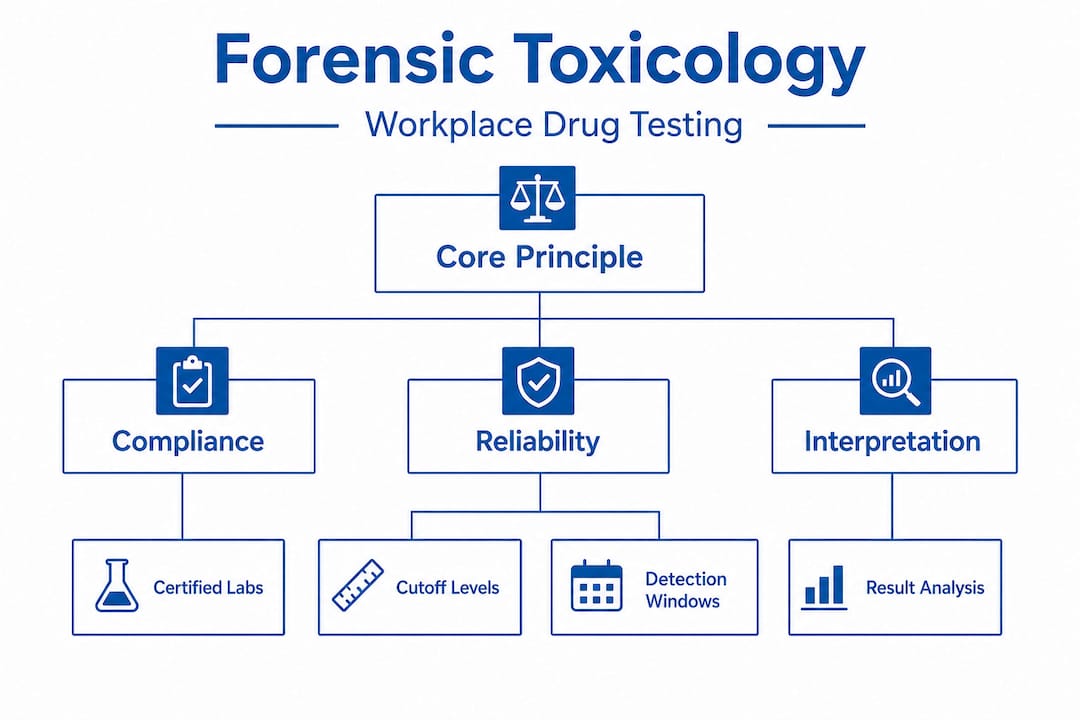
Clinical or medical toxicology focuses on treating patients. Forensic toxicology focuses on producing defensible data. The chain of custody, the lab’s certification, and the interpretation of results all matter far more in your workplace program than they would in a routine clinical setting.
For employers, the forensic toxicology process follows a clear sequence:
- Sample collection: A designated collector gathers a biological specimen, typically urine, under controlled conditions with a documented chain of custody.
- Initial screening: An immunoassay test provides a rapid yes-or-no result based on cutoff concentrations.
- Confirmatory analysis: Any screen positive is forwarded to a certified laboratory for mass spectrometry confirmation.
- Result interpretation: A Medical Review Officer (MRO) reviews confirmed positives before communicating them to the employer.
The biological matrix matters too. While urine is the standard for most compliance programs, blood, hair, oral fluid, and even sweat can be analyzed depending on the situation. Each matrix has different detection windows and legal acceptance. Employers building multi-industry programs or post-accident protocols should understand the types of drug tests available before selecting their approach.
“The goal of forensic toxicology in the workplace is not just to detect substances—it’s to produce results that are accurate, documentable, and legally defensible.” This distinction shapes every decision from vendor selection to how you communicate results to employees.
Commonly tested substances in occupational settings include cannabis (THC), cocaine, amphetamines, opiates and synthetic opioids, and phencyclidine (PCP). Expanded panels may also screen for benzodiazepines, barbiturates, methadone, and alcohol. The specific panel you use should align with your industry’s regulatory requirements and your organization’s risk profile.
How workplace drug testing works: Methods and compliance
Understanding what forensic toxicology involves is the starting point—but implementing it correctly is where most employers face real challenges. The method you use, the lab you choose, and the standards you follow determine whether your results will hold up under scrutiny.
Why urine testing dominates compliance programs
Urine is the preferred matrix in regulated workplace testing for straightforward reasons: it’s non-invasive, produces reliable concentrations of drug metabolites, and is supported by decades of validated research. Per federal workplace testing standards, urine specimens require a minimum volume of 30-45 mL collected at a temperature between 32-38°C, which is verified immediately to detect adulteration or substitution attempts. These controls are non-negotiable for federally regulated programs.
Federal frameworks you need to know
If your organization operates in a safety-sensitive industry, federal requirements set the floor—not a suggestion. The key frameworks include:
- SAMHSA (Substance Abuse and Mental Health Services Administration): Establishes the mandatory guidelines for federal workplace drug testing programs, including specimen collection, lab certification, and MRO review.
- HHS (Department of Health and Human Services): HHS-certified labs are required for all federal testing. Certification signals that the lab follows strict quality controls.
- DOT (Department of Transportation): Applies to commercial drivers, airline employees, pipeline workers, and others in transportation. DOT testing requires the standard 5-panel urine screen.
Understanding SAMHSA lab certification is essential before you finalize any testing vendor relationship. Working with a non-certified lab for a federally regulated position can invalidate results entirely.
Standard 5-panel breakdown
| Drug | Specimen type | Screen cutoff | Confirmatory method |
|---|---|---|---|
| Marijuana (THC) | Urine | 50 ng/mL | GC-MS / LC-MS |
| Cocaine metabolites | Urine | 150 ng/mL | GC-MS / LC-MS |
| Opiates/opioids | Urine | 2000 ng/mL | GC-MS / LC-MS |
| Amphetamines | Urine | 500 ng/mL | GC-MS / LC-MS |
| PCP | Urine | 25 ng/mL | GC-MS / LC-MS |
Pro Tip: Don’t assume the 5-panel test covers everything your industry requires. Sectors like healthcare or construction often benefit from expanded panels that include synthetic opioids like fentanyl or benzodiazepines. Reviewing your risk exposure annually ensures your panel stays relevant.
For employers comparing sample collection methods or evaluating whether to add oral fluid testing, looking at types of drug tests can help you map each option to specific use cases.
Cutoff levels and detection windows: Reading drug test results
Understanding testing methods is only part of the picture—deciphering the results correctly is where HR teams often struggle, and mistakes here carry real legal weight.
What cutoff levels mean
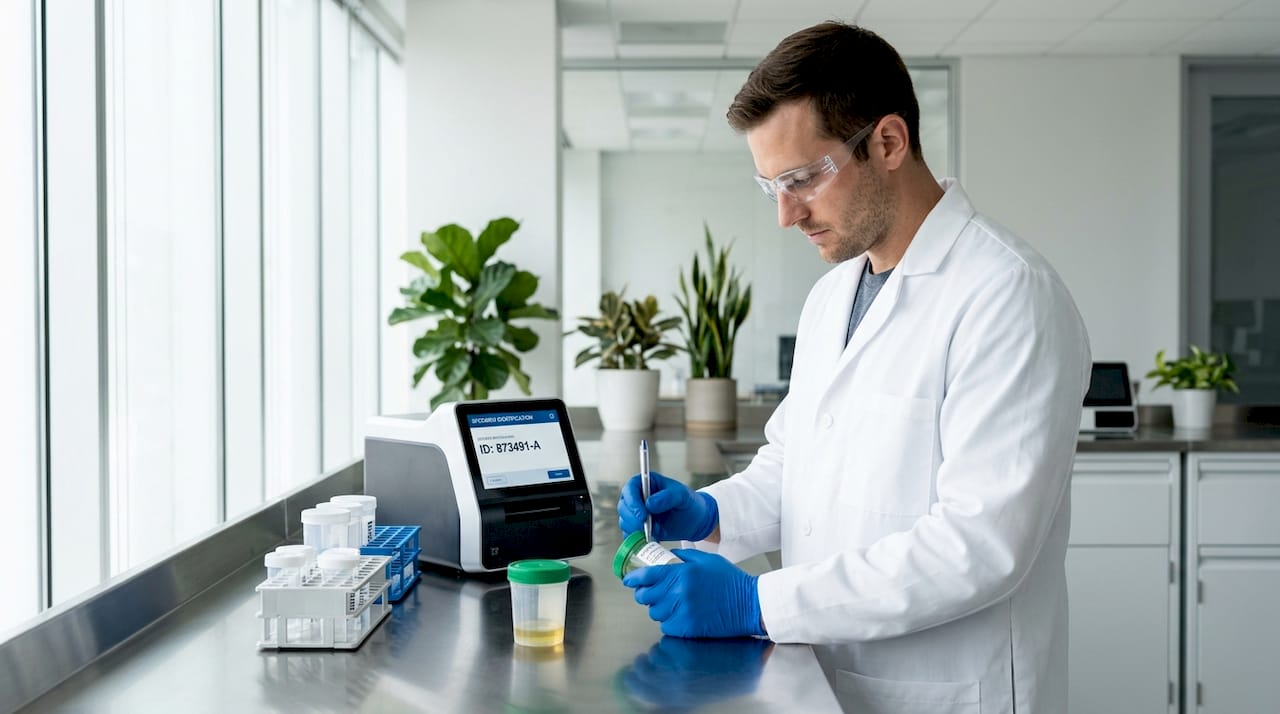
A cutoff level is the minimum concentration of a drug or its metabolite that must be present in a sample for the test to return a positive result. Anything below that threshold is reported as negative, even if trace amounts exist. This is by design. Cutoff levels protect against penalizing employees for incidental environmental exposure or legitimate prescriptions taken at therapeutic doses.
There are two thresholds to understand: the initial screen cutoff and the confirmatory threshold. The SAMHSA standard cutoffs for urine testing are:
| Drug | Screen cutoff (ng/mL) | Confirmatory cutoff (ng/mL) |
|---|---|---|
| Marijuana (THC) | 50 | 15 |
| Cocaine | 150 | 100 |
| Opiates | 2000 | 2000 |
| Amphetamines | 500 | 250 |
| PCP | 25 | 25 |
Notice that the confirmatory cutoffs are often lower than the screening cutoffs. This is intentional: confirmatory tests using mass spectrometry are far more specific and sensitive, so the bar for proof is set higher to catch substances that an immunoassay might have flagged non-specifically.
Detection windows: What they tell you and what they don’t
Detection windows describe how long a drug or its metabolites remain detectable in urine after use. These windows vary significantly between substances and between individuals based on metabolism, body composition, hydration, and frequency of use. Key detection window estimates for urine testing are:
- Marijuana: 2 to 4 days for occasional users; up to 30 or more days for chronic, heavy users
- Cocaine: 1 to 3 days
- Amphetamines: 2 to 4 days
- Opiates: 2 to 4 days
- PCP: 7 to 14 days
A positive marijuana result does not necessarily indicate impairment at the time of testing. A chronic user could test positive days after their last use. Conversely, someone who used cocaine the night before might test negative if tested several days later. HR teams need to communicate these realities clearly when presenting results to management or legal counsel.
Comparing urine vs. mouth swab detection helps clarify which matrix better fits post-accident versus pre-employment scenarios, since oral fluid tests have much shorter detection windows but may indicate more recent use.
Practical do’s and don’ts for HR
- Do require confirmatory testing before taking any adverse employment action.
- Do involve an MRO to review all positives for potential legitimate medical explanations.
- Don’t assume a positive screen is conclusive without GC-MS or LC-MS confirmation.
- Don’t disclose specific drug concentrations to managers—communicate only the final MRO determination.
- Don’t ignore the difference between chronic and occasional use when evaluating detection window context.
Ensuring defensible results: Advances and pitfalls in toxicology testing
To get results you can rely on and protect your organization, your forensic toxicology program needs to be both technically sound and procedurally airtight. Good intentions don’t prevent lawsuits; documented, defensible processes do.
The limits of immunoassay screening
Immunoassay tests are fast, cost-effective, and widely used for initial screens. But they have a meaningful weakness: immunoassays are prone to false positives and false negatives. Cross-reactivity with over-the-counter medications and certain foods can trigger false positives. This is why immunoassay results should never be the basis for employment decisions on their own.
Mass spectrometry confirmation, specifically GC-MS (gas chromatography-mass spectrometry) or LC-MS (liquid chromatography-mass spectrometry), eliminates most of this ambiguity. These methods identify substances by their molecular fingerprint, not by antibody binding, producing results that hold up to legal scrutiny.
Steps to build a defensible program
- Use only certified laboratories. For regulated positions, HHS-certified or SAMHSA-compliant labs are mandatory. For non-regulated programs, ISO or CAP-accredited labs provide equivalent rigor.
- Require MRO review. A licensed Medical Review Officer evaluates all confirmed positives, contacts the employee for a medical explanation, and issues the final determination.
- Collect split samples. Federal programs require the original specimen to be split into two bottles. The employee can request retesting of the second bottle if they dispute the result.
- Maintain chain of custody documentation. Every transfer of the specimen must be logged and verified. A gap in documentation can make results inadmissible.
- Train your collectors. An improperly collected sample can be challenged regardless of how accurate the lab analysis is.
For organizations that want to understand how multi-step screening works in practice, layering initial screens with confirmation testing is the framework that supports both accuracy and compliance. For choosing the right tools at the facility level, reviewing best drug testing kits for your sector can clarify which products align with your protocols.
For employers in safety-sensitive industries, SAMHSA and DOT-compliant programs with certified labs, MRO review, and split samples are the recognized standard for minimizing legal risk and ensuring that results are both accurate and fair.
“The single most costly mistake in workplace drug testing isn’t a false positive—it’s taking action on a false positive without confirmatory evidence. That’s where litigation begins.”
Pro Tip: Every time your organization updates its drug testing policy, review it against the current federal guidelines and your state’s laws simultaneously. State cannabis laws in particular continue to evolve rapidly, and a policy that was compliant two years ago may now expose you to discrimination claims.
Perspective: What HR rarely hears about forensic toxicology
Most workplace drug testing guides focus on the mechanics—what tests to use, which labs to call, what the cutoffs are. But there’s a harder conversation that almost never makes it into policy training, and it’s the one that matters most when things go wrong.
Many HR teams treat drug testing as an administrative checkbox. They select a vendor, hand employees a cup, and assume the results speak for themselves. The reality is that forensic toxicology requires interpretation, not just measurement. A number on a lab report carries context that most HR professionals are never trained to read. Was the sample collected correctly? Did the MRO actually contact the employee? Was the detection window relevant to the incident in question?
The rise of cannabis legalization has made this issue more urgent. An employee in a legal-use state who tests positive for THC metabolites days after off-duty use may have grounds for a legal challenge under state anti-discrimination statutes, especially in states like California, New Jersey, and Minnesota that have enacted employment protections for cannabis users. A rigid, one-size-fits-all policy is increasingly a legal liability, not a safety net.
Post-accident testing is another area where interpretation errors compound quickly. Understanding the principles behind post-accident drug testing reveals how timing, sample type, and chain of custody interact in high-stakes situations. A urine test collected 48 hours after an incident tells you very little about impairment at the time of the incident.
Our perspective: Stop treating drug test results as binary verdicts. Treat them as data points that require qualified interpretation, documented procedures, and legal context. The organizations that do this consistently are the ones that avoid wrongful termination claims, regulatory audits, and reputational damage.
Get started with reliable workplace drug testing solutions
Understanding forensic toxicology is one thing—having the right tools and lab partners to act on that knowledge is another. Now that you understand the essentials, here’s how your organization can act on this knowledge with solutions built for reliable, compliant workplace testing.
CountryWideTesting.com connects employers and HR teams with certified lab testing services that meet SAMHSA, ISO, CLIA, and CAP standards, giving you results that are defensible at every level. Whether you need a validated 12 panel drug test for onsite use or a fully supported federally compliant lab program, the platform makes it simple to access what your program actually needs. For employers building or updating their testing protocols, CountryWideTesting.com provides educational resources, compliance guidance, and direct access to certified testing products in one place.
Frequently asked questions
What biological samples are commonly used in forensic toxicology?
Urine is the most common matrix for workplace testing, but as forensic toxicology principles confirm, blood, hair, and tissue can also be analyzed depending on the legal context and the substance being detected.
What is a SAMHSA 5-panel test?
It’s a standardized urine drug test that screens for amphetamines, cocaine, marijuana, opiates, and PCP. Per federal compliance standards, HHS-certified labs are required to process these specimens for regulated workplace programs.
How long after drug use can urine tests detect substances?
Detection windows vary widely: marijuana is detectable for 2 to 4 days in occasional users and over 30 days in chronic users, cocaine 1 to 3 days, amphetamines and opiates 2 to 4 days, and PCP 7 to 14 days.
Why is lab certification important for workplace testing?
Certified labs follow strict collection, handling, and analysis protocols that produce legally defensible results. HHS-certified labs are a federal requirement for safety-sensitive positions, and skipping certification exposes your organization to results that can be invalidated in a legal proceeding.
How can HR reduce the risk of unfair test results?
Never act on an initial screen positive alone. Immunoassays can produce false positives due to cross-reactivity, so always confirm with GC-MS or LC-MS analysis before making any employment decision.