
Fentanyl Workplace Testing: Route Every Sample Through HHS Certified Labs
Fentanyl is now on the federally authorized drug testing panel, effective July 7, 2025, which means employers who want defensible results need to route every sample through an HHS-certified lab with Medical Review Officer (MRO) review. Rapid test strips can flag a problem on-site, but they confirm nothing on their own. Choosing between urine and oral fluid specimens, updating your written policy, and training supervisors now will put you ahead of the compliance curve rather than scrambling after an incident.
TL;DR:
- Urine testing remains the most established and court-accepted specimen type for fentanyl detection in workplace drug testing, with a detection window of one to three days.
- Starting July 7, 2025, fentanyl must be included in federally authorized drug testing panels, requiring labs to meet specific sensitivity and cross-reactivity standards.
- Rapid test strips are useful for immediate screening but cannot replace lab confirmation through LC-MS/MS testing and MRO review for employment decisions.
- Employers must select HHS-certified labs with confirmed fentanyl and norfentanyl testing capability, and ensure an in-house confirmatory testing process is available.
- A comprehensive testing policy should specify testing circumstances, consent procedures, observable suspicion criteria, and proper chain-of-custody procedures to stay legally defensible.
Table of Contents
- Fentanyl Workplace Testing: Comparing Your Specimen Options
- How Federal Guidance Now Treats Fentanyl Testing
- Vetting a Certified Lab and Understanding the MRO’s Role
- Building a Fentanyl Testing Policy That Holds Up Legally
- From Policy to Practice: The Testing Workflow Employers Should Follow
- Setting a Testing Schedule for Safety-Sensitive Roles
- Keeping Specimens Secure From Collection to Lab
- Getting Supervisors and Employees on the Same Page
- Why Rapid Strips Can’t Replace Lab Confirmation
- An HR Perspective on Getting This Right
- Get Fentanyl-Capable Testing Set Up Through Countrywidetesting
- Sources
- FAQ
Fentanyl Workplace Testing: Comparing Your Specimen Options
Not every specimen type answers the same question, and picking the wrong one for your program’s goal wastes money and creates legal exposure. Urine testing remains the default for federally regulated and most private-sector programs because it has the longest track record and the clearest cutoff standards. Oral fluid is gaining ground fast for observed, harder-to-cheat collections, especially in safety-sensitive industries where speed matters. Hair testing exists but plays a narrow role for fentanyl specifically, since research on hair-based fentanyl detection windows is far less established than for urine or oral fluid.
Here’s how the main options stack up for an employer building or updating a fentanyl workplace testing program:
- Urine testing: Detects recent use over a window of roughly one to three days for fentanyl; requires lab confirmation via LC-MS/MS for legal defensibility; widely accepted by courts and regulators.
- Oral fluid testing: Shorter detection window than urine, but collection is observed and harder to adulterate; increasingly used for post-accident and reasonable-suspicion testing.
- Rapid test strips: Useful for immediate, informal screening or harm-reduction purposes; not a substitute for laboratory confirmation in any employment decision.
- Hair testing: Offers a longer historical detection window but carries more variability and less standardization specifically for fentanyl.
Test strips have a real place in a harm-reduction context, but treating a strip result as grounds for termination is a legal risk employers should avoid without lab confirmation behind it.
How Federal Guidance Now Treats Fentanyl Testing
The regulatory shift here is concrete, not theoretical. HHS and SAMHSA added fentanyl and norfentanyl to the authorized federal workplace testing panels effective July 7, 2025, closing a gap that had left fentanyl outside the formal federal drug-testing framework even as it became one of the most dangerous substances in American workplaces.
By the numbers: HHS-certified labs report initial-test cutoffs in the 0.5 to 2 ng/mL range for fentanyl, with confirmatory testing set at roughly 1 ng/mL, according to Federal Register documentation on the new authorized panels.
That level of sensitivity matters because fentanyl is active at microgram doses, far smaller than substances like cannabis or cocaine. A lab’s immunoassay has to be tuned correctly or it will miss exposures entirely. The Federal Register notice from March 2026 specifies that a fentanyl immunoassay used for initial screening must show at least 5% cross-reactivity to norfentanyl, fentanyl’s primary metabolite. If your current lab vendor can’t confirm that their assay meets this threshold, you don’t have a compliant fentanyl testing program regardless of what the panel checklist says.
Transportation employers have an added layer to watch. The Department of Transportation has proposed adding fentanyl to its own drug-testing panel and is working to harmonize its rules with the HHS guidelines, which means DOT-regulated employers should expect a formal rule change rather than assuming HHS panel inclusion automatically covers them. Until that rulemaking finalizes, DOT-covered employers should confirm with their consortium or lab exactly which analytes are being tested under which authority.
Vetting a Certified Lab and Understanding the MRO’s Role
Your lab selection determines whether a positive result holds up in an unemployment hearing, a wrongful-termination suit, or a workers’ compensation dispute. Run through this checklist before signing with any vendor:
- HHS certification for the specimen types you plan to use (urine and, increasingly, oral fluid).
- CLIA and CAP accreditation, the broader clinical-lab quality standards that sit alongside SAMHSA certification.
- Confirmed fentanyl and norfentanyl capability at published cutoffs, not just a general opioid panel that happens to flag fentanyl incidentally.
- LC-MS/MS confirmatory testing available in-house rather than outsourced to a third lab, which adds delay.
- Published turnaround times and transparent per-test pricing, especially for confirmation testing.
Pro Tip: Ask any prospective lab vendor to show you their fentanyl immunoassay’s cross-reactivity data for norfentanyl in writing. A lab that hesitates to share this is a lab that hasn’t updated its methods for the 2025 panel change.
The MRO is your defensibility backstop. This licensed physician reviews every non-negative result, contacts the employee to rule out a legitimate medical explanation such as a valid fentanyl prescription for pain management, and only then reports a verified positive to the employer. SAMHSA’s employer guidance treats certified labs and MRO review as the two trust anchors of any workplace testing program, and skipping either one turns a routine screening into a liability.
Building a Fentanyl Testing Policy That Holds Up Legally
Private employers have far more flexibility than federally regulated ones, but that flexibility cuts both ways. Without a federal mandate telling you exactly what to do, the burden falls on you to write a policy that’s specific enough to enforce and neutral enough to survive an ADA or discrimination challenge.
A workable fentanyl testing policy needs to spell out:
- The specimen types used and the circumstances triggering each (pre-employment, random, reasonable suspicion, post-accident).
- Consent language and confidentiality protections for test results and medical explanations.
- A clear, objective definition of what qualifies as reasonable suspicion, tied to observable behavior rather than assumptions about a protected medical condition.
- How random selection is generated and documented, particularly for safety-sensitive or DOT-covered roles.
The single biggest legal trap here is reasonable-suspicion testing built on ambiguous symptoms. Slurred speech, drowsiness, or pinpoint pupils can result from fentanyl use, but they can also stem from a disability or a legitimate prescription. SAMHSA’s federal law resources recommend documenting specific, observable behavior and training supervisors to record it consistently, which protects both the employee’s rights and the employer’s position if the decision is challenged. Union environments add another layer. If your workforce is organized, testing changes are often a mandatory bargaining subject, so loop in counsel and labor relations before the policy update goes out, not after.
From Policy to Practice: The Testing Workflow Employers Should Follow
Once your policy is written, the operational sequence matters as much as the paperwork. Here’s the workflow that keeps a fentanyl workplace testing program consistent and defensible from start to finish:
- Before testing: Distribute the written policy, obtain signed consent, and confirm which specimen type applies to the testing event.
- Collection day: Follow strict chain-of-custody procedures. If an on-site rapid strip flags a preliminary positive, treat it as a lead, not a verdict. Hold any disciplinary action until lab confirmation and MRO review are complete.
- After a confirmed positive: The MRO verifies the result and rules out valid medical explanations. Employees in safety-sensitive roles are typically removed from those duties immediately.
- Support and return-to-duty: Refer the employee to your EAP or a Substance Abuse Professional (SAP), document the process, and schedule follow-up testing before any return to safety-sensitive work.
Skipping step 2, and acting on a strip result alone, is the most common way employers turn a good-faith safety measure into a lawsuit.
Setting a Testing Schedule for Safety-Sensitive Roles
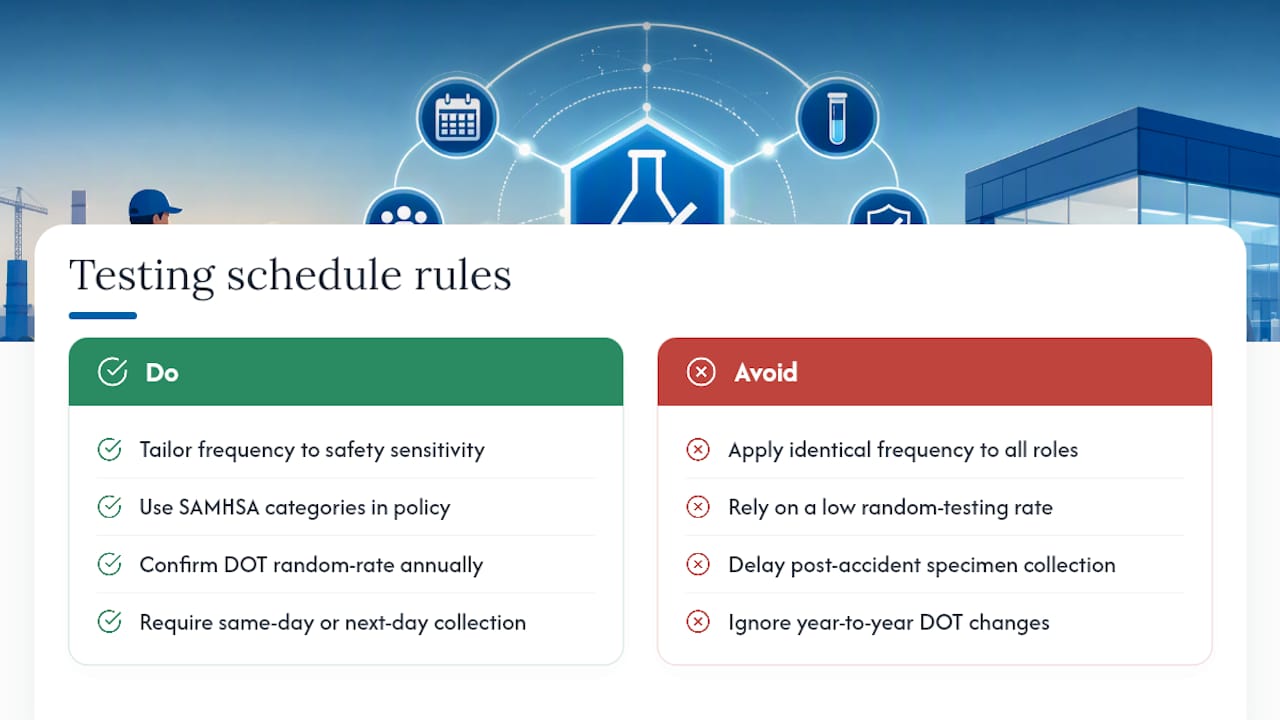
Frequency depends heavily on how safety-sensitive the role is, and there’s no single federal number that applies across every industry. Construction, manufacturing, transportation, and healthcare employers tend to run the fullest testing cycle: pre-employment, random testing throughout the year, post-accident testing after any incident meeting a defined threshold, and reasonable-suspicion testing as needed. SAMHSA’s model drug-free workplace plan outlines these categories, applicant, random, reasonable-suspicion, post-accident, voluntary, and follow-up as the standard structure most comprehensive programs build around.
Random testing rates matter more than most employers realize. A program that tests 10% of the safety-sensitive workforce annually sends a very different signal than one testing 50%, and DOT-regulated positions already carry mandated minimum random-testing percentages that employers should confirm annually since they can shift year to year.
Office and administrative roles with no safety-sensitive function generally don’t need the same testing cadence as a forklift operator or a delivery driver, and applying identical frequency across dissimilar roles can actually weaken your legal position by suggesting the policy isn’t tied to genuine safety risk. Post-accident testing timing deserves special attention too. Fentanyl’s detection window in urine is roughly one to three days, so delays in collection after an incident can mean a true positive gets missed entirely. Building a same-day or next-day collection requirement into your incident-response protocol closes that gap.
Keeping Specimens Secure From Collection to Lab
Chain-of-custody failures are one of the fastest ways a legitimate positive result gets thrown out. Every specimen needs a documented, unbroken path from the moment of collection to the moment a lab technician opens the sealed container.
Standard safeguards include temperature strips on urine specimens to flag dilution attempts, tamper-evident seals initialed by both the collector and the donor, and a locked chain-of-custody form that travels with the sample at every handoff. Oral fluid collections reduce some tampering risk simply because they’re observed directly, but they still require the same documentation trail. Any break in that chain, an unsealed container, a missing signature, a gap in the timeline, gives a challenged result an opening to be dismissed regardless of what the lab reports. Training your collection staff to follow the protocol exactly the same way every single time is more valuable than any single piece of equipment.
Getting Supervisors and Employees on the Same Page
A testing program only works if the people running it and the people subject to it both understand why it exists and how it operates. Supervisor training should cover the specific, observable signs that justify a reasonable-suspicion referral, how to document those observations in real time, and the exact chain of command for initiating a test. Vague guidance like “look for signs of impairment” invites inconsistent, potentially discriminatory decisions.
Employee-facing communication matters just as much. Workers should know, before any testing event, what substances are covered, what specimen types are used, what happens after a positive result, and where to find support through the EAP. Fentanyl’s presence in counterfeit pills and adulterated substances means employees may test positive without knowingly using fentanyl at all, so framing communication around safety and support rather than punishment tends to produce better compliance and less resistance. Regular refreshers, not just a one-time training at policy rollout, keep the program credible as the regulatory landscape shifts.
Why Rapid Strips Can’t Replace Lab Confirmation
Rapid fentanyl test strips are inexpensive, fast, and genuinely useful for immediate screening, but they were designed primarily as a harm-reduction tool for detecting fentanyl contamination in illicit substances, not as an employment-decision instrument. Strips can produce false positives from cross-reactivity with other compounds, and they can’t quantify how much fentanyl is present. A lab running LC-MS/MS confirmatory testing can pinpoint concentration down to nanogram-per-milliliter precision, which is exactly the level of detail an MRO needs to rule out a medical explanation or confirm a genuine violation.
The gap becomes clearest in disputed cases. An employee challenging a termination will have their attorney ask what method produced the positive result, and “a rapid strip used in the parking lot” is a far weaker answer than “an HHS-certified lab confirmed the result via LC-MS/MS, verified by an MRO.” Employers who understand how accurate fentanyl test strips really are tend to use them as an early-warning tool, not a final answer, reserving them for informal safety checks while routing every employment-related decision through certified lab confirmation.
An HR Perspective on Getting This Right
If you take one thing from this guide, make it this: certified lab plus MRO review comes first, always, before anything else in your program gets built out. Pilot the fentanyl panel with a small group of safety-sensitive roles before rolling it out company-wide. Treat test strips as a harm-reduction tool, never a disciplinary trigger. Bring in legal counsel, your EAP provider, and labor representatives before you finalize policy language, not after an employee challenges it. Programs built this way tend to hold up. Programs built backward rarely do.
— Alan
Get Fentanyl-Capable Testing Set Up Through Countrywidetesting
An online provider can offer a direct route to a defensible fentanyl testing program without hunting down separate vendors for kits, lab confirmation, and MRO coordination. Our lab testing services connect employers to labs built around SAMHSA, ISO, CLIA, and CAP standards, so you’re not left guessing whether a vendor’s fentanyl immunoassay actually meets the current cross-reactivity requirements.
For programs that need confirmation-level accuracy on a specific case, the Phamatech Urine Lab Confirmation Mail-In Drug Test and the Phamatech Zero Tolerance SAMHSA Seven Mail In Confirmation Test route samples straight to certified lab review. Orders over $75 ship free with returns included, and support is available 24/7 if you’re not sure which panel fits your industry. If your organization needs a custom panel or a quote for ongoing employer testing, visit Countrywidetesting to request a custom order built around your specific compliance needs.
Sources
Bookmark these primary sources before writing or updating any fentanyl testing policy:
- Frequently Asked Questions (FAQs) and Answers About Federal Workplace Drug Testing | SAMHSA
- Federal Register: HHS publication of authorized testing panels (March 13, 2026)
- Mandatory Guidelines for Federal Workplace Drug Testing Programs – Authorized Testing Panels | Federal Register
FAQ
Is Fentanyl Testing Required for U.S. Employers?
No federal law requires private employers to test for fentanyl, but HHS added it to the authorized federal workplace testing panel effective July 7, 2025, making it available and increasingly expected for safety-sensitive industries.
Can a Fentanyl Test Strip Alone Justify Firing an Employee?
No. Test strips are a preliminary screening tool prone to false positives, and any employment decision should rest on lab confirmation via LC-MS/MS and MRO verification, not a strip result alone.
What’s the Detection Window for Fentanyl in a Urine Test?
Fentanyl is typically detectable in urine for roughly one to three days after use, which is why prompt collection after an accident or suspicion event matters for accurate results.
Does Countrywidetesting Offer Lab-Confirmed Fentanyl Testing for Employers?
Yes. Countrywidetesting’s lab testing services connect employers to certified labs for fentanyl-capable panels and mail-in confirmation testing, and current pricing is available on the site.
How Much Does Adding Fentanyl to a Drug Panel Cost?
Per-specimen costs for adding fentanyl to an existing panel are generally modest, though employers should budget for confirmatory testing and MRO review as part of the total program cost.