
How Accurate Are Fentanyl Test Strips for Compliance Testing?
Accuracy depends entirely on which method you order. Modern immunoassays that detect both fentanyl and its metabolite norfentanyl can reach clinical sensitivity above 98%, but no immunoassay, however good, is legally definitive on its own. Only LC‑MS/MS confirmation separates and quantifies fentanyl and norfentanyl at the molecular level, which is why compliance programs, clinics, and legal cases treat it as the standard for any result that will support a hiring decision, a termination, or a courtroom argument.
If you’re building or auditing a testing program, here’s what to do right now:
- Order a fentanyl-inclusive panel. Standard 5 panel and even many 10 panel screens do not automatically include fentanyl. Confirm it’s on the requisition.
- Specify norfentanyl detection. An assay that only targets parent fentanyl will miss a meaningful share of true positives. The Roche FEN2 study is the clearest evidence of why this matters.
- Request reflex confirmatory testing. Any presumptive positive should automatically trigger LC‑MS/MS or GC‑MS confirmation before anyone acts on it.
- Use a CLIA-certified, CAP-accredited lab. Certification isn’t paperwork. It’s what makes the chain of custody and the result defensible later.
- Route results through a Medical Review Officer. An MRO interprets lab findings in context, which protects both the employer and the individual from a false call.
Key Takeaways
Accurate, legally defensible fentanyl testing requires pairing a norfentanyl-detecting immunoassay screen with LC‑MS/MS confirmation through a certified laboratory.
| Point | Details |
|---|---|
| Screen for norfentanyl, not just fentanyl | Assays like Roche FEN2 hit 98% sensitivity largely because they detect the metabolite, not just the parent drug. |
| Never treat a screen as final | Presumptive positives require reflex LC‑MS/MS or GC‑MS confirmation before any action is taken. |
| Match specimen to purpose | Urine documents exposure windows; oral fluid tracks recent use; blood supports acute or forensic quantitation. |
| Verify lab credentials and cutoffs | Confirm CLIA, CAP, and HHS certification and check that reportable cutoffs match validated LOD/LLOQ. |
| Use Countrywidetesting for the full workflow | Countrywidetesting connects compliance programs to certified labs offering fentanyl/norfentanyl screening, LC‑MS/MS reflex confirmation, and MRO support. |
Table of Contents
- What “Fentanyl Test Strips Accuracy” Actually Means in a Compliance Program
- Understanding Sensitivity, Specificity, and Cutoffs in Fentanyl Testing
- How Do the Major Fentanyl Assays Compare?
- Choosing the Right Specimen: Urine, Oral Fluid, or Blood
- What Causes False Positives and False Negatives
- Building a Defensible Fentanyl Testing Workflow
- What a Confirming Lab Should Be Able to Show You
- Why Screening Alone Isn’t Enough
- How Countrywidetesting Supports Lab-Confirmed Fentanyl Testing
- Frequently Asked Questions About Fentanyl Test Strip Accuracy
- Sources
What “Fentanyl Test Strips Accuracy” Actually Means in a Compliance Program
When employers, clinics, and compliance officers ask about fentanyl test strip reliability, they’re rarely talking about the small paper strips harm-reduction programs use to check street drugs for contamination. In a workplace, clinical, or legal context, “testing for fentanyl accuracy” means something more layered: an initial immunoassay screen, followed by definitive laboratory confirmation, backed by documented method validation. Two very different tools are doing two very different jobs, and conflating them is where most testing programs go wrong.
Immunoassay screening is presumptive. It works by detecting antibody binding between reagents and the drug or its metabolites in a urine, oral fluid, or blood sample. It’s fast, usually delivering results in minutes at the point of care or same-day at a lab, and it’s built to flag likely positives cheaply and at scale. The tradeoff is cross-reactivity: an antibody built to bind fentanyl might not bind norfentanyl efficiently, or it might react to an unrelated compound and throw a false signal.
LC‑MS/MS or GC‑MS confirmation works differently. It physically separates compounds by their chemical properties, then identifies them by their mass signature. This is what gives it molecule-level specificity. Where an immunoassay says “something matching a fentanyl-like antibody profile is present,” a properly validated LC‑MS/MS assay says “this sample contains 1.4 ng/mL of fentanyl and 3.1 ng/mL of norfentanyl,” period.
A presumptive positive on a screen is not a fact you can act on. It’s a signal to escalate: preserve the chain of custody, send the specimen for confirmatory testing, and let the MRO review both results before any employment or legal action happens. CLIA-waived rapid devices have a real place in clinics that need a fast triage answer for immediate patient care, but for anything that could end up in an HR file or a courtroom, send-out testing through a certified lab is the only defensible path.
Pro Tip: If your current drug testing vendor can’t tell you offhand whether their fentanyl screen detects norfentanyl, that’s a red flag worth escalating before you sign another contract.
Understanding Sensitivity, Specificity, and Cutoffs in Fentanyl Testing
Sensitivity and specificity are the two numbers that determine how much you can trust a result. Sensitivity is the percentage of true fentanyl-positive samples the assay correctly flags; specificity is the percentage of true-negative samples it correctly clears. A test with high sensitivity but mediocre specificity will produce more false positives; low sensitivity means real exposures slip through as false negatives.
Cutoffs complicate the picture further. There are three distinct thresholds at play, and vendors don’t always distinguish them clearly:
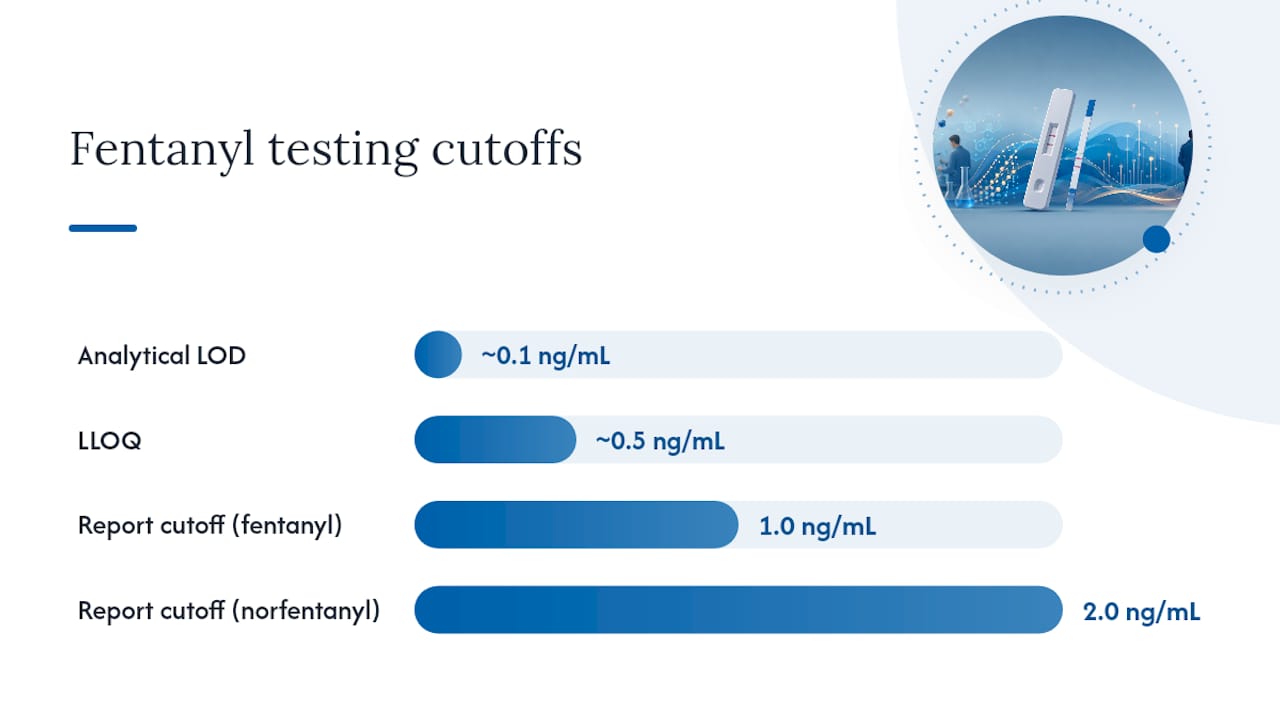
- Limit of Detection (LOD): the lowest concentration the instrument can reliably detect at all, often around 0.1 ng/mL for validated LC‑MS/MS methods.
- Lower Limit of Quantification (LLOQ): the lowest concentration the lab can report as a precise number, typically around 0.5 ng/mL for the same method.
- Reportable cutoff: the threshold a lab actually uses to call a result positive for clinical or workplace purposes, which is a policy decision, not just a chemistry limit.
A lab can be analytically capable of detecting fentanyl well below its reportable cutoff and still choose not to report it, because reporting cutoffs are set to balance sensitivity against the risk of flagging trace-level, clinically insignificant exposure. ARUP Laboratories, for example, lists a fentanyl cutoff of 1.0 ng/mL and a norfentanyl cutoff of 2.0 ng/mL for its quantitative urine test. Raise that cutoff and fewer borderline exposures get reported; lower it and you catch more, but risk more disputes over what counts as meaningful exposure.
| Metric | Example Value | What It Tells You |
|---|---|---|
| Sensitivity | 98% (Roche FEN2) | Percentage of true positives correctly flagged |
| Specificity | 99.5% (Roche FEN2) | Percentage of true negatives correctly cleared |
| Analytical LOD | ~0.1 ng/mL | Lowest concentration the method can detect |
| LLOQ | ~0.5 ng/mL | Lowest concentration reportable as a precise number |
| Reportable cutoff | 1.0 ng/mL (fentanyl), 2.0 ng/mL (norfentanyl) | Policy threshold used to call a result positive |
Pro Tip: Ask your lab whether their reportable cutoff matches the manufacturer’s validated LOD/LLOQ. A mismatch between the two is exactly where positivity rates can swing in ways that are hard to explain later, especially in a legal dispute.
How Do the Major Fentanyl Assays Compare?
The single biggest driver of accuracy across commercial assays is whether they detect norfentanyl, fentanyl’s primary metabolite, alongside parent fentanyl. Assays built only around fentanyl itself tend to miss a meaningful share of true positives, because norfentanyl is often present at higher and more detectable concentrations than the parent drug.
- Roche FEN2 immunoassay. In a 250-sample comparative study, FEN2 achieved 98% clinical sensitivity and 99.5% specificity, a dramatic improvement over an older DRI assay that managed only 61% sensitivity at the same specificity. Researchers attributed the jump directly to FEN2’s ability to detect norfentanyl.
- ARK Fentanyl II assay. Evaluated alongside other laboratory immunoassays, ARK Fentanyl II performed favorably against a CLIA-waived rapid device in a 142-sample study, reinforcing that lab-based immunoassays with norfentanyl coverage outperform point-of-care strips on both sensitivity and specificity.
- Immunalysis SEFRIA Fentanyl assay. In the same evaluation, SEFRIA showed higher sensitivity and specificity than the rapid point-of-care device it was compared against, consistent with the pattern that lab-processed immunoassays with broader metabolite coverage catch more true positives.
- Rapid Drug Test Device (CLIA Waived, Inc.). The RDTD delivered fast, point-of-care results but landed at 84.3% sensitivity and 87.5% specificity against the two lab assays and mass spectrometry, meaningfully lower on both measures.
For workplace and clinical screening programs, that gap matters. A device that misses roughly 15% of true positives is not a device you want anchoring a termination decision or a legal record. Assays that detect norfentanyl should be the default for any initial screen feeding into a compliance program, with CLIA-waived strips reserved for situations where speed matters more than legal defensibility, such as immediate clinical triage.
Choosing the Right Specimen: Urine, Oral Fluid, or Blood
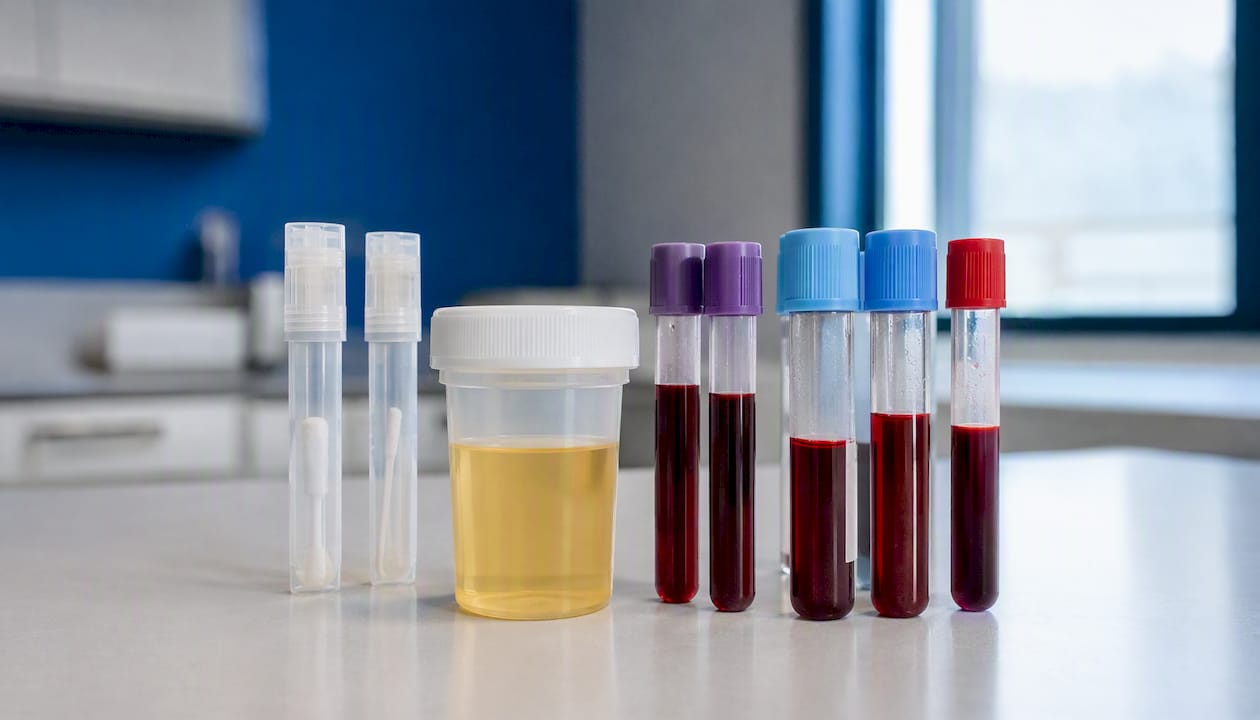
The specimen you collect shapes what the result can actually tell you. Urine, oral fluid, and blood each answer a different question, and picking the wrong one is a common, avoidable mistake in compliance testing.
- Urine offers the longest detection window for fentanyl and norfentanyl, making it the standard choice when the goal is documenting prior exposure over a period of days rather than pinpointing recent use.
- Oral fluid has a shorter detection window and correlates more closely with recent use, which makes it useful when the question is closer to current impairment rather than historical exposure.
- Blood offers precise quantitation and is the matrix of choice in forensic and acute clinical settings where the concentration at a specific moment in time matters, such as suspected overdose management.
Because norfentanyl typically appears at higher concentrations than parent fentanyl in urine, its presence or absence changes how a result should be read. A urine sample positive for norfentanyl but low or negative for fentanyl still indicates exposure. The American College of Medical Toxicology is explicit on this point: a standard drug panel coming back negative does not rule out fentanyl exposure, and clinicians shouldn’t wait for confirmation before managing a suspected overdose.
For HR documentation, urine with reflex confirmation is usually the right call. For clinical triage where speed matters more than a multi-day window, oral fluid or point-of-care urine screening fits better, provided any actionable result gets confirmed.
What Causes False Positives and False Negatives
Interferences, analogue diversity, and metabolite blind spots are the three main reasons a fentanyl result can mislead you. None of them are exotic edge cases. They show up regularly enough that any compliance program needs a policy for handling them.
- Ketamine has been documented to interfere with the norfentanyl-d5 internal standard used in some LC‑MS/MS methods, which can distort quantitation if the lab’s protocol doesn’t account for it.
- Assays with narrow cross-reactivity profiles can miss structurally novel fentanyl analogues entirely, since the antibody was never designed to bind that specific molecule.
- An immunoassay built around parent fentanyl alone, without norfentanyl coverage, systematically undercounts true positives, as the FEN2 versus DRI comparison demonstrates.
Fentanyl analogue diversity is the deeper problem here. According to UNODC’s recommended identification methods, immunoassays are suitable for initial screening but routinely miss analogues that don’t closely resemble the antibody’s target compound. Only chromatographic and mass spectrometric methods, including GC‑MS, LC‑MS/MS, and LC‑HRMS, reliably identify the wider analogue landscape.
A negative immunoassay screen should never be treated as proof of no exposure when a fentanyl analogue is suspected. The molecule has to structurally match what the antibody was built to catch, and dozens of analogues simply don’t.
Relying on a CLIA-waived rapid device alone for disciplinary action or legal proceedings is a genuine liability. With sensitivity around 84% in published evaluation, roughly one in six true positives could be missed, and that’s before accounting for analogue blind spots. Confirmatory testing and MRO review exist precisely to catch what point-of-care devices can’t.
Building a Defensible Fentanyl Testing Workflow
A testing result only protects you if the process behind it can survive scrutiny. That means pairing every presumptive screen with confirmatory testing, running it through a certified lab, and documenting the chain of custody from collection to report.
- Select the right specimen matrix based on your objective: urine for a documented exposure window, oral fluid for recent use, blood for acute or forensic quantitation.
- Specify a fentanyl-inclusive panel on the requisition. Don’t assume a standard multi-panel screen includes it. Reviewing the differences between a 5 panel and a 10 panel test will show you exactly where fentanyl coverage tends to get dropped.
- Require norfentanyl detection on the immunoassay screen itself, per the evidence from the FEN2 comparison.
- Set and document your cutoffs. Confirm the lab’s reportable cutoff aligns with a validated LOD/LLOQ rather than an arbitrary internal threshold.
- Use a certified lab. Confirm CLIA, CAP, and, where applicable, HHS certification before you sign a contract. Reviewing current lab certification standards is a reasonable first step.
- Maintain chain of custody on every specimen, from collection kit through final report.
- Reflex to LC‑MS/MS confirmation automatically on any presumptive positive before anyone acts on it.
- Route the confirmed result through an MRO for interpretation, especially where legitimate prescription use could explain a positive.
- Retain full documentation, including the lab’s SOP reference, cutoffs used, and MRO notes, in case the result is ever challenged.
Pro Tip: When you fill out a lab requisition, write it exactly like this: “Fentanyl and norfentanyl screen, reflex to LC‑MS/MS confirmation, report quantitative cutoffs.” That single line prevents most of the ambiguity that causes disputes later.
What a Confirming Lab Should Be Able to Show You
A results printout that says “confirmed positive” means little without the validation behind it. Any lab running LC‑MS/MS confirmation for fentanyl should be able to produce documentation covering method validation, run controls, and reporting rules, not just a final number.
- Calibrators and internal standards used to validate each analytical run.
- At least one negative control and three positive controls per batch, per the Washington State Patrol’s published SOP.
- Controls making up at least 10% of the extracted batch.
- Ion ratio and retention time tolerances used to confirm compound identity.
- Documented LOD, LLOQ, and dynamic range for the specific method in use.
That same SOP reports a method LOD around 0.1 ng/mL and an LLOQ near 0.5 ng/mL, with results below the LLOQ reported qualitatively rather than as a precise number, and quantitative results typically truncated to two significant figures. These aren’t arbitrary numbers. They’re the difference between a result that holds up under legal challenge and one that gets thrown out for lacking a documented chain of scientific validation. LC‑MS/MS’s molecular-level specificity is also what labs use to validate new immunoassays before deploying them clinically, which is worth asking about if your vendor recently switched screening platforms.
Before accepting a lab’s services, request their method SOP reference, stated LOD/LLOQ, reportable cutoff, a sample chain-of-custody form, and a description of how their MRO interprets borderline or unexpected results.
Why Screening Alone Isn’t Enough
Compliance testing exists because a decision, employment, legal, or clinical, is going to be made based on the result. That raises the bar considerably above what harm-reduction testing needs to accomplish. A community test just needs to flag danger fast. A workplace or legal test needs to survive a challenge from an attorney, a grievance process, or a licensing board months after the sample was collected.
That’s the lens compliance officers should apply to every vendor claim about accuracy. A 98% sensitivity figure sounds reassuring until you ask what it’s compared against, what specimen matrix it was tested on, and whether the study population resembles your own testing pool. The Roche FEN2 data holds up because it was measured against a known assay in a defined sample size with transparent methodology, not because a marketing sheet says “highly accurate.”
The uncomfortable truth is that most testing programs still default to whatever panel their vendor sold them five years ago, often without fentanyl coverage at all, let alone norfentanyl detection. Updating a panel takes one conversation with your lab. Explaining to an arbitrator why your program missed a documented exposure takes a lot longer, and it doesn’t always end well. Treat confirmatory testing as the baseline requirement it is, not an upgrade you add after something goes wrong.
How Countrywidetesting Supports Lab-Confirmed Fentanyl Testing
Building a defensible fentanyl testing program shouldn’t require chasing down three separate vendors for collection kits, lab send-outs, and MRO review. Countrywidetesting connects employers, clinics, and legal/compliance teams directly to certified laboratories that support fentanyl and norfentanyl screening with reflex to LC‑MS/MS confirmation, so your results hold up when they’re challenged.
Countrywidetesting’s lab testing services cover the full workflow: send-out ordering to CLIA and CAP certified labs, chain-of-custody collection kits, configurable cutoffs and reporting formats, and MRO support for interpreting results before they land in an HR file or a legal record. For specimen collection, partner options like multi-drug test cups that include fentanyl coverage integrate cleanly into that same chain-of-custody process. If your current panel doesn’t specify norfentanyl detection or reflex confirmation, that’s worth fixing before your next testing cycle, not after a disputed result. Request a custom lab requisition through Countrywidetesting to get your program aligned with current fentanyl testing standards.
Frequently Asked Questions About Fentanyl Test Strip Accuracy
How accurate are fentanyl test strips used in compliance and clinical settings? Accuracy depends on the assay. Lab immunoassays that detect norfentanyl, like Roche FEN2, report sensitivity around 98% and specificity near 99.5%.
What’s the difference between fentanyl strip sensitivity and specificity? Sensitivity measures how well the test catches true positives; specificity measures how well it clears true negatives. A test can be strong on one and weaker on the other, so both figures matter when you’re evaluating a lab report or vendor claim.
Why does norfentanyl detection matter for testing accuracy? Norfentanyl is fentanyl’s primary metabolite and is often present at higher, more detectable concentrations than the parent drug. Assays that miss norfentanyl systematically undercount true fentanyl exposure.
Can a negative fentanyl screen rule out exposure? No. The American College of Medical Toxicology explicitly states that a negative standard panel does not rule out fentanyl exposure, particularly with analogue variants that immunoassays weren’t built to detect.
What should a compliance program request from its testing lab? Request a fentanyl and norfentanyl screen with reflex to LC‑MS/MS confirmation, documented cutoffs, CLIA/CAP certification, a chain-of-custody form, and MRO review of any positive result before it’s used in a decision.
This article is general information, not a substitute for advice from a qualified doctor. Consult a qualified healthcare professional about your own circumstances before acting on anything here.
Sources
- Evaluating the performance of the Roche FEN2 fentanyl immunoassay and its clinical implementation: The role of LDT-based mass spectrometry testing - PMC
- CONFIRMATION OF FENTANYL AND NORFENTANYL BY LIQUID CHROMATOGRAPHY-TANDEM MASS SPECTROMETRY (Washington State Patrol SOP) - 04/24/2021
- Evaluation of a Rapid Drug Test Device for Urine Fentanyl Compared to Mass Spectrometry and 2 Urine Fentanyl Assays (JALM, 2024-06-13)