
FAA Drug Testing Requirements: A 2026 Employer's Guide
If you employ anyone in a safety-sensitive aviation role, you must run a drug and alcohol testing program under 14 CFR part 120 and the DOT procedures in 49 CFR part 40, and that program has to be operating before those employees ever start safety-sensitive duties. That’s the whole rule in one sentence. Everything else is implementation detail, and the details are where employers get tripped up.
Three things need to happen immediately if you haven’t already handled them:
- Add every covered employee to your random testing pool the moment they’re hired or transferred into a safety-sensitive role.
- Confirm you hold the correct Operations Specification, Letter of Authorization, or program registration with the FAA before anyone begins covered work.
- Use only HHS-certified laboratories for every specimen you collect. Non-certified labs void the results and expose you to a finding during inspection.
The FAA Drug Abatement Division enforces the aviation-specific rules, DOT’s Office of Drug and Alcohol Policy and Compliance sets the government-wide testing procedures every mode of transportation follows, and HHS/SAMHSA certifies the labs that actually process your samples. All three have to line up for your program to hold up under scrutiny.
Pro Tip: Keep a single binder, digital or physical, that maps each regulatory citation to the exact policy or SOP that satisfies it. Inspectors move faster through a program that shows its work.
Key Takeaways
FAA-regulated employers must maintain a documented drug and alcohol testing program under 14 CFR part 120 and 49 CFR part 40, using HHS-certified labs, before any safety-sensitive employee begins work.
| Point | Details |
|---|---|
| Coverage starts at hire | Add employees to the random pool the day they begin safety-sensitive duty. |
| Registration comes first | Secure your A449, A049, or program registration before operations begin. |
| Five-panel standard applies | DOT testing covers THC, cocaine, amphetamines, opioids, and PCP through HHS-certified labs. |
| Documentation wins inspections | Written policies, selection logs, and service-agent records matter more than a clean history alone. |
| Countrywidetesting supports compliance | Offers HHS-certified lab testing services and screening products aligned with FAA program requirements. |
Table of Contents
- Who Falls Under FAA Drug Testing Requirements?
- What Regulations Govern FAA Drug and Alcohol Testing?
- What Types of Drug Tests Does FAA Require?
- What Substances Are Tested and Which Labs Are Certified?
- Who Handles What: MRO, SAP, and Service Agent Roles
- How Do You Register and Set Up an FAA Testing Program?
- How Does Random Testing and Pool Management Work?
- What Happens After a Positive Test or Refusal?
- What Records Must Employers Keep for FAA Inspections?
- What’s the Fastest Path to Full Compliance?
- An Editorial Take on What Actually Keeps Programs Compliant
- Getting Your Testing Program Set Up With the Right Partners
- Frequently Asked Questions
- Sources
Who Falls Under FAA Drug Testing Requirements?
Coverage isn’t limited to pilots. Under §120.105 and §120.215, the safety-sensitive category includes flightcrew members, flight attendants, flight instructors, aircraft dispatchers, maintenance and preventive maintenance personnel, ground security coordinators, aviation screeners, and air traffic controllers not employed by the FAA itself. Part 145 repair station employees performing maintenance functions fall in too, and depending on your operation, certain part 135 personnel working with unmanned aircraft systems may qualify as well.
Contractors and subcontractors are not exempt. If a contract mechanic or a staffing-agency dispatcher performs safety-sensitive work for a part 121, part 135, or 91.147 operator, that person needs to be in a compliant testing program, whether it’s yours or the contractor’s own registered program.
A few practical points worth locking into your onboarding process:
- Add new hires and internal transfers to the random pool on their first day in a covered role, not at the next quarterly cycle.
- Verify a contractor’s program coverage in writing before their personnel touch safety-sensitive work, not after.
- Keep documentation of that verification. If a contractor’s coverage lapses, the liability doesn’t automatically transfer away from you.
Pro Tip: Before signing any maintenance or ground-handling contract, ask the vendor for proof of their A449, A049, or program registration. A verbal assurance won’t hold up in an FAA file review.
What Regulations Govern FAA Drug and Alcohol Testing?
Two documents form the backbone of every FAA drug testing requirement: 14 CFR part 120, which is FAA’s own binding rule, and 49 CFR part 40, the DOT-wide procedural rule that part 120 incorporates by reference. Part 120 tells you who is covered and what’s required; part 40 tells you exactly how collections, lab testing, and MRO verification have to be conducted.
Beyond the regulatory text, the FAA publishes Advisory Circular AC 120-126A, which walks through the entire process of establishing and running a compliant program. It’s guidance, not law, but inspectors use it as the working playbook, so treat it as close to mandatory in practice.
Here’s the reading order that actually saves time:
- Start with 14 CFR part 120 to confirm your coverage obligations.
- Read 49 CFR part 40 for the procedural mechanics of collection, testing, and verification.
- Use AC 120-126A as your implementation manual.
- Check the FAA’s Industry Drug and Alcohol Testing Program page for current forms and contact information.
Pro Tip: Bookmark the eCFR version of part 120 rather than a PDF copy. Amendments happen, and a static PDF can quietly go out of date.
| Document | What It Governs |
|---|---|
| 14 CFR Part 120 | FAA scope, covered employees, employer duties |
| 49 CFR Part 40 | DOT-wide collection and lab procedures |
| AC 120-126A | Step-by-step program setup guidance |
What Types of Drug Tests Does FAA Require?
FAA mandates six distinct testing circumstances, and each one has a different trigger.
- Pre-employment. A verified negative result is required before an individual performs any safety-sensitive function for the first time.
- Random. Employees are selected without notice throughout the year, based purely on a scientifically valid random method.
- Post-accident. Testing follows specific accident or incident thresholds and has to happen within tight timeframes after the event.
- Reasonable suspicion. A trained supervisor observes specific, documented behavior suggesting impairment and orders a test.
- Return-to-duty. Required before an employee who violated the drug or alcohol rule resumes safety-sensitive work.
- Follow-up. Unannounced testing continues for a set period after an employee returns to duty.
Sequencing matters here. A new hire needs a verified negative pre-employment result before day one on the job, and if more than 180 days pass between that verified negative and the actual start date, the test expires and a new one is required. Once someone is working, they enter the random pool immediately. Post-accident testing has to happen fast, generally within hours, or the window closes and the data point is lost. Return-to-duty and follow-up testing only apply after a violation, and they run on a schedule set by the Substance Abuse Professional, not the employer.
Pro Tip: Build a simple tracking sheet with the 180-day countdown built in for every pending hire. It’s the single most common documentation gap FAA inspectors flag.
What Substances Are Tested and Which Labs Are Certified?
DOT’s authorized panel screens for five drug classes: marijuana metabolites (THC), cocaine, amphetamines, opioids, and phencyclidine (PCP), with the opioid category covering both natural and semi-synthetic compounds. This is the standard federal five-panel, and it applies uniformly across aviation, trucking, rail, and transit employers under DOT jurisdiction.
Every confirmatory test has to run through an HHS-certified laboratory under the National Laboratory Certification Program. A lab that isn’t certified cannot legally process a DOT specimen, no matter how reputable it looks on paper. SAMHSA sets the specific cutoff levels: for THC metabolite (THCA), the initial screening cutoff is 50 nanograms per milliliter, with confirmation at 15 ng/mL if the initial screen comes back positive.
A 2026 Federal Register notice from HHS confirmed that the authorized panels and reporting nomenclature remain unchanged for both urine and oral fluid testing, so employers running programs built around the current five-panel standard don’t need to rebuild anything this year. Employers considering saliva-based collection for non-DOT screening purposes can review options like the QuickScreen 5 Panel Saliva Drug Test, though DOT-regulated testing still runs through certified urine collection until oral fluid rules are formally operational for aviation.
Who Handles What: MRO, SAP, and Service Agent Roles
Your program runs on a handful of specialized roles, and understanding each one prevents costly missteps.
The Medical Review Officer reviews every non-negative lab result before it ever reaches you. The MRO contacts the employee directly, checks for a legitimate medical explanation like a valid prescription, and only reports a verified positive to the employer once that review is complete. A lab-confirmed positive doesn’t automatically end someone’s career; the MRO process exists specifically to catch legitimate medical explanations before consequences kick in.

The Substance Abuse Professional evaluates any employee who tests positive or refuses a test, recommends education or treatment, and determines when and how often follow-up testing occurs.
Beyond those two, your program likely relies on a Consortium/Third-Party Administrator (C/TPA) to manage logistics, trained collectors and breath alcohol technicians (BATs) to conduct specimen collection, and the certified laboratory itself. Here’s the part employers underestimate: you remain legally responsible for the actions of every one of these service agents under §§120.103© and 120.203©. If your C/TPA botches a chain-of-custody form, that’s your finding, not theirs.
Pro Tip: Ask any prospective service agent for their FAA program experience specifically, not just general DOT experience. Aviation has quirks the trucking-focused vendors sometimes miss.
How Do You Register and Set Up an FAA Testing Program?
Setting up a compliant program follows a defined sequence, and skipping steps is what generates violations later.
- Determine your coverage obligations under §120.105 and §120.215 based on your operational certificate type.
- Choose your registration path: an A449 operations specification for part 121 or 135 operators and electing part 145 repair stations, an A049 Letter of Authorization for air tour operators under part 91.147, or program registration directly with the Drug Abatement Division for other covered entities.
- Contact your FAA Principal Operations Inspector or local FSDO to initiate the paperwork.
- Secure your operations specification, LOA, or registration confirmation before any covered employee performs safety-sensitive duties.
- Select and vet your service agents: C/TPA, collection sites, MRO, and laboratory.
- Finalize written policies and distribute employee notices.
Timing is not flexible. Per §§120.117 and 120.225, the program must be functioning, not just paperwork-approved, before safety-sensitive operations begin.
Your written documentation package should include:
- Signed employee consent and notification forms.
- A written policy describing all six testing types and consequences.
- Random selection procedures with an audit trail.
- Chain-of-custody SOPs for collection staff.
- A record-retention schedule matching FAA requirements.
Pro Tip: Have your FSDO contact review your draft policy before finalizing it. A quick informal check catches wording problems before they become inspection findings.
| Step | What It Requires |
|---|---|
| Coverage check | Confirm which roles trigger §120.105/120.215 |
| Registration | Obtain A449, A049, or program registration |
| Service agents | Vet C/TPA, MRO, collectors, and lab |
| Documentation | Written policy, notices, SOPs, retention plan |
How Does Random Testing and Pool Management Work?
Random selection has to give every covered employee an equal chance of being tested, using a method that can’t be predicted or manipulated. Employees enter the pool the day they start safety-sensitive work, not at some later administrative checkpoint, and if someone works under multiple DOT-regulated positions, they still need to be represented proportionally across applicable testing pools.
The FAA Administrator publishes the minimum annual random testing percentage each year, and historically that rate has run around 50% for drug testing, though employers should confirm the current year’s published rate rather than assuming it holds steady. Your program has to meet or exceed whatever percentage applies for that testing period.
Extended absences create a gray area worth planning for. FAA doesn’t mandate automatic re-testing for employees who’ve been out of the pool more than 60 days, but building that re-test into your own policy is a reasonable safeguard many employers adopt to maintain consistent safety standards.
Pro Tip: Have your C/TPA generate a quarterly random selection audit report. It’s the fastest way to catch pool errors before an inspector does.
What Happens After a Positive Test or Refusal?
A verified positive result triggers a specific, non-negotiable sequence. The employee comes off safety-sensitive duty immediately. The employer documents the removal, and the employee is referred to a SAP for formal evaluation.
The process runs like this:
- MRO verifies the result and documents any medical review outcome.
- Employer removes the employee from safety-sensitive functions immediately.
- SAP conducts a face-to-face evaluation and recommends education or treatment.
- Employee completes the recommended program.
- Employee passes a verified negative return-to-duty test.
- Employer schedules unannounced follow-up testing.
Follow-up testing isn’t a formality. Employees must undergo a minimum of six unannounced tests in the first 12 months back on duty, and the SAP can extend that schedule up to five years depending on the case.
Employers need a checklist here too: document the removal date, retain SAP correspondence, confirm the return-to-duty test result with the MRO, and log every follow-up test as it happens. Missing even one follow-up test is a compliance gap an inspector will find.
What Records Must Employers Keep for FAA Inspections?
Recordkeeping is where a technically sound program can still fail an inspection if the paper trail doesn’t exist. Keep testing records, random selection logs, MRO verification documents, and SAP evaluation records, all retained for the periods specified under 49 CFR part 40 and part 120.
Certain events require reporting to the FAA, and the agency also maintains a voluntary disclosure process for employers who identify and self-correct compliance gaps before an inspection catches them. That’s worth knowing, because FAA guidance repeatedly emphasizes that a functional, documented program matters more to inspectors than a perfect track record.
When an inspector arrives, virtually or on-site, expect them to review:
- Your written policy and employee notices.
- Proof of your A449, A049, or program registration.
- Random selection logs and selection methodology.
- C/TPA and service agent records.
- Evidence of corrective action for any past findings.
Pro Tip: Run a mock inspection internally once a year using the same document checklist an FAA inspector would use. It surfaces gaps while you still have time to fix them.
| Record Type | Retention Focus |
|---|---|
| Testing results | MRO-verified outcomes, all test types |
| Selection logs | Proof of random, equal-chance methodology |
| SAP/return-to-duty files | Evaluation, education, follow-up schedule |
What’s the Fastest Path to Full Compliance?
Here’s a prioritized checklist that covers the ground most employers miss:
- Confirm your A449, A049, or program registration status is current.
- Update your written policy to reflect all six testing types and current consequences.
- Verify every service agent’s qualifications and HHS-lab relationships in writing.
- Schedule your annual random selection cycle with your C/TPA.
- Train supervisors on reasonable-suspicion documentation and behavior indicators.
- Audit your pre-employment testing files for any 180-day expirations.
The mistakes that show up most often in FAA findings are predictable:
- Choosing a service agent purely on price, without confirming their regulatory track record.
- Letting a pre-employment test lapse past 180 days before the employee actually starts.
- Weak or missing documentation of the random selection methodology.
- Misunderstanding SAP and MRO timelines, particularly around when an employee can legally return to safety-sensitive duty.
Pro Tip: Print a one-page version of this checklist and post it where your HR and safety teams both see it. Compliance breaks down most often at the handoff between departments.
An Editorial Take on What Actually Keeps Programs Compliant
Most FAA violations don’t come from employers ignoring the rules. They come from employers who understood the rules once, built a program around them, and then let the documentation drift while the regulation stayed still. The gap between “we have a testing program” and “we can prove our testing program works” is where inspectors spend their time, and it’s the gap most compliance officers underestimate.
The employers who stay clean aren’t necessarily the ones with the biggest compliance budgets. They’re the ones who treat vendor vetting as an ongoing task, not a one-time signature, and who retrain supervisors on reasonable-suspicion indicators every year instead of once at hire. Documentation habits, not dramatic overhauls, are what separate a program that passes inspection from one that doesn’t.
Getting Your Testing Program Set Up With the Right Partners
Running a compliant program depends on lab relationships you can actually verify, and that’s where Countrywidetesting fits into your operation. Rather than chasing down separate vendors for collection kits, lab processing, and HHS certification paperwork, you get access to certified laboratory testing built around the same five-panel standard your FAA program requires, plus documentation resources that make audit prep less of a scramble.
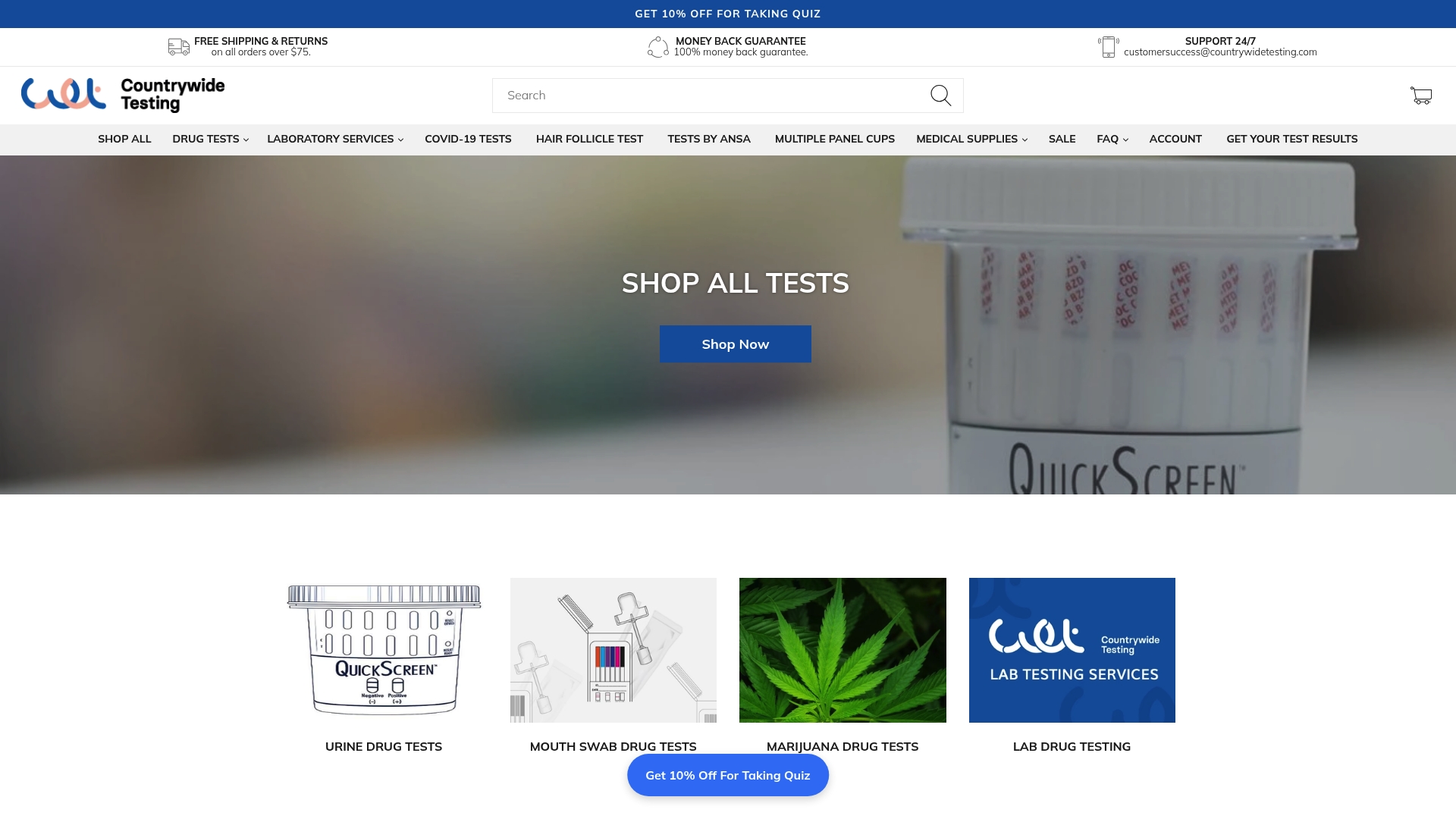
Countrywidetesting works with HHS-certified labs for confirmatory testing, offers laboratory drug testing services suited to employer compliance programs, and stocks a range of on-site screening options if you need supplemental testing beyond your DOT-mandated panel. One caveat worth stating plainly: no vendor relationship removes your legal responsibility as the employer. You still have to verify that every service agent, lab included, meets FAA and HHS certification standards before you rely on their results. If you’re ready to line up compliant lab testing for your program, start by reviewing the lab testing services page and requesting a quote for your employee volume.
Frequently Asked Questions
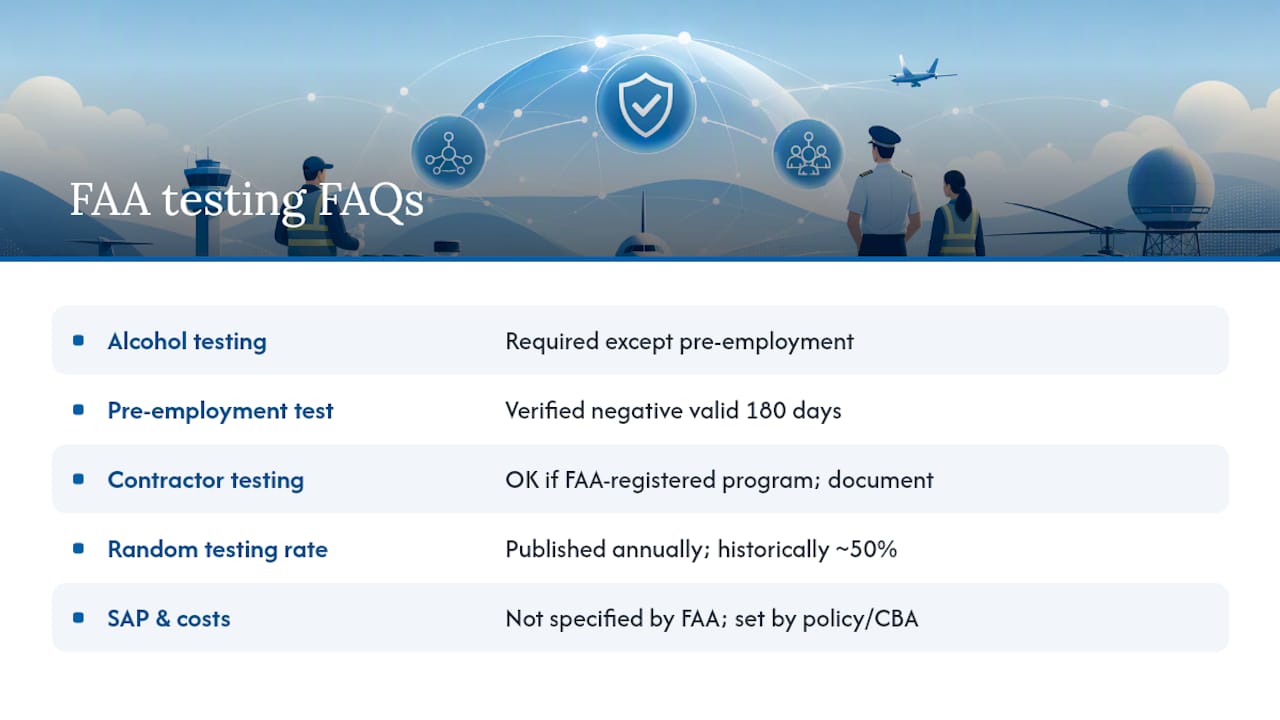
Does FAA require alcohol testing in addition to drug testing? Yes, for random, post-accident, reasonable-suspicion, and return-to-duty circumstances. Pre-employment alcohol testing isn’t required by FAA, though employers who choose to include it must apply it consistently to avoid discrimination claims.
How long is a pre-employment drug test valid before an employee starts work? A verified negative pre-employment result is valid for 180 days. If more than 180 days pass before the employee begins safety-sensitive duty, a new test is required.
Can a contractor’s own testing program satisfy FAA requirements for work performed at my company? Yes, if the contractor maintains a valid FAA-registered program covering the safety-sensitive functions their personnel perform. Verify and document that coverage before their staff begin work.
What’s the minimum random testing rate employers must meet? The FAA Administrator publishes the minimum annual percentage each year, historically around 50% for drug testing. Confirm the current year’s published rate rather than assuming it stays fixed.
Who pays for SAP evaluations and follow-up testing after a positive result? FAA regulations don’t dictate cost allocation between employer and employee for SAP services, so this is typically addressed in company policy or a collective bargaining agreement. Follow-up testing costs are generally treated the same as other employer-mandated testing.
This article is general information, not a substitute for advice from a qualified lawyer. Consult a qualified legal professional about your own circumstances before acting on anything here.
Sources
- DOT 5 Panel Notice
- How do I establish a federal drug and alcohol testing program to comply with FAA’s regulation? | Federal Aviation Administration
- eCFR / 14 CFR Part 120 (CFR PDF)