
Aviation Alcohol Screening Guide for Employers in 2026
TL;DR:
- FAA regulations require alcohol testing for safety-sensitive aviation employees with strict BAC limits and waiting periods. Employers must establish FAA-registered programs, conduct multiple testing types, and maintain accurate records to ensure compliance. Common mistakes include overrelying on the 8-hour rule and neglecting contractor testing responsibilities.
Aviation alcohol screening is defined as the structured process of testing safety-sensitive aviation employees for alcohol impairment under federal regulations, primarily 14 CFR Part 120 and Part 91.17. The FAA sets a hard 0.04 BAC threshold and requires a minimum 8-hour waiting period before any crewmember performs flight duties. These rules are not suggestions. Violating either standard triggers immediate removal from safety-sensitive functions and a formal return-to-duty process. This aviation alcohol screening guide covers who must be tested, what types of testing the FAA requires, how to build a compliant program, and where most employers go wrong.
What is an aviation alcohol screening guide and why does it matter?
Every FAA-regulated aviation employer must run a formal alcohol testing program under 14 CFR Part 120. The regulation applies to certificate holders operating under Parts 121, 135, and 145, as well as air traffic control facilities not operated by the FAA. Failing to maintain a compliant program is not just a regulatory risk. FAA audit failures primarily occur due to missing random testing benchmarks and inadequate recordkeeping, not test methodology issues. That means most compliance breakdowns are administrative, and entirely preventable.
The 8-hour bottle-to-throttle rule under Part 91.17 sets the minimum waiting period between consuming alcohol and performing crewmember duties. The 0.04 BAC limit is the legal cutoff for a confirmed violation. Both standards work together to define the outer boundary of acceptable behavior, but they do not guarantee fitness for duty on their own.
Who must participate in FAA alcohol testing programs?
The FAA defines “safety-sensitive functions” broadly. Any employee who performs one of the following roles must be included in a compliant alcohol testing program:
- Flight crewmembers (pilots and co-pilots operating under Part 121 or 135)
- Flight attendants performing in-flight duties
- Aircraft dispatchers who release flights
- Aircraft maintenance and preventive maintenance technicians
- Ground security coordinators with direct security responsibilities
- Air traffic controllers at non-FAA facilities
The distinction between certificate holders and contractors matters here. If a contractor performs safety-sensitive functions for a Part 121 or 135 operator, that contractor must either be covered by the operator’s testing program or maintain their own FAA-compliant program. Small operators and contractors frequently miss this requirement. Private operators flying under Part 91 are subject to the bottle-to-throttle and BAC rules personally, but they are not required to run a formal employer testing program unless they employ safety-sensitive workers under a certificate.
Understanding your workforce structure is the first step in building a program that covers everyone it should. An employer who assumes all contractors are self-managing their compliance is taking on significant audit risk.
What types of alcohol testing does the FAA require?
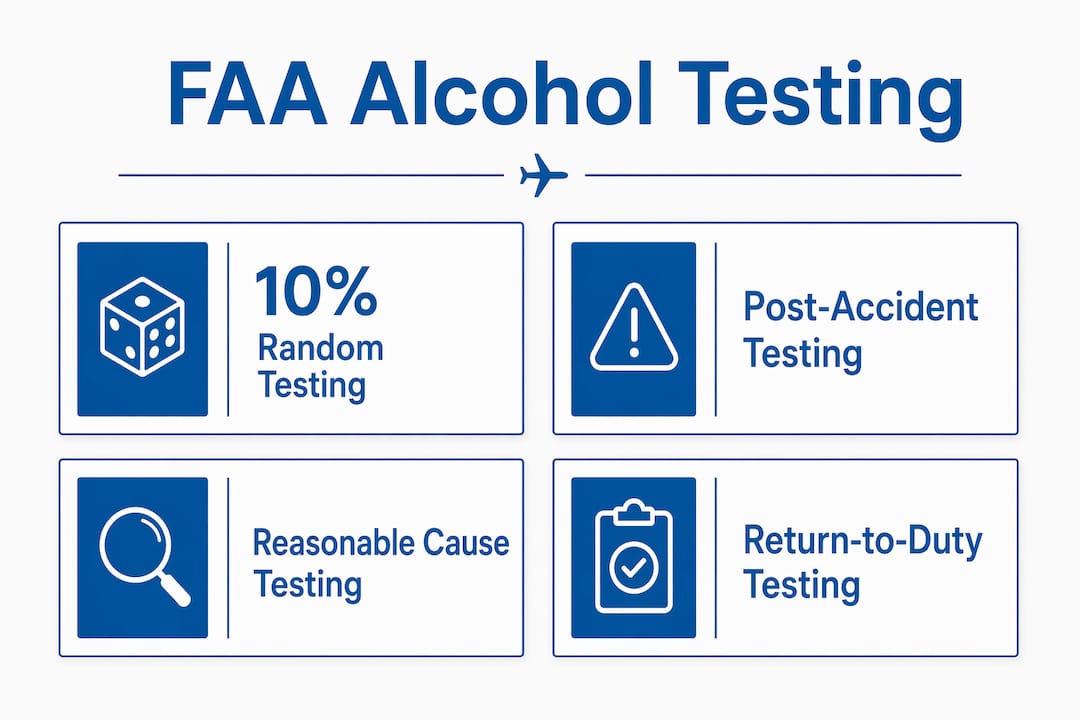
The FAA mandates six distinct categories of alcohol testing. Each serves a specific compliance function, and missing any one of them creates a program gap.
- Pre-employment testing is required before a new hire performs safety-sensitive duties for the first time.
- Random testing is the backbone of any ongoing program. The 2026 minimum random alcohol testing rate is 10% of safety-sensitive employees annually, compared to 25% for drug testing. That gap surprises many employers, but it reflects the FAA’s reliance on the bottle-to-throttle rule as a first-line deterrent.
- Post-accident testing must occur within 2 hours of a qualifying incident. Post-accident alcohol tests have an absolute maximum window of 8 hours. If testing cannot happen within 2 hours, the employer must document why and continue attempting to test until the 8-hour deadline passes.
- Reasonable suspicion testing is triggered when a trained supervisor observes specific, documented signs of impairment.
- Return-to-duty testing applies after a confirmed violation before the employee can resume safety-sensitive functions.
- Follow-up testing continues for up to 60 months after a violation, with a minimum of 6 tests in the first 12 months.
The table below summarizes the key timing and rate requirements:
| Testing Type | Minimum Rate or Timing Requirement |
|---|---|
| Random alcohol testing | 10% of safety-sensitive employees annually |
| Random drug testing | 25% of safety-sensitive employees annually |
| Post-accident alcohol test | Within 2 hours; 8-hour maximum |
| Follow-up testing duration | Up to 60 months post-violation |
Pro Tip: Schedule random selections using a scientifically valid random number method and document every draw. Auditors look for selection records, not just test results.
How to implement an FAA-compliant alcohol screening program
Building a compliant program starts before the first test is ever administered. The FAA requires employers to register with the Drug Abatement Division before any testing can legally begin. Many small operators and contractors skip this step, assuming testing alone satisfies the requirement. It does not. FAA program registration through an Operations Specification (A449) or direct registration is a legal prerequisite.
Once registered, every program needs a Designated Employer Representative. The DER manages testing logistics, receives results from the collection site or lab, coordinates the return-to-duty process after violations, and maintains all required records. DER responsibilities include recordkeeping for periods ranging from 1 to 5 years depending on the document type.
Core implementation steps include:
- Register with the FAA Drug Abatement Division before testing begins
- Appoint a qualified DER and train supervisors in reasonable suspicion recognition
- Select a DOT-compliant collection site and confirm it uses evidential breath testing devices approved under 49 CFR Part 40
- Establish a random selection pool that includes all safety-sensitive employees
- Document post-accident attempts immediately, including timestamps and reasons for any delay
- Retain records per FAA requirements: 5 years for positive results, 2 years for random program records, 1 year for negative results
The table below outlines record retention requirements:
| Record Type | Retention Period |
|---|---|
| Positive test results and violations | 5 years |
| Random testing program records | 2 years |
| Negative and cancelled test results | 1 year |
| Reasonable suspicion documentation | 2 years |
A positive test at or above 0.04 BAC requires immediate removal from duties and a Substance Abuse Professional evaluation before any return-to-duty testing can occur. Employers who skip the SAP step and allow an employee back on the line face serious enforcement action.
Pro Tip: Review your alcohol screening compliance practices at least once per year. Regulatory rates and procedural requirements can change, and an outdated program is treated the same as no program during an audit.
What common mistakes do aviation employers make with alcohol screening?
The most widespread misunderstanding in aviation alcohol screening is treating the 8-hour bottle-to-throttle rule as a guaranteed clearance. The FAA treats the 8-hour rule as a minimum baseline, not a certification of fitness for duty. A pilot who consumed significant alcohol 9 hours before a flight may still be impaired. Supervisors and DERs must evaluate total fitness, not just elapsed time.
A second common error involves the gray zone between 0.02 and 0.039 BAC. A confirmed BAC between 0.02 and 0.039 does not technically violate the 0.04 limit, but it almost always results in immediate removal from safety-sensitive duties pending re-evaluation. Employers who allow an employee to continue working after a 0.02 reading face significant liability even without a formal violation on record.
Other frequent compliance gaps include:
- Assuming Part 91 private operators are fully exempt from all testing obligations
- Failing to test contractors who perform safety-sensitive functions on behalf of a certificate holder
- Missing the 2-hour post-accident window without documenting the reason
- Allowing random testing pools to shrink without recalculating the required annual rate
- Not training supervisors to document reasonable suspicion observations in writing before ordering a test
Pro Tip: Use a written alcohol testing protocol for supervisors that includes a checklist of observable signs and a documentation template. Verbal observations that are not recorded before the test are nearly impossible to defend in a challenge.
Unlike many international aviation systems that rely on ramp-side spot checks, US aviation places the compliance burden directly on employers through random testing programs. That structure means your internal program design determines whether you pass or fail an FAA audit.
Key Takeaways
A compliant aviation alcohol screening program requires FAA registration, a qualified DER, documented random testing at the correct annual rate, and strict post-accident timing adherence to avoid audit failures and enforcement action.
| Point | Details |
|---|---|
| FAA BAC threshold | The legal limit is 0.04 BAC; a reading of 0.02–0.039 triggers stand-down even without a formal violation. |
| Random testing rate | Employers must test at least 10% of safety-sensitive employees for alcohol annually in 2026. |
| Post-accident timing | Alcohol tests must begin within 2 hours of an incident; the absolute deadline is 8 hours. |
| Program registration | FAA registration through the Drug Abatement Division must happen before any testing begins. |
| Recordkeeping periods | Positive results require 5-year retention; negative results require 1 year; random program records require 2 years. |
The part of aviation alcohol screening most programs get wrong
Aviation alcohol screening programs tend to fail at the edges, not the center. Most employers know the 0.04 BAC number. Far fewer have thought carefully about what happens in the hour after a post-accident when everyone is scrambling, or what a supervisor is actually supposed to do when they suspect impairment but are not certain.
The 8-hour rule is where I see the most dangerous overconfidence. Employers treat it like a legal shield. If the pilot waited 8 hours, the thinking goes, the employer is covered. The FAA does not see it that way. Fitness for duty is a holistic judgment, and the 8-hour clock is just the floor. A supervisor who clears someone for duty at exactly the 8-hour mark without any further evaluation is not doing their job.
The other issue I keep coming back to is program ownership. US aviation puts the compliance burden squarely on employers, which is actually a reasonable design. But it only works when someone inside the organization genuinely owns the program. A DER who treats the role as paperwork is a liability. The best programs I have seen treat the DER as a safety function, not an HR checkbox.
Transparent communication with employees matters too. Workers who understand why the program exists, what triggers a test, and what happens after a positive result are far less likely to challenge results or create legal complications. Clarity is not just good ethics. It is good risk management.
— Alan
How Countrywidetesting supports your aviation screening program
Aviation employers need a testing partner that understands DOT and FAA requirements, not just general workplace screening. Countrywidetesting works with licensed laboratories that meet SAMHSA, CLIA, CAP, and ISO standards, giving you the documentation trail that FAA auditors expect.
Whether you are setting up a new program or filling gaps in an existing one, Countrywidetesting’s lab testing services cover the full range of FAA-required alcohol and drug testing categories. From random pool management to post-accident testing logistics, the platform connects aviation employers with certified collection and analysis resources that hold up under regulatory scrutiny. Reach out to Countrywidetesting to discuss your program requirements and get compliant before your next audit cycle.
FAQ
What is the FAA alcohol limit for pilots?
The FAA prohibits any crewmember from performing duties with a BAC at or above 0.04. A reading between 0.02 and 0.039 does not constitute a formal violation but typically results in immediate removal from safety-sensitive duties.
How is alcohol tested in aviation under FAA rules?
FAA-regulated employers use evidential breath testing devices approved under 49 CFR Part 40. Testing occurs across six categories: pre-employment, random, post-accident, reasonable suspicion, return-to-duty, and follow-up.
What is the minimum random alcohol testing rate for 2026?
The FAA requires aviation employers to randomly test at least 10% of safety-sensitive employees for alcohol per year. This rate is separate from the 25% minimum required for random drug testing.
Does the 8-hour bottle-to-throttle rule mean a pilot is cleared to fly?
No. The 8-hour rule is a minimum waiting period, not a fitness-for-duty certification. The FAA expects supervisors to evaluate total impairment beyond the time elapsed since last consuming alcohol.
Who counts as a safety-sensitive employee under FAA alcohol testing rules?
Safety-sensitive employees include pilots, flight attendants, aircraft dispatchers, maintenance technicians, ground security coordinators, and air traffic controllers at non-FAA facilities. Contractors performing these functions for certificate holders must also be covered by a compliant testing program.