
DNA testing services: Know your options before you act
TL;DR:
- Different DNA tests use distinct methods, such as SNP genotyping for health and ancestry or STR profiling for legal purposes.
- Legal and forensic DNA testing requires strict chain-of-custody protocols and accredited laboratories; consumer tests do not suffice.
- Use reputable, certified providers aligned with your specific need to ensure accurate, legally admissible, and privacy-compliant results.
Most people assume that because DNA is DNA, any test should tell you the same things. That assumption can cost you. A consumer ancestry kit from a retail website and a court-ordered paternity test are built on completely different science, follow different legal standards, and deliver fundamentally different outcomes. Using the wrong type of test for your specific need, whether that’s understanding a health risk, proving a biological relationship in family court, or staying compliant as an employer, can result in wasted money, legal complications, or dangerously misread results. This guide breaks down the landscape clearly so you can make the right call from the start.
Table of Contents
- How DNA testing works: Methods and scientific basics
- Types of DNA testing services and what they reveal
- When and why to use DNA testing for health, legal, or employment needs
- Key factors when choosing a reliable DNA testing service
- Our take: Avoiding the most common DNA testing mistakes
- Find the right testing solution for your needs
- Frequently asked questions
Key Takeaways
| Point | Details |
|---|---|
| Different methods, different results | DNA testing services use varied scientific approaches tailored to health, legal, or ancestry insights. |
| Legal versus consumer tests | Only accredited chain-of-custody testing is valid for court or legal purposes. |
| Privacy law matters | Regulations like GINA set strict limits on using genetic information in US employment and insurance. |
| Fit-for-purpose selection | Choose your DNA service based on the exact insight or proof required for your situation. |
How DNA testing works: Methods and scientific basics
To understand why DNA services differ in value, let’s see how the underlying science and collection process diverge depending on the purpose.
At the core of every DNA test is the same raw material: your genetic code. But what labs do with that material varies enormously based on what question they’re trying to answer. There are two primary analytical methods in use today, and knowing which one a service uses tells you a lot about its purpose and reliability.
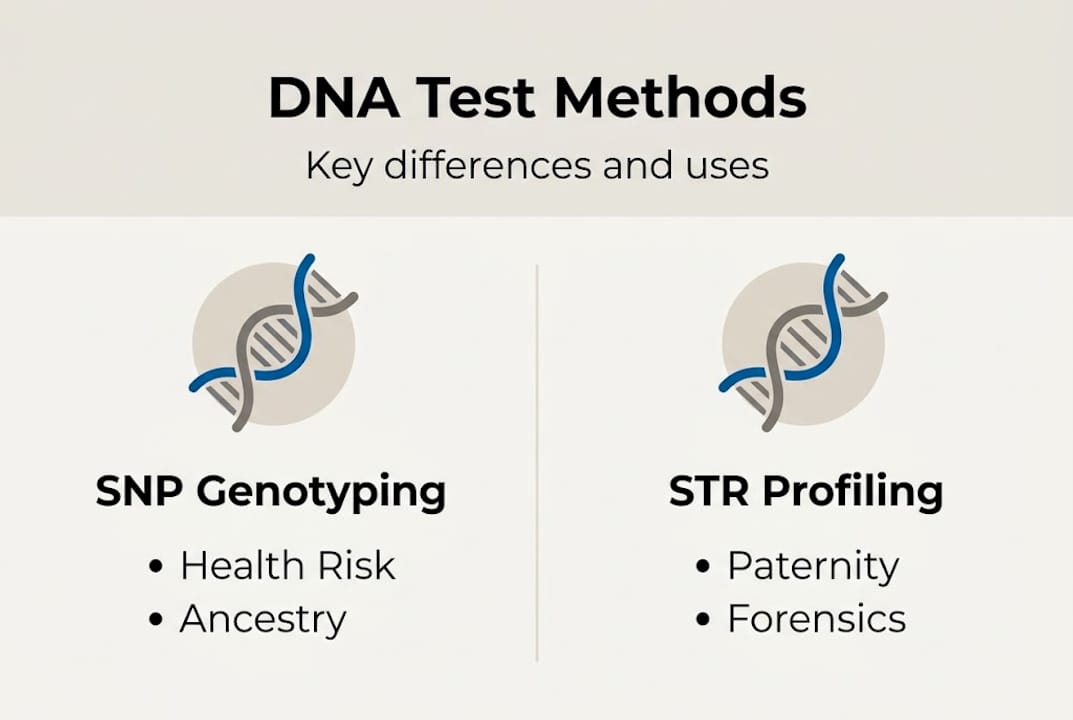
SNP genotyping (single nucleotide polymorphism) is the backbone of consumer health and ancestry testing. It scans specific, known locations in your genome to identify common variations across the population. Consumer DNA testing for ancestry and health primarily uses microarray genotyping to analyze roughly 700,000 SNPs simultaneously. The process works like this: you provide a saliva sample, the lab extracts your DNA, then hybridizes it to a chip containing probe sequences that light up when they match your genetic variants. The resulting pattern is compared to population reference databases to draw conclusions about ancestry percentages or health risk associations.
STR profiling (short tandem repeat) is the method used in legal and forensic contexts. Rather than scanning the genome broadly, it targets between 13 and 20 specific identity markers that are highly variable across individuals. Forensic DNA testing uses STR genotyping to establish identity with a degree of certainty that far exceeds consumer-grade tests. This is why paternity testing and criminal evidence analysis use STR profiling.
Quick comparison: SNP vs. STR
| Feature | SNP genotyping | STR profiling |
|---|---|---|
| Primary use | Health risk, ancestry | Legal identity, paternity |
| Markers analyzed | ~700,000 SNPs | 13-20 STR loci |
| Sample type | Saliva (typically) | Buccal swab, blood |
| Legal admissibility | No | Yes (with chain-of-custody) |
| Accuracy for identity | Low to moderate | Greater than 99.99% |
The collection method matters too. Consumer tests usually involve mailing a saliva tube from home, with no witness or verification process. Legal tests require a witnessed, documented sample collection that creates what’s called a “chain-of-custody.” This paper trail is what makes the result defensible in court.
Pro Tip: If you’re considering any kind of genetic testing that might eventually support a legal claim or medical decision, ask the provider upfront whether their process includes chain-of-custody documentation and what accreditations their lab holds. Our lab testing services can clarify what’s required for your specific situation.
The connection between genetics and everyday wellness is growing fast, with personalized nutrition and genetics increasingly informing how people approach diet and supplementation. But understanding the limits of SNP-based health data is essential before acting on those insights.
Types of DNA testing services and what they reveal
With testing basics covered, now let’s examine what each type of DNA service actually delivers.
The DNA testing market spans a wide range of services with very different purposes. Grouping them by use case makes it much easier to identify which one fits your situation.
1. Consumer health and ancestry tests (direct-to-consumer) These are the kits you order online, complete at home, and mail back. They use SNP genotyping and give you probabilistic outputs. Ancestry results depend heavily on which reference panel the company uses, meaning the same person can receive meaningfully different ethnicity percentages from two different providers. Health risk reports flag elevated probability for certain conditions, but these are not diagnoses. Health insights from DTC tests are probabilistic, not diagnostic, and ancestry results vary by company reference panels and databases.
2. Legal and forensic DNA tests These include paternity testing, immigration DNA verification, estate and inheritance testing, and criminal forensics. They use STR profiling with strict protocols. Forensic DNA tests achieve greater than 99.99% accuracy for paternity and relationship confirmation. The critical difference is procedure, not just technology. A forensic result without chain-of-custody documentation is not valid in court, regardless of how accurate the underlying analysis is.
Comparison of DNA testing categories
| Category | What it reveals | Legal value | Admissibility |
|---|---|---|---|
| Consumer ancestry | Ethnicity estimates | None | No |
| Consumer health | Probabilistic risk flags | None | No |
| Legal paternity | Biological relationship | High | Yes |
| Immigration DNA | Family relationship | High | Yes |
| Criminal forensics | Identity match | High | Yes |
3. Edge cases worth knowing Phenotyping, which predicts physical appearance from DNA, is used in forensics when no suspect exists. Mixed or degraded samples, common in criminal cases, require specialized analysis that goes beyond standard STR protocols. These are niche applications, but they illustrate that the field of DNA analysis is far more specialized than most people realize.
How does this connect to compliance-focused testing? Understanding that DNA testing in legal or court contexts demands documented procedure is the same logic that applies to understanding forensic drug testing, where chain-of-custody and lab accreditation are equally non-negotiable. If you need evidence for a court case, reviewing lab drug tests for legal cases can also clarify what legal-grade testing actually looks like in practice.
Pro Tip: Never use a consumer ancestry kit to try to establish paternity or family relationships for immigration or estate purposes. Courts and government agencies require tests from AABB-accredited labs with full chain-of-custody, regardless of how confident a consumer kit’s results appear.
When and why to use DNA testing for health, legal, or employment needs
Now that you know what’s possible, it’s crucial to understand which service fits your specific goal and the legal rules that protect your privacy.
Personal use: Health and ancestry Consumer DNA tests serve a legitimate purpose when used correctly. Exploring family history, connecting with distant relatives, or getting a broad view of genetic predispositions for conditions like BRCA-related cancer risk or hereditary heart conditions are all reasonable uses. The key is to treat results as a starting point, not a conclusion. A flagged genetic variant for Type 2 diabetes doesn’t mean you will develop it. Lifestyle, environment, and other factors all play a role. Sharing these results with a physician or genetic counselor adds real context.
Legal use: Paternity, immigration, and inheritance These are the highest-stakes scenarios in DNA testing. Courts, immigration agencies, and probate proceedings require tests from AABB-accredited laboratories that follow strict chain-of-custody protocols. You cannot substitute a consumer kit for a legal test, even if you believe the results are accurate. The process of testing, not just the result, is what gives the evidence its legal standing.
Employment use: What DNA has to do with it Here’s where many employers and HR teams get confused. DNA testing plays almost no role in standard employment screening. The Genetic Information Nondiscrimination Act (GINA), passed in 2008, prohibits US employers and health insurers from discriminating based on an individual’s genetic information. Employers cannot require, request, or purchase genetic information about employees or applicants. This applies to health insurance decisions as well.
What employers can do is conduct drug and alcohol testing, which is a completely separate process that has nothing to do with genetic analysis. Drug tests analyze biological markers of substance use, not your DNA sequence. If you’re looking for compliant testing tools for healthcare providers or workplace programs, resources like drug testing kits for healthcare or a documented drug screening workflow apply directly to that need.
“Genetic Information Nondiscrimination Act (GINA) makes it illegal for health insurers to use your genetic information to make eligibility, coverage, underwriting, or premium-setting decisions. It also makes it illegal for most employers to use your genetic information in making employment decisions.” — Worker.gov
Privacy considerations also vary by state. Some states have enacted stronger genetic privacy laws than GINA requires. Before undergoing any DNA testing for employment-adjacent purposes, consulting legal counsel is a reasonable step.

Key factors when choosing a reliable DNA testing service
Before you choose a provider for yourself or your organization, make sure you understand what sets a credible DNA testing service apart.
Not all DNA testing providers are equal. Research confirms that methodological variability in DTC services is high, with differences in methods causing discrepancies even when the same donor submits samples to multiple companies. This isn’t a minor issue. It means your ancestry percentages and health risk flags can shift significantly depending on who processes your sample.
Here’s what to look for when evaluating any DNA testing provider:
- Lab accreditation: For legal or forensic tests, look for AABB accreditation, FBI Quality Assurance Standards (QAS), or equivalent certification. For health and clinical tests, CLIA and CAP certification are the benchmarks.
- Testing method transparency: Does the provider clearly state whether they use SNP arrays or STR profiling? Are the number of markers disclosed?
- Reference panel quality: For ancestry and health tests, larger and more diverse reference panels produce more accurate results. Ask which populations are represented.
- Data privacy policies: Who owns your DNA data after testing? Can it be shared with third parties, including insurers or law enforcement? Read the fine print.
- Chain-of-custody documentation: Required for legal use. Not optional.
- Result interpretation support: Reputable providers offer counseling services or physician consultation options, especially for health-related findings.
NIST (the National Institute of Standards and Technology) publishes reference materials such as RM 8398 that serve as accuracy benchmarks for DNA testing labs. Providers that reference or participate in NIST standards demonstrate a commitment to quality that goes beyond marketing claims.
Statistic callout: A 2025 study in Nature Communications Biology found substantial variability in results between direct-to-consumer DNA testing services for the same individuals, highlighting the urgent need for standardized methods across the industry.
Understanding what separates good from poor testing also applies when looking at current drug testing trends and learning how lab drug testing works in regulated environments. The principles of accreditation, chain-of-custody, and method transparency are consistent whether you’re testing for substances or genetic markers.
Common pitfalls to avoid:
- Treating a probabilistic health risk flag as a diagnosis requiring immediate treatment
- Using a consumer ancestry test to make legal claims about family relationships
- Choosing a provider based on price alone without verifying accreditation
- Ignoring data sharing policies that could expose sensitive genetic information to third parties
- Assuming that a faster turnaround time means an equally reliable result
Our take: Avoiding the most common DNA testing mistakes
Even with all this information, many people still fall into preventable traps when seeking a DNA test. Here’s what experience teaches that most guides miss.
The most common mistake isn’t choosing the wrong provider. It’s choosing the right provider for the wrong test. We see this frequently: someone orders a consumer health or ancestry kit and then tries to use those results to support a custody case or immigration petition. It doesn’t work, and it can delay legal proceedings significantly.
The second mistake is overestimating what health risk DNA testing actually tells you. A result flagging elevated risk for a condition is a signal to have a conversation with your doctor, not a verdict. Treating probabilistic outputs as clinical diagnoses leads to unnecessary anxiety and, in some cases, unnecessary medical procedures.
Data privacy is the third area where people consistently underestimate the risk. Genetic data is among the most sensitive personal information that exists. Understanding who controls your data after testing is as important as understanding the results themselves. For cases involving family law and sensitive custody or biological relationship questions, reviewing how DNA plays a role in family law cases gives essential context on what courts actually require and accept.
Employment contexts add another layer of confusion. Organizations sometimes conflate drug testing programs with genetic testing, treating them as related compliance activities. They are not. One is a standard safety tool with well-established legal frameworks. The other is tightly restricted under GINA and rarely appropriate in workplace settings.
Find the right testing solution for your needs
Ready to apply what you’ve learned? Explore reliable testing solutions trusted by individuals, employers, and legal professionals.
Whether you need a certified lab result for a personal health question, a documented test for a legal proceeding, or a compliant drug screening program for your organization, working with accredited, transparent providers is non-negotiable. Cutting corners on provider quality creates problems downstream, especially when results need to hold up in court or satisfy regulatory requirements.
CountryWideTesting.com connects individuals and organizations with SAMHSA, CLIA, CAP, and ISO-compliant laboratories for a full spectrum of testing needs. From at-home health and genetics testing to legally defensible lab screening programs, the platform makes it straightforward to find the right test for your actual goal. Visit our lab testing services page to explore certified options suited to your personal, legal, or compliance needs and take the guesswork out of choosing a provider.
Frequently asked questions
Is consumer DNA testing admissible in court?
No. Consumer DNA tests conducted without strict chain-of-custody documentation are not accepted as legal evidence, as forensic chain-of-custody is a non-negotiable requirement for court admissibility.
What does GINA protect against in workplace DNA testing?
GINA prohibits employers from using an employee’s or applicant’s genetic information to make hiring, firing, promotion, or health insurance decisions in the United States.
How accurate are paternity DNA tests?
Forensic paternity tests using STR analysis are greater than 99.99% accurate when performed by an accredited laboratory following proper chain-of-custody procedures.
Can DNA tests detect all health risks?
No. Consumer health DNA tests provide probabilistic risk estimates, not clinical diagnoses, and results vary depending on which company processes your sample and what reference databases they use.