
Make Drug Tests Admissible in U.S. Courts: GC/MS and Chain of Custody
For evidence to hold up in a U.S. courtroom, samples must be collected under documented chain of custody and confirmed by an accredited laboratory using instrumented methods like GC/MS or LC/MS. A presumptive screen alone rarely satisfies a judge. Courts also weigh which matrix was tested, since urine, hair, oral fluid, and blood each answer a different legal question about timing and use.
TL;DR:
- Urine is the most common matrix used in courts, but its short detection window of 2 to 4 days limits its usefulness for establishing recent impairment.
- Confirmatory testing with GC/MS or LC/MS is essential for admissibility, as presumptive screens alone are considered unreliable in legal proceedings.
- Chain of custody and witnessed collection procedures are critical, with documentation gaps often leading to evidence exclusion regardless of lab accuracy.
- Hair testing tracks drug use over about 90 days but cannot specify when during that period use occurred, and external contamination remains a concern.
- Combining multiple matrices, like urine and blood, improves case robustness, especially when timing and impairment are the legal questions.
Table of Contents
- Which Drug Testing Matrices Do Courts Actually Rely On?
- What Procedures Do Courts Require Before Trusting a Result?
- Why Do Courts Insist on GC/MS or LC/MS Confirmation?
- When Do Courts Order Drug Testing?
- What Standards Back Reliable Testing Programs?
- What Happens When a Drug Test Result Is Wrong?
- What New Technology Is Changing Court Drug Testing?
- How Do You Challenge a Drug Test Result in Court?
- What Courts Actually Look For
- Get Court-Ready Confirmatory Testing Without the Guesswork
- Where to Verify These Standards
- Sources
- FAQ
Which Drug Testing Matrices Do Courts Actually Rely On?
Not every sample type proves the same thing, and picking the wrong one can sink an otherwise solid case. A family law attorney trying to establish recent impairment gains nothing from a hair test that only shows use from months ago. Matching the matrix to the legal question is the first decision, long before anyone worries about lab accreditation.
- Urine remains the workhorse for court and probation testing. Metabolites are often detectable for only 2 to 4 days, which makes it strong for establishing recent historical use but weak for pinning down the exact day of use. Dilution is the persistent problem, which is why labs run creatinine checks alongside the drug panel.
- Oral fluid and blood track much closer to actual impairment, since drugs appear in these matrices while still active in the bloodstream. That makes them the preferred choice in DUI cases and any proceeding where the question is “was this person impaired right now,” not “did they use last month.”
- Hair offers a look-back window of roughly 90 days, useful in custody disputes where a parent’s pattern of use over months matters more than a single incident. The tradeoff is interpretive: hair testing cannot pinpoint when during that window use occurred, and external contamination remains a defense angle.
- Sweat patches and continuous alcohol monitors (SCRAM) serve ongoing compliance monitoring rather than single-incident proof, common in probation and drug court settings where the goal is catching any lapse over weeks.
- EtG/EtS testing for alcohol detects metabolites for up to 80 hours after consumption, but courts scrutinize cutoffs carefully because incidental exposure (hand sanitizer, mouthwash) can trigger low-level positives. No single matrix works for every case, and combining two is often the more defensible move.
What Procedures Do Courts Require Before Trusting a Result?
The lab work matters, but sloppy paperwork is what actually gets drug test evidence thrown out. Judges have seen enough forged logs and unwitnessed cups to know that a pristine GC/MS printout means nothing if nobody can prove the sample stayed untampered from collection to analysis.
- Chain of custody has to be unbroken. Every hand that touches the specimen, from collector to courier to lab technician, gets logged with a timestamp and signature.
- Witnessed collection closes the biggest cheating loophole. An unobserved sample invites arguments about substitution or dilution that a witnessed one simply does not face.
- Specimen validity testing checks creatinine levels, pH, and adulterants before the drug panel even runs, catching diluted or spiked samples early.
- Random, unannounced scheduling prevents participants from timing their use around known test dates. Best-practice standards call for testing at least twice weekly in a program’s early months, and programs that stick to that cadence see up to 38% greater reductions in crime and 61% greater cost-effectiveness.
- Predictable schedules undermine everything. If a defendant knows testing happens every Monday, urine’s short detection window gives them a workaround the other five days of the week.
Pro Tip: If you’re building a case around test results, ask for the collection log before you look at the toxicology report. A perfect lab result with a gap in custody documentation is often worse than no test at all.
Why Do Courts Insist on GC/MS or LC/MS Confirmation?
A presumptive screen is a starting point, not proof. Immunoassay tests and point-of-care devices are fast and cheap, but they cross-react with legal medications and produce false positives often enough that no court treats them as final. The accepted model is a two-step process: a screen flags a potential positive, then an instrumented method confirms it.
Gas chromatography mass spectrometry (GC/MS) and liquid chromatography mass spectrometry (LC/MS) separate and identify compounds at the molecular level, which is why forensic guidance treats them as Category A confirmatory techniques that require at least one supporting test. These methods rarely produce false positives when run correctly, though quantitation still matters for cutoff disputes.
- Accreditation standards like SAMHSA certification, CLIA compliance, and CAP inspection give courts a baseline assurance that a lab’s methods were validated, not improvised.
- A defensible lab report names the method used, states the cutoff applied, includes the chain-of-custody log, carries an analyst’s signature, and confirms an aliquot was retained for potential re-testing.
- Under gatekeeping frameworks like Kelly v. State, even a scientifically accepted technique must be shown to have been applied correctly in this specific case, not just accepted in general.
When Do Courts Order Drug Testing?
Judges order testing across a narrower set of scenarios than most people expect. Family courts use it in custody disputes where substance use affects parental fitness. Probation and parole officers rely on it for compliance monitoring, often paired with drug court programs designed around graduated sanctions. DUI proceedings lean on blood or breath alcohol testing tied to specific statutory thresholds.
Requesting a test usually means filing a motion or using discovery to compel testing at a specified lab with a defined matrix and frequency. If you’re on the receiving end of an order, you have real options.
- Ask for independent confirmatory testing at an accredited lab rather than accepting a single result as final.
- Challenge chain-of-custody gaps directly, since a broken log can exclude an otherwise valid result.
- Request the underlying lab documentation, not just a summary, including cutoff levels and analyst notes.
- Insist on aliquot preservation so a disputed result can be re-tested rather than requiring a fresh, differently timed sample.
What Standards Back Reliable Testing Programs?
Reliable court testing rests on three pillars: accredited labs, validated instrumented methods, and documented collection procedures. Some testing services work with labs aligned to SAMHSA, CLIA, and CAP standards, providing a compliant option for confirmatory or lab-based testing needs. This article draws on Alan’s focus on test adulteration risks and courtroom compliance checklists.
What Happens When a Drug Test Result Is Wrong?
A false positive can end a custody case badly, and a false negative can let a genuine safety risk slip past a judge unnoticed. Both errors carry real consequences, and courts treat them differently depending on which direction the error runs.
False positives usually stem from cross-reactivity in presumptive screens, poppy seed consumption triggering opiate flags, or certain prescription medications mimicking illicit drug signatures. This is precisely why confirmation testing exists: a screen that flags amphetamines because someone takes Adderall gets corrected once GC/MS identifies the actual compound present. A false positive that reaches a judge unconfirmed can trigger custody restrictions, probation violations, or job loss before anyone catches the error.
False negatives cut the other way. Someone facing a scheduled test can abstain briefly, dilute a sample, or substitute a clean specimen if collection isn’t witnessed. In a probation context, a false negative means a genuine relapse goes undetected, undermining the entire premise of court-ordered monitoring.
The legal stakes explain why cutoffs aren’t arbitrary numbers. They’re calibrated to separate incidental exposure from actual use, protecting people from false accusations while still catching genuine positives. When a lawyer challenges a result, the first question is almost always whether a screen was confirmed, and the second is whether the cutoff applied matches the accredited method’s validated threshold.
What New Technology Is Changing Court Drug Testing?
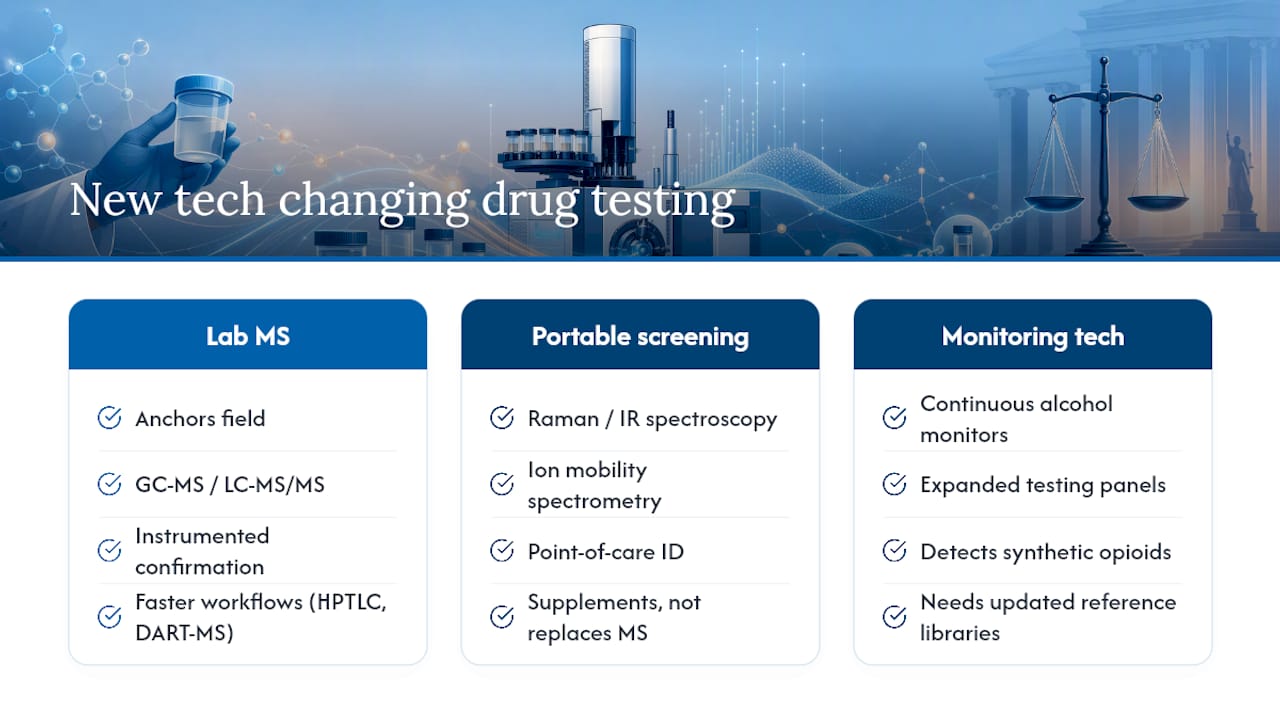
Mass spectrometry still anchors the field, but the tools around it keep improving. Recent forensic reviews point to techniques like DART-MS (direct analysis in real time mass spectrometry) and high-performance thin-layer chromatography (HPTLC) supplementing traditional GC-MS and LC-MS/MS workflows, giving labs faster turnaround without sacrificing the instrumented confirmation courts expect.
Portable spectroscopy tools using Raman and infrared analysis, along with ion mobility spectrometry, are gaining traction for point-of-care screening. These devices can identify a substance on the spot, which is useful for law enforcement and treatment settings. But reviews of point-of-care methods are consistent on one point: mass spectrometry remains the forensic gold standard, and portable tools supplement rather than replace lab confirmation for courtroom purposes.
The bigger shift is in monitoring technology rather than the chemistry itself. Continuous alcohol monitors and expanded panel testing that screens for synthetic opioids and novel psychoactive substances are closing gaps that older panels missed entirely. Fentanyl analogs, in particular, have forced labs to update their reference libraries regularly, since a static panel from a few years ago may not flag a compound that’s now common on the street.
None of this changes the underlying legal standard. New technology has to clear the same gatekeeping hurdle as older methods: validated theory, validated technique, and correct application to the specific case at hand.
How Do You Challenge a Drug Test Result in Court?
Disputing a result starts with the paperwork, not the chemistry. Request the complete lab file, including the chain-of-custody log, the specimen validity results, the cutoff levels applied, and the analyst’s signature. Gaps in any of these documents give grounds to challenge admissibility before the science is even discussed.
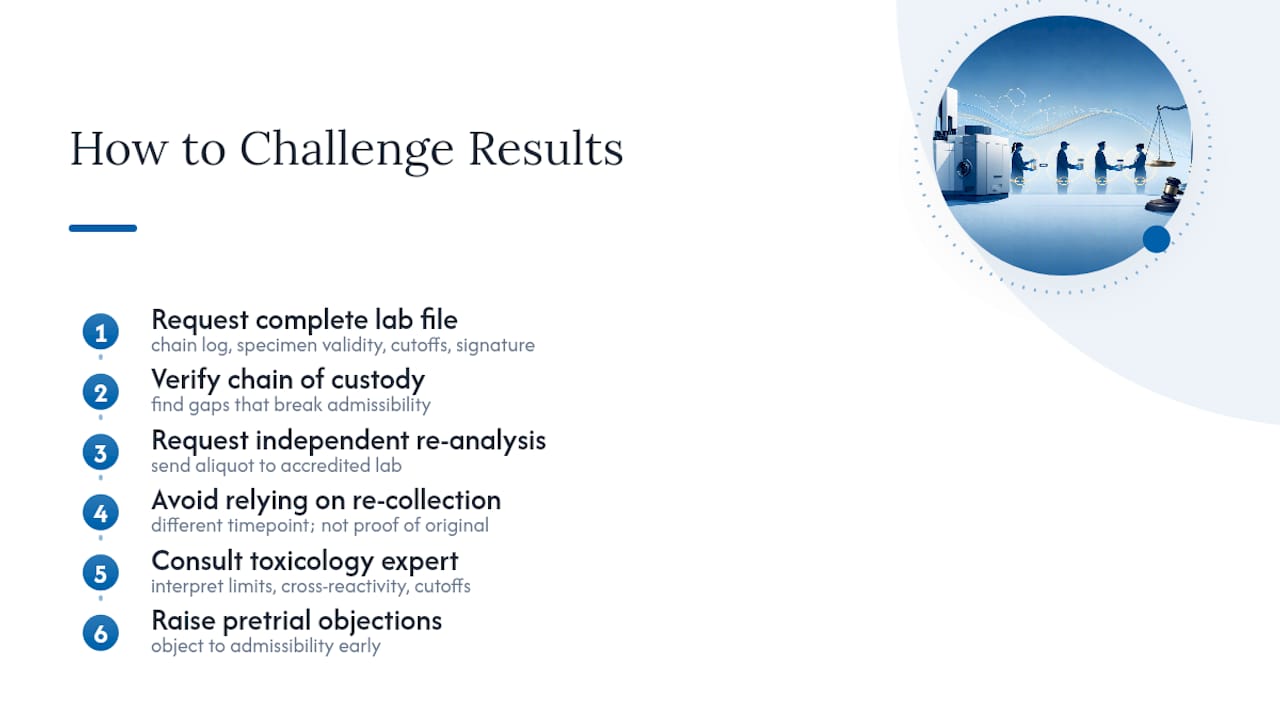
Independent confirmatory testing is the next move. If the original test used an aliquot, request that a portion be sent to a separate accredited lab for re-analysis. Re-collection later is a weaker substitute, since a fresh sample reflects a different point in time and can’t speak to what was actually in the original specimen.
A toxicology expert can testify to interpretive limits: cross-reactivity risks, cutoff selection, and whether the collection process followed accepted protocol. This is where Kelly-style gatekeeping challenges come in. An attorney can argue that even a generally accepted method, like GC/MS, was misapplied in this instance, whether through improper calibration, contamination, or a documentation gap that breaks the evidentiary chain.
Timing matters too. Raise chain-of-custody objections early, ideally in pretrial motions, rather than waiting until testimony. Courts are far more receptive to excluding evidence before it’s been presented than after a witness has already described the result to a jury.
What Courts Actually Look For
Missing custody logs and unwitnessed collections sink more cases than bad chemistry ever does. My advice: preserve the aliquot, use an accredited lab, and log custody in real time. Courts respect paperwork discipline as much as the science itself.
— Alan
Get Court-Ready Confirmatory Testing Without the Guesswork
If you need results that hold up under a judge’s scrutiny, working with accredited labs from the start beats trying to fix documentation gaps after the fact. Some testing providers work with labs aligned to SAMHSA, CLIA, and CAP standards and can facilitate witnessed collection and instrumented confirmation for individuals, attorneys, and organizations who need defensible results the first time.
For readers seeking independent confirmation on an existing specimen, the Phamatech Urine Lab Confirmation Mail-In Drug Test sends samples directly to an accredited lab for GC/MS or LC/MS analysis. Attorneys and case managers building a broader testing plan can start with the lab testing services page to see available panels and turnaround options. Whether you’re responding to a court order or requesting independent verification of a disputed result, get in touch through the lab testing services page to discuss which test matches your specific case.
Where to Verify These Standards
Court staff and attorneys who want to check these claims against primary sources can start with the following references.
- Adult Drug Court Best Practice Standards, Volume II covers testing frequency and chain-of-custody protocols.
- Kelly v. State outlines the reliability framework courts apply to scientific evidence.
- Forensic drug test methods guidance details confirmatory technique categories and validation requirements.
This article is general information, not a substitute for advice from a qualified lawyer. Consult a qualified legal professional about your own circumstances before acting on anything here.
Sources
- Adult Drug Court Best Practice Standards, Volume II (UNC SOG)
- Indiana Forensic Services Division: Drug test methods and validation guidance
- Adult Drug Court Best Practice Standards (AllRise)
FAQ
What Kind of Drug Test Do Courts Use?
Courts typically require a presumptive screen followed by instrumented confirmation using GC/MS or LC/MS at an accredited lab, with urine as the most common matrix and hair or oral fluid used for specific timing questions.
Are Field Drug Tests Admissible in Court?
Roadside or presumptive field tests are generally treated as investigative tools, not standalone evidence, because they lack the instrumented confirmation courts require for a definitive finding.
Do Court-Ordered Drug Tests Violate the Fourth Amendment?
Court-ordered testing tied to probation, parole, or family court proceedings is generally upheld because the individual is subject to a court’s supervisory authority, though the scope and reasonableness of the order can still be challenged.
How Do You Get a Court-Ordered Drug Test?
A party typically requests testing through a motion or discovery request specifying the matrix, frequency, and an accredited lab, and Lab testing services can serve as an option for compliant, confirmatory testing once an order is in place.
What Does Court-Admissible Testing Cost?
Pricing depends on the specific panel, matrix, and confirmation service needed, and current options are listed directly on the Countrywidetesting site.