
Science-Backed Alcohol Test Accuracy: Lab Rules for Clinicians and HR
Venous blood BAC testing remains the most accurate method for measuring current intoxication, with a detection window of roughly 12 hours after the last drink. Evidential breath devices come close when properly calibrated, but consumer breath gadgets often miss the mark. For anything beyond “right now,” metabolite tests like EtG/EtS, PEth, and CDT tell you whether someone drank recently or heavily, not exactly when or how much.
TL;DR:
- Venous blood testing remains the most accurate method for detecting alcohol within about 12 hours, especially in legal or medical contexts.
- Consumer breath devices often underestimate blood alcohol content, missing the legal intoxication threshold more than 50% of the time in tests.
- Metabolite tests like EtG, EtS, PEth, and CDT extend detection windows from days to weeks but cannot specify exact drinking amounts or times.
- Transdermal alcohol sensors provide trend data over days but lack the reliability of blood or breath tests for single-event confirmation.
- Proper sample handling, calibration, and lab accreditation are crucial to obtaining legally defensible alcohol test results.
Table of Contents
- Alcohol Test Accuracy: Types of Tests and What the Numbers Mean
- Blood and Breath Testing: The Gold Standard and Its Nearest Rival
- Metabolite Testing: EtG, EtS, PEth, and CDT Explained
- Wearable Alcohol Sensors: What Transdermal Devices Actually Measure
- What Actually Breaks Accuracy Before the Test Even Runs
- Reading a Result: Sensitivity, Cutoffs, and the False Positive/Negative Trap
- Choosing the Right Alcohol Test for Your Situation
- Why Lab Accreditation Changes What a Result Is Worth
- Balancing Accuracy, Cost, and Purpose in Real Testing Programs
- Get an Accurate Alcohol Test Result, Not Just a Fast One
- Sources
- FAQ
Alcohol Test Accuracy: Types of Tests and What the Numbers Mean
Alcohol testing accuracy depends entirely on what question you’re actually asking. “Is this person intoxicated right now?” and “Has this person been drinking heavily for weeks?” require completely different tests, and grading one by the standards of the other is where most confusion starts.
Testing methods generally fall into four categories. Acute tests measure ethanol directly in blood, breath, or saliva and reflect intoxication at the moment of collection. Metabolite tests detect ethyl glucuronide (EtG) and ethyl sulfate (EtS), byproducts your liver makes after processing alcohol, which linger longer than ethanol itself. Chronic-use biomarkers like phosphatidylethanol (PEth) and carbohydrate-deficient transferrin (CDT) build up with sustained heavy drinking. Transdermal sensors estimate blood alcohol indirectly through sweat vapor, useful for continuous monitoring rather than a single snapshot.
To interpret any result, you need three concepts:
- Sensitivity measures how well a test catches true positives. A test with low sensitivity produces false negatives, missing people who actually drank.
- Specificity measures how well a test avoids false positives. Low specificity flags people who didn’t drink at all.
- Detection window is the span during which a test can still find evidence of alcohol use. Windows vary from hours to weeks depending on what’s being measured.
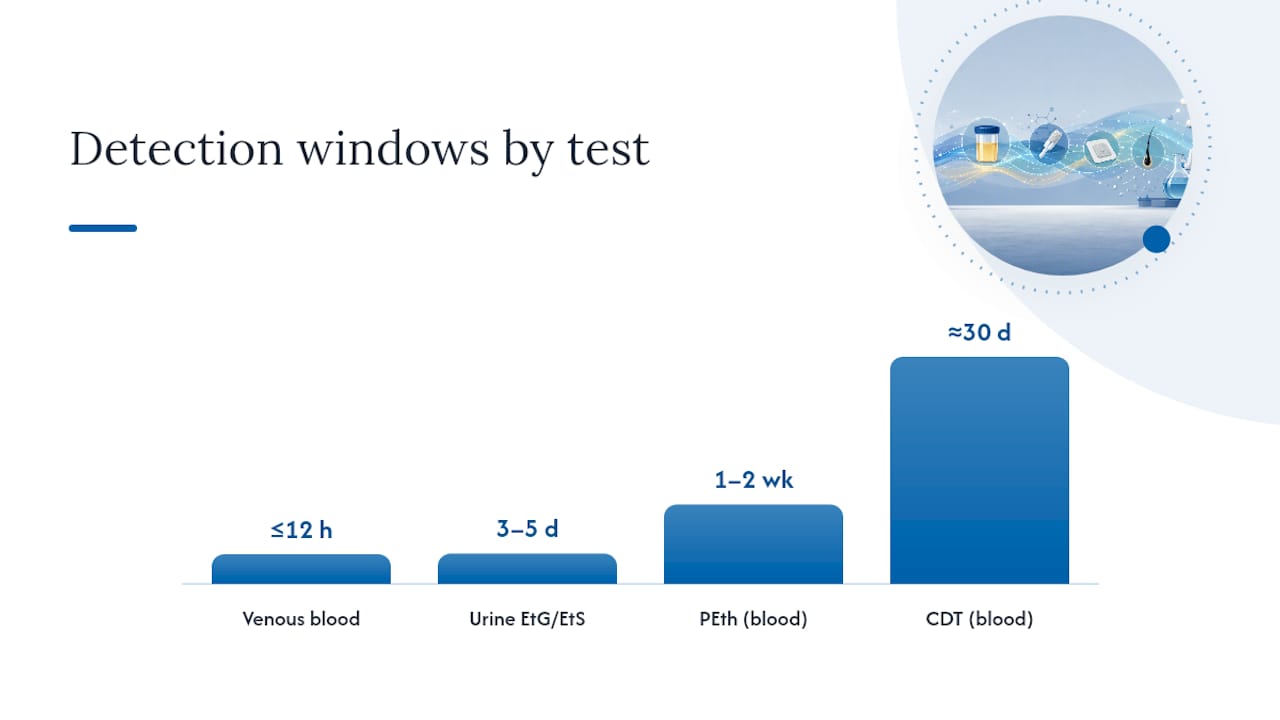
Here’s how those windows typically break down by specimen type:
| Test type | Typical detection window | Best use case |
|---|---|---|
| Venous blood (ethanol) | Up to 12 hours | Current intoxication, legal evidence |
| Breath (evidential) | Hours (mirrors blood in real time) | Roadside/legal current intoxication |
| Urine EtG/EtS | 3 to 5 days | Recent use monitoring |
| PEth (blood) | 1 to 2 weeks or longer | Heavy/chronic use pattern |
| CDT (blood) | Around 30 days | Sustained heavy drinking |
Confusing a metabolite result with a “how intoxicated were they” answer is the single most common misread in alcohol testing, and it’s worth keeping that table in mind as you move through the rest of this guide.
Blood and Breath Testing: The Gold Standard and Its Nearest Rival
Venous blood BAC testing is the reference method against which every other alcohol test gets judged. A phlebotomist draws blood, the lab runs it through gas chromatography, and the result comes back as a precise weight/volume percentage. This method can detect alcohol for up to about 12 hours after the last drink, with the exact window shifting based on dose, body composition, and metabolism speed. Because the ethanol is measured directly from the bloodstream rather than estimated from another fluid, blood testing carries the least room for interpretation error, and it’s the method courts and hospitals lean on when a number has to hold up under scrutiny.
Breath testing works differently. Fuel-cell and infrared sensors estimate blood alcohol by measuring ethanol vapor in exhaled air, then apply a partition ratio to convert that reading into an equivalent BAC. Evidential breath devices used by law enforcement follow strict quality protocols: regular calibration checks, gas equivalent breath standard (GEBS) verification, and documented uncertainty of measurement so the result can survive legal challenge. Done correctly, breath testing tracks venous blood closely enough to serve as legal evidence in most jurisdictions.
Consumer breath devices are a different story entirely. A laboratory validation study of smartphone-paired breath testing devices found that many consumer units underestimated BAC relative to venous blood by more than a small margin, and some failed to flag the legal intoxication threshold over half the time compared to police-grade references.
The gap that matters: Some consumer breath devices missed the legal intoxication threshold more than 50% of the time in controlled lab testing, while others performed close to evidential standards. Brand and model matter enormously here. There’s no consistent floor of quality across the category.
That variability has real consequences. Someone relying on a bargain breath device to decide whether they’re safe to drive could be getting a number that’s meaningfully lower than reality.
A few practical rules for choosing between blood and breath:
- Use venous blood when a result needs to hold up in court, in an employment dispute, or in a medical emergency.
- Use evidential breath testing when speed matters and the device carries documented calibration records.
- Treat consumer breath devices as a rough guide only, never as a green light to drive or as proof in a dispute.
- Ask any breath-device vendor for calibration frequency and validation data before trusting the number.
If you’re evaluating a device’s legitimacy, the calibration paperwork tells you more than the marketing copy.
Metabolite Testing: EtG, EtS, PEth, and CDT Explained
EtG and EtS extend the detection window well past what blood or breath can offer. Your body converts a small fraction of consumed ethanol into these two metabolites, which then linger in urine for roughly 3 to 5 days after drinking, longer than ethanol itself would ever be detectable. Blood-based EtG windows run shorter than urine. Sensitivity climbs with heavier drinking, meaning EtG catches binge or sustained consumption more reliably than it catches a single light drink several days out.
Why this matters for interpretation: A positive EtG doesn’t tell you how much alcohol someone consumed or exactly when. It only confirms exposure occurred sometime within the detection window, which is a meaningfully different claim than “this person was drunk on Tuesday.”
That distinction trips up a lot of testing programs. EtG and EtS are presence/absence markers tied to a cutoff concentration, not a dose calculator. Someone who had one drink four days ago and someone who drank heavily two days ago could both test positive, and the test alone won’t tell you which happened. Incidental exposure adds another wrinkle: mouthwash, hand sanitizer, certain cooking extracts, and some medications contain enough ethanol to trigger a positive EtG without any intentional drinking. Our breakdown of EtG detection timing walks through realistic windows and how incidental exposure factors into interpretation.
PEth and CDT solve a different problem: identifying sustained, heavy alcohol use rather than a single recent episode. PEth is a phospholipid that forms only in the presence of ethanol and stays measurable in blood for 1 to 2 weeks or longer, with levels correlating reasonably well to the volume and frequency of recent drinking. CDT reflects a longer pattern, typically useful for spotting heavy consumption across roughly a 30-day stretch, though it responds more slowly to changes in drinking behavior than PEth does. Our guide to PEth detection windows covers how clinicians read those levels in practice.
When should metabolite testing get the nod over acute testing?
- Substance abuse treatment programs monitoring abstinence over weeks or months.
- Liver transplant evaluation, where sustained heavy drinking history matters more than a single reading.
- Workplace or legal monitoring programs that need a longer look-back than a breath test allows.
- Any case where an unexpected positive needs lab confirmation before consequences follow.
Wearable Alcohol Sensors: What Transdermal Devices Actually Measure
Transdermal alcohol sensors estimate blood alcohol by measuring ethanol vapor released through sweat, worn continuously on the wrist or ankle rather than sampled at a single moment. That constant readout is the appeal: instead of a single BAC number, you get a running curve of someone’s alcohol exposure over hours or days.
The accuracy picture is mixed. A systematic review of 32 studies on transdermal sensors found moderate to large correlations with blood and breath alcohol readings overall, but sensitivity varied enormously by device and brand. One commonly studied model, the WrisTAS, showed sensitivity ranging anywhere from 24% to 85.6% across different studies, a spread wide enough to make any single reading hard to trust in isolation.
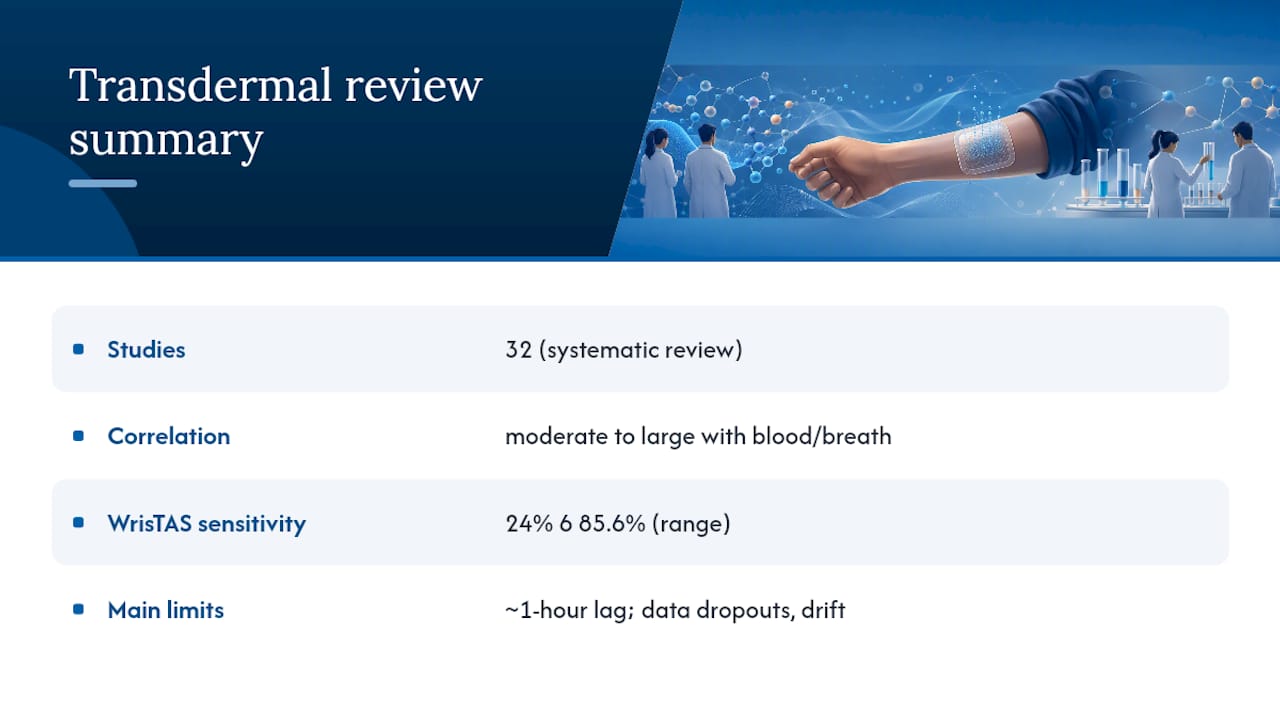
Two structural issues explain most of that gap. First, there’s a time lag between blood alcohol rising and sweat vapor catching up, so a transdermal sensor reading someone’s peak intoxication an hour after the fact isn’t unusual. Second, these devices fail to record data reliably in some study conditions, from skin contact issues to battery and calibration drift.
That combination makes transdermal sensors a poor substitute for blood or breath testing anytime a single-event, defensible number is needed. Their real strength is longitudinal: tracking a court-ordered abstinence program, supporting a behavioral intervention, or giving a treatment provider a pattern over days rather than a moment. Use them to watch a trend, not to prove a specific event.
What Actually Breaks Accuracy Before the Test Even Runs
Most alcohol test errors have nothing to do with the analytical instrument and everything to do with what happened before the sample reached it. A narrative review of the preanalytical phase in forensic and diagnostic blood alcohol testing found that collection, handling, and storage account for a disproportionate share of measurement error, far more than most people assume.
For blood draws specifically, a few details separate a defensible result from a disputed one:
- Use a nonalcoholic antiseptic to clean the draw site. Alcohol-based skin prep can contaminate the sample and inflate the reading.
- Fill collection tubes completely to minimize headspace, which reduces ethanol evaporation and volatilization loss.
- Store and transport samples at controlled cold temperatures to prevent microbial fermentation, which can artificially raise or lower ethanol readings over time.
- Document chain-of-custody at every handoff if the result may ever need to stand up in a legal or employment dispute.
On the instrument side, both breath devices and lab analyzers rely on documented calibration and quality control to mean anything. Evidential breath programs run regular gas standard checks and calculate a formal uncertainty of measurement for every result. Laboratory analyzers confirm screening positives with chromatographic methods like GC-MS or LC-MS/MS, which identify and quantify ethanol directly rather than relying on an indirect chemical reaction that other substances might trigger.
Pro Tip: Before you accept a lab or breath result at face value, ask the provider three questions: how recently the instrument was calibrated, whether the lab confirms positives with GC-MS or LC-MS/MS, and whether they can produce a documented chain-of-custody. A lab that answers all three without hesitation is one you can trust with a result that matters.
Reading a Result: Sensitivity, Cutoffs, and the False Positive/Negative Trap
A number on a lab report only means something once you know the context around it. Work through these steps before drawing a conclusion:
- Establish the timing. Compare when the test was collected against when the drinking event supposedly happened, and check whether that gap falls inside the test’s detection window.
- Check the cutoff used. Labs report EtG and EtS results against a specific cutoff concentration; a result just above cutoff carries different weight than one far above it.
- Rule out incidental exposure. Mouthwash, hand sanitizer, certain cough syrups, and even some foods can trigger a low-level positive EtG without intentional drinking.
- Consider medication interference. A handful of prescription and over-the-counter products can produce false signals on immunoassay screening tests specifically.
- Match the test to the claim being made. A positive breath test proves current intoxication; a positive EtG proves exposure sometime in the past several days, nothing more precise.
- Order confirmation for anything contested. Any screening result that carries real consequences, employment, legal, medical, deserves confirmatory testing by GC-MS or LC-MS/MS before anyone acts on it.
False negatives happen just as often as false positives, usually from testing outside the detection window or from a poorly collected sample that degraded before analysis. If a result doesn’t match the clinical or behavioral picture in front of you, the test timing and handling are the first places to look, not the person’s honesty.
Choosing the Right Alcohol Test for Your Situation
Match the test to the actual question you’re answering, not the test that’s easiest to buy.
- Need proof of current intoxication for legal or safety purposes? Venous blood or evidential breath testing, both with documented calibration and chain-of-custody.
- Need to confirm recent drinking within the last few days? Urine or blood EtG/EtS, ideally with lab confirmation on any positive.
- Monitoring abstinence or heavy use over weeks? PEth for a shorter look-back, CDT for a longer pattern.
- Tracking a person continuously over days? Transdermal sensors, understanding they’re for trend-spotting, not evidentiary proof.
Before ordering, confirm turnaround time, whether the lab holds SAMHSA, CLIA, or CAP accreditation, and whether positives get automatic confirmatory testing. Our guide on alcohol screening methods for workplace safety walks through how HR teams typically structure these decisions.
Why Lab Accreditation Changes What a Result Is Worth
A test result is only as defensible as the lab behind it. We work with licensed laboratories that meet regulatory standards governing everything from instrument calibration to chain-of-custody documentation. That matters because a result from an unaccredited source can be challenged or dismissed outright in an employment or legal dispute, no matter how confident the number looks on paper.
That lab network supports services that map directly onto what this article covers: confirmatory testing for screening positives, EtG and PEth ordering for monitoring programs, and at-home kits that route to certified labs for confirmation rather than relying on a screening card alone. For organizations building compliance programs, our overview of alcohol testing methods for HR breaks down how these pieces fit together in practice.
Balancing Accuracy, Cost, and Purpose in Real Testing Programs
The instinct to reach for the cheapest or fastest test is understandable, but it’s the wrong starting question. Start with what the result needs to survive: a legal challenge demands blood and documented chain-of-custody, no exceptions. A treatment program tracking abstinence gets more value from PEth than from a dozen breath tests. And anyone using a consumer breath device to decide whether they’re safe to drive should treat the number as a rough estimate, not a guarantee, given how inconsistently those devices performed in lab validation. Accuracy isn’t one fixed standard here. It’s a moving target that depends entirely on what you’re trying to prove.
— Alan
Get an Accurate Alcohol Test Result, Not Just a Fast One
Choosing the right test matters more than choosing the cheapest one, especially when a result might get challenged later. Our partnered laboratories meet regulatory standards, so confirmatory EtG, PEth, or CDT results come with documentation to support their reliability if questioned.
Our lab testing services include confirmatory blood and metabolite testing suitable for various monitoring programs and compliance needs, with turnaround times provided before ordering. If you’d rather start with a screening step, an at-home multi-panel test kit can be used with lab confirmation when needed for reliable results. For complex cases, forensic requests, or employer compliance programs, contact the main site to discuss which testing options may fit your situation before purchasing.
This article is general information, not a substitute for advice from a qualified doctor. Consult a qualified healthcare professional about your own circumstances before acting on anything here.
Sources
- Blood Alcohol Level: MedlinePlus Medical Test
- Accuracy of Consumer Marketed Smartphone-Paired Alcohol Breath Testing Devices: A Laboratory Validation Study
- Alcohol Use Biomarkers | Choose the Right Test
FAQ
How far back can an alcohol test detect alcohol?
It depends on the test: blood and breath detect alcohol for up to about 12 hours, urine EtG/EtS for 3 to 5 days, PEth for 1 to 2 weeks or longer, and CDT for roughly 30 days.
Why do I test positive for alcohol when I haven’t been drinking?
Incidental exposure from mouthwash, hand sanitizer, certain cooking extracts, or some medications can contain enough ethanol to trigger a positive EtG result even without intentional drinking. Learn more about how alcohol can show up unexpectedly on a drug test.
How much alcohol causes a positive EtG result?
There’s no fixed drink count that guarantees a positive EtG. Sensitivity is higher for heavier drinking, meaning binge or sustained consumption is far more likely to trigger a positive result than a single light drink, especially near the edge of the detection window.
Can alcoholism show up on routine bloodwork?
Routine bloodwork can show indirect signs of heavy, sustained drinking, such as elevated liver enzymes, but it isn’t a direct alcohol test. Biomarkers like PEth and CDT are the tests specifically designed to flag chronic heavy use.