
EtG Test Detection Time: Realistic Urine Windows Explained
For most people, an EtG urine test will detect alcohol use within a window of 24 to 72 hours after drinking, though the exact range depends heavily on how much was consumed and which lab cutoff the program uses. Light drinking (one to two drinks) often clears below the 200 ng/mL threshold within 24 hours. Moderate drinking (three to five drinks) typically stays detectable for 24–48 hours. Heavy or binge drinking can push detection out to 72 hours or beyond, particularly at the most sensitive 100 ng/mL cutoff.
The widely repeated “up to 80 hours” figure is technically possible in heavy-use scenarios at very low cutoffs, but research shows it is not the norm. For most drinking episodes, the realistic window is shorter.
Typical EtG detection ranges by drinking level:
- Light (1–2 drinks): Under 24 hours at 200–500 ng/mL; up to 24 hours at 100 ng/mL
- Moderate (3–5 drinks): 24–48 hours across most cutoffs
- Heavy/binge (6+ drinks or multi-day): 48–72+ hours; may approach 80 hours at 100 ng/mL
How cutoff choice changes what gets detected:
| Cutoff | Sensitivity | Best for |
|---|---|---|
| 100 ng/mL | Highest — catches light and older drinking | Treatment monitoring, clinical research |
| 200 ng/mL | Moderate — balances sensitivity and specificity | General compliance programs |
| 500 ng/mL | Lowest — reduces incidental-exposure positives | Workplace screening, legal settings |
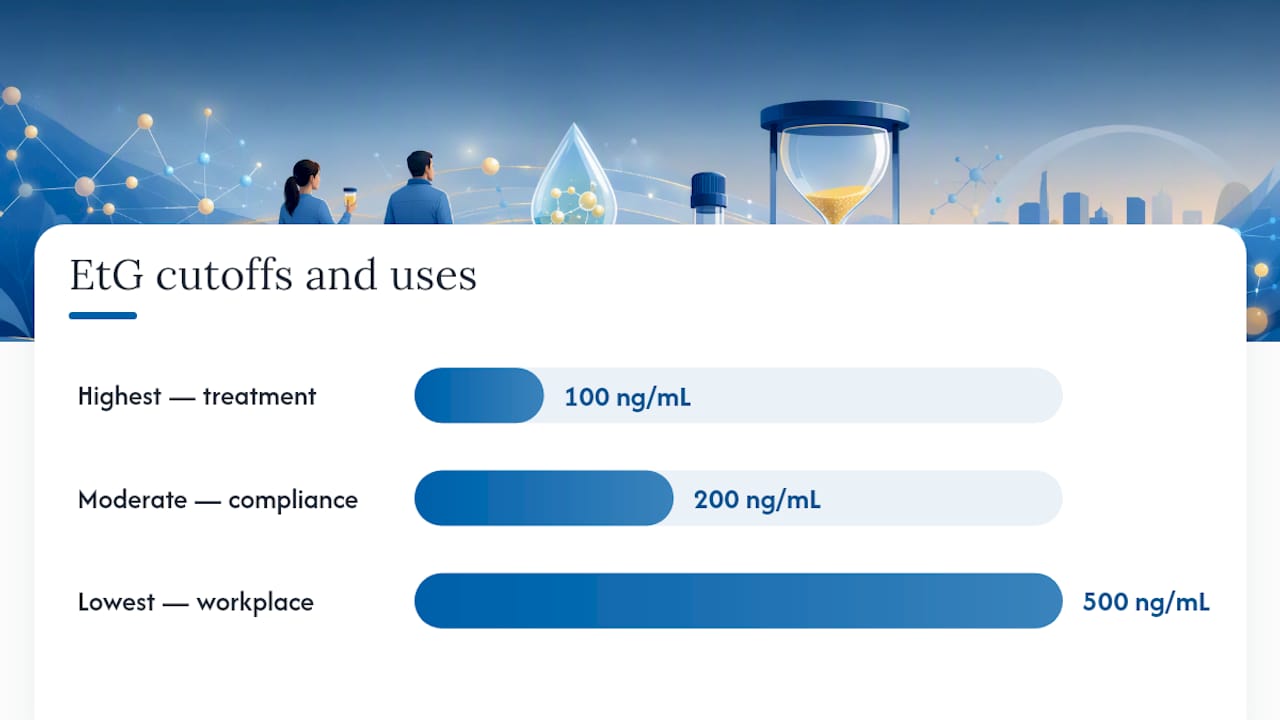
The cutoff is the single biggest operational variable in EtG testing. Choosing a low versus high cutoff can mean the difference between detecting a drink from a couple of days ago and missing it entirely.
Key Takeaways
For most drinking episodes, EtG is detectable in urine for 24–72 hours, and the lab cutoff is the single biggest factor determining whether a result comes back positive or negative.
| Point | Details |
|---|---|
| Realistic detection window | EtG is typically detectable for 24–72 hours; the “80-hour” claim applies mainly to heavy use at 100 ng/mL. |
| Cutoff drives sensitivity | A 100 ng/mL cutoff detects more than 80% of drinkers within 24 hours; sensitivity falls below 40% at 24–48 hours. |
| Confirm before acting | Any positive used for legal or employment decisions should be confirmed with LC-MS and paired with EtS testing. |
| Incidental exposures matter | Mouthwash and hand sanitizer can produce low-level EtG positives; creatinine and EtS results help distinguish them. |
| Countrywidetesting for testing | Countrywidetesting offers EtG dip cards and CLIA/CAP-accredited lab services for compliance and clinical needs. |
Table of Contents
- What is an EtG urine test and why do programs use it?
- How does EtG detection time change with cutoff and drinking amount?
- Why does EtG detection time vary from person to person?
- How should you interpret a positive or negative EtG result?
- How does EtG compare to breath, blood, EtS, and PEth tests?
- Who uses EtG tests, and what do turnaround time and cost look like?
- What should you ask before ordering an EtG test?
- The case for reading EtG results in context, not in isolation
- Countrywidetesting offers EtG testing kits and accredited lab services
- Sources
What is an EtG urine test and why do programs use it?
Ethyl glucuronide (EtG) is a direct metabolite of ethanol. When your body processes alcohol, the liver conjugates a portion of it into EtG, which then passes into urine. Because EtG is a byproduct of ethanol metabolism rather than ethanol itself, it stays detectable in urine long after the parent alcohol has cleared from your blood and breath.
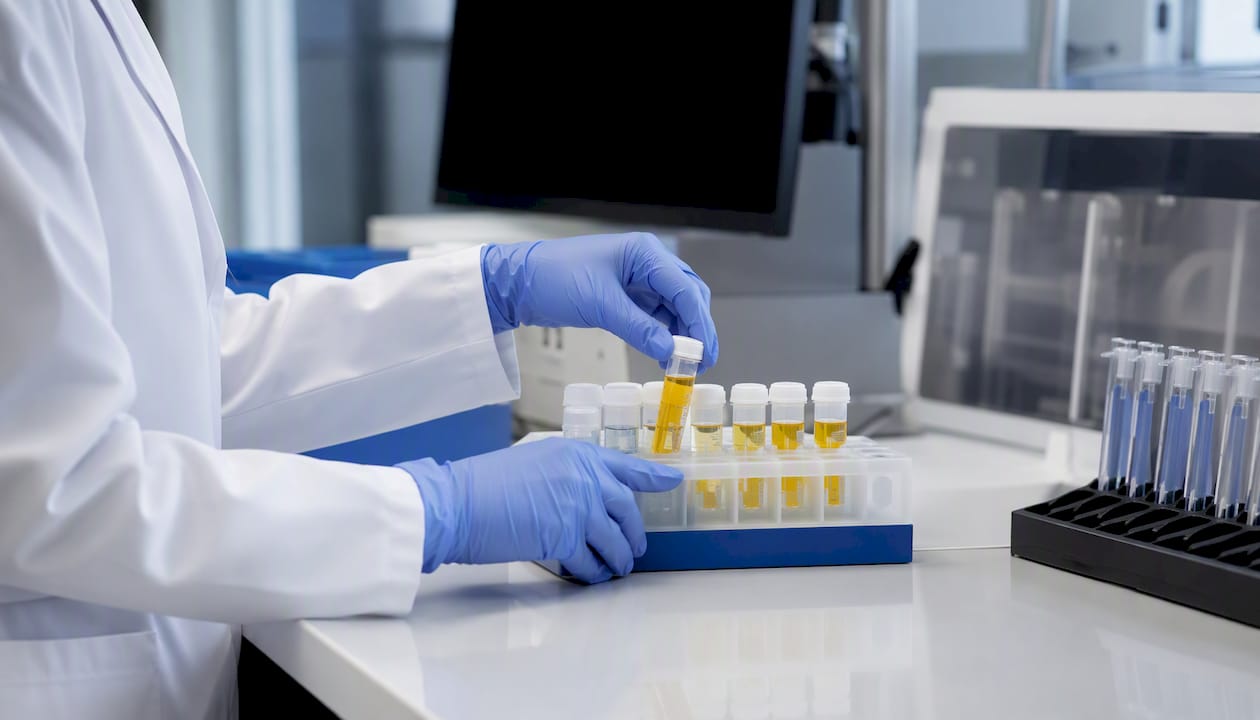
That distinction matters in practice. A breathalyzer measures active intoxication right now. A blood alcohol concentration (BAC) test does the same, with a window of roughly 12 hours. An EtG urine test, by contrast, looks back across the past one to three days, making it a fundamentally different tool for a fundamentally different question: not “is this person drunk?” but “did this person drink recently?”
EtG and EtS tests are more sensitive than ethanol tests and can detect recent drinking that breath or blood tests miss, though they cannot pinpoint exactly how much was consumed or precisely when.
Primary uses of EtG urine testing include:
- Addiction treatment monitoring: Outpatient and residential programs use EtG to verify abstinence between sessions
- Probation and court-ordered monitoring: Judges and probation officers rely on EtG to enforce alcohol-related conditions of release
- Workplace screening: Employers in safety-sensitive industries use EtG as part of return-to-duty or random alcohol monitoring programs
- Clinical research: Studies on alcohol use disorder use EtG as an objective biomarker for self-reported drinking
- At-home preliminary checks: Individuals in recovery or family members monitoring a loved one’s sobriety can use point-of-care EtG dip cards for informal screening
How does EtG detection time change with cutoff and drinking amount?
The EtG detection window is not a fixed number. It is a spectrum shaped by two variables above all others: how much alcohol was consumed and what cutoff the lab applies to call a result positive.
A controlled challenge study and pooled clinical-trial data showed that EtG sensitivity at 100 and 200 ng/mL cutoffs identified more than 80% of drinkers within 24 hours, but sensitivity fell below 40% at 24–48 hours and dropped to 21% or less at 49–72 hours across cutoffs. In plain terms: the further from the drinking episode, the less reliable any single cutoff becomes.
A separate outpatient study of alcohol-dependent patients found that a 100 ng/mL EtG cutoff detected the majority of heavy drinking up to five days, while higher cutoffs missed more of those positive cases. The tradeoff is that lower cutoffs also produce more false positives from incidental exposures.
Three scenarios that illustrate how this plays out:
- One drink the night before: At a 500 ng/mL cutoff, this will likely be negative by morning. At 100 ng/mL, it may still be positive 12–18 hours later, depending on the individual.
- Four to six drinks over an evening: Detectable at 200 ng/mL for roughly 24–36 hours; at 100 ng/mL, detection may extend to 48 hours.
- Binge or heavy multi-day drinking: At 100 ng/mL, detection can reach 72 hours and occasionally longer. At 500 ng/mL, the same episode may clear in 48 hours.
| Drinking level | 100 ng/mL window | 200 ng/mL window | 500 ng/mL window |
|---|---|---|---|
| Light (1–2 drinks) | Up to 24 hrs | Under 24 hrs | Under 12 hrs |
| Moderate (3–5 drinks) | 24–48 hrs | 24–36 hrs | 12–24 hrs |
| Heavy/binge (6+ drinks) | 48–72+ hrs | 36 hours | 24–48 hrs |
EtG is typically detectable for 24–72 hours after drinking, with the 80-hour upper bound applying mainly to heavy use at the lowest cutoffs. For most real-world scenarios, the window is closer to 24–48 hours.
Why does EtG detection time vary from person to person?
Even two people who drink the same amount on the same night can produce different EtG results the next morning. Biology, behavior, and lab methodology all contribute.
The main factors that lengthen or shorten the EtG window:
- Amount consumed: More alcohol means more EtG produced. This is the strongest predictor of detection time.
- Frequency and pattern of drinking: Chronic or repeated drinking can sustain EtG levels longer than a single episode of the same total volume.
- Individual metabolism: Enzyme activity (particularly alcohol dehydrogenase and glucuronyl transferase) varies by genetics, age, and liver health. Faster metabolizers clear EtG sooner.
- Hydration and urine concentration: High fluid intake dilutes urine, which can push EtG concentration below a lab cutoff and produce a negative result even when EtG is present. Dehydration concentrates urine and can make EtG appear higher. Aggressive fluid intake can reduce EtG concentration below the cutoff, which is why labs check creatinine alongside EtG.
- Renal function: Kidneys clear EtG from the body. Impaired renal function slows clearance; strong kidney function speeds it.
- Body mass: Larger body mass generally means more total body water, which dilutes ethanol and its metabolites.
- Age: Older adults tend to metabolize alcohol more slowly, which can extend EtG detection windows.
- Incidental non-beverage exposures: Mouthwash, hand sanitizer, some medications, and certain foods can introduce small amounts of ethanol into the body. These exposures typically produce low-level EtG results (often below 500 ng/mL), which is one reason many labs adopt higher cutoffs for workplace or legal testing. Peer-reviewed studies note that incidental exposures can cause low-level positives, prompting labs to weigh cutoff choice carefully.
Pro Tip: Labs and compliance programs often use creatinine normalization to account for urine dilution. A creatinine-corrected EtG result gives a more accurate picture of actual alcohol exposure than a raw concentration alone. If you are ordering or interpreting an EtG test, ask whether the lab reports creatinine alongside EtG.
How should you interpret a positive or negative EtG result?
A single EtG result is a data point, not a verdict. Interpreting it correctly requires context: which cutoff was used, how concentrated the urine was, and whether any incidental exposures could explain a low-level positive.
A stepwise approach to interpreting EtG results:
- Confirm the cutoff used. A positive at 100 ng/mL carries different implications than a positive at 500 ng/mL. Ask the lab or provider which threshold was applied.
- Check creatinine. If creatinine is below 20 mg/dL, the sample is likely diluted. A low EtG in a diluted sample may not be a true negative. Creatinine normalization, as supported by outpatient clinical data, reduces misinterpretation from concentrated or diluted samples.
- Ask about incidental exposures. Mouthwash used within hours of the test, hand sanitizer applied repeatedly, or certain over-the-counter medications can produce low-level EtG. Document any reported exposures before drawing conclusions.
- Confirm positives with a second method. Gas chromatography/mass spectrometry (GC/MS) or liquid chromatography/mass spectrometry (LC-MS) confirmation is the standard for any positive result used in a legal, employment, or clinical decision. Combining EtG with EtS or running LC-MS confirmation is the standard way to differentiate environmental exposure from actual beverage alcohol ingestion.
- Consider the retesting timeline. If a result is borderline or unexpected, retesting within 12–24 hours can clarify whether EtG is rising (suggesting recent drinking) or falling (consistent with clearance).
Why false positives happen and how to reduce them:
- Low cutoffs (100 ng/mL) are sensitive enough to pick up EtG from mouthwash or sanitizer
- Diluted samples can mask a true positive or create ambiguous readings
- Some medications contain trace ethanol
Confirmatory EtS (ethyl sulfate) testing alongside EtG significantly reduces false positives. EtS follows a similar metabolic pathway but is less susceptible to environmental contamination, so a positive EtG with a negative or low EtS is a flag for incidental exposure rather than beverage alcohol. SAMHSA guidance recommends that programs consider incidental exposure risk when selecting cutoffs and establish clear confirmation policies for clinical and legal use.
For a deeper look at what causes a false positive alcohol urine test, Countrywidetesting has a dedicated resource covering the most common sources and how labs handle them.
How does EtG compare to breath, blood, EtS, and PEth tests?
Each alcohol test answers a different question. Choosing the right one depends on what you need to know and how far back you need to look.
A practical comparison by detection window and purpose:
- Breathalyzer: Detects active intoxication only. Window is roughly 12–24 hours for ethanol itself, but practically speaking it reflects current BAC. Used for roadside checks and immediate impairment assessment.
- Blood alcohol (BAC): Similar window to breath, roughly 12 hours. More precise for quantifying intoxication level. Used in emergency medicine and forensic settings.
- EtG urine: Detects recent drinking across 24–72 hours (occasionally longer at low cutoffs). Cannot quantify how much was consumed. Best for compliance monitoring and treatment verification.
- EtS urine: Follows a similar window to EtG but is less affected by environmental ethanol. Often run alongside EtG to confirm results and reduce false positives.
- PEth (phosphatidylethanol): A blood-based biomarker that reflects heavy drinking over the past two to four weeks. Used in clinical and legal settings when a longer retrospective window is needed.
- Hair ethanol markers (FAEE/EtG in hair): Can detect heavy alcohol use over months. Rarely used in routine compliance programs due to cost and collection complexity.
When to prefer each approach:
For immediate impairment, breath or blood is the right tool. For verifying abstinence in a treatment or probation program over the past few days, EtG urine is the standard choice. When you need to reduce the chance of a false positive from environmental exposure, pairing EtG with EtS or running confirmatory LC-MS adds meaningful specificity. For a retrospective picture of chronic heavy use, PEth is more informative than EtG alone.
Employers and HR teams evaluating these options can find a practical breakdown of alcohol screening methods for workplace safety that covers when each test type fits different policy goals.
Who uses EtG tests, and what do turnaround time and cost look like?
EtG testing shows up across a wide range of real-world settings, each with its own policy requirements and operational expectations.
Common programs and their typical EtG policy choices:
- Outpatient addiction treatment: Frequent testing (weekly or more), often at 100–200 ng/mL to catch any drinking
- Probation and drug courts: Regular random testing, cutoffs vary by jurisdiction (commonly 200–500 ng/mL)
- Workplace return-to-duty programs: Less frequent but higher-stakes testing, often at 500 ng/mL to minimize incidental-exposure disputes
- Employee assistance programs (EAPs): Monitoring agreements following a workplace incident, cutoff and frequency set by the EAP provider
- Self-monitoring in recovery: At-home dip cards for personal accountability, typically 300–500 ng/mL
Turnaround time by test type:
- Point-of-care (POC) immunoassay dip cards: Results in 5–10 minutes. POC dipsticks detect EtG reliably up to about 24 hours for most drinking scenarios, though lab-based methods offer greater sensitivity and specificity.
- Lab-based immunoassay: Results typically within 24–48 hours of sample receipt at the lab
- Confirmatory LC-MS: Usually 48–72 hours; some labs offer expedited turnaround for urgent compliance needs
Cost expectations:
Point-of-care EtG dip cards are the most affordable option, suitable for routine screening. Lab immunoassay testing adds cost but provides a documented, defensible result. Confirmatory LC-MS carries the highest per-test cost and is reserved for cases where a positive will have legal or employment consequences. For a broader view of urine drug test detection timeframes and how cost scales with test type, Countrywidetesting’s educational resources cover the full spectrum.
What should you ask before ordering an EtG test?
Not all EtG tests are equal. The cutoff, assay type, confirmation policy, and lab accreditation all affect whether a result is defensible and correctly interpreted.
Why labs choose specific cutoffs:
Labs select cutoffs based on the program’s tolerance for false positives versus false negatives. A 100 ng/mL cutoff maximizes sensitivity but risks flagging incidental exposures. A 500 ng/mL cutoff reduces those flags but will miss light or older drinking. The NCBI’s review of alcohol biomarkers notes that detection windows are context-dependent and that assay sensitivity is a key variable programs must specify upfront.
Questions to ask the lab or provider before ordering:
- What cutoff (ng/mL) does this test use?
- Is this an immunoassay screen, or does it include LC-MS confirmation?
- Does the lab report creatinine alongside EtG?
- What is the turnaround time from sample receipt to result?
- Is the lab CLIA-certified, CAP-accredited, or ISO-certified?
- Does the collection process include chain-of-custody documentation?
- What is the lab’s policy for borderline or low-level positives?
Why accreditation and chain-of-custody matter:
For any result used in a legal proceeding, employment decision, or clinical record, the lab must be CLIA-certified at minimum. CAP accreditation and ISO certification add additional layers of quality assurance. Chain-of-custody documentation tracks the sample from collection through analysis, making the result defensible if challenged. Without it, a positive EtG result can be disputed on procedural grounds regardless of its accuracy.
Understanding cut-off levels for drug tests and how labs set them is a practical starting point for anyone ordering EtG testing for compliance or clinical purposes.
The case for reading EtG results in context, not in isolation
The EtG test is one of the most useful tools available for detecting recent alcohol use. But it is also one of the most frequently misread, often because programs treat a positive result as self-explanatory when it rarely is.
A positive at 110 ng/mL in a diluted sample from someone who used mouthwash that morning is a very different finding from a positive at 800 ng/mL in a well-hydrated sample with no reported exposures. Both are “positive.” Neither tells the same story.
The tendency to anchor on the “80-hour” detection claim compounds this problem. That figure comes from best-case scenarios: very heavy drinking, very low cutoffs, and individuals who metabolize EtG slowly. Applying it universally sets unrealistic expectations and can lead to unfair consequences when a result is borderline. Programs that combine EtG with EtS, require confirmatory LC-MS for any actionable positive, and document creatinine alongside results are doing it right. Programs that act on a single immunoassay screen at 100 ng/mL without confirmation are taking on unnecessary risk, both for the individual being tested and for the program’s own legal defensibility.
The practical advice here is straightforward: match the cutoff to the program’s purpose, confirm before acting, and treat the result as one piece of evidence rather than the whole case.
Countrywidetesting offers EtG testing kits and accredited lab services
When you need EtG testing that holds up, whether for personal monitoring, employer compliance, or court-ordered verification, the quality of the test and the lab behind it matters as much as the result itself.
Countrywidetesting provides both point-of-care EtG dip cards and access to certified laboratory testing services backed by CLIA, CAP, and ISO-accredited labs. The 1 Panel EtG Alcohol Dip Card gives you a fast, affordable screening option for routine monitoring, while the lab testing services cover immunoassay screening and confirmatory LC-MS for results that need to stand up in a clinical or legal context. Employers and compliance programs can also access custom testing solutions with chain-of-custody documentation built in. To order a kit or get a quote for lab-based EtG testing, visit the Countrywidetesting lab services page and select the option that fits your program’s cutoff and confirmation requirements.
Sources
The sources below represent the most authoritative references on EtG detection time, cutoff science, and interpretation guidance. For clinical policy decisions, start with the SAMHSA/NIAAA advisory. For detection-time research grounded in controlled data, the PMC challenge studies are the primary evidence base.
- Ethylglucuronide and Ethyl Sulfate Assays in Clinical Trials, Interpretation and Limitations: Results of a Dose Ranging Alcohol Challenge Study and Two Clinical Trials
- Using Ethyl Glucuronide in Urine to Detect Light and Heavy Drinking in Alcohol Dependent Outpatients
- Urine Alcohol Levels: Chart, Comparison, Other Tests
- Alcohol urine test
- Advisory: Role of Biomarkers in the Treatment of Alcohol Use Disorders (SAMHSA advisory hosted on NIAAA site)
This article is general information, not a substitute for advice from a qualified doctor. Consult a qualified healthcare professional about your own circumstances before acting on anything here.