
Drug Test Detection Windows: What They Measure and How Long
TL;DR:
- A detection window measures how long a drug or its metabolites remain above the test’s cutoff, indicating detectability. It varies by specimen type, from hours in blood and saliva to months in hair, depending on individual and test factors. Confirmatory testing and lab questions are essential to interpret these windows accurately for legal or clinical purposes.
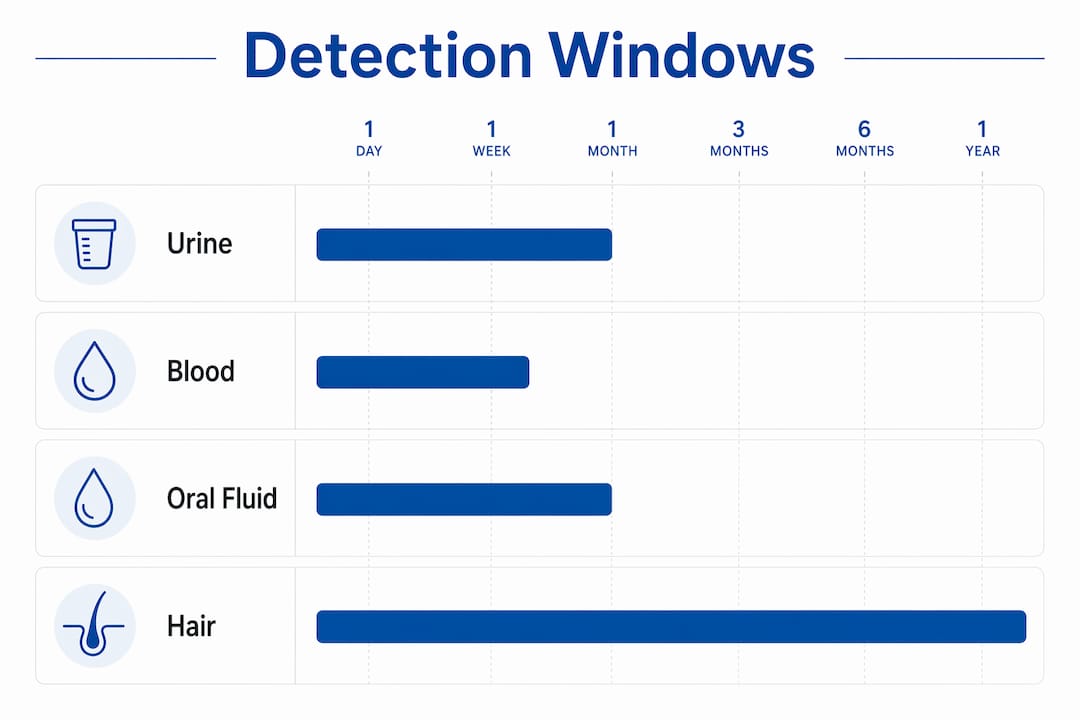
A detection window in drug testing is the span of time during which a parent drug or its metabolites remain at or above a test’s analytical cutoff concentration, making the sample reportable as positive. The window starts when the substance first becomes detectable in a given specimen and ends when concentrations fall below that threshold. Ranges vary considerably by specimen type:
- Blood/plasma: typically hours to a couple of days for most substances
- Oral fluid/saliva: usually up to 48 hours
- Urine: most drugs detectable for several days after a single use; chronic cannabis use can extend this to a longer period
- Hair: scalp hair reflects roughly 90 days of exposure; body hair may capture use up to 12 months prior
These ranges come from clinical drug testing research published through NCBI/PMC (StatPearls), laboratory reference data from ARUP Consult, and workplace testing standards set by SAMHSA. All three are the primary authorities you should consult when you need specimen-specific or assay-specific figures.
Key fact: Detection windows measure the presence of a drug or metabolite above a cutoff — not impairment, not quantity consumed, and not how long the substance was pharmacologically active.
Table of Contents
- What does “detection window” actually mean in a drug test?
- How detection windows differ by specimen type
- Typical detection times by drug class
- What factors lengthen or shorten a detection window?
- How screening and confirmatory testing affect detection windows
- What should you ask your lab before testing?
- At-home screens vs. certified lab testing: which do you need?
- Key Takeaways
- Reliable drug testing starts with the right test for the right purpose
What does “detection window” actually mean in a drug test?
The term gets used loosely, but the clinical definition is precise. A detection window measures how long a substance remains above the analytical cutoff of a specific assay in a specific specimen matrix. That distinction matters because two tests for the same drug can produce different windows depending on what they target and how sensitive they are.
Parent drug vs. metabolite
Most immunoassay screens do not detect the original drug molecule. They detect metabolites, which are the breakdown products the body produces after metabolizing the substance. Cocaine, for example, is rapidly metabolized in the body; labs typically report cocaine exposure by detecting benzoylecgonine, the primary urinary metabolite. Because benzoylecgonine persists in urine far longer than cocaine itself, the detection window for “cocaine use” in urine is actually the window for benzoylecgonine. The same logic applies to cannabis: tests target THCCOOH (11-nor-9-carboxy-THC), not THC itself, which is why the urine window for cannabis extends well beyond the hours of psychoactive effect.
Cutoff levels and what they change
Every assay has a cutoff concentration, expressed in nanograms per milliliter (ng/mL). A sample is reported positive only when the analyte concentration meets or exceeds that threshold. SAMHSA sets standard workplace cutoffs for federally mandated testing panels, and those cutoffs directly shape the effective detection window. A lab running a more sensitive assay with a lower cutoff will detect the same substance for a longer period than a lab using a higher cutoff. This is why two labs can give you different windows for the same drug.
Screening vs. confirmatory testing
Initial screens use immunoassay techniques, which are fast and cost-effective but susceptible to cross-reactivity. A positive screen is presumptive, not definitive. Confirmatory testing with gas chromatography–mass spectrometry (GC‑MS) or liquid chromatography–tandem mass spectrometry (LC‑MS/MS) identifies the specific analyte with high specificity and often at lower detection limits, which can extend the effective window further.
Onset timing
Detection windows also have a starting point. Most substances become detectable in urine approximately 2 hours after use, though this varies by route of administration and individual metabolism. Oral fluid reflects plasma concentrations almost immediately after use. Hair has a delayed onset because the drug must be incorporated into the hair shaft as it grows above the scalp, typically taking 7–10 days before the use period appears in the sample.
Pro Tip: Before relying on any published detection range, ask the lab whether they report the parent drug or a specific metabolite and what cutoff (ng/mL) they use. A lab running a 15 ng/mL THCCOOH cutoff will detect cannabis use significantly longer than one using a 50 ng/mL cutoff.
How detection windows differ by specimen type
The specimen matrix you choose determines the detection window more than almost any other variable. Each matrix has a different biological mechanism for accumulating and clearing drugs, which produces distinct onset times, peak windows, and clearance rates.
| Specimen | Onset After Use | Typical Detection Window | Best Used For |
|---|---|---|---|
| Urine | ~2 hours | several days (most drugs); extended period for chronic cannabis | Workplace, clinical, and compliance screening |
| Blood/plasma | Minutes | Hours to a couple of days | Recent use, quantification, emergency/impairment |
| Oral fluid/saliva | Minutes | Up to ~48 hours | Roadside, recent-use, parent-drug detection |
| Sweat patch | Hours | Days to several weeks (cumulative) | Ongoing monitoring, probation |
| Hair (scalp) | ~7–10 days post-use | ~90 days (1.5-inch sample) | Historical exposure, retrospective review |
| Hair (body) | Weeks post-use | Up to ~12 months | Long-term historical use |
Urine is the most widely used matrix for point-of-care testing in the United States. Detection windows generally range from several hours to a few days, with most substances becoming detectable approximately 2 hours after use. Chronic or heavy use can extend detectability to several weeks for certain substances, particularly cannabis metabolites. Urine pH and hydration status also affect urinary drug concentrations, which is why labs routinely check creatinine and osmolality to assess specimen validity.
Blood/plasma offers a short but precise window. It is primarily used in emergency settings and for quantification of ethanol and other substances. The detection window typically spans a couple of days, making blood most useful for assessing recent exposure or impairment rather than historical use.
Oral fluid mirrors plasma concentrations closely and detects parent compounds more often than urine does. The detection window is typically up to 48 hours for most substances, with onset occurring shortly after use. This makes oral fluid well-suited for post-accident or reasonable-suspicion testing.
Sweat patches provide a cumulative measure of exposure over the entire wear period, which can range from days to weeks. The extended window is an advantage for monitoring programs, though contamination and incomplete adhesion are practical limitations.
Hair offers the longest retrospective window. Scalp hair typically reflects approximately three months of exposure in a standard 1.5-inch sample, while body hair such as pubic or axillary hair may capture use up to about a year prior. The tradeoff is a delayed onset and different interpretive rules compared to urine or blood.
Worth knowing: Hair testing is not appropriate for detecting recent use. If someone used a substance within the past week, a hair test may not capture it yet. Use urine or oral fluid for recent-use assessment.
Typical detection times by drug class
Detection windows vary significantly across drug classes, primarily because of differences in metabolite half-lives, lipophilicity, and how the body processes each substance. The table below reflects typical urine detection periods for commonly screened substances.
| Drug Class | Key Analyte Detected | Urine Window (Single Use) | Urine Window (Chronic Use) | Notes |
|---|---|---|---|---|
| Amphetamines | Amphetamine/methamphetamine | a few days | a few days | Urinary pH affects elimination rate |
| Cocaine | Benzoylecgonine (metabolite) | a few days | up to about one week | Parent drug clears in hours |
| Cannabis (THC) | THCCOOH (metabolite) | a few days | several weeks or longer | Highly lipophilic; accumulates in fat tissue |
| Opioids (heroin, morphine) | Morphine/codeine | a few days | a few days | 6-MAM (heroin marker) clears in hours |
| Oxycodone | Noroxycodone (metabolite) | several days | several days | Requires specific panel inclusion |
| Fentanyl | Norfentanyl (metabolite) | a few days | a few days | Not on standard panels; requires expanded test |
| Benzodiazepines | Oxazepam (metabolite) | several days to about a week | up to a few weeks | Long-acting agents (e.g., diazepam) persist longer |
| Barbiturates | Phenobarbital | a few days (short-acting) | Approximately 3 weeks (phenobarbital) | Half-life varies widely by agent |
| PCP | PCP | Approximately 7 days | Several days to a few weeks | Highly lipophilic |
| MDMA | MDMA/MDA | Up to 4 days | Up to 4 days | Cross-reacts with amphetamine immunoassays |
| Methadone | Methadone/EDDP | several days | several days | Requires specific methadone assay |
A few outliers deserve attention. Chronic cannabis use produces the longest and most variable urine window of any commonly tested substance, because THCCOOH is lipophilic and accumulates in fat tissue. Heavy, daily users can test positive for THCCOOH for 4–6 weeks after last use. Long-acting benzodiazepines like diazepam and its active metabolite desmethyldiazepam can persist for weeks in chronic users. Phenobarbital, a long-acting barbiturate, has a half-life that can extend its urine window to approximately three weeks.
Fentanyl and synthetic opioids are not included on standard 5-panel or 10-panel immunoassay screens. If fentanyl detection is required, you need to specifically request an expanded panel that targets norfentanyl.
Pro Tip: For drug-specific half-lives and urine detection window estimates, consult ARUP Consult’s drug half-lives table and the StatPearls tables on NCBI. Both are freely accessible and regularly updated with lab-referenced data.
What factors lengthen or shorten a detection window?
Two people with identical drug use histories can produce very different test results. The detection window is not a fixed biological clock. It shifts based on a combination of biological, behavioral, and technical variables.
Biological factors
- Metabolism rate: Genetic variation in liver enzymes (particularly CYP450 isoforms) means some people clear drugs two to three times faster than others.
- Body fat percentage: Lipophilic drugs like THC and PCP accumulate in adipose tissue and release slowly back into circulation, extending the urine window substantially in people with higher body fat.
- Liver and kidney function: Impaired hepatic or renal function slows elimination and can extend detection windows beyond typical ranges.
- Urine pH and hydration: Alkaline urine slows the excretion of basic drugs like amphetamines; acidic urine accelerates it. High fluid intake dilutes urine, potentially dropping concentrations below the cutoff temporarily.
Behavioral factors
- Dose: Higher doses produce higher peak concentrations and longer detection windows, simply because there is more substance to clear.
- Route of administration: Intravenous use produces rapid, high peak concentrations. Oral ingestion results in slower absorption and a more gradual rise and fall.
- Frequency and chronicity: Single-use events clear faster than repeated use, which builds up tissue concentrations. This effect is most pronounced with cannabis and long-acting benzodiazepines.
- Time since last use: The single most predictable variable. The further from last use, the lower the concentration.
Technical and operational factors
- Assay cutoff: A lower cutoff extends the detectable window; a higher cutoff shortens it. This is a lab-controlled variable, not a biological one.
- Target analyte: Labs measuring a long-lived metabolite will report positives longer than labs targeting the parent drug.
- Sample dilution or adulteration: Diluted specimens may fall below cutoff even when the substance is present. Labs check for this with validity testing.
- Specimen collection timing: Collecting a sample at peak excretion versus trough can produce very different concentration readings.
Pro Tip: If you are interpreting a result for compliance or legal purposes, check whether the lab ran a specimen validity test alongside the drug screen. A dilute specimen (low creatinine) may produce a false-negative even within the expected detection window.
How screening and confirmatory testing affect detection windows
The type of assay a lab uses is not just a technical detail. It directly shapes what gets detected and for how long.
Immunoassay screening
Initial drug screens use immunoassay technology, which works by detecting the presence of a target analyte class rather than a specific molecule. These tests are fast, inexpensive, and well-suited for high-volume screening. The tradeoff is cross-reactivity: certain medications and structurally similar compounds can trigger a positive result for a drug the person never used. Benzodiazepine immunoassays, for instance, typically target oxazepam and may miss clonazepam or alprazolam entirely, producing a false negative for those specific agents.
| Assay Type | Turnaround | Specificity | Common Use | Effect on Detection Window |
|---|---|---|---|---|
| Immunoassay (screen) | Minutes to hours | Moderate (cross-reactivity risk) | Initial workplace, clinical, POC screening | Broader window; may detect drug class, not specific agent |
| GC‑MS (confirmatory) | 24–72 hours | Very high | Confirm positive screens; legal/forensic | Precise analyte ID; lower detection limits may extend window |
| LC‑MS/MS (confirmatory) | 24–72 hours | Very high | Expanded panels, synthetic opioids, low-concentration analytes | Highest sensitivity; longest effective window for trace analytes |
Confirmatory testing with GC‑MS and LC‑MS/MS
When a screen returns positive, confirmatory testing with GC‑MS or LC‑MS/MS identifies the exact molecule present and quantifies it. These methods have significantly lower detection limits than immunoassays, which means they can detect trace concentrations that a screen would miss. In practice, this can extend the effective detection window for certain analytes. SAMHSA-compliant workplace testing requires GC‑MS or LC‑MS/MS confirmation before a positive result is reported to an employer.
How cutoffs interact with assay type
SAMHSA sets standard cutoff concentrations for federally mandated workplace panels. For example, the SAMHSA initial test cutoff for THC metabolites in urine is 50 ng/mL, with a confirmatory cutoff of 15 ng/mL. A sample that screens negative at 50 ng/mL might confirm positive at 15 ng/mL. Understanding how to interpret lab results requires knowing which cutoff applies at each stage of the testing process.
- Positive screen + positive confirmation = reportable positive
- Positive screen + negative confirmation = reported negative (screen was a false positive)
- Negative screen = no confirmation needed; reported negative
What should you ask your lab before testing?
Getting accurate information about detection windows requires asking the right questions. Published ranges are population-level estimates. Your specific result depends on the lab’s assay, cutoffs, and specimen handling.
Checklist of questions to ask your testing laboratory:
- What specimen matrix does this test use? (urine, oral fluid, hair, blood)
- Which specific analytes or metabolites does the assay target? (e.g., THCCOOH, benzoylecgonine, norfentanyl)
- What is the initial screening cutoff? (in ng/mL)
- What is the confirmatory cutoff, and which method is used? (GC‑MS or LC‑MS/MS)
- What is the typical detection window your lab uses for this analyte?
- Are results reported qualitatively (positive/negative) or quantitatively (concentration)?
- Does the lab follow SAMHSA, CLIA, CAP, or ISO standards for this test?
- What is the expected turnaround time from specimen receipt to result?
- Is chain-of-custody documentation included? (required for employment and legal use)
For employment or legal testing, chain-of-custody documentation is not optional. It creates an unbroken record of specimen handling from collection through reporting, which is required for results to hold up in court or satisfy federal employer requirements. SAMHSA-compliant testing also requires a Medical Review Officer (MRO) to review positive results before they are reported to the employer.
If you are ordering testing for legal or forensic purposes, ask specifically about lab tests for legal cases and confirm that the lab provides MRO review and chain-of-custody documentation as part of the service.
At-home screens vs. certified lab testing: which do you need?
The right test depends entirely on what you need the result for. At-home screens and certified lab tests serve different purposes, and choosing the wrong one can leave you with results that are either unactionable or inadmissible.
When an at-home screen is appropriate:
- Private, personal screening to check for recent use
- Quick preliminary check before a scheduled lab test
- Situations where chain-of-custody and legal defensibility are not required
- Cost-sensitive screening where a presumptive result is sufficient
At-home tests like the 12-panel urine dip card or the 12-panel cup test are FDA-cleared for home use and screen for the most common drug classes. The FDA notes that home-use drug tests have limitations compared with laboratory testing and recommends follow-up lab confirmation for any result with significant consequences.
When certified lab testing is necessary:
- Employment screening (pre-employment, random, post-accident, reasonable suspicion)
- Court-ordered or probation testing
- Clinical monitoring or treatment compliance
- Any situation requiring legally defensible, chain-of-custody documentation
- Confirmatory testing after a positive screen
Certified labs use validated GC‑MS or LC‑MS/MS methods and operate under SAMHSA, CLIA, and CAP standards. Countrywidetesting provides access to licensed laboratories that meet these standards, offering both urine and mouth-swab test kits alongside lab-processed confirmation services.
Checklist for choosing the right service:
- Does the result need to be legally defensible? → Certified lab with chain-of-custody
- Is the specimen type urine, oral fluid, or hair? → Confirm the lab supports that matrix
- Do you need confirmatory GC‑MS/LC‑MS/MS? → Verify it is included or available
- What turnaround time do you need? → At-home screens are immediate; lab results typically take 24–72 hours
- Is SAMHSA compliance required? → Confirm the lab is on the SAMHSA-certified lab list
Pro Tip: If results will be used in an employment decision or legal proceeding, choose a lab-processed test with documented chain-of-custody and GC‑MS or LC‑MS/MS confirmation. An at-home screen cannot substitute for this, regardless of the result.
Key Takeaways
A drug test’s detection window measures how long a substance or its metabolites remain above a lab’s cutoff — not how long the drug was active — and that window varies from hours in blood to months in hair depending on the specimen and the individual.
| Point | Details |
|---|---|
| Detection window definition | The period a drug or metabolite stays above an assay’s cutoff; it measures detectability, not impairment. |
| Specimen determines the window | Blood and saliva windows last hours to ~48 hours; urine several days (several weeks or longer for chronic cannabis); hair up to approximately 90 days. |
| Chronic use extends windows | Cannabis metabolites can persist 4–6 weeks in urine for heavy daily users; long-acting benzodiazepines and PCP also extend substantially. |
| Ask the lab for specifics | Confirm the analyte targeted, cutoff (ng/mL), and assay type before relying on any published detection range. |
| Countrywidetesting for lab-confirmed results | Countrywidetesting connects you to SAMHSA/CLIA/CAP-certified labs for urine and oral-fluid testing with GC‑MS/LC‑MS/MS confirmation and chain-of-custody documentation. |
A note on reading results without over-interpreting them
Most people who look up detection windows are trying to understand what a positive or negative result actually means. The answer is more nuanced than a simple pass/fail.
A positive result tells you that a specific analyte exceeded the lab’s cutoff concentration during that specimen’s detection window. It does not tell you when the substance was used, how much was consumed, or whether the person was impaired at any point. Cross-reactivity in immunoassay screens can also produce positives for substances the person never used, which is exactly why confirmatory testing exists.
A negative result is equally limited. It means the targeted analyte was not detected above the cutoff in that specimen at that time. It does not rule out substance use. The person may have used outside the detection window, used a substance not included on the panel, or produced a dilute specimen that fell below the threshold. Benzodiazepine screens are a particularly common source of confusion here: standard immunoassays target oxazepam and may not detect clonazepam, alprazolam, or other agents at all.
When results carry real consequences, whether for employment, legal proceedings, or clinical decisions, confirmatory testing and consultation with a Medical Review Officer or qualified clinician are the appropriate next steps. A result is a data point, not a verdict.
Reliable drug testing starts with the right test for the right purpose
Knowing the detection window is only half the equation. The other half is choosing a test that actually matches your need, whether that is a quick private screen or a legally defensible lab result with full chain-of-custody documentation.
Countrywidetesting gives you both options in one place. For private, at-home screening, the site offers multi-panel urine kits that cover the most common drug classes with results in minutes. For employment, legal, or clinical needs, Countrywidetesting connects you to licensed laboratories certified under SAMHSA, CLIA, and CAP standards, with GC‑MS/LC‑MS/MS confirmation and chain-of-custody documentation built into the process. You can order directly online without a lengthy quoting process.
Browse lab testing services to review available panels, specimen types, and turnaround times, or start with an at-home kit if you need a fast preliminary result. Either way, you will know exactly what you are ordering and what the result means.
This article is for general informational purposes only and does not constitute medical, legal, or professional advice. Consult a qualified professional or your testing laboratory for guidance specific to your situation.
Authoritative sources and further reading
The following primary references were used throughout this article. Consult them directly for assay-specific cutoffs, half-life tables, and specimen-by-specimen detection ranges.
- StatPearls: Drug Testing (NCBI Bookshelf) — urine detection windows, specimen comparisons, and screening panel composition
- StatPearls: Clinical Drug Testing (NCBI Bookshelf) — clinical roles of drug testing, matrix differences, and metabolite targeting
- ARUP Consult: Drug Half-Lives and Urine Detection Windows — drug-by-drug half-life and urine window estimates with lab-specific notes
- ARUP Lab: Cocaine Metabolite Test Detail — specific analyte targeting for cocaine and metabolite detection
- PMC: Objective Testing — Urine and Other Drug Tests — peer-reviewed review of detection windows and chronic-use considerations
- MSD Manuals: Drug Testing Overview — specimen selection, hair and blood windows, and clinical use cases
- FDA: Drugs of Abuse Home Use Test — consumer guidance on at-home test limitations and follow-up recommendations
- SAMHSA — workplace testing cutoffs, panel standards, and MRO requirements (consult SAMHSA.gov directly for current mandatory guidelines)