
PEth Detection Time: How Far Back Does It Go?
PEth (phosphatidylethanol) is generally detectable in whole blood for about 2–4 weeks after alcohol consumption, though that window shifts based on drinking pattern, the lab’s cutoff threshold, liver function, and red blood cell turnover. For a single light drink, detection is unlikely beyond a few days at standard cutoffs. For chronic heavy use, some labs report positive results beyond four weeks.
Here is how peth detection time breaks down by drinking pattern:
- Single light drink (1–2 standard drinks): Detectable for roughly 1–3 days at sensitive cutoffs; often undetectable within 24–48 hours at ≥20 ng/mL.
- Moderate single episode (3–5 drinks): Typically detectable for up to 1 week.
- Binge episode (6+ drinks in one night): Detection window commonly extends to 1–2 weeks.
- Repeated weekly drinking: Likely detectable for 2–3 weeks after the last drink.
- Chronic daily heavy use: Detection can reach 3–4 weeks or longer, especially at lower lab cutoffs.
PEth is optimized to identify moderate to heavy alcohol use over the prior month. It is not a reliable tool for confirming absolute abstinence in someone who drinks occasionally.
Key Takeaways
PEth typically detects moderate to heavy alcohol use for 2–4 weeks after the last drink, with chronic use extending that window and lab cutoffs determining what counts as a positive result.
| Point | Details |
|---|---|
| Standard detection window | PEth is detectable for approximately 2–4 weeks; chronic heavy use can push this beyond four weeks. |
| Half-life drives clearance | PEth’s reported half-life of 4–10 days means a single binge clears faster than sustained daily drinking. |
| Cutoff determines the result | Labs using ≥20 ng/mL may miss light drinkers; ≥8 ng/mL captures more moderate use. |
| Context is required | BMI ≥30 and advanced liver disease both affect accuracy; always pair results with clinical history. |
| Countrywidetesting | Order PEth through CLIA/CAP/ISO-accredited labs via Countrywidetesting for results that meet clinical and forensic standards. |
Table of Contents
- How does PEth form, and what drives its detection window?
- What are the typical detection timelines for different drinking scenarios?
- How do lab cutoffs affect what a PEth result actually means?
- What factors make PEth detection longer or shorter for different people?
- How does PEth compare with other alcohol biomarkers?
- What does the PEth testing process actually look like?
- When do clinicians use PEth, and what are its limits?
- What do clinicians recommend for interpreting PEth results?
- A note on how we approach PEth testing support
- Ordering PEth testing through Countrywidetesting
- Sources
How does PEth form, and what drives its detection window?
PEth is not a direct metabolite of ethanol in the conventional sense. It forms through an enzymatic reaction: phospholipase D acts on phosphatidylcholine in red blood cell (RBC) membranes, substituting ethanol for choline to produce phosphatidylethanol. Because PEth embeds directly into RBC membranes, it persists far longer than ethanol itself, which clears the blood within hours.
The two predominant homologues measured in clinical labs are 16:0/18:1 (POPEth) and 16:0/18:2 (PLPEth). According to Mayo Clinic Laboratories, these two homologues correlate with the amount of alcohol consumed in the prior two weeks and may be detected up to 2–4 weeks after excessive consumption. POPEth alone accounts for roughly 37–46% of total PEth in some analyses, making it the primary analyte most labs target.
The reported half-life of PEth in whole blood is approximately 4–10 days. That range matters. At a 10-day half-life, meaningful concentrations can persist well past four weeks. Chronic drinking compounds this: each drinking episode adds to the existing RBC-bound PEth pool before prior amounts have fully cleared, pushing total concentrations higher and extending the detection window.
Key kinetic insight: Because PEth accumulates in RBC membranes rather than circulating freely in plasma, its clearance follows RBC lifespan dynamics, not simple hepatic metabolism. This is why PEth outlasts breath alcohol by days and urine EtG by over a week in heavy drinkers.
Labs typically report a limit of quantification (LOQ) around 10 ng/mL for PEth, though this is method-dependent. Below that threshold, a result may be reported as “not detected” even if trace amounts are present. The LOQ is not the same as the clinical cutoff, and understanding the difference is critical when interpreting a borderline result.
What are the typical detection timelines for different drinking scenarios?
Translating half-life into real-world timelines requires accounting for how much PEth accumulated in the first place. The table below reflects typical detection probabilities at a commonly used ≥20 ng/mL cutoff, though lower cutoffs will extend these windows.
| Drinking Scenario | Estimated Peak PEth | Typical Detection Window | Notes |
|---|---|---|---|
| Single light drink (1–2 drinks) | Very low | Up to 1–3 days | Often below cutoff at ≥20 ng/mL |
| Moderate single episode (3–5 drinks) | Low–moderate | Up to 1 week | More likely detectable at ≥8 ng/mL |
| Binge episode (6+ drinks, one night) | Moderate | 1–2 weeks | Detectable at most standard cutoffs |
| Repeated weekly drinking | Moderate–high | 2–3 weeks | Accumulation extends window |
| Chronic daily heavy use | High | 3–4+ weeks | May exceed 4 weeks at lower cutoffs |
A few practical distinctions worth keeping in mind:
- “Detectable” vs. “above cutoff” are not the same thing. A lab may detect trace PEth below its reporting threshold and still return a negative result. The clinical cutoff determines the reported outcome, not the instrument’s raw sensitivity.
- Frequency matters more than quantity per occasion when it comes to accumulation. Someone drinking moderately every day will often show higher PEth than someone who binge-drinks once a week, even if total weekly alcohol is similar.
- The last drink’s timing is the clock that starts the clearance countdown. PEth does not begin clearing until ethanol is no longer present to drive new synthesis.
For a broader look at how detection windows compare across test types, the underlying biology of each biomarker explains most of the variation.
How do lab cutoffs affect what a PEth result actually means?
Cutoff selection is one of the most consequential decisions in PEth testing, and it is often invisible to the person being tested. Research published in ScienceDirect evaluating PEth sensitivity and cutoffs found that cutoffs ranging from ≥2 to ≥20 ng/mL carry meaningfully different sensitivity and specificity trade-offs, with a ≥20 ng/mL threshold potentially missing some self-reported drinkers.
Here is how common cutoffs are generally interpreted in clinical and research practice:
- ≥2 ng/mL: Highly sensitive; may flag very light or incidental exposure. Used in some research protocols but rarely in routine clinical practice due to specificity concerns.
- ≥8 ng/mL: Balances sensitivity and specificity reasonably well for light-to-moderate drinking detection. More likely to capture someone who drinks a few times per week.
- ≥20 ng/mL: The most common threshold for identifying moderate-to-heavy use. Reduces false positives but may miss lighter drinkers. Often used in occupational and forensic contexts.
Lower cutoffs raise sensitivity, meaning they catch more drinkers, including light ones. But they also increase the chance of a positive result in someone whose exposure was minimal or incidental. Higher cutoffs favor specificity, which is useful when the clinical question is whether someone is drinking heavily, not whether they drank at all.
Serial monitoring adds another layer of value here. A single PEth result tells you where someone is at one point in time. Two results, spaced weeks apart, reveal a trend: rising, stable, or falling. That trajectory is often more clinically meaningful than any single number.
What factors make PEth detection longer or shorter for different people?
Two people with identical drinking histories can produce noticeably different PEth results. Several biological and technical variables drive that gap.
Biological factors
RBC lifespan is the most fundamental. Red blood cells live approximately 90–120 days, but PEth clearance does not track the full RBC lifespan. It follows the half-life of PEth within those cells, which runs 4–10 days. Individuals with conditions that shorten RBC survival, such as hemolytic anemia, may clear PEth faster.
BMI and liver disease are the two clinical variables with the clearest documented impact. Research cited by the AAFP notes that a BMI of ≥30 kg/m² is associated with lower PEth sensitivity, meaning heavy drinkers with obesity may test lower than expected. Advanced liver disease, conversely, can cause false elevations, making PEth results harder to interpret in patients with significant hepatic fibrosis.
Drinking-pattern factors
Quantity per occasion, frequency, and time since the last drink all interact. Chronic daily drinking produces the highest and most sustained PEth levels. Infrequent heavy episodes produce spikes that clear faster. The gap between last drink and test date is the single most controllable variable.
Laboratory and technical factors
Sample type affects results. Dried blood spot (DBS) collection is convenient and requires only a finger-prick, but venous whole blood generally provides more consistent analytic results. Assay sensitivity and the lab’s specific LOQ also vary. A lab with an LOQ of 5 ng/mL will detect lower concentrations than one reporting at 10 ng/mL.
Pro Tip: When ordering PEth for workplace or forensic purposes, always request documentation of the lab’s LOQ and cutoff thresholds. A result of “not detected” means different things depending on where the lab’s detection floor sits.
How does PEth compare with other alcohol biomarkers?
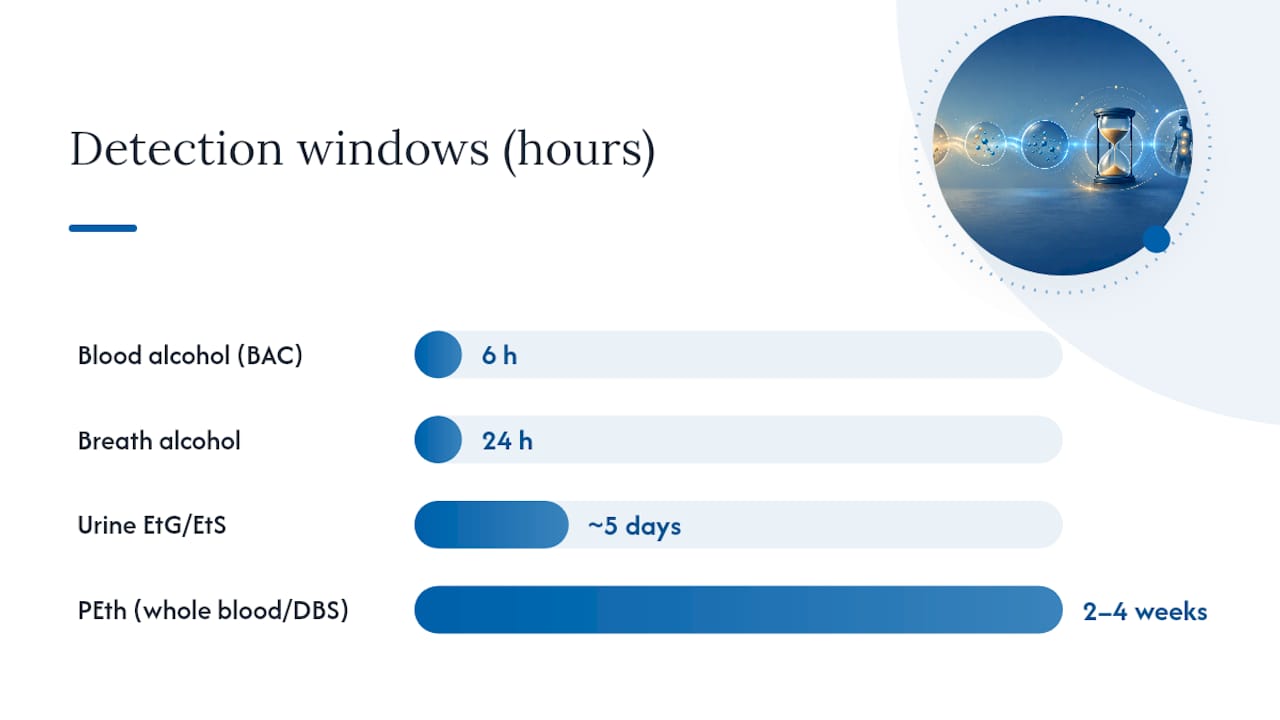
PEth’s 2–4 week window is its defining advantage over most other alcohol biomarkers. Mayo Clinic Laboratories confirms that PEth provides a substantially longer detection window than urine EtG/EtS, which typically detect alcohol up to approximately 5 days after consumption.
| Biomarker | Sample Type | Typical Detection Window | Best Use Case |
|---|---|---|---|
| Breath alcohol | Exhaled air | 24 hours | Immediate impairment screening |
| Blood alcohol (BAC) | Venous blood | 6 hours | Acute intoxication confirmation |
| Urine EtG/EtS | Urine | Up to ~5 days | Recent use (days), not chronic monitoring |
| CDT (carbohydrate-deficient transferrin) | Serum | Weeks to months | Chronic heavy use; less specific |
| GGT | Serum | Weeks to months | Chronic use; nonspecific, many confounders |
| PEth | Whole blood or DBS | 2–4 weeks (longer with chronic use) | Moderate-to-heavy use over prior month |
PEth is a direct biomarker of ethanol exposure, meaning it forms only when ethanol is present. CDT and GGT are indirect markers that reflect physiological changes caused by heavy drinking over time. They can be elevated by conditions unrelated to alcohol, which limits their specificity. Breath and blood alcohol confirm current intoxication but say nothing about what happened last week.
For alcohol screening in workplace safety programs, PEth is most appropriate when the question is whether someone has been drinking regularly over the past month, not whether they are impaired right now. When the clinical or forensic question requires both recent and acute information, combining PEth with a breath or urine test covers both windows.
What does the PEth testing process actually look like?
The practical steps are straightforward. PEth is measured from either a dried blood spot (DBS) collected via finger-prick or venous whole blood drawn by a phlebotomist. DBS collection is more convenient for remote or at-home scenarios, while venous whole blood is the standard for forensic and occupational programs where chain-of-custody documentation is required.
From Mayo Clinic Laboratories on turnaround: Analytic processing for PEth confirmation testing can be completed in approximately 2 days, though total time from sample collection to reported result depends on shipping logistics, lab batching schedules, and whether confirmatory testing is triggered.
For most people ordering through a testing service, expect a total turnaround of 3–7 business days from the time the sample arrives at the lab. Expedited options may be available for clinical or legal situations.
Cost varies by lab and program. PEth testing is not universally covered by insurance for routine screening, though occupational health programs and some clinical protocols may include it. Ordering through a certified testing service that works with CLIA- and CAP-accredited labs is the most reliable path for results that hold up to clinical or legal scrutiny.
For context on how blood and urine test detection windows compare across different substances and methods, the collection process and lab certification standards follow similar principles.
When do clinicians use PEth, and what are its limits?
PEth is well-suited to specific clinical situations. It performs best when the question is: “Has this person been drinking moderately or heavily in the past month?” It is less useful for proving abstinence or detecting a single isolated drink.
Common clinical applications include:
- Treatment compliance monitoring in alcohol use disorder programs, where objective data supplements self-report.
- Clarifying uncertain self-report when a patient’s history and clinical presentation do not align.
- Occupational and forensic testing where a longer detection window is required and chain-of-custody documentation is needed.
- Research settings where quantifiable biomarker data is needed alongside validated questionnaires.
The limitations are real and worth stating plainly. PEth cannot tell you exactly how many drinks someone consumed or on which specific days they drank. It reflects cumulative exposure over the detection window, not a precise drinking log. Advanced liver disease can produce false elevations, and BMI ≥30 can suppress results below what the actual drinking pattern would predict. There are no universal consensus guidelines for routine PEth screening, which means interpretation still depends heavily on clinical judgment.
The AAFP review is direct on this point: PEth results should be interpreted within a broader clinical and behavioral assessment, not as a standalone verdict. A single elevated result in a patient with liver disease, for example, warrants a different response than the same result in a healthy patient with a history of heavy drinking.
What do clinicians recommend for interpreting PEth results?
Expert guidance consistently points in one direction: use PEth as one objective data point within a broader assessment, not as the sole determinant of a clinical decision.
AAFP guidance on PEth use: PEth is best used to detect moderate or heavy alcohol use over a four-week period and should be interpreted alongside clinical context, behavioral history, and validated screening tools. It is not a replacement for a thorough clinical assessment.
Practical recommendations from clinical reviews include:
- Use serial PEth measurements rather than a single reading when monitoring treatment compliance. A downward trend over weeks is more meaningful than any one result.
- Apply extra caution when interpreting results in patients with BMI ≥30 or advanced hepatic fibrosis, where sensitivity and specificity are both affected.
- Pair PEth with validated questionnaires such as the AUDIT (Alcohol Use Disorders Identification Test) to build a fuller picture of drinking behavior.
- Document the behavioral and clinical context in the patient record alongside the PEth result, so future providers can interpret the number in context.
Pro Tip: When PEth is used for forensic or occupational purposes, request that the lab document its specific cutoff and LOQ in the report. This protects both the ordering party and the individual being tested if results are later contested.
The absence of universal consensus guidelines does not mean PEth is unreliable. It means the test is best used by clinicians who understand its window, its limits, and the population they are testing.
A note on how we approach PEth testing support
PEth testing sits at the intersection of clinical precision and practical logistics. Getting the right test, from the right lab, with the right documentation, is not always straightforward. At Countrywidetesting, we work with certified laboratories to make that process clearer and more accessible for individuals, clinicians, and employers who need reliable results.
Ordering PEth testing through Countrywidetesting
When a PEth result carries clinical, occupational, or legal weight, the lab behind it matters as much as the test itself.
Countrywidetesting connects you with CLIA-, CAP-, and ISO-accredited laboratories for PEth whole blood testing. The process is direct: place your order, collect your sample (DBS or venous whole blood depending on your program), ship to the certified lab, and receive results typically within 3–7 business days. For employer and forensic programs, chain-of-custody collection options are available to protect result integrity.
Every lab in the Countrywidetesting network meets federal and accreditation standards, so results hold up in clinical records, occupational health files, and legal proceedings. Visit the lab testing services page to review available options, get pricing, or start your order.
Sources
The following sources provide the original evidence and lab-specific method details referenced throughout this article:
- Phosphatidylethanol Test for Identifying Harmful Alcohol Consumption | AFP
- PETH - Overview: Phosphatidylethanol Confirmation, Blood | Mayo Clinic Laboratories
- Ethanol biomarker test features longer detection window - Insights
- Phosphatidylethanol (PEth), Whole Blood | OHSU
- Sensitivity and cutoff analysis of PEth (ScienceDirect)
This article provides general educational information about PEth testing and is not a substitute for professional medical, legal, or occupational health advice. Consult a qualified clinician or testing professional for guidance specific to your situation.