
After Hours Drug Testing: NLCP Certified Labs for U.S. Employers
After hours drug testing, in practical terms, means ordering an at-home or lab-processed drug and alcohol test online whenever your schedule demands it, rather than waiting for a clinic appointment. For employers, clinics, legal professionals, and individuals who need certified results, ordering through Countrywidetesting gets you chain-of-custody documentation, HHS-aware lab processing, and Medical Review Officer verification, whether the need arises Tuesday morning or Saturday at midnight.
TL;DR:
- Certified lab processing with chain-of-custody and MRO review is essential for legal or employment disputes, as at-home screens alone cannot be challenged legally.
- Urine remains the most common specimen, but oral fluid testing offers faster detection of recent use and is increasingly recognized for federal workplace programs.
- Employers should continuously review and update their testing panels to include emerging substances like fentanyl and ketamine, aligning with current drug trends for effective risk management.
- Ordering a test through a certified provider ensures results are valid, with laboratory processing and proper specimen collection protocols crucial to avoid invalidation.
- State laws can differ significantly from federal regulations, making it vital for employers to regularly review their policies and consult legal counsel to mitigate litigation risks.
Table of Contents
- What Does After Hours Drug Testing Actually Cover?
- Urine, Oral Fluid, or At-Home Kit: Which Test Fits?
- What Legal Rules Govern Workplace Drug Testing?
- How Do You Order and Complete a Test the Right Way?
- Why Employers Should Rethink Their Testing Panels for 2026
- Order Certified Testing Through Countrywidetesting Anytime
- Where to Verify the Rules Yourself
- Sources
What Does After Hours Drug Testing Actually Cover?
Let’s clear up a common mix-up first. Some searches for this topic land on mobile collection teams that drive to a job site at 2 a.m. That’s not what we’re covering here. After hours drug testing, as we define it, means at-home kits you order online and certified laboratory testing services you can arrange without waiting for standard clinic hours. You’re not scheduling a technician to show up; you’re ordering a kit or a lab requisition on your own timeline.
The right choice depends entirely on what you’ll do with the result. If a court, an employer’s HR file, or a regulatory body needs to see documented proof, you need lab processing with chain of custody and Medical Review Officer review. If you just want a private, preliminary read on a family member’s recent use, an at-home kit alone may be enough.
Common situations that fit this framework:
- Pre-employment screening where HR needs a defensible, documented result before a start date.
- Return-to-duty testing after a policy violation, which almost always requires lab confirmation.
- Court-ordered testing for custody cases or probation, where chain of custody is non-negotiable.
- Personal confirmation testing, where someone wants clarity before a bigger decision, like a lab-verified result to bring to a doctor.
Urine, Oral Fluid, or At-Home Kit: Which Test Fits?
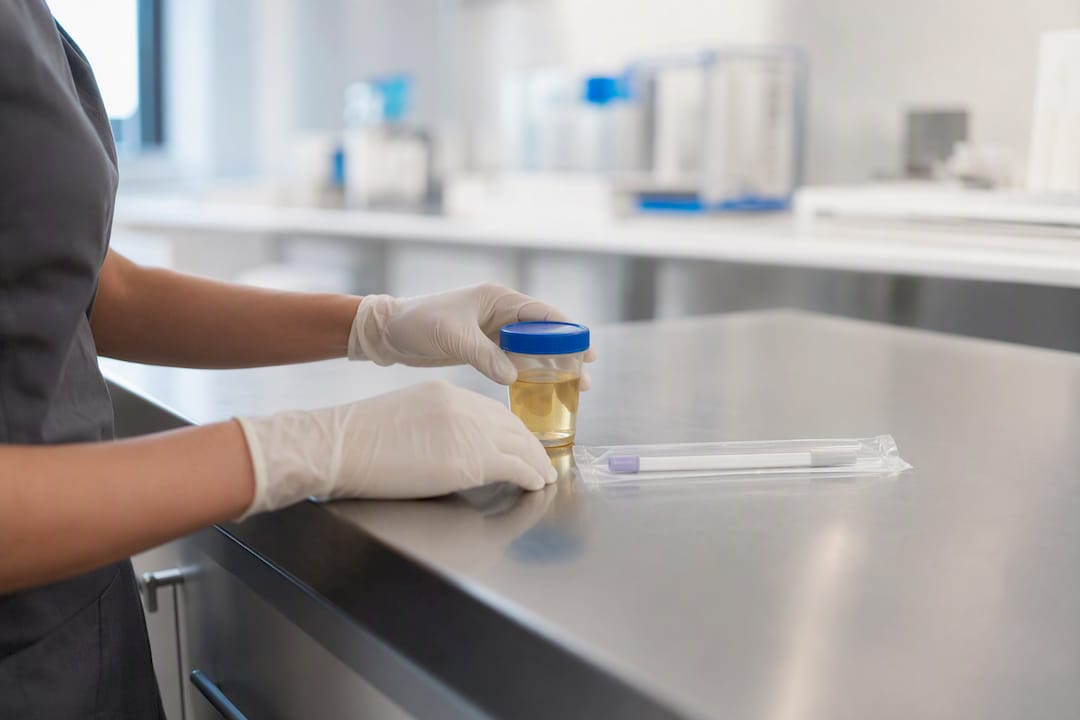
Every drug test starts as a screen, not a verdict. Screening tests use immunoassay technology, which is fast and cheap but prone to false positives from cross-reacting medications. That’s why anything with legal or employment stakes needs a confirmatory test using gas chromatography-mass spectrometry (GC-MS) or liquid chromatography-mass spectrometry (LC-MS). Confirmation is what actually holds up when someone challenges a result.
Specimen choice matters just as much as the testing method:
- Urine testing remains the most established option, with detection windows employers and courts have relied on for decades.
- Oral fluid testing picks up recent use faster than urine and is harder to adulterate, which is why HHS updated its Mandatory Guidelines to authorize oral fluid alongside urine for federal workplace programs.
- At-home dip tests are genuinely useful for private screening, but a negative or positive read from a cup at your kitchen counter carries little weight in a courtroom or an HR dispute without lab confirmation behind it.
Pro Tip: If there’s any chance a result will end up in a legal file or an unemployment hearing, skip the standalone at-home screen and order lab processing with MRO review from the start. Re-testing after a disputed screen costs more time than doing it right the first time.
The practical takeaway: an at-home kit answers a private question. A lab-confirmed, MRO-verified result answers a question someone else can challenge and lose.
What Legal Rules Govern Workplace Drug Testing?
Federal and state rules on this topic don’t always agree, and that gap is where employers get sued. HHS and SAMHSA set the Mandatory Guidelines that govern federal workplace testing programs, and the National Laboratory Certification Program (NLCP) is what certifies the labs allowed to process those samples. Labs seeking certification go through proficiency testing rounds and inspections before they make the list, and SAMHSA notifies federal agencies monthly about which labs currently hold that status.
Outside federally regulated industries, state law takes over, and it varies enormously. Marijuana screening rules, privacy protections, and random-testing restrictions differ from state to state, which is exactly why outdated written policies create litigation exposure for employers who haven’t reviewed their handbook language recently.
Three actions reduce that risk meaningfully:
- Apply your policy consistently. Selective enforcement is one of the fastest routes to a discrimination claim.
- Review your panel for emerging substances rather than assuming a standard test still covers what’s actually circulating.
- Negotiate testing terms with unions where applicable, since SAMHSA notes that unionized workplaces fall under the National Labor Relations Act and testing schedules often require bargaining.
SAMHSA itself recommends involving legal counsel before rolling out or revising a testing program, since past lawsuits have centered on privacy invasion, wrongful discharge, and discrimination claims. Our guide to SAMHSA lab certification walks through how to verify a lab’s status before you commit to it, and our breakdown of random drug testing rules covers the state-by-state variation in more depth.
How Do You Order and Complete a Test the Right Way?
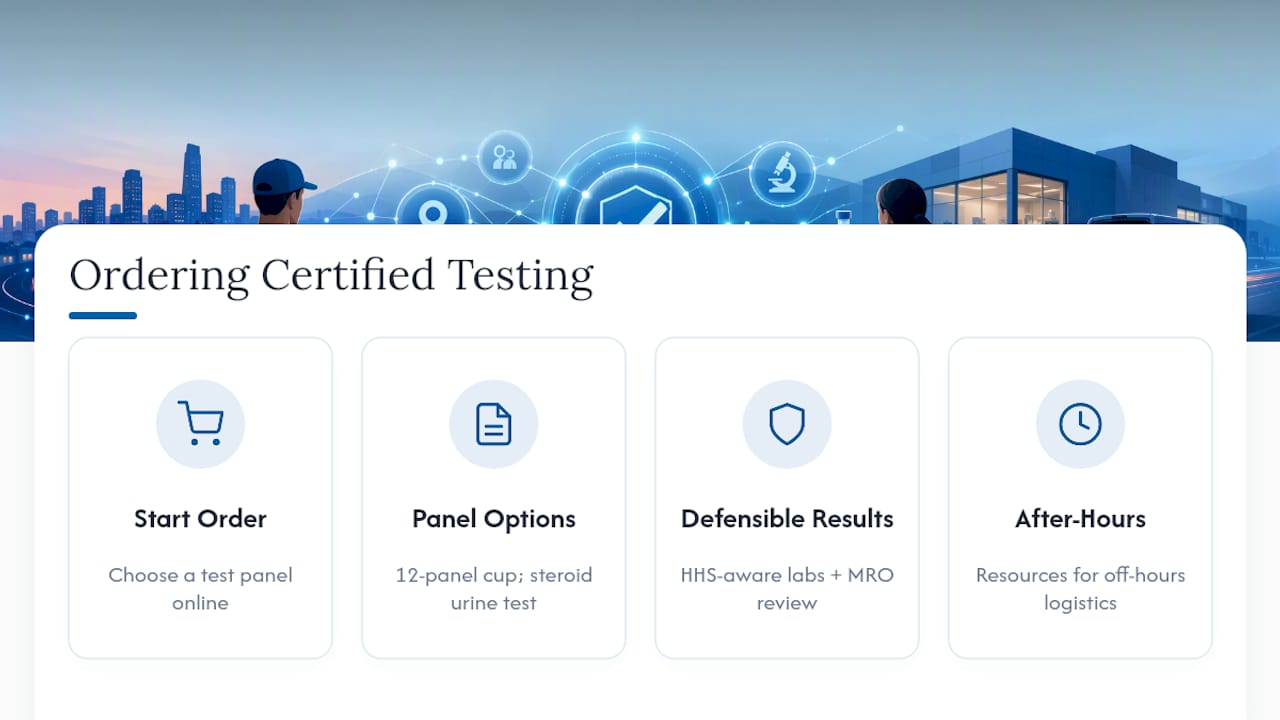
Ordering a certified test isn’t complicated, but skipping a step can invalidate the whole process. Start by choosing the right panel for your situation, whether that’s a standard multi-panel screen or something built for a specific substance concern, then select lab processing if the result needs to be defensible. If you need Medical Review Officer verification, that gets requested at the same stage, before the sample ever ships.
Collection protocols depend on the stakes involved:
- Unsupervised collection works for most private and pre-employment situations.
- Supervised or observed collection applies to return-to-duty cases or situations with a documented history of tampering.
- Chain-of-custody forms must be completed and sealed correctly, since a broken chain can get an otherwise valid result thrown out entirely.
Our chain-of-custody guide covers the sealing and shipping steps in detail if you want the specifics before your first order.
Screening alone answers a quick question. A confirmatory result, verified by an MRO, is what actually counts as documented evidence.
Why Employers Should Rethink Their Testing Panels for 2026
Substance use patterns don’t stay still, and neither should your testing panel. Legal advisors are increasingly flagging fentanyl and ketamine as substances a standard multi-panel screen may not catch, which means an employer relying on a panel chosen five years ago may be testing for the wrong things entirely.
I’d push this further than most compliance guides do: A testing program should be considered ongoing risk management. Employers are advised to regularly review their vendor’s capabilities to ensure the testing panel matches current substance trends and to document any changes along with counsel recommendations. That paper trail matters as much as the test result itself if a decision ever gets challenged.
— Alan
Order Certified Testing Through Countrywidetesting Anytime
Countrywidetesting gives you a faster path to defensible results than scheduling a clinic visit and hoping your case doesn’t need re-testing. Every lab order routes through HHS-aware certified labs with MRO workflows built in, so you’re not left guessing whether a result will hold up when someone reviews it later.
Ordering starts with picking your panel. Our 12-panel at-home cup test covers a broad range of common substances for straightforward screening needs, while options like the at-home steroid abuse urine test handle more specific concerns. When a result needs to stand up in an HR file or a courtroom, add lab processing and MRO review at checkout rather than after the fact. If your organization needs help planning testing access outside normal business hours, resources like Chameleon’s overview of after-hours care options can help you think through logistics alongside your testing schedule.
Visit our lab testing services page to see current turnaround windows and place an order today.
Where to Verify the Rules Yourself
Check SAMHSA’s National Laboratory Certification Program overview and its certified lab list directly. For program structure, review the federal Model Plan, and for 2026 legal trends, see Ogletree’s workplace testing analysis.
This article is general information, not a substitute for advice from a qualified lawyer. Consult a qualified legal professional about your own circumstances before acting on anything here.
Sources
- Model Plan for a Comprehensive Federal Drug-Free Workplace Program (SAMHSA) — March 2026
- The evolution of workplace drug testing: what employers need to know for 2026 (Ogletree)