
88.7% Detection Edge: PEth vs EtG for Clinical Alcohol Testing
PEth catches repeated or moderate-to-heavy drinking over the past few weeks; EtG catches a single drinking episode within the last few days, or, from hair and nails, exposure stretching back months. Neither test replaces the other. For monitoring programs, transplant clearance, or any high-stakes decision, ordering both markers gives a far more complete picture than relying on one alone.
TL;DR:
- PEth provides a detection window of two to four weeks and is most reliable for monitoring patterns of moderate to heavy drinking over time.
- Urine EtG detects alcohol use within one to five days, making it ideal for recent, single-episode detection, especially in workplace or legal settings.
- Hair and nail EtG can reconstruct alcohol exposure over several months, serving well for long-term abstinence verification.
- Combining PEth and EtG testing yields a more comprehensive assessment, with PEth outperforming EtG in identifying sustained drinking, and EtG better for recent episodes.
- Laboratory confirmatory testing with LC-MS/MS is standard for both markers, with results typically available in two to four days, and costs around $150 for PEth testing.
Table of Contents
- PEth Test vs. EtG: A Quick Side-by-Side Comparison
- How Do PEth and EtG Actually Form in the Body?
- What Are Typical PEth and EtG Detection Windows and Cutoffs?
- Which Test Catches Real Drinking More Reliably?
- How Should Clinicians Interpret PEth and EtG Together?
- What Should You Know About Testing Logistics and Costs?
- When Does Combining PEth and EtG Make Sense?
- What Are the Limitations and False-Positive Risks?
- An Editorial Take on Matching the Marker to the Mission
- Order PEth and EtG Testing Through Countrywidetesting
- Sources
- FAQ
PEth Test vs. EtG: A Quick Side-by-Side Comparison
Before getting into the biochemistry, it helps to see how these two markers stack up on the factors that actually drive test selection: what fluid or tissue you need, how long the window stays open, and where each test earns its keep clinically.
- PEth: measured in whole blood or dried blood spots (DBS); detection window runs roughly 2 to 4 weeks, sometimes longer with sustained heavy drinking; used heavily in transplant evaluation, clinical monitoring, and abstinence verification.
- Urine EtG (uEtG): measured in urine; detection window is short, generally 1 to 5 days depending on dose and hydration; common in workplace spot checks and probation or court-ordered testing.
- Hair and nail EtG: measured in keratin segments; detection window extends to several months, making it the tool of choice for forensic and long-term abstinence claims.
- Blood EtG: less common, but emerging LC-MS/MS methods can measure it with a detection window similar to urine.
Turnaround for confirmatory testing on any of these specimens typically runs 2 to 4 business days once the sample reaches an accredited lab running LC-MS/MS, though rapid immunoassay screens can return same-day results with lower specificity.
How Do PEth and EtG Actually Form in the Body?
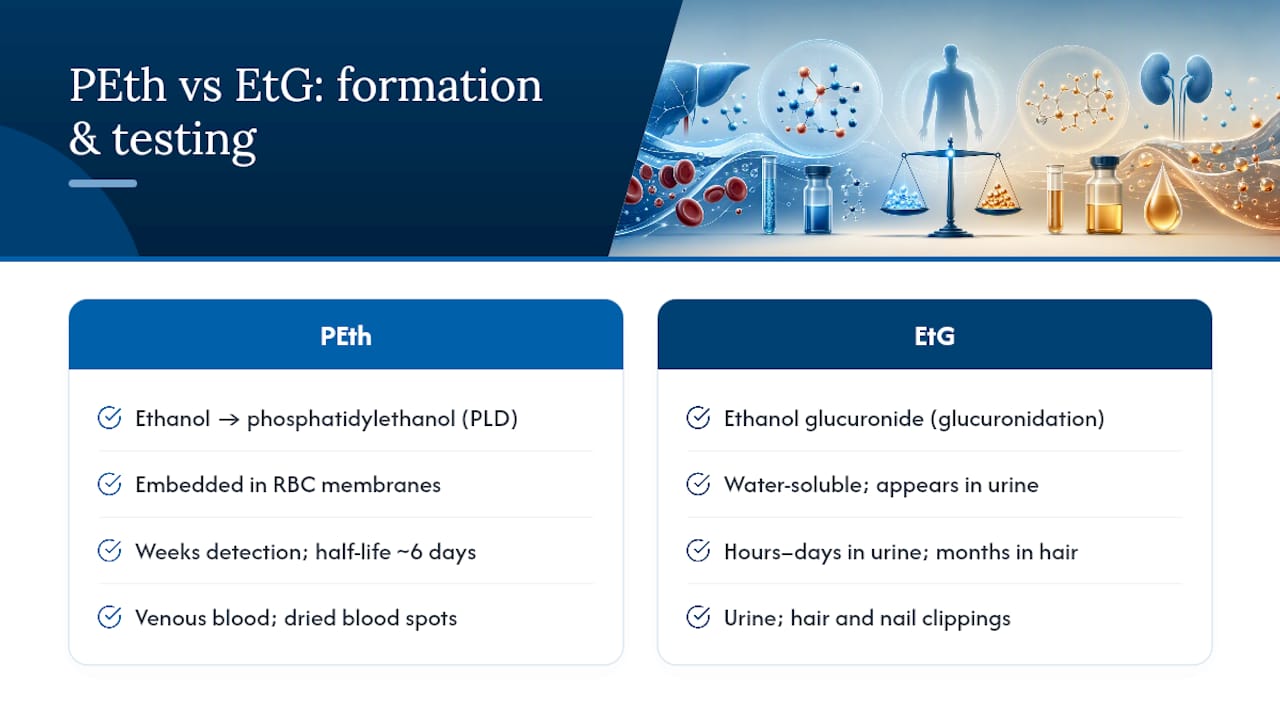
PEth is not a metabolite in the usual sense. It’s a phospholipid that only exists because ethanol is present. When alcohol enters the bloodstream, an enzyme called phospholipase D swaps ethanol into a reaction that normally produces phosphatidic acid, generating phosphatidylethanol instead. This compound then embeds itself in red blood cell membranes, where it lingers with a half-life of roughly six days in most people. That’s the biochemical reason PEth’s detection window stretches into weeks rather than hours: it’s baked into the membrane, not floating free in plasma waiting to be filtered out.
EtG works differently. It’s a direct metabolite of ethanol formed through glucuronidation, a liver process that attaches a glucuronic acid molecule to ethanol so the body can excrete it. That water-soluble byproduct shows up in urine within an hour or two of drinking and clears out relatively fast. Hair and nails accumulate trace EtG as they grow, which is why segments of hair or nail clippings can reconstruct a drinking history spanning months instead of days.
On the lab side, LC-MS/MS is the reference-standard confirmatory method for both markers. It separates and identifies compounds with enough precision to distinguish PEth homologs and EtG from cross-reacting substances, something older immunoassay screens can’t reliably do. Immunoassays still have a role as inexpensive first-pass screens, but they carry a known risk of false positives and typically require LC-MS/MS confirmation before a result gets used for any consequential decision.
Specimen handling matters more than most people assume. Venous blood draws for PEth need proper anticoagulant tubes and refrigeration; dried blood spot cards are gaining ground because they’re stable at room temperature and easier to ship. Urine EtG samples require strict chain-of-custody documentation to hold up in workplace or legal contexts. Hair and nail specimens follow segment-length standards, since the growth rate of keratin determines how far back a given segment reflects.
What Are Typical PEth and EtG Detection Windows and Cutoffs?
PEth’s detection window typically runs 2 to 4 weeks after the last drink, and chronic heavy drinkers can stay positive even longer because their baseline levels start higher. Cutoff choice changes what “positive” even means. Research-grade thresholds around 2 to 8 ng/mL maximize sensitivity, catching light or occasional drinking but also raising false positives. Many clinical and forensic programs instead settle on 20 ng/mL as a practical line for moderate-to-heavy use, while levels climbing into the hundreds of ng/mL point toward heavy, sustained drinking rather than a single lapse.
Urine EtG behaves on a much shorter clock. It generally clears within 1 to 5 days, though heavy intake or slow metabolism can push that toward the longer end. Forensic screening programs commonly use a 500 ng/mL cutoff to filter out incidental exposure from things like hand sanitizer or cooking wine, with confirmatory testing applying tighter, lab-specific thresholds. Hair EtG, by contrast, uses a threshold around 7 pg/mg to distinguish abstinence from chronic exposure across a growth segment representing roughly a month per centimeter.
Individual biology moves these numbers around more than most testing protocols acknowledge. Hematocrit and red blood cell turnover affect how much PEth accumulates and clears. Body mass index changes volume of distribution. Liver disease slows both PEth elimination and EtG conjugation. And drinking pattern itself matters: someone who has one drink on a Friday night will likely show trace or negative PEth and a narrow EtG window, while someone drinking most days will show elevated PEth that stays positive for weeks after they stop, even if their last EtG-detectable drink was three days ago.
Which Test Catches Real Drinking More Reliably?
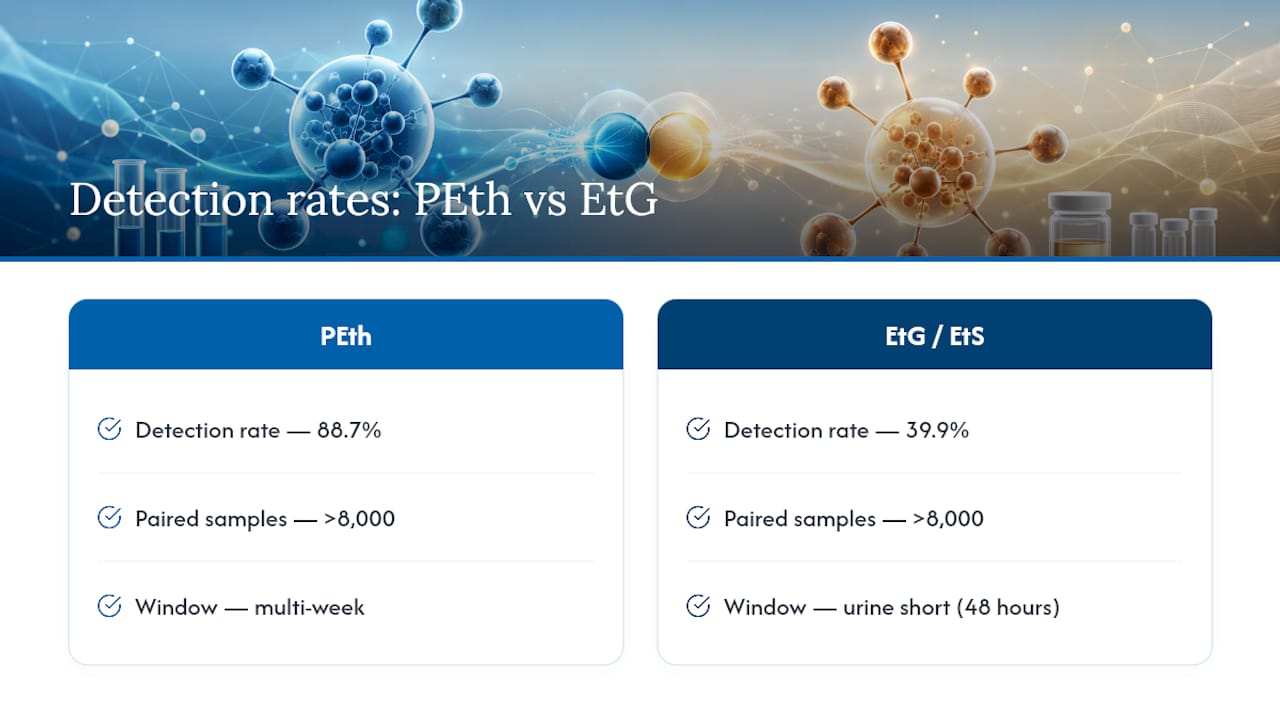
A 2025 paired-sample study focused on a predominantly transplant population found that limiting testing to PEth alone would have correctly identified alcohol consumption in 88.7% of instances, compared to just 39.9% for EtG or its metabolite EtS in the same samples. That gap is large enough to change how programs allocate testing budgets, and the study’s authors noted it held across more than 8,000 paired samples.
Systematic reviews back this up from a different angle. PEth consistently posts strong diagnostic accuracy for detecting recent unhealthy alcohol use, generally outperforming indirect biomarkers like GGT or carbohydrate-deficient transferrin, with its multi-week window giving it an edge over any single urine spot check. Hair EtG, meanwhile, holds its own advantage for the months-long exposure question that neither PEth nor uEtG can answer.
None of this means EtG is a weak test. It’s built for a different job. The transplant cohort study skews toward populations expected to be abstinent, where a single missed drinking day matters less than a pattern of ongoing use. In a workplace context checking for use within the last 48 hours, uEtG’s short window is exactly the point, not a limitation. Cutoff heterogeneity across studies (some using 8 ng/mL for PEth, others 20 ng/mL) also means comparing sensitivity figures across papers requires reading the methods section, not just the abstract.
The practical takeaway: across several studies, PEth catches more moderate-to-heavy drinking patterns than EtG does, while EtG remains the more sensitive option for confirming or ruling out a specific recent episode.
How Should Clinicians Interpret PEth and EtG Together?
Matching the marker to the actual question being asked resolves most testing decisions before results even come back.
- Abstinence monitoring over time (recovery programs, licensing boards): serial PEth, spaced weeks apart, tracks whether someone has genuinely stopped or is drinking intermittently.
- Transplant clearance: PEth alone, given its documented higher sensitivity in these populations, often suffices; add uEtG only if a very recent lapse is suspected.
- Workplace spot checks: uEtG or point-of-care dip screening fits the short-window question of “did this person drink in the last day or two.”
- Forensic or custody evaluation over months: hair or nail EtG answers the long-range abstinence question no blood test can.
- Research or high-stakes legal decisions: order both PEth and EtG from the same draw when possible.
Discordant results aren’t a lab error; they’re information. A PEth-positive, EtG-negative result usually means drinking happened in the past two to three weeks but not in the last day or two. A PEth-negative, uEtG-positive result suggests a single recent, possibly light, episode that hasn’t had time to build detectable PEth. Since PEth and EtG concentrations correlate weakly (r² around 0.15), one negative result should never automatically override a positive on the other marker.
When a result seems inconsistent with self-report, repeat testing on a fresh specimen before escalating, and pair biomarkers with validated screening tools like AUDIT or AUDIT-C, or a timeline followback interview, to add behavioral context numbers alone can’t provide.
Pro Tip: Document the specific cutoff and marker you used for any high-stakes decision, and explain to the patient what the result can and can’t tell you. A PEth of 25 ng/mL says “weeks of drinking,” not “yesterday’s drink” — miscommunicating that distinction is where most disputes start.
What Should You Know About Testing Logistics and Costs?
Blood draws for PEth need standard venipuncture technique and refrigerated or DBS-stable handling; urine EtG samples require documented chain-of-custody from collection to lab; hair and nail specimens follow segment-cutting standards that preserve their timeline. Confirmatory LC-MS/MS testing typically returns in 2 to 4 business days, though incomplete paperwork or specimen rejection can add delays.
Cost varies by lab and payer, but PEth testing is often billed around $150, with CPT coding and insurance coverage varying enough that it’s worth confirming with the lab before ordering. Point-of-care EtG dip screening costs far less upfront but adds confirmatory testing fees if a screen comes back positive. Before selecting a lab, ask about CLIA, CAP, or ISO accreditation. These aren’t paperwork formalities; they’re the quality assurance framework that keeps a positive result defensible in court or in a workplace dispute.
When Does Combining PEth and EtG Make Sense?
Because PEth and EtG concentrations move largely independently of each other, combined testing genuinely adds information rather than just doubling the cost for redundant data. A practical algorithm for a monitoring program: establish a baseline PEth, retest periodically on a set schedule, and layer in uEtG only when recent use is suspected or after a suspected lapse.
This approach also controls costs better than blanket dual-testing every visit. Reserving EtG for targeted moments, rather than running it alongside every PEth draw, keeps the added utility high without inflating lab bills unnecessarily. Where a lab supports dual assays from one specimen, ordering both from the same blood draw simplifies logistics and guarantees the two results are directly comparable rather than drawn hours apart under different conditions.
What Are the Limitations and False-Positive Risks?
PEth formation and elimination rates vary between individuals, so the same drinking pattern can produce different levels in two people, and a recent blood transfusion can distort results entirely. Neither test converts cleanly into an exact drink count. EtG carries its own false-positive risk from incidental exposure, hand sanitizer, mouthwash, and certain foods have all triggered positive urine results, and hair treatments or dyes can degrade hEtG accuracy. Improperly stored urine samples are also vulnerable to bacterial degradation that alters EtG measurements before they even reach the lab, which is why prompt refrigeration and preservatives matter for remote collections. Given these variables, no single test result should carry a high-stakes decision on its own. Combined biomarker data plus clinical context remains the safer standard.
An Editorial Take on Matching the Marker to the Mission
Most confusion around PEth vs. EtG comes from treating them as competitors instead of tools built for different questions. Match the marker to what you actually need to know: recent single episode, order EtG; pattern over weeks, order PEth; months of history, go to hair. For anything with real consequences, employment, custody, transplant listing, run both and document why. Cheap testing that gives you the wrong window isn’t actually cheap. Pair biomarkers with a validated screening tool, and always tell the person being tested what the result can and cannot prove.
— Alan
Order PEth and EtG Testing Through Countrywidetesting
Choosing the right biomarker only matters if you can actually order it without friction. We work with accredited laboratory partners to offer both specimen collection kits and mail-in lab testing services, so clinicians and program managers can request PEth, uEtG, or hair EtG testing without chasing down separate vendors for each specimen type.
If you already know which marker fits your situation, Countrywidetesting’s lab testing services page lists available options and how to get a sample processed through a lab that meets recognized accreditation standards. For workplace or point-of-care screening, the EtG alcohol dip card offers a fast first-pass check before confirmatory testing. Reach out through the lab services page to request a quote or ask which specimen type fits your monitoring plan, whether that’s a single transplant clearance test or an ongoing abstinence-verification program.
This article is general information, not a substitute for advice from a qualified doctor. Consult a qualified healthcare professional about your own circumstances before acting on anything here.
Sources
- Limited added utility of urine ethyl glucuronide compared to blood phosphatidylethanol in a predominantly transplant population
- Phosphatidylethanol, ethyl glucuronide and ethanol in blood as complementary biomarkers for alcohol consumption
- Phosphatidylethanol (PEth) in blood as a marker of unhealthy alcohol use: A systematic review with novel molecular insights
- Phosphatidylethanol test for identifying harmful alcohol consumption | AAFP
FAQ
How Far Back Can a PEth Test Detect Alcohol?
PEth typically detects drinking for 2 to 4 weeks after the last drink, and heavier or more frequent drinking can extend that window further because baseline levels start higher.
Will Two Beers Show Up on a PEth Test?
Light, isolated drinking can register on a low-cutoff PEth test, but a single moderate drinking episode often falls below the 20 ng/mL threshold many U.S. labs use for moderate-to-heavy use; PEth is built to flag repeated drinking, not a single light occasion.
Will I Pass an EtG Test After Drinking Two Beers?
It depends on timing: uEtG can detect alcohol for 1 to 5 days after drinking, so two beers consumed within that window can still trigger a positive result, especially against a sensitive 500 ng/mL screening cutoff.
Can PEth Be Falsely Elevated?
PEth is formed only in the presence of ethanol, so incidental exposure rarely causes false positives, but a recent blood transfusion from a donor who drank can transiently raise a recipient’s PEth level.
Which Test Should a Monitoring Program Choose First?
For ongoing abstinence monitoring or transplant clearance, PEth alone correctly identified alcohol consumption far more often than EtG in a large paired-sample study, making it the stronger default marker, with EtG reserved for confirming very recent, suspected lapses.