
Save $10–$20 Per Test: Onsite Drug Testing Cost RFP Checklist, U.S. HR
Onsite drug testing costs typically run $20 to $40 per employee for instant urine or oral fluid screening, with lab-based confirmations starting near $50 and hair panels closer to $125. Travel and collector fees, not the test kit itself, usually drive the biggest swings in a final invoice. DOT-regulated programs add another layer of cost because of mandatory paperwork and trained collectors. A testing provider can help you build a compliance-aware quote once you know which of these variables apply to your workforce.
TL;DR:
- Onsite drug testing costs range from $20 to $40 per employee for instant tests, with additional charges for travel, collection, and confirmation fees.
- Point-of-care instant tests are the most affordable option, often costing around $5 per unit when purchased in volume, suitable for quick screening needs.
- Lab confirmation paired with onsite collection typically starts around $50, with costs increasing for broader drug panels like 10- or 12-panel urine tests or hair follicle tests near $125.
- DOT compliance requirements add expenses due to mandatory trained collectors, precise documentation, and mandatory split-specimen handling, making it costlier than non-DOT screening.
- Accurate quotes should itemize all line items, including collector fees, travel, lab work, and MRO review, to avoid hidden costs and compare providers effectively.
Table of Contents
- Onsite Drug Testing Cost by Test Type and Delivery Method
- What’s Actually Inside an Onsite Drug Testing Quote
- How DOT Compliance Changes Your Onsite Testing Cost
- Budgeting Models for Different Company Sizes
- Getting Comparable Onsite Testing Quotes
- Onsite Testing vs. Alternative Screening Methods
- How Turnaround Time Affects What You Pay
- Balancing Cost and Compliance: A Practical Recommendation
- Get a Custom Onsite Testing Quote
- Sources
- FAQ
Onsite Drug Testing Cost by Test Type and Delivery Method
Your total spend depends less on the brand of test and more on what happens after the sample gets collected. An instant dip-card panel that stays onsite costs far less than a specimen that gets sealed, shipped, and run through a laboratory instrument.
Point-of-care instant tests are the budget option. These dip-card or cassette-style kits deliver a preliminary result on the spot, usually within five to ten minutes, and pricing for instant urine tests can start around $5 per unit when purchased in volume. Employers rely on these for quick pre-employment screens or reasonable-suspicion checks where a fast, non-certified result is enough to make an immediate decision, with positives sent for lab confirmation afterward.
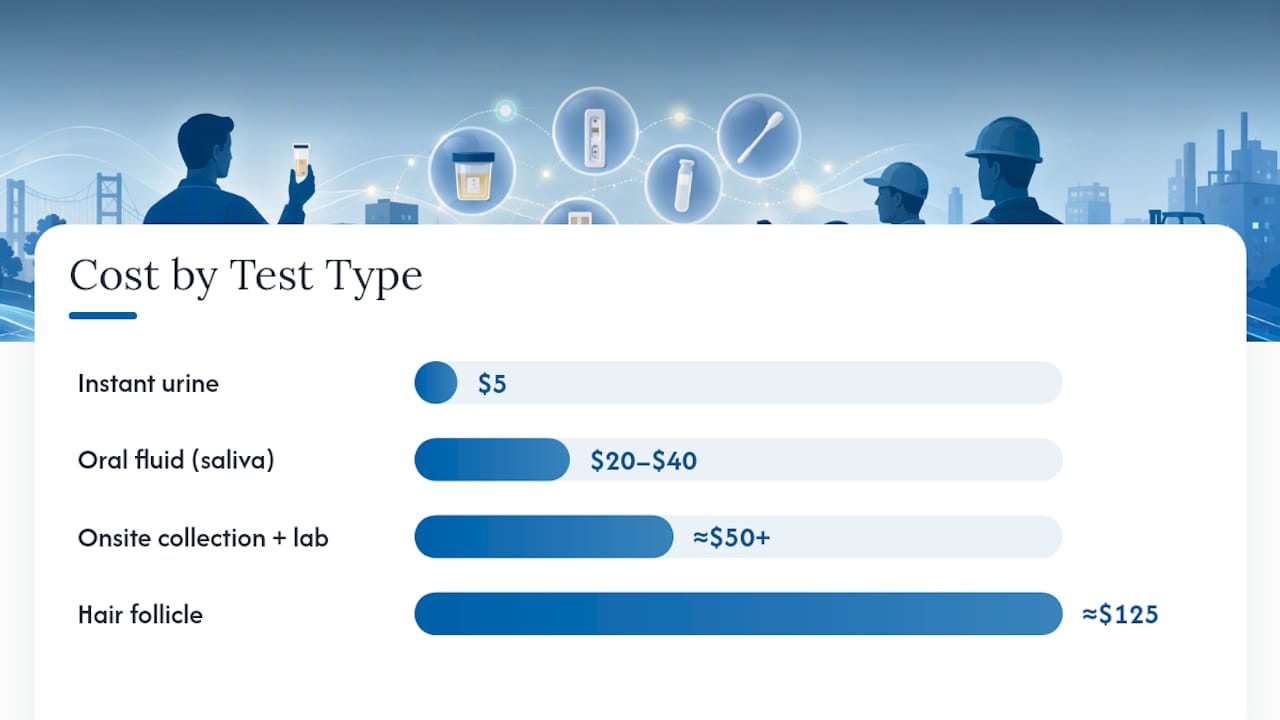
Onsite collection paired with lab confirmation is the middle tier. A trained collector visits your site, gathers the specimen under proper chain-of-custody, and ships it to an accredited lab. You’re paying for two things bundled together: the collection visit and the lab’s confirmatory testing, which commonly starts around $50 and climbs from there depending on panel size.
Here’s how the major test types typically stack up on price and use case:
- 5-panel urine screen: Covers the federally mandated drug categories; initial screen plus confirmatory GC/MS or LC-MS/MS testing is the standard DOT approach.
- 10-panel or 12-panel urine screen: Adds detection for additional substances like benzodiazepines and barbiturates, priced higher than the 5-panel due to the broader lab workup.
- Oral fluid (saliva) tests: Shorter detection window than urine, often chosen for observed, harder-to-cheat collection, generally priced in the same $20 to $40 range as instant urine.
- Hair follicle tests: Longest detection window, useful for pattern-of-use questions, but typically starts near $125 because of specialized lab processing.
- Breath alcohol screening: Requires a calibrated device and a trained Breath Alcohol Technician, so cost is tied more to collector certification and equipment maintenance than the test itself.
Oral fluid works well when you need observed collection without the privacy concerns urine testing raises. Hair testing costs more but answers a different question: not “is this person impaired today” but “what’s their pattern over the last several months.”
What’s Actually Inside an Onsite Drug Testing Quote
A quote that just says “$45 per test” is hiding information you need. Real onsite pricing breaks down into several separate line items, and understanding each one is how you spot a fair price versus an inflated one.
Collection billing usually works one of two ways: an hourly collector rate or a flat per-visit fee. Rate sheets from providers like Labworks USA show scheduled onsite collection billed by the hour, often with a minimum charge even if the visit takes fifteen minutes. That minimum matters most for small employers testing only one or two people at a time.
Travel adds its own surcharge, typically scaled by distance or drawn into pricing “zones.” Rural or remote job sites often carry a premium because the collector’s drive time eats into their billable hours. Emergency or after-hours dispatch, for a post-accident test at 2 a.m., for instance, carries the steepest surcharge of all.
Beyond collection, expect separate line items for:
- Lab fees, split into an initial screen cost and a higher confirmatory testing cost
- MRO (Medical Review Officer) review fees for verifying and interpreting results
- Split-specimen testing charges, which the employer generally covers unless the donor requests and pays for an independent retest
- Chain-of-custody documentation and electronic result reporting
Pro Tip: Ask every provider to itemize collector rate, travel, lab screen, lab confirmation, and MRO fee as five separate numbers. A vendor unwilling to break these apart is usually padding one of them.
How DOT Compliance Changes Your Onsite Testing Cost
Regulated testing under 49 CFR Part 40 isn’t optional for employers with safety-sensitive, DOT-covered positions, and the rulebook directly shapes what you pay. Collectors must be specifically trained on Federal chain-of-custody form procedures, the collection site address has to be documented precisely, and split-specimen handling and MRO review are mandatory rather than optional add-ons.
Part 40 requires the actual collection site address be recorded on the CCF. When collection happens at your facility or via a mobile unit, that address has to be as precise as the regulation demands. Get it wrong and a test can be challenged or invalidated.
That documentation burden is exactly why DOT-compliant onsite visits cost more than non-DOT screening. You’re paying for a specialized collector, mandatory paperwork, and a process built to survive a legal challenge. If your workforce doesn’t fall under DOT jurisdiction, a simpler non-DOT protocol is usually acceptable and considerably cheaper. Employers with any DOT-regulated positions should never mix protocols to save money. A single retest triggered by a documentation error usually costs more than the compliance premium would have.
Budgeting Models for Different Company Sizes
The right pricing structure depends heavily on how often you test and how many people you’re testing. Three scenarios illustrate the math.
- Small employer, occasional pre-employment screens. Testing five new hires a month with instant onsite kits plus lab confirmation for any positives keeps costs predictable and low. Per-event pricing, paying only when you actually schedule a visit, makes more sense here than a subscription.
- Mid-size employer, monthly random testing. Once you’re testing a consistent pool every month, a membership or consortium arrangement typically lowers your per-test rate and guarantees a faster response window, since the provider can plan collector time around your schedule.
- Large employer, ongoing DOT-regulated pool. With continuous random selection requirements, volume discounts and a dedicated account structure usually beat one-off pricing. Guaranteed same-day or next-day response windows also reduce the hidden cost of delayed hiring decisions.
Whichever model you choose, track tests per month, average collector response time, and the percentage requiring lab confirmation. Those three numbers tell you whether you’re overpaying for a service tier you don’t need.
Getting Comparable Onsite Testing Quotes
A quote missing key line items is a red flag, not a bargain. Require every provider to spell out the collector base rate, travel or zone charges, minimum hours billed, lab screen cost, confirmatory testing cost, MRO fee, and a written DOT compliance statement if applicable.
Walk away from any vendor who can’t clearly explain chain-of-custody procedures, doesn’t have direct MRO access, or hedges when asked about split-specimen handling. Those aren’t minor gaps. They’re signs the provider hasn’t built a program that survives scrutiny.
On negotiation, your strongest levers are volume commitments, a guaranteed response SLA, and bundled onsite-plus-lab-plus-MRO pricing under one contract. Ask providers to cap emergency-dispatch fees rather than leaving them open-ended.
- Request collector base rate, travel/zone fee, and minimum billable hours as separate numbers
- Require a written DOT compliance statement if any tested employees are safety-sensitive
- Confirm MRO access and turnaround time in writing before signing
Pro Tip: Send the same five-line RFP checklist to at least three providers. Side-by-side comparison usually reveals a $10 to $20 per-test gap you’d never spot from a single quote.
Onsite Testing vs. Alternative Screening Methods
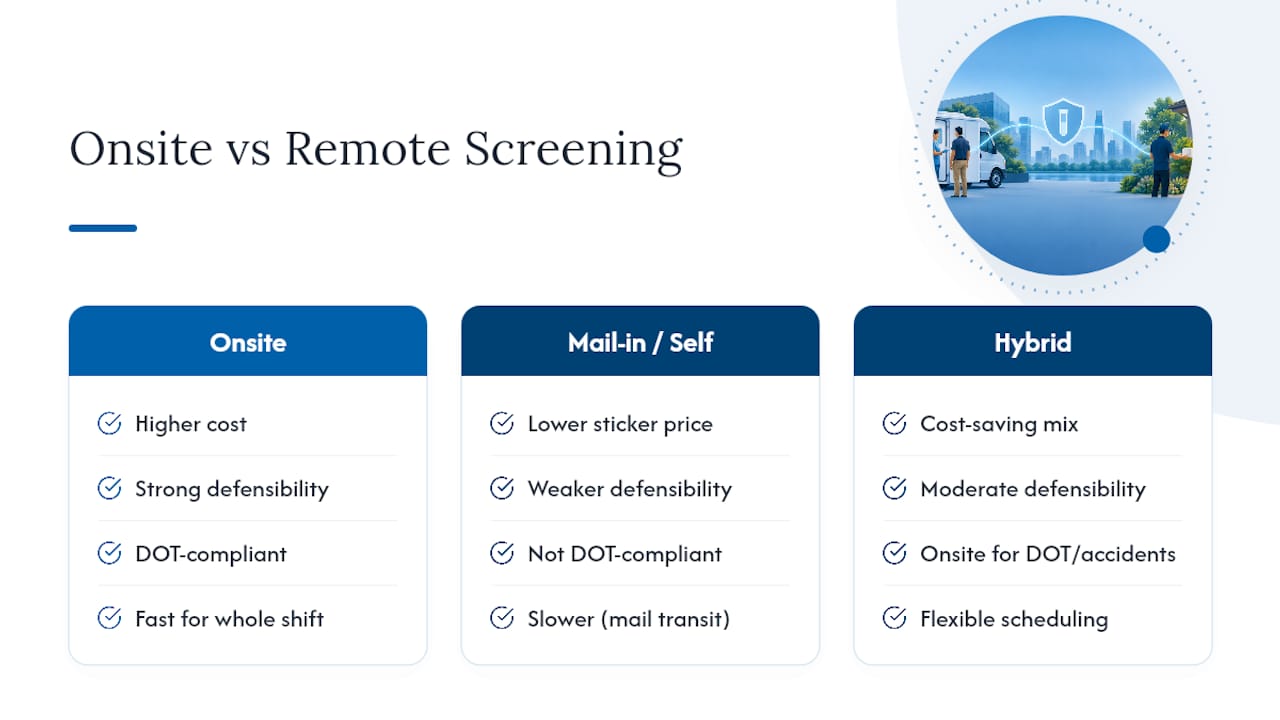
Remote or self-administered testing looks cheaper on paper. A mail-in kit sidesteps collector travel fees entirely, and instant kits shipped directly to an employee’s home cost less than a scheduled site visit. But that lower sticker price comes with a tradeoff: no observed collection means weaker defensibility if a result is ever challenged, and self-administered tests generally can’t satisfy DOT requirements at all.
Onsite testing earns its higher cost through control. A trained collector on your site means you’re not waiting on mail transit time, you get observed collection that holds up under scrutiny, and you can test an entire shift in one visit instead of coordinating dozens of individual mail-in kits. For pre-employment screening with no regulatory requirement, a mail-in or self-administered option can be a reasonable way to cut costs. For safety-sensitive positions, post-accident testing, or any DOT pool, the collection integrity onsite testing provides isn’t something a remote alternative can replace.
The practical approach many employers land on is a hybrid: mail-in or instant kits for low-stakes pre-employment screening, onsite collection reserved for random, post-accident, and reasonable-suspicion testing where documentation quality actually matters.
How Turnaround Time Affects What You Pay
Speed costs money, and understanding that tradeoff helps you avoid paying rush fees you don’t actually need. Instant onsite results arrive in minutes, but that speed only applies to the preliminary screen. Anything confirmatory still routes through a laboratory, and standard lab turnaround typically runs one to three business days from specimen receipt.
Rush or expedited lab processing carries a premium, often a flat surcharge added to the standard confirmatory fee. It’s worth paying when a hiring decision or a post-accident investigation is genuinely time-sensitive. It’s wasted money when you’re running routine random testing on a schedule that already accounts for a few days’ delay.
After-hours or weekend collection visits carry their own surcharge separate from lab rush fees. If your testing program can be scheduled during standard business hours, you avoid that charge entirely. Employers who build a predictable testing calendar, rather than reacting test-by-test, consistently pay less than those calling for same-day emergency collection every time a need arises.
Balancing Cost and Compliance: A Practical Recommendation
If any part of your workforce is DOT-regulated, don’t shop for the cheapest onsite provider — understanding how cannabis detection works in roadside versus workplace settings can influence your compliance strategy (Cannabis au volant : comment fonctionne la détection en France). Pay for the compliance-trained collector and full MRO workflow, because a failed chain-of-custody costs far more in retesting and legal exposure than the premium ever would. Outside of DOT requirements, match the test to the decision: instant screening for routine pre-employment checks, lab confirmation reserved for anything contested. Always ask providers for bundled pricing if you’re testing regularly. One takeaway to plan around: your biggest lever isn’t the test itself, it’s collector time and travel.
— Alan
Get a Custom Onsite Testing Quote
Every scenario above (small employer, monthly random pool, full DOT program) needs a different mix of instant kits, lab confirmation, and MRO support, and guessing at that mix from a generic rate sheet wastes money in both directions. The confirmatory results behind any onsite collection are generally supported by labs accredited to standards like SAMHSA, ISO, CLIA, and CAP, ensuring reliability whether for routine pre-employment screening or DOT-regulated pools.
Some providers coordinate onsite collection, lab confirmation, and MRO review as one connected process instead of three separate vendors to manage. Many offer free shipping over a certain order amount and provide money-back guarantees if products don’t fit a program. If you’re ready to see real numbers instead of estimates, visit the lab testing services page to request a quote built around your test volume, your DOT status, and your turnaround needs.
Sources
- Drug Test Cost Comparison: What Employers Pay for Different Screening Methods | Checkr
- Procedures for Transportation Workplace Drug and Alcohol Testing Programs | US Department of Transportation
- Labworks USA DOT or FMCSA Drug and Alcohol Testing Rates
FAQ
How Much Does Onsite Drug Testing Cost?
Onsite instant screening typically runs $20 to $40 per employee, while collection paired with lab confirmation starts around $50 and rises with panel size and DOT requirements. Travel fees, minimum collector hours, and MRO charges usually add to that base price. A provider can put together a custom quote once you know your test volume and compliance needs.
How Much Does a Drug Test Typically Cost in the US?
Instant urine tests can start around $5 per kit for the device alone, while lab-based confirmatory testing generally starts near $50. Hair follicle testing costs more, often starting close to $125, because of the specialized lab processing required.
How Much Does a 10-Panel Urine Drug Test Cost?
A 10-panel lab-confirmed urine test costs more than a standard 5-panel because it screens for additional substance categories and requires more extensive lab confirmation work. Exact pricing varies by lab and whether DOT protocols apply, so requesting an itemized quote covering both the screen and confirmation cost is the only reliable way to compare providers.
How Much Urine Is Needed for a 10-Panel Drug Test?
Most labs require a minimum specimen volume, generally around 30 milliliters, to run a full 10-panel screen and reserve enough for confirmatory testing or a split-specimen request if one is needed. Collectors are trained to check for adequate volume onsite before the specimen is sealed, which is one reason DOT protocols under Part 40 specify collector training requirements.