
20 mg/dL Creatinine Often Shows Dilution, and What Labs Do Next
Creatinine confirms whether a urine sample is genuine, not whether it contains drugs. A reading below 20 mg/dL usually signals dilution, and labs treat that as a red flag requiring a closer look. Most accredited labs pair creatinine with specific gravity before making a final call, because a single low number rarely tells the whole story on its own.
TL;DR:
- Creatinine levels below 20 mg/dL typically indicate dilution, but pairing with specific gravity helps labs distinguish between hydration and tampering.
- Creatinine is a stable waste product used to verify urine sample validity, not to detect drug use directly.
- Reflex testing with specific gravity and osmolality refines the assessment, reducing false accusations of substitution due to hydration.
- Repeated dilute results, especially with creatinine under 2 mg/dL, should trigger immediate recollection under direct observation.
- Factors like hydration, exercise, muscle mass, and supplements such as creatine can influence creatinine, complicating interpretation.
Table of Contents
- What Creatinine Measures and the Standard Thresholds Labs Use
- How Labs Combine Creatinine With Specific Gravity and Osmolality
- What a Low Creatinine Reading Actually Means
- Factors That Push Creatinine Up or Down Outside of Tampering
- How Programs Handle Abnormal Creatinine Results
- How Countrywidetesting Supports Specimen Validity Testing
- Why Numbers Alone Never Tell the Full Story
- Ordering Accredited Lab Testing and Specimen Validity Services
- Sources
What Creatinine Measures and the Standard Thresholds Labs Use
Creatinine is a waste product from normal muscle metabolism, filtered out of the blood by the kidneys at a fairly constant rate. Because the body produces it steadily, its concentration in urine tends to stay within a predictable range, which is exactly why labs use it as a stability marker for specimen validity rather than a marker for drug use.
That stability is the whole point. If someone drinks a large volume of water before a collection, urine volume spikes and creatinine gets diluted along with everything else, including any drug metabolites. Labs exploit that relationship to catch tampering that would otherwise let a positive result slip through as a false negative.
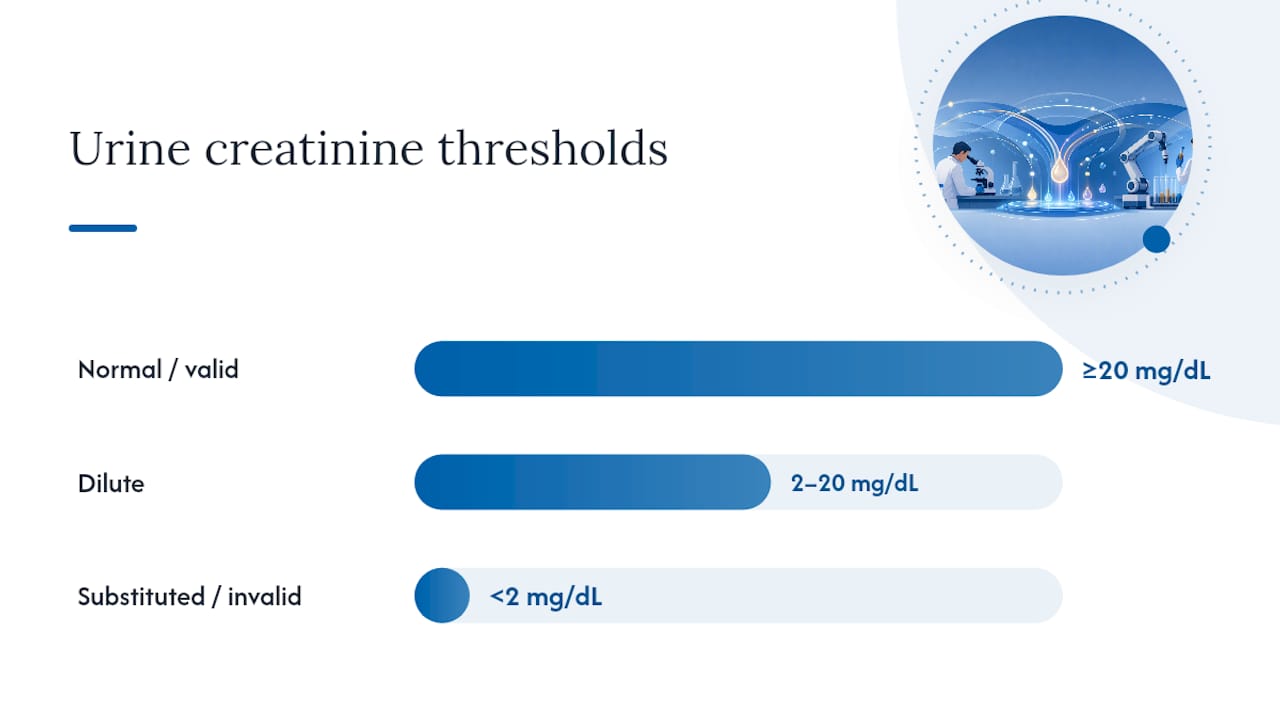
Toxicology reference standards break urine creatinine into three working categories:
- Normal/valid: creatinine at or above 20 mg/dL, generally accepted as a legitimate, undiluted specimen.
- Dilute: creatinine between 2 mg/dL and 20 mg/dL, meaning the sample is likely real urine but too watered down to interpret with full confidence.
- Substituted or invalid: creatinine below roughly 2 mg/dL, especially when paired with abnormal specific gravity, which points toward a sample that may not be human urine at all.
These bands come directly from clinical toxicology guidance on creatinine screening, and they show up almost verbatim in the reference ranges labs list on their own test menus. A commercial lab test panel for specimen validity, for instance, sets its cutoffs at creatinine ≥20.0 mg/dL alongside a specific gravity threshold of at least 1.003, which is the same logic treatment courts and workplace programs rely on.
When results come back, they rarely show up as a plain pass or fail. A lab report typically lists the numeric creatinine value in mg/dL alongside a specimen-validity status such as “normal,” “dilute,” or “substituted.” That distinction matters for anyone reviewing results: a dilute flag on an otherwise negative drug screen is not the same finding as a substituted flag, and each triggers a different next step. Treatment-court guidance goes further, recommending that creatinine be tested on every single urine sample collected under a monitoring program, not just when something looks suspicious.
There’s a good reason for that blanket approach. A study from 1991 found that when researchers concentrated urine samples that had originally tested negative because they were dilute, several revealed drug metabolites that had been masked by the dilution itself. Skipping creatinine testing on the assumption that a sample “looks fine” can let a genuinely positive result walk right through as a false negative.
How Labs Combine Creatinine With Specific Gravity and Osmolality
Creatinine alone leaves gaps. A reading of 15 mg/dL could mean someone drank three bottles of water an hour before their appointment, or it could mean someone swapped in a substance that isn’t urine at all. Specific gravity and osmolality close that gap by measuring different physical properties of the same sample.
Specific gravity compares the density of urine to that of pure water, reflecting how concentrated the dissolved solids are. Osmolality measures the actual number of dissolved particles per kilogram of water, which gives a more precise picture of concentration than specific gravity alone. Labs typically measure specific gravity with a refractometer or an automated analyzer, and osmolality through freezing-point depression testing when a more detailed confirmation is needed.
Reflex testing is what ties these numbers together operationally. Instead of running every possible validity test on every sample, labs set up a triggered sequence:
- The initial screen measures creatinine on every specimen submitted.
- If creatinine comes back below the dilute threshold, the system automatically reflexes to a specific gravity measurement on that same sample.
- If specific gravity also falls outside the expected range (commonly below 1.003 or above 1.020, depending on the lab’s validated cutoffs), the lab may reflex further to a creatine assay or osmolality test to rule out supplement interference or outright substitution.
- Results are compiled into a single report showing the numeric creatinine value, the specific gravity reading, and a final validity classification.
This sequencing is exactly how commercial toxicology labs structure their specimen-validity panels, and it exists because creatinine and specific gravity respond to slightly different variables. A person’s diet, exercise routine, and hydration status all move both numbers, but not always in lockstep. Requiring both to fall outside normal range before flagging a sample as substituted (rather than merely dilute) cuts down on false accusations against someone who just drank a lot of water before their appointment.
Pro Tip: If you manage a testing program, always request the numeric creatinine and specific gravity values on the report, not just a pass/fail flag. A “dilute” result with creatinine at 18 mg/dL and normal specific gravity tells a very different story than one at 3 mg/dL with an abnormal specific gravity reading, even though both might print out looking similar on a summary sheet.
Some collection sites now use instrumented cups that give an on-site readout of creatinine and specific gravity within minutes. These tools are useful for flagging an obviously dilute sample before the collector even seals it, but they don’t replace laboratory confirmation. A borderline or invalid on-site reading still needs to go to an accredited lab for a defensible, documented result, especially in any setting where the outcome could affect employment or a court proceeding. Our guide to specimen validity testing walks through this handoff in more detail for employers and clinicians building out a testing protocol.
What a Low Creatinine Reading Actually Means
Not every low creatinine result means someone tried to cheat. The most common cause is simply drinking too much fluid too close to the test. Downing a large amount of water, sports drinks, or even excessive coffee in the hour or two before a collection can push creatinine below the dilute threshold within about 60 to 90 minutes, without any intent to deceive anyone.
The distinction between “dilute” and “substituted” comes down to what the numbers suggest about the specimen itself. A dilute result usually still looks and behaves like real human urine, just heavily watered down, with creatinine somewhere in that 2 to 20 mg/dL band and specific gravity only mildly off from normal. A substituted result is a different animal: creatinine drops below roughly 2 mg/dL, specific gravity reads at or near that of pure water, and the overall chemistry no longer resembles urine at all. That combination points toward tampering, whether through an additive, a swapped sample, or something else entirely.
Programs generally build a tiered response around that distinction:
- A dilute result with drug screen negative often leads to a straightforward retest, sometimes with instructions to limit fluid intake beforehand.
- A dilute result on a positive drug screen typically still counts as a positive, since the metabolites were detected despite the dilution.
- A substituted result almost always triggers immediate recollection under direct observation, meaning a collector watches the specimen leave the body to rule out any chance of a swapped sample.
- Repeated dilute results from the same person, even without a single confirmed positive, often carry their own policy consequences, since a pattern of dilution starts to look less like coincidence and more like an attempt to avoid detection.
That last point deserves emphasis. One dilute reading tells you very little. Three dilute readings from the same person over a few months tell you something worth investigating. Program managers who treat every isolated dilute result as a disciplinary event risk punishing people for drinking a lot of water on a hot day, while managers who ignore repeated dilution risk letting genuine tampering slide. The difference between a merely diluted sample and a deliberately adulterated one matters both scientifically and legally, and it’s worth building that distinction into any written policy rather than leaving it to case-by-case judgment calls.
Factors That Push Creatinine Up or Down Outside of Tampering
Muscle mass, hydration, medication, and even dietary supplements all move urinary creatinine, and none of them have anything to do with cheating a drug test. Separating legitimate physiological variation from deliberate manipulation is where a lot of testing programs get tripped up.
Creatine supplementation deserves special attention here, because it can actively interfere with dilution detection. A 2021 controlled study gave subjects creatine along with water before urine collection and compared the results to water alone. Mean urinary creatinine came in at 11.6 mg/dL with water by itself, but jumped to 22.5 mg/dL when creatine was added to the same fluid load. That’s the difference between a result that flags as dilute and one that reads as perfectly normal, even though the person drank the same amount of water either way. Anyone taking creatine supplements, which includes a large share of gym-goers and athletes, could unintentionally mask a genuinely dilute sample without any intent to defeat the test.
Beyond supplements, a handful of other factors reliably shift creatinine in one direction or the other:
- Causes of elevated creatinine: dehydration, high muscle mass, intense or prolonged exercise shortly before collection, and certain kidney conditions that reduce filtration efficiency.
- Causes of depressed creatinine: low muscle mass (common in older adults or people with certain chronic illnesses), diuretic medications, pregnancy, and simply drinking large volumes of fluid.
- Medical conditions worth flagging: chronic kidney disease can push creatinine in either direction depending on the stage and type of dysfunction, which is why isolated abnormal readings deserve context before anyone draws conclusions.
Clinical references note that normal creatinine levels vary by age, sex, muscle mass, and overall activity level, which is precisely why forensic and workplace testing rely on ranges rather than a single fixed number. A muscular 25-year-old and a slender 70-year-old can both produce perfectly normal urine and still land at noticeably different creatinine values.
Consistently high creatinine across multiple tests, especially when paired with symptoms like fatigue, swelling, or changes in urination, warrants a referral to a medical provider rather than a testing-program response. Specimen validity testing was never designed to diagnose kidney disease, and program staff shouldn’t try to make that call. When a pattern looks medical rather than behavioral, the right move is a referral, not a policy write-up.
How Programs Handle Abnormal Creatinine Results
A defensible response to an abnormal creatinine result follows a set sequence, and skipping steps is usually what turns a routine dilute flag into a disputed case later on.
- Flag the specimen based on the initial creatinine reading against the lab’s validated cutoffs.
- Run reflex testing for specific gravity, and osmolality or a creatine assay if warranted, to classify the result as dilute, substituted, or explainable by a legitimate factor.
- Notify the responsible party, whether that’s an employer’s designated contact, a treatment-court supervisor, or a clinical program administrator, with the full numeric report rather than a bare pass/fail summary.
- Arrange recollection under direct observation when the result is substituted, or a standard recollection when it’s simply dilute, following clear timing rules so the new sample isn’t collected too soon after the first.
- Document everything, including chain-of-custody records and the lab’s numeric outputs, since these records are often what gets scrutinized if a decision is later challenged or appealed.
Medical review should enter the process whenever elevated creatinine looks like it might reflect kidney dysfunction rather than dehydration or muscle mass, since treating a health issue as a compliance issue helps no one and can expose a program to unnecessary liability.
Treatment courts and workplace programs each have their own operational wrinkles, but both benefit from having a written policy that spells out exactly what happens at each threshold before a case ever comes up. Programs that improvise their response case by case tend to apply inconsistent standards, which becomes a real problem the first time a decision gets challenged. A written protocol covering recollection timing, observed collection triggers, and documentation requirements protects both the tested individual and the organization running the program. For guidance on collection logistics specifically, our breakdown of urine volume requirements covers what a proper recollection should look like in practice.
How Countrywidetesting Supports Specimen Validity Testing
Some laboratories follow SAMHSA guidelines and hold CLIA and CAP certification, the same standards referenced throughout specimen-validity procedures in workplace and forensic settings. That accreditation matters because a numeric creatinine result only carries weight if the lab producing it follows a chain-of-custody process that can withstand scrutiny.
Laboratory-based urine testing can include specimen-validity measures alongside standard drug panels. That means creatinine, specific gravity, and reflex testing protocols are handled by the laboratory itself, not left to an unverified point-of-collection device, which is the level of documentation that treatment courts and HR departments tend to require. Observed collections may be used for situations where a prior result came back substituted or where a program’s policy calls for direct observation from the outset.
Those looking to set up accredited lab testing for various needs can request services through providers that connect the appropriate test panel and collection method to the specific requirement, whether a single confirmatory test or ongoing monitoring.
Why Numbers Alone Never Tell the Full Story
Thresholds exist because someone has to draw a line somewhere, and a creatinine concentration near 20 mg/dL is a commonly used, well-documented reference point. But treating that number as gospel, divorced from context, is where testing programs get into trouble. A single dilute result from someone who works outdoors in July and drinks water constantly looks identical on paper to a dilute result from someone actively trying to beat a screen. The numbers can’t tell you which is which. Pattern and context can.
My honest read on this: the programs that handle abnormal creatinine best are the ones that resist the urge to treat every flagged result as an accusation. A dilute reading should trigger a process, not a verdict. That process should ask whether this is a one-time event or a repeat pattern, whether there’s a plausible physiological explanation like heavy exercise or a creatine regimen, and whether the specific gravity data supports genuine dilution versus outright substitution. Programs that skip straight to disciplinary consequences on a first dilute result, without giving someone a chance to explain or retest under normal conditions, end up punishing hydration habits more than actual tampering.
The flip side matters too. Ignoring repeated dilute results because “it’s probably nothing” undermines the entire point of specimen-validity testing. If someone shows up dilute three times in a row, the benefit of the doubt has run out, and it’s time for observed collection. Fairness runs in both directions: don’t overreact to a single number, and don’t underreact to a pattern.
Anyone building or managing a testing program should treat the numeric thresholds as a starting point for investigation, not a final ruling. Combine them with specific gravity, look at the person’s history, and loop in a medical provider when the pattern looks clinical rather than behavioral. That’s how you get results that hold up to scrutiny instead of just decisions that feel fast.
— Alan
Ordering Accredited Lab Testing and Specimen Validity Services
If you’re responsible for a testing program, the gap between a home test strip and a defensible, court-ready result usually comes down to lab accreditation and proper specimen-validity handling, and that’s exactly where Countrywidetesting fits in. Rather than guessing whether a result will hold up under scrutiny, you get access to laboratories that already run SAMHSA, CLIA, and CAP-aligned protocols, with creatinine and specific gravity built into the standard workflow.
Countrywidetesting’s lab testing services page covers the full menu of laboratory-based urine screening options, including specimen-validity testing for employers, clinicians, treatment programs, and individuals who need a result they can rely on. Ordering starts with identifying the panel and collection type your situation calls for, whether that’s a routine compliance screen or a case involving a prior dilute or substituted flag that needs observed recollection. From there, the request routes to an accredited lab partner that handles chain-of-custody documentation from collection through final report. If you need a testing solution set up for an organization or a one-off confirmatory result, reviewing the lab testing services page is the fastest way to see what’s available and get the process started.
Sources
- Importance of creatinine analyses of urine when screening for abused drugs (Clinical Chemistry / PMC)
- The effect of creatine ingestion on urinary creatinine concentration: Does supplementation mask a heavy dilution? (PubMed, 2021)
- The Use of Urine Creatinine Concentrations for Abstinence Monitoring in Treatment Courts (Paul Cary handout)
- Creatinine test - MedlinePlus