
What a Nitrite in Urine Test Reveals About Specimen Tampering
A nitrite adulterant screen detects oxidizing chemicals added to urine to mask drug metabolites, and a positive result at forensic levels means the specimen is invalid until a lab confirms it. This test has nothing to do with urinary tract infections. In workplace and forensic drug screening, nitrite is a red flag for tampering, not a clinical marker.
Forensic cutoffs exist for a reason: natural nitrite in human urine rarely climbs high enough to trigger them. Concentrations above 500 µg/mL are a commonly referenced adulteration threshold in specimen-validity guidance, and confirmed tampering cases often measure far higher than that. A single screen is never the final word, though. What happens next determines whether the result holds up.
- Quarantine the specimen immediately and stop any further processing on it.
- Document the time, temperature, and appearance of the sample at collection.
- Contact the laboratory to request quantitative confirmatory testing before reporting anything as adulterated.
Key Takeaways
Forensic nitrite findings hold up only when quantitative lab confirmation, not a field color change, backs the adulteration call.
| Point | Details |
|---|---|
| Never rely on a spot test alone | A permanganate or peroxide color change is triage evidence, not proof of adulteration. |
| Know the concentration gap | Natural nitrite stays under roughly 200 µg/mL; confirmed adulteration cases run into the thousands. |
| Follow SVT before drug results | Temperature, creatinine, specific gravity, and pH checks come first and flag most tampering. |
| Confirm with orthogonal methods | Ion chromatography, LC–HRMS, and biomarkers like HIU strengthen a defensible finding. |
| Route confirmatory cases through accredited labs | Countrywidetesting connects employers and collectors to SAMHSA, CLIA, and CAP compliant labs for confirmatory nitrite assays. |
Table of Contents
- How Nitrite Adulterants Interfere With Drug Testing
- Specimen Validity Testing: The Checklist Collectors Run First
- Rapid Spot Tests: Field Chemistry for Nitrite and Other Oxidants
- Laboratory Confirmatory Testing and Forensic Nitrite Thresholds
- What Employers, Collectors, and Labs Should Do When Nitrite Is Detected
- Why Quantitation Beats Suspicion Every Time
- Confirmatory Nitrite Testing Through Accredited Lab Partners
- Sources
How Nitrite Adulterants Interfere With Drug Testing
Nitrite works by oxidizing drug metabolites before they ever reach the testing reagents. THC metabolites are especially vulnerable. Add enough nitrite to a sample, and the chemical reaction can degrade the compound immunoassays are designed to catch, producing a false negative on a specimen that should have flagged positive.
People rarely improvise this chemistry from scratch. Commercial adulterant products marketed under names like “Klear” and “Whizzies” rely on nitrite salts, and some tamperers reach for household oxidants such as pool shock treatments or nitrite-based rust removers instead.
The distinction between “present” and “adulterated” comes down to concentration, not detection alone.
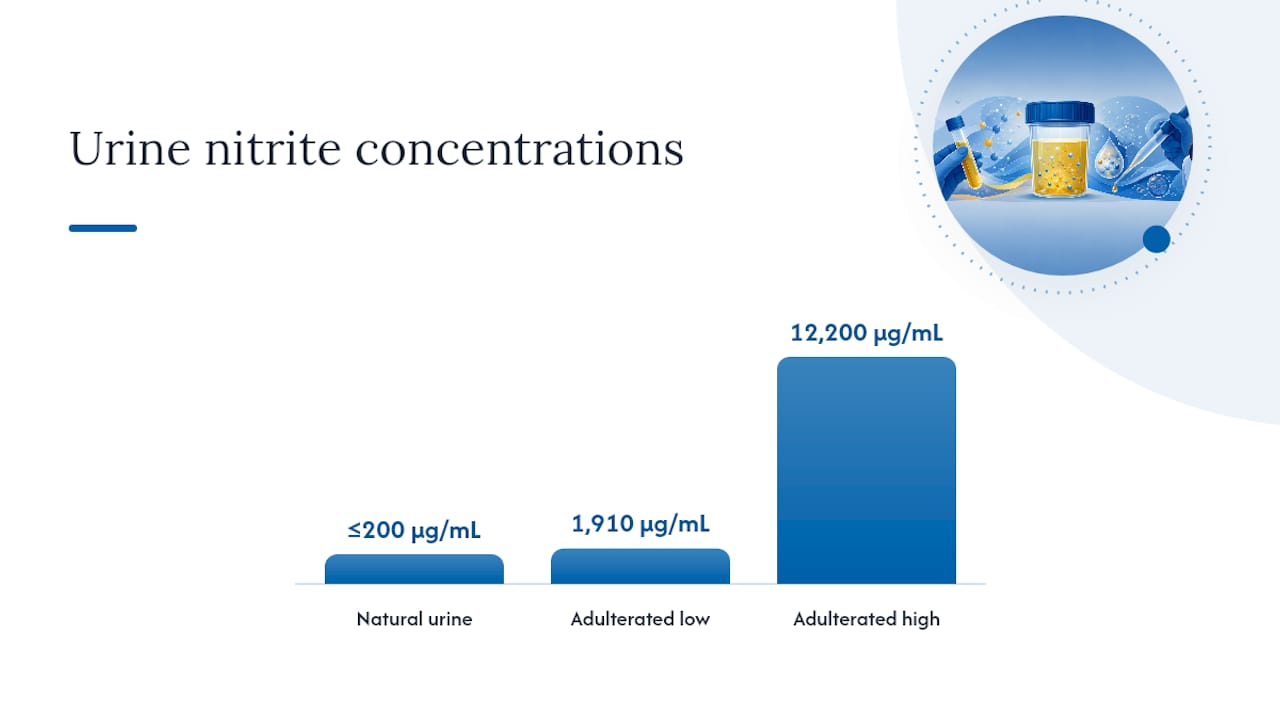
The numbers that matter: Natural urine nitrite typically stays under roughly 200 µg/mL, while confirmed adulteration cases have measured between 1,910 and 12,200 µg/mL in published case data. That gap is wide enough that a well-run lab rarely has trouble telling the two apart, provided it runs a quantitative assay instead of relying on a qualitative color change alone.
Specimen Validity Testing: The Checklist Collectors Run First
Nitrite screening never happens in isolation. It’s one piece of specimen validity testing (SVT), the broader panel of checks labs and collectors run on every regulated specimen before anyone looks at drug results.
- Check temperature within 4 minutes of collection. A valid range runs 90°F to 100°F; anything outside it suggests substitution.
- Measure creatinine and specific gravity. Low creatinine paired with low specific gravity points to dilution, whether accidental or intentional.
- Check pH. Values far outside the normal urine range can indicate an added substance.
- Run an oxidant or nitrite screen when any of the above checks raise suspicion, or as a routine part of the panel under current SVT guidance.
- Document everything in real time. Chain-of-custody paperwork should capture who handled the sample, when, and under what conditions, at every step.
An initial positive on any of these checks means the specimen needs a second look, not an automatic adverse finding.
Pro Tip: Train collectors to log temperature strip readings the moment they’re read, not after the collection is finished. A five-minute delay in paperwork can turn a defensible record into a disputed one.
Rapid Spot Tests: Field Chemistry for Nitrite and Other Oxidants
Before a specimen ever reaches an accredited lab, a collector can run a quick chemical check to flag likely tampering. These spot tests rely on simple, well-established reactions.
- Potassium permanganate plus acid decolorizes almost immediately in the presence of nitrite, a fast visual cue that something is off.
- Potassium iodide plus acid liberates free iodine, producing a distinct color shift when oxidants are present.
- Hydrogen peroxide reacts with pyridinium chlorochromate (PCC) to produce a brown color but does not react the same way with nitrite, which helps collectors tell the two adulterants apart.
Controlled testing on 100 clean urine specimens found no false positives using these reagents, which makes them a reasonably reliable first pass. Timing matters, though: read the color change within the window the reagent manufacturer specifies, wear gloves and eye protection, and never mix reagents outside their intended pairing.
Pro Tip: Spot tests are a triage tool, not a verdict. A positive field reaction should trigger quarantine and lab confirmation, never a same-day adverse action against the donor.
Laboratory Confirmatory Testing and Forensic Nitrite Thresholds
A colorimetric spot test can tell a collector something looks wrong. Only an accredited laboratory can say, with defensible certainty, that a specimen was adulterated. That distinction runs through every accredited program, whether it operates under SAMHSA guidelines, CLIA certification, or CAP accreditation.
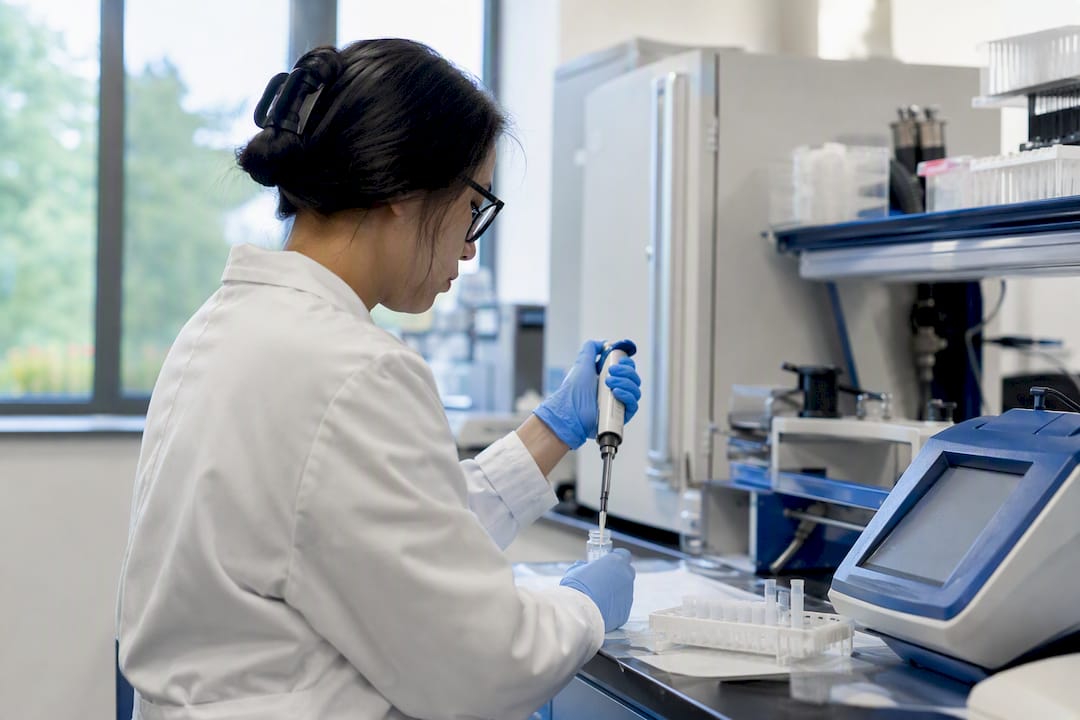
Labs typically start with a general oxidant screen calibrated to nitrite equivalents, then move to specific confirmatory methods when the screen flags a concern. Those confirmatory techniques include ion chromatography, LC–HRMS (liquid chromatography high-resolution mass spectrometry), and multi-wavelength spectroscopy, each capable of quantifying nitrite concentration rather than just detecting its presence.
Why the number matters: Guidance built on published case data treats 500 µg/mL as the initial oxidant cutoff, while genuinely adulterated specimens commonly measure in the thousands. That gap is the foundation of a defensible adulteration call.
Newer biomarker strategies add another layer of confidence. HIU (5-hydroxyisourate) and uric acid depletion are byproducts of the same oxidation reaction that degrades drug metabolites, and validated LC–HRMS methods have shown:
- HIU identifying potassium-nitrite adulteration with a reported positive predictive value near 100% in blinded testing.
- Uric acid depletion performing nearly as well, with a positive predictive value around 93% in the same validation work.
Together, quantitative nitrite assays and biomarker confirmation give labs two independent lines of evidence rather than one.
What Employers, Collectors, and Labs Should Do When Nitrite Is Detected
A nitrite flag sets off a sequence, not a single decision. Getting the order right protects everyone involved, including the donor.
- Quarantine the original specimen and document the exact collection time and temperature before anything else happens.
- Offer recollection under observation, where policy allows, rather than treating the first result as final.
- Send a second aliquot for confirmatory quantitative testing, with the lab documenting its method and limit of quantitation (LOQ).
- Consider MS biomarker confirmation (HIU or uric acid depletion) when the case may face legal scrutiny.
- Notify HR or the requesting party through proper channels, preserving chain-of-custody records and the donor’s confidentiality throughout.
If the situation calls for stronger evidence, alternative matrices such as blood or hair testing can supplement or replace a disputed urine result.
Pro Tip: Build your recollection and confirmation steps into written policy before you ever need them. Deciding the workflow after a positive nitrite screen invites inconsistency, and inconsistency is what gets adulteration findings challenged.
Why Quantitation Beats Suspicion Every Time
The biggest mistake I see in how people talk about nitrite adulteration is treating a color change as proof. It isn’t, and it was never meant to be. A permanganate strip turning clear is a reason to quarantine a specimen and pick up the phone, not a reason to end someone’s employment. The forensic literature is unambiguous on this: adulteration calls stand or fall on quantitative concentration data, not on how dramatic the field reaction looked.
Where conventional advice falls short is in treating spot testing and lab confirmation as interchangeable steps in the same process. They’re not. One is triage. The other is evidence. Programs that blur that line end up with findings that don’t survive a grievance hearing or a legal challenge, because the paperwork can’t answer the question a hearing officer will actually ask: how do you know this was tampering and not natural variation?
If you take one thing from this, prioritize the confirmatory step. A screen tells you where to look. Only a quantitative assay, ideally backed by biomarker data like HIU, tells you what you’re actually looking at.
— Alan
Confirmatory Nitrite Testing Through Accredited Lab Partners
When a field screen flags a nitrite adulterant, the next call matters more than the first result. Countrywidetesting works with a network of licensed laboratories that meet SAMHSA, CLIA, and CAP standards, so a suspicious specimen doesn’t sit in limbo while you figure out where to send it. That’s the practical advantage here: instead of hunting for a lab that will run ion chromatography or LC–HRMS on short notice, you have a channel already built for that exact scenario.
Countrywidetesting supports the full workflow, not just the initial kit. That includes ordering confirmatory oxidant and nitrite testing on a second aliquot, chain-of-custody documentation that holds up to scrutiny, and alternate-matrix options like blood or hair testing when a urine result gets disputed. Employers managing recurring programs can also set up enterprise arrangements for consistent SVT-aware collection and lab coordination.
If a specimen in your program just triggered a nitrite flag, the next step is straightforward: visit Countrywidetesting’s lab testing services page to request confirmatory testing or get a quote for ongoing program support.
Sources
Not every trace of nitrite means tampering, and a defensible program never treats it that way. Some dietary and metabolic factors can nudge urine nitrite slightly upward, but published case data shows natural levels rarely approach forensic cutoffs.
- A Practical Guide to Urine Drug Monitoring - PMC
- Rapid spot tests for detecting adulterants in urine specimens (PubMed)
- Nitrite adulteration of workplace urine drug-testing specimens (PubMed)
- Suitability evaluation of new endogenous biomarkers for the identification of nitrite‐based urine adulteration in mass spectrometry methods
A defensible adulteration report has to demonstrate that the nitrite concentration measured could not plausibly occur naturally. That’s why quantitative spectrophotometric or confirmatory assays, not qualitative color reactions, are the scientific standard labs rely on.
Retaining a second aliquot, applying an accredited method, and documenting the full chain of custody are what turn a suspicious result into a finding that holds up under challenge.