
4-Step Timeline to Expose Chain of Custody Errors for Defense Counsel
A broken chain of custody does not automatically throw out evidence, but it can, when the break is substantive enough to undermine the item’s identity or integrity. Courts weigh whether the party offering evidence gave a sufficient foundation under authentication rules like Federal Rule of Evidence 901. If you suspect a gap in your case, preserve every record you can access, send a preservation letter immediately, and call your attorney before anything gets discarded or overwritten.
TL;DR:
- Minor custody errors, such as missing signatures or mismatched timestamps, typically impact the weight of evidence but rarely lead to automatic exclusion.
- Substantive breaks that question the item’s identity, like unaccounted-for discrepancies or missing reserve portions, can result in evidence being excluded altogether.
- Investigating suspected breaks requires detailed record requests, building a chronological timeline, and pinpointing the exact missing or mismatched entries.
- Digital evidence custody is more fragile, relying on cryptographic hashes, verified imaging, and thorough documentation of software and system logs.
- Promptly sending preservation letters, requesting comprehensive discovery, and involving relevant experts can preserve your ability to challenge questionable evidence effectively.
Table of Contents
- What Are the Most Common Chain of Custody Errors?
- How Do Custody Errors Affect Admissibility and Jury Weight?
- How Do You Investigate a Suspected Chain Break?
- What Makes Digital Evidence Custody Different?
- What Should You Do Right Now if You Suspect a Break?
- Which Trust Signals Actually Matter in a Lab’s Process?
- Why Reading the Record First Beats Arguing First
- Independent Lab Confirmation When Chain of Custody Is Contested
- Where to Learn More About Chain of Custody Standards
- Sources
- FAQ
What Are the Most Common Chain of Custody Errors?
Most custody failures aren’t dramatic. They’re paperwork slips and storage shortcuts that pile up until they matter.
On the physical side, the usual suspects include missing signatures at handoff points, mislabeled evidence bags, containers that were resealed without documentation (or never sealed properly in the first place), and storage conditions that violate a lab’s own protocols, like a specimen sitting outside its required temperature range overnight.
Inside the lab, the problems get subtler. Internal transfers between technicians sometimes go unlogged. A sample gets subdivided for multiple tests without anyone recording the split. Worse, an entire specimen gets consumed during testing with no reserve portion kept for independent confirmation, which closes the door on a defense retest entirely.
Digital evidence brings its own failure modes:
- Missing or unrecorded cryptographic hashes at intake
- Investigators analyzing the original device instead of a verified image
- System logs that don’t match across acquisition tools or workstations
- No documented verification step after a file transfer
Any one of these, standing alone, might mean little. Several stacked together tell a different story.
How Do Custody Errors Affect Admissibility and Jury Weight?
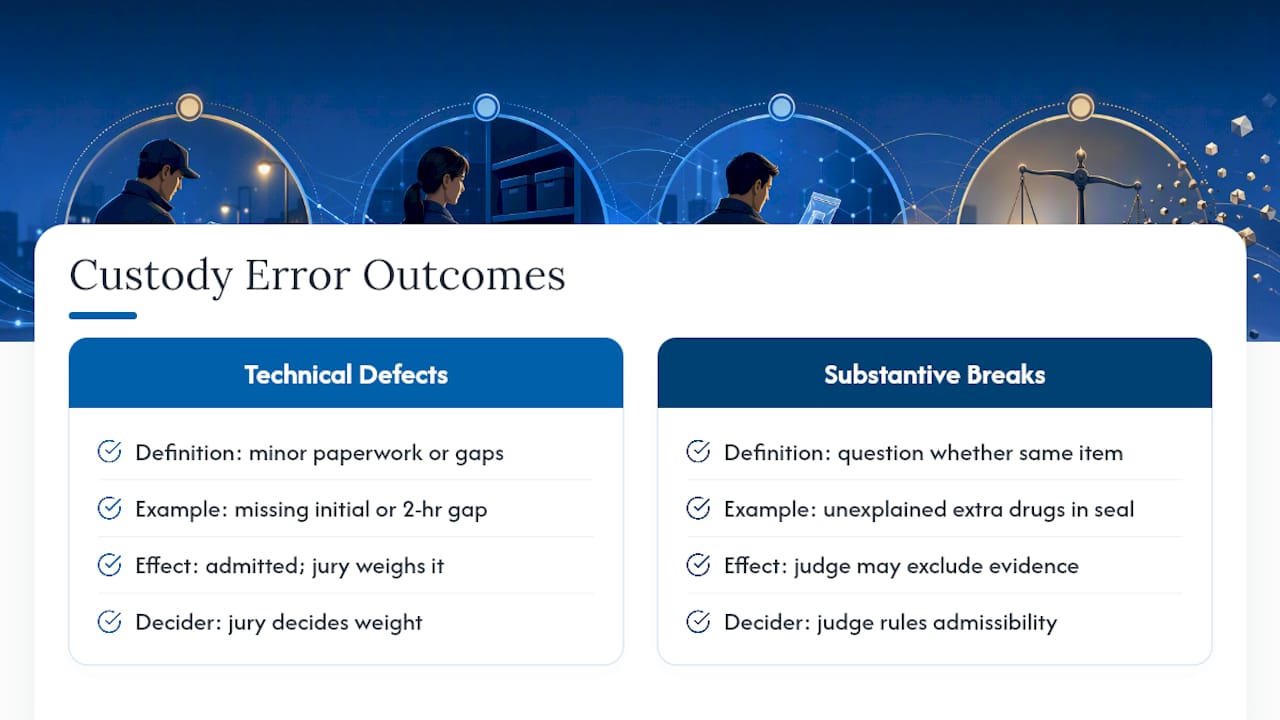
Authentication law under Rule 901 asks a simple question: has the proponent shown the evidence is what they claim it is? That’s a lower bar than perfection. A missing initial on a transfer log or a two-hour gap in a timestamp usually counts as a technical defect. Courts let the jury hear it and decide how much to trust it. That’s the “weight” side of the equation.
Substantive breaks are different. When there’s a genuine question about whether the item in the courtroom is the same item collected from the scene, judges can exclude it outright. The distinction comes down to who decides what: a judge rules on admissibility as a gatekeeping function, while a jury decides how much weight to give evidence that does get admitted.
A 2026 South Carolina case illustrates the stakes: a drug trafficking conviction was reversed after an unexplained additional amount of methamphetamine was found in a container that was supposedly sealed, with the state unable to account for the discrepancy. That’s a substantive break, not a paperwork typo, and it moved the needle from “argue about weight” to “exclude the evidence entirely.” Readers should verify the case record independently before citing it in a filing.
How Do You Investigate a Suspected Chain Break?
Vague suspicion doesn’t win suppression motions. You need specific, documented gaps, so treat the investigation like building a timeline with named entries and named holes.
- Request the full custody file in discovery. Ask for custody logs, lab worksheets, LIMS exports, intake receipts, evidence room access logs, and any relevant CCTV footage.
- Build a chronological timeline. Plot every documented handoff, then mark the gaps where no entry exists or where two records contradict each other.
- Pull secondary records to corroborate. Keycard access logs, courier delivery receipts, and even lab maintenance logs can confirm or contradict what the official custody form claims.
- Decide on remedies. If records are incomplete or the state resists producing them, consider a motion to compel, a formal preservation letter, or spoliation remedies if evidence has already gone missing.
Pro Tip: Don’t argue “the chain was broken” in the abstract. Name the exact missing entry, the exact mismatched timestamp, or the exact broken seal. Specificity is what turns a suppression argument from noise into something a judge has to rule on.
This investigation-first approach mirrors what practitioners recommend: assemble the record, find the precise gap, then decide whether you’re arguing exclusion or attacking weight in front of a jury.
What Makes Digital Evidence Custody Different?
Digital evidence runs on cryptographic proof instead of paper signatures, and that raises the technical bar considerably.
Best practice calls for a bit-for-bit forensic image of any device, with a SHA-256 hash recorded at intake and verified again after analysis. If the hash values don’t match, or if investigators analyzed the original device instead of a verified copy, that’s a serious integrity problem.
Watch for these specific failure points:
- No hash value recorded at the point of acquisition
- Analysis performed on the source device rather than a forensic image
- Workstation logs that don’t reconcile with the acquisition tool’s own logs
- No documented record of which software version and settings performed the acquisition
Cloud and third-party data add another layer. When evidence lived on a cloud provider’s servers, you may need to subpoena that provider’s own access and modification logs, not just what local investigators documented. Ask for the acquisition tool logs, hash verification reports, the image files themselves, and any export identifiers tied to the chain of custody.
What Should You Do Right Now if You Suspect a Break?
Move fast, but move on paper. Everything from this point forward should create a record, not just a phone call.
- Send a preservation letter identifying the specific evidence and records at risk.
- File early discovery requests for every custody-related document, not just the lab report.
- Retain the right expert early. A forensic toxicologist can review specimen handling; a digital forensics examiner can verify hash chains and imaging logs.
- Ask whether independent retesting is still possible. Some specimens have reserve portions available; others were fully consumed during the state’s original test, which forecloses that option.
Pro Tip: Once your expert identifies a real gap, disclose it to the prosecutor before trial rather than saving it as a surprise. A documented custody problem often moves plea negotiations more than it moves a jury.
Which Trust Signals Actually Matter in a Lab’s Process?
Not every lab claim is worth the same. Look for accreditation to ISO/IEC 17025, CLIA certification for clinical testing, and CAP accreditation where applicable. These standards require documented procedures and regular audits, not just a certificate on a wall.
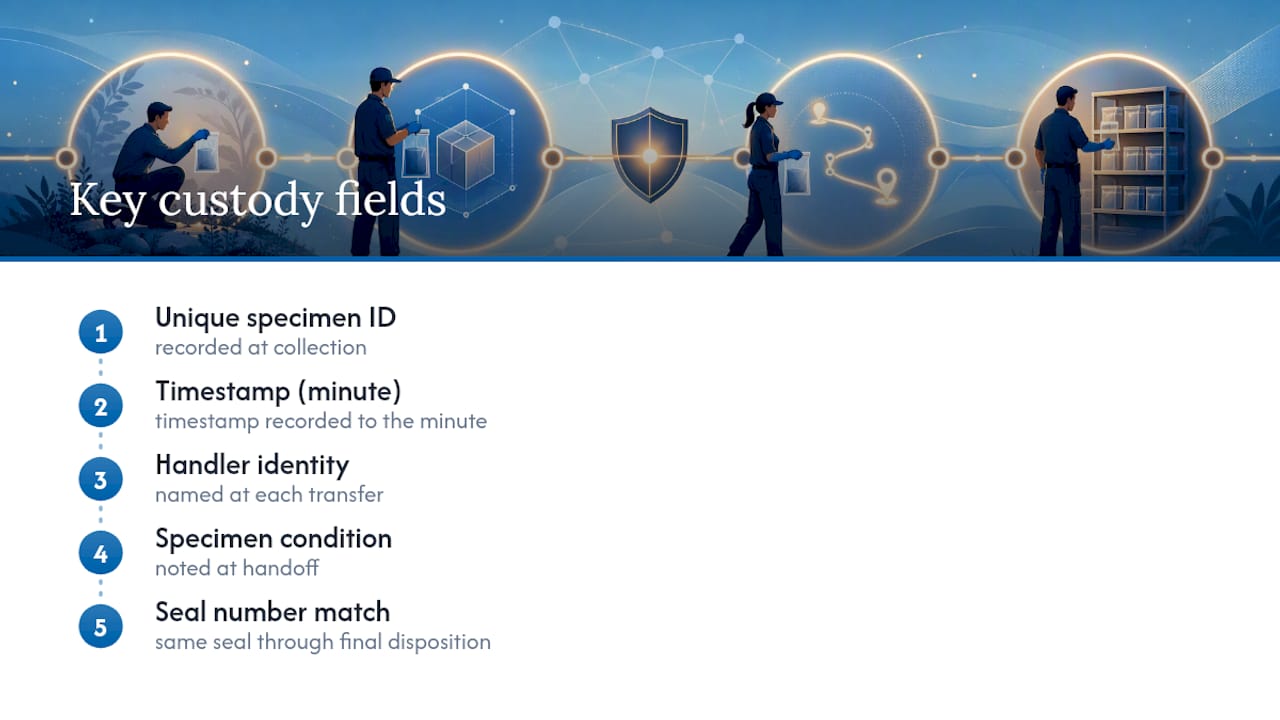
On the custody form itself, check for a unique specimen ID, a timestamp recorded to the minute, the handler’s identity at each transfer, the specimen’s condition at handoff, and a seal number that matches from collection through final disposition. A lab with an integrated LIMS audit trail can usually produce these fields on demand; one without a system like that often can’t.
If you’re unsure what a compliant form should look like, Countrywidetesting’s guide to filling out a chain of custody form walks through each required field. Document any gap you find immediately and in writing. Waiting only makes the gap harder to prove later.
Why Reading the Record First Beats Arguing First
Chain-of-custody arguments live or die on documents, not instinct. Before deciding whether to push for suppression or settle for attacking weight in front of a jury, read the custody file line by line and find the exact entry that’s missing or the exact timestamp that doesn’t add up.
Vague claims that “something feels off” rarely move a judge. A named gap, backed by a secondary record that contradicts the official log, usually does. Bring in a forensic toxicologist or digital examiner only after the paper trail suggests a real technical problem worth their time, not as a first move.
— Alan
Independent Lab Confirmation When Chain of Custody Is Contested
When a toxicology result or specimen identity is disputed, an independent read on the sample can settle the question faster than a motion ever will. Countrywidetesting works with accredited laboratories and offers lab testing services for exactly this kind of confirmation, alongside employer compliance programs that follow documented custody procedures from collection through reporting.
Independent confirmation matters most when the original chain shows a genuine gap, not just a clerical typo, and a second, properly documented result can clarify whether that gap changed the outcome. If you’re preparing custody paperwork yourself, Countrywidetesting’s chain of custody form guide covers the fields labs and courts expect to see filled out correctly. Start by reviewing the lab testing services page to see which testing option fits your situation, then request a confirmation test before your next filing deadline.
Where to Learn More About Chain of Custody Standards
For deeper reading, the NIJ’s chain-of-custody training materials cover legal foundations and pretrial procedure. The CASRAI forensic chain-of-custody guide details form fields and lab documentation standards. Practitioner explainers on real-case implications round out a practical research base.
This article is general information, not a substitute for advice from a qualified lawyer. Consult a qualified legal professional about your own circumstances before acting on anything here.
Sources
- Chain of Custody: What it Requires, Where it Breaks, and How to Read the Record — ClutchJustice (2026)
- Chain of custody in forensic science: Procedure, documentation, and procurement — CASRAI
- NIJ chain-of-custody guidance — NIJ (US DOJ)
FAQ
What Is the Biggest Mistake People Make in a Custody Dispute?
The most common mistake is arguing that a chain was broken without naming a specific missing entry, mismatched timestamp, or broken seal; vague claims rarely persuade a judge.
What Happens if the Chain of Custody Is Broken?
A broken chain doesn’t automatically exclude evidence. Courts look at whether the break is substantive enough to raise a real question about the item’s identity, and substantive breaks can lead to suppression while minor defects typically just affect jury weight.
What Are the Legal Implications of a Chain of Custody Error?
Legally, an error shifts the burden onto the proponent to show sufficient foundation under Rule 901; if they can’t, a judge can exclude the evidence, and if they can, the jury still gets to weigh how much the error matters.
What Happens if a Lab Fails to Maintain Proper Custody Records?
Incomplete records can support a motion to suppress or a spoliation argument, especially when the lab can’t produce required fields like handler identity, timestamps, or seal numbers, and independent lab confirmation through an accredited facility can sometimes clarify a disputed result.