
The ADA and Drug Testing: What Employers Must Know
Under the ADA, tests for the illegal use of drugs are not medical examinations, so employers may conduct them at any stage of employment without showing job-relatedness or business necessity. Alcohol tests, however, are treated as medical examinations and carry stricter requirements. Here is what that means for your HR program right now:
- Drug tests for illegal use are permitted at pre-offer, post-offer, random, or reasonable-suspicion stages without ADA justification, per EEOC enforcement guidance.
- Employees in recovery and those taking legally prescribed medication (including medication for opioid use disorder) are protected under the ADA if they are not currently using drugs illegally.
- Confidentiality is non-negotiable: any medical information a test reveals must be stored in a separate file, shared only on a need-to-know basis, and routed through a Medical Review Officer (MRO) to shield prescription details from supervisors.
- Authoritative guidance comes from the EEOC, the ADA National Network, SAMHSA, and ADA.gov. Consult them before finalizing any policy.
Key Takeaways
The ADA permits drug testing for illegal use at any employment stage without medical-exam justification, but alcohol testing is a medical examination and requires job-relatedness and business necessity.
| Point | Details |
|---|---|
| Drug tests vs. alcohol tests | Tests for illegal drug use are not ADA medical exams; alcohol tests are, and carry stricter requirements. |
| Protected employees | Workers in recovery, in supervised treatment, or taking legally prescribed MOUD are protected if not currently using drugs illegally. |
| Confidentiality is mandatory | Test results revealing medical information must be stored in a separate file; MRO review prevents prescription disclosure to supervisors. |
| Consistent application | Applying testing triggers unevenly across job categories is one of the most common sources of ADA discrimination claims. |
| Countrywidetesting’s role | Countrywidetesting provides SAMHSA-, CLIA-, and CAP-certified lab testing with MRO review, supporting employer ADA compliance from collection through final reporting. |
This article provides general information about ADA compliance in drug and alcohol testing and is not a substitute for legal advice. Consult qualified employment counsel for guidance on your specific situation and applicable state law.
Table of Contents
- Why the ADA and drug testing rules matter for every employer
- What the ADA permits and forbids in drug testing programs
- How does the ADA treat alcohol testing differently from drug tests?
- Who does the ADA protect when it comes to substance use?
- What testing models are allowed, and where does the ADA create risk?
- How should you handle test results and medical information under the ADA?
- How do you write a drug and alcohol testing policy that holds up?
- How to choose labs, vendors, and MROs that protect your program
- Common employer mistakes and how to avoid them
- What happens when an employer gets this wrong?
- Balancing safety, compliance, and humane treatment
- Compliant lab testing services from Countrywidetesting
- Sources
Why the ADA and drug testing rules matter for every employer
ADA Title I prohibits covered employers (those with 15 or more employees) from discriminating against qualified individuals with disabilities in any aspect of employment. Drug and alcohol testing sits squarely in that territory because a positive result can reveal a disability, trigger an accommodation request, or expose the employer to a discrimination claim if the policy is applied unevenly.
The EEOC is the primary federal agency that enforces Title I and issues guidance on how testing intersects with the ADA’s medical-examination rules. The ADA National Network, a federally funded technical-assistance network, translates that guidance into practical tools for HR. Together, they form the authoritative baseline every employer policy should reference.
Why should HR care beyond avoiding a lawsuit? Three practical reasons. First, an ADA violation can expose the organization to back pay, compensatory damages, and reinstatement orders. Second, confidentiality failures, such as a supervisor learning about an employee’s prescription through a positive test, are among the most common and avoidable sources of ADA liability. Third, the ADA’s rules interact with DOT federal testing mandates and a growing patchwork of state cannabis laws, so a policy that was compliant two years ago may not be today.
What the ADA permits and forbids in drug testing programs
The legal framework here is more precise than most HR teams realize. The ADA draws a sharp line between testing for illegal drug use and other medical inquiries, and that line determines what employers can do without ADA justification.
What the ADA permits:
- Testing for the illegal use of drugs at any employment stage (pre-offer, post-offer, random, reasonable-suspicion, post-accident) without demonstrating job-relatedness or business necessity, per EEOC guidance.
- Taking adverse action against an employee currently engaged in the illegal use of drugs, even if that person has a substance use disorder.
- Maintaining a drug-free workplace policy that includes testing, provided it is applied consistently.
What the ADA forbids:
- Discriminating against an employee or applicant because they are in recovery from drug addiction, have completed a rehabilitation program, or are erroneously regarded as currently using drugs illegally. The EEOC’s employer responsibilities guidance is explicit on this point.
- Firing or refusing to hire someone solely because they take legally prescribed medication, including medication for opioid use disorder (MOUD), when that medication is taken as directed under medical supervision.
- Treating a positive test result as automatic grounds for termination without first determining whether the result reflects current illegal use or a lawful prescription.
Where agency guidance and case examples clarify the limits:
The U.S. Commission on Civil Rights has analyzed how disability law applies to substance abuse and confirms that the ADA’s exclusion for “current illegal use” is narrow. Courts have generally interpreted “current” to mean recent enough that the employer has reasonable cause to believe use is ongoing, not a distant history of addiction. An employee who completed a rehabilitation program six months ago and has been sober since is protected. An employee who tested positive last week and has no treatment history is not.
The ADA National Network and EEOC also note that employers cannot use a drug test as a pretext to screen out people with disabilities unrelated to drug use. If a test panel includes markers that reveal a medical condition (certain prescription medications, for example), the employer’s handling of that information immediately becomes subject to ADA confidentiality rules.
How does the ADA treat alcohol testing differently from drug tests?
This is the distinction that catches employers off guard most often. Alcohol testing is a medical examination under the ADA. Drug testing for illegal use is not. The practical consequences of that difference are significant.
The core difference:
- A test for illegal drug use: not a medical exam under the ADA, no job-relatedness or business-necessity showing required.
- A breath or blood alcohol test: a medical examination, subject to ADA’s requirement that it be job-related and consistent with business necessity when conducted pre-offer or in ways that could screen out people with disabilities.
Practical consequences:
- Pre-offer alcohol screening is generally impermissible under the ADA because it constitutes a medical examination before a conditional offer has been made.
- Post-offer alcohol testing is permissible if the employer tests all employees in the same job category.
- Random or reasonable-suspicion alcohol testing in the workplace is permissible when the employer can demonstrate job-relatedness and business necessity, which is typically straightforward for safety-sensitive roles.
Three brief scenarios:
- Pre-offer alcohol screen: An employer asks all applicants to take a breath alcohol test before extending a conditional offer. This likely violates the ADA because it is a medical examination conducted before an offer.
- Post-accident breath test: An employee is involved in a forklift accident. The employer administers a breath alcohol test as part of the post-accident investigation. This is generally permissible because it is job-related and consistent with business necessity.
- Reasonable-suspicion alcohol test in a safety-sensitive role: A supervisor observes slurred speech and unsteady gait in a crane operator. The employer sends the employee for a breath test. Permissible, provided the employer has documented objective observations and trained supervisors to make reasonable-suspicion determinations.
The Job Accommodation Network (JAN) notes that alcoholism can itself be a disability under the ADA, which means an employer may discipline an employee for alcohol-related conduct (showing up impaired, for example) but must be careful not to discriminate against someone solely because they have a diagnosis of alcohol use disorder.
Who does the ADA protect when it comes to substance use?
Protection under the ADA is not automatic for everyone who has ever used drugs or alcohol. The statute draws careful distinctions, and understanding them is the difference between a defensible policy and a discrimination claim.
Conditions that can qualify as disabilities:
- Opioid use disorder (OUD), alcohol use disorder, and other substance use disorders can qualify as disabilities under the ADA when they substantially limit a major life activity.
- The key caveat: the ADA explicitly excludes individuals who are currently engaging in the illegal use of drugs from protection based on that use.
Who is protected:
- Employees and applicants who have successfully completed a drug rehabilitation program and are no longer using drugs illegally.
- Individuals currently participating in a supervised rehabilitation program who are not using drugs illegally.
- People taking legally prescribed medication, including MOUD such as buprenorphine or methadone, when taken as directed under medical supervision. Ada that employers may not fire or refuse to hire someone solely on the basis of lawful, supervised MOUD use if the person can perform essential job functions safely.
- Individuals who are erroneously regarded as currently using drugs illegally.
Reasonable accommodation basics:
- Temporary duty modifications while an employee completes a treatment program.
- A leave of absence for inpatient or intensive outpatient treatment.
- A return-to-work agreement that includes periodic testing as a condition of reinstatement (this is a recognized accommodation, not a punishment, when applied consistently).
- Schedule adjustments for outpatient counseling or support group attendance.
HR dos and don’ts:
- Do engage in the interactive process when an employee discloses a substance use disorder or requests accommodation.
- Do consult with legal counsel before denying an accommodation request related to substance use.
- Do not automatically terminate an employee who tests positive without first determining whether the result reflects current illegal use or a lawful prescription.
- Do not ask an employee to disclose their specific diagnosis as a condition of receiving accommodation.
Research published in PMC reinforces that courts and policy actors treat addiction-related disability claims seriously in employment contexts, and that employers who skip the interactive process face heightened litigation risk.
What testing models are allowed, and where does the ADA create risk?
Different testing triggers carry different ADA implications. The table below maps each common model to its primary ADA concern and the federal or state considerations that apply.
| Testing Type | ADA Concern | Federal / State Considerations |
|---|---|---|
| Pre-offer drug test (illegal drugs) | None — not a medical exam under ADA | State law may restrict timing or notice requirements |
| Pre-offer alcohol test | High — constitutes a medical exam; generally impermissible before conditional offer | ADA bars pre-offer medical exams; DOT rules govern regulated industries |
| Post-offer drug test (illegal drugs) | Low — permissible; apply consistently across job category | SAMHSA-certified labs required for federal/DOT programs |
| Post-offer alcohol test | Moderate — permissible if applied to all in same job category | DOT mandates post-offer alcohol testing for safety-sensitive roles |
| Random drug test (illegal drugs) | Low — permissible; consistent application required | DOT mandates random testing rates for regulated employees |
| Random alcohol test | Moderate — must be job-related and consistent with business necessity | DOT sets minimum random alcohol testing rates for safety-sensitive roles |
| Reasonable-suspicion test | Low to moderate — requires documented objective observations | Supervisor training required; DOT has specific reasonable-suspicion criteria |
| Post-accident test | Low — generally permissible when job-related | DOT mandates post-accident testing thresholds for regulated industries |
| Safety-sensitive / DOT-mandated | Governed by DOT rules, which operate alongside (not instead of) ADA | SAMHSA sets lab and MRO standards for federal programs |
DOT-regulated employers (transportation, aviation, pipeline, transit, and related sectors) operate under a separate mandatory testing regime that has its own lab certification, MRO, and chain-of-custody requirements. The ADA still applies to those employers, but DOT rules set the floor for testing frequency, panel content, and procedures. For a deeper look at federal drug testing compliance, the interaction between DOT and ADA obligations is worth reviewing with counsel.
State cannabis laws add another layer. Medical marijuana remains illegal under federal law, so the ADA offers no federal protection for adverse actions based solely on marijuana use. State law is a different matter: several states now prohibit employers from taking adverse action against employees who use cannabis lawfully off-duty. The ADA.gov opioid resources page notes that employers must consider state statutes that can impose additional obligations beyond what federal law requires. For more on how legalization affects workplace drug testing policy, state-specific review is essential.
How should you handle test results and medical information under the ADA?
Confidentiality is where many employers create ADA liability without realizing it. The moment a drug test reveals prescription medication or any other health-related information, ADA confidentiality rules attach.
The core obligation:
- All medical information obtained through testing must be stored in a separate, confidential medical file, physically or electronically segregated from the general personnel file.
- Access is limited to supervisors and managers who need to know about work restrictions or accommodations, first-aid and safety personnel when relevant, and government officials investigating ADA compliance.
- Disclosing an employee’s prescription information to their direct supervisor, even casually, can constitute an ADA violation.
The MRO firewall:
Using a Medical Review Officer is the single most effective way to protect prescription information. The MRO reviews a positive result, contacts the employee confidentially to ask about legitimate prescriptions, and reports back to the employer only a narrow employability determination: “negative” (prescription verified) or “positive” (no legitimate explanation). Supervisors never learn what medication the employee takes. For a full breakdown of what an MRO does and why that firewall matters, the MRO’s role in protecting ADA-sensitive information is the central point.
Recordkeeping checklist:
- Maintain chain-of-custody documentation for every specimen from collection through laboratory analysis.
- Store MRO reports in the confidential medical file, not the personnel file.
- Limit access to the medical file to those with a documented need to know.
- Retain records in accordance with applicable federal and state retention schedules.
- Document every disclosure of medical information, including to whom, when, and the legal basis.
Pro Tip: Train HR staff and supervisors explicitly on what they may and may not ask after a positive test. A supervisor who asks “What prescription are you on?” after learning of a positive result has potentially created an ADA violation before the MRO process is even complete.
For employers navigating the overlap between ADA confidentiality and HIPAA, HIPAA compliance in drug testing provides additional context on how these two frameworks interact.
How do you write a drug and alcohol testing policy that holds up?
A well-drafted policy is your first line of defense in any EEOC investigation or litigation. It also sets clear expectations for employees and supervisors, which reduces the risk of inconsistent application.
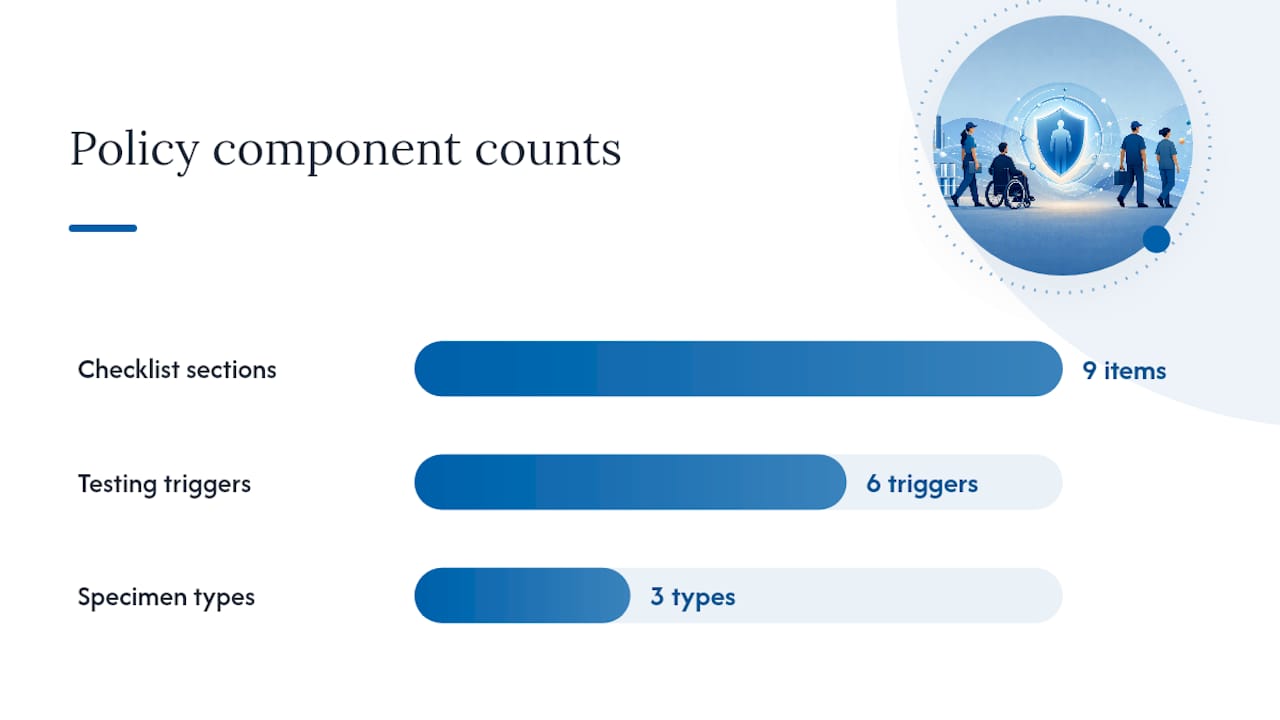
Policy checklist:
- Scope: Which employees and locations are covered? Include contractors if applicable.
- Covered substances: Specify illegal drugs, prescription medication misuse, and alcohol separately.
- Testing triggers: List each trigger (pre-offer, post-offer, random, reasonable-suspicion, post-accident, return-to-duty) and the procedure for each.
- Sample collection procedures: Specify collection site requirements, chain-of-custody steps, and specimen types (urine, oral fluid, breath).
- Confidentiality: State explicitly that results are stored in a separate medical file and disclosed only on a need-to-know basis.
- Disciplinary steps: Define consequences for a confirmed positive, refusal to test, and adulteration or substitution of a specimen.
- Accommodation and rehabilitation pathway: Describe how employees may request accommodation, access an Employee Assistance Program (EAP), and return to work after treatment.
- Appeal process: Provide a mechanism for employees to contest a result, including the right to request a split-specimen retest.
- State-law compliance note: Acknowledge that the policy is subject to applicable state law and will be adjusted regionally where required.
Sample policy language HR can adapt:
Random testing clause: “The Company reserves the right to conduct unannounced, random drug testing of employees in safety-sensitive positions. Selection for random testing is made by a scientifically valid random-selection method. Participation is a condition of employment for covered positions.”
Post-offer testing clause: “All conditional offers of employment are contingent upon the successful completion of a drug screen. The Company will conduct testing for illegal drug use consistent with applicable law. A confirmed positive result for illegal drug use may result in withdrawal of the conditional offer.”
Confidentiality paragraph: “All information obtained through drug and alcohol testing, including test results and any medical information disclosed in connection with testing, will be maintained in a confidential medical file separate from the employee’s personnel file. Access to this information is limited to those with a documented, legitimate need to know.”
Documentation tips:
- Use a standardized reasonable-suspicion observation form that captures objective, behavioral observations (not diagnoses or speculation).
- Apply testing triggers uniformly across job categories. Testing only hourly workers while exempting salaried staff in the same role creates disparate-impact risk.
- If a collective-bargaining agreement covers some employees, coordinate with labor counsel before implementing or changing testing procedures.
How to choose labs, vendors, and MROs that protect your program
Vendor selection is a compliance decision, not just a procurement one. The certifications a lab holds and the MRO workflow it uses directly affect whether your test results will hold up in litigation or a DOT audit.
Required lab certifications:
- SAMHSA certification: Required for federal workplace drug testing programs and DOT-mandated testing. SAMHSA-certified labs follow strict chain-of-custody, confirmation testing, and quality-assurance protocols.
- CLIA (Clinical Laboratory Improvement Amendments): Required for labs performing clinical testing; ensures analytical accuracy and quality control.
- CAP (College of American Pathologists) accreditation: A higher-tier accreditation that includes proficiency testing and on-site inspections; often required by large employers and government contractors.
- ISO accreditation: Signals adherence to international quality management standards; relevant for labs serving multinational employers.
The MRO workflow:
- Lab reports a non-negative result to the MRO, not to the employer.
- MRO contacts the employee directly to ask about legitimate medical explanations (prescriptions, medical procedures).
- MRO verifies the explanation with the prescribing provider if needed.
- MRO reports a final determination (positive or negative) to the employer, with no prescription details disclosed.
- If the result is positive, the employer receives only the employability determination and the substance category, not the specific medication.
This workflow is the practical implementation of the ADA’s confidentiality requirement. For a detailed look at the MRO’s role in drug testing, the step-by-step process and its legal significance are worth reviewing before you finalize vendor contracts.
Vendor RFP checklist:
- Proof of SAMHSA certification, CLIA certification, and CAP accreditation.
- Documented chain-of-custody procedures from collection through final reporting.
- Turnaround time guarantees for initial screen and confirmation testing.
- Litigation support policy: will the lab provide expert testimony and records in the event of a legal challenge?
- Data security and HIPAA-compliant data handling for electronic results.
- Sample retention policy: how long are specimens held for potential retest?
- MRO availability: is an MRO included in the service, or must the employer contract separately?
Pro Tip: Ask vendors for a sample chain-of-custody form and a redacted MRO report before signing a contract. If the MRO report includes prescription details in the employer-facing copy, that vendor’s workflow creates ADA liability. Walk away.
Common employer mistakes and how to avoid them
Most ADA violations in drug testing programs are not intentional. They stem from gaps in training, inconsistent application, and assumptions about what a positive test means.
Frequent mistakes:
- Inconsistent policy application: Testing some employees in a job category but not others, or applying different consequences for the same result across departments.
- Premature disclosure of prescription information: A supervisor learns about an employee’s medication before the MRO process is complete, often because HR shared the raw lab result.
- Skipping MRO review: Treating a non-negative initial screen as a confirmed positive and taking adverse action before the MRO has reviewed the result.
- Ignoring state cannabis laws: Terminating an employee for off-duty cannabis use in a state that prohibits such termination, then discovering the ADA and state law both create exposure.
- Mishandling accommodation requests: Denying a return-to-work request from an employee who completed treatment without engaging in the interactive process.
- Failing to document reasonable-suspicion observations: Supervisors make a verbal determination without completing a written observation form, leaving the employer unable to defend the testing decision.
Best-practice checklist:
- Apply every testing trigger uniformly across all employees in covered job categories.
- Route all non-negative results through an MRO before any employer decision.
- Store all test-related medical information in a separate, access-controlled medical file.
- Train supervisors annually on reasonable-suspicion observation and documentation.
- Review state cannabis and medical-marijuana laws at least annually and adjust regional policy addenda accordingly.
- Engage the interactive process for every accommodation request related to substance use disorder.
- Consult legal counsel before taking adverse action on any result that involves a disclosed prescription or a claimed disability.
Pro Tip: Supervisor training on reasonable-suspicion observations is the most overlooked compliance investment. A supervisor who documents “seemed off” instead of “slurred speech, unsteady gait, odor of alcohol at 9:00 AM” has given the employer almost nothing to work with in litigation. Invest in a half-day training and a standardized observation form.
What happens when an employer gets this wrong?
ADA enforcement in drug testing cases follows a predictable path, and knowing it in advance helps HR prepare a faster, more credible response.
Enforcement channels:
- EEOC: The primary enforcement agency for ADA Title I. An employee or applicant files a charge; the EEOC investigates, attempts conciliation, and may litigate or issue a right-to-sue letter.
- DOJ: Handles ADA Title II (public entities) and can bring pattern-or-practice suits under Title I in coordination with the EEOC.
- State civil-rights agencies: Many states have their own disability discrimination laws with broader coverage (smaller employer thresholds, additional protected classes) and their own enforcement agencies.
- DOT: For regulated industries, DOT can audit testing programs, assess civil penalties, and refer violations to the EEOC.
Typical remedies in ADA drug-testing cases:
- Reinstatement to the position from which the employee was wrongfully terminated.
- Back pay from the date of the adverse action.
- Compensatory damages for emotional distress.
- Punitive damages in cases of malicious or reckless disregard for the employee’s rights.
- Injunctive relief requiring the employer to revise its policy and provide training.
Enforcement-response documents HR should gather immediately:
- The written drug and alcohol testing policy in effect at the time of the adverse action.
- The employee’s complete personnel file (separate from the medical file).
- Chain-of-custody records for the specimen at issue.
- The MRO’s final report and any communication between the MRO and the employee.
- Supervisor observation forms and any written reasonable-suspicion determination.
- Records of any accommodation request and the employer’s response.
- Documentation of how similarly situated employees were treated under the same policy.
Practical tips for early-stage remediation:
- Engage employment counsel as soon as an EEOC charge is received, not after the investigation is underway.
- Conduct an internal audit of the policy and its application before responding to the charge.
- If the investigation reveals a genuine policy gap, correct it prospectively and document the correction. Remediation after a charge is not an admission of liability; it is evidence of good faith.
Balancing safety, compliance, and humane treatment
The compliance framework around ADA and drug testing is precise, but the human reality it governs is not. Employees struggling with substance use disorders are not abstractions in a policy document. They are colleagues, and how an employer responds to a positive test or an accommodation request says something real about the organization’s values.

My view is that the employers who handle this best are the ones who treat the ADA’s protections not as legal obstacles but as a floor for decent treatment. The statute requires you to engage the interactive process, protect confidentiality, and avoid discriminating against people in recovery. Those are also just the right things to do.
Practically, that means:
- Prioritizing uniform application above all else. Inconsistency is both the most common legal vulnerability and the most visible signal of unfairness to employees.
- Documenting everything, not to build a litigation file, but because clear records protect both the employer and the employee from misunderstandings.
- Providing a genuine path to treatment and return to work. An EAP referral and a return-to-work agreement are not just legal tools; they are investments in retaining experienced employees.
- Considering whether immediate termination is the only option. For a first-time positive in a non-safety-sensitive role, a last-chance agreement with treatment requirements and periodic testing is often a better outcome for everyone.
Aligning company values with legal obligations is not a contradiction. A policy that is humane, consistent, and well-documented is also the one most likely to survive scrutiny.
Compliant lab testing services from Countrywidetesting
When your drug testing program needs certified lab support, Countrywidetesting connects employers with licensed laboratories that meet SAMHSA, CLIA, CAP, and ISO standards — the same certifications your vendor RFP should require. Whether you need confirmation testing for a non-negative screen, chain-of-custody documentation for a DOT-regulated program, or a scalable solution for multi-site random testing, the platform is built for employer compliance needs.
Countrywidetesting’s lab testing services include MRO-reviewed confirmation testing, so prescription information stays protected and your supervisors receive only the employability determination the ADA requires. For employers who want to verify vendor credentials before committing, here is a quick checklist to bring to any conversation:
- SAMHSA certification confirmed in writing?
- CLIA and CAP accreditation current?
- MRO included in the service or contracted separately?
- Chain-of-custody documentation provided for every specimen?
- Litigation support and sample retention policy in the contract?
Visit Countrywidetesting to review available testing options or request a quote for your organization’s specific compliance needs.
Sources
- EEOC — Questions and Answers: Enforcement Guidance on Disability-Related Inquiries and Medical Examinations
- Ada
- Job Accommodation Network (JAN) — Drug addiction
- SAMHSA — Drug testing federal laws and regulations
- U.S. Commission on Civil Rights — Substance Abuse under the ADA
- PMC — The Americans with Disabilities Act, addiction, and recovery
When to consult counsel: Complex accommodation requests, any adverse action involving a disclosed prescription or substance use disorder, state cannabis law compliance, and collective-bargaining agreement interactions all warrant review by qualified employment counsel before the employer acts.