
10–90 Day STD Timeline: When to Test and Book Your 90 Day Retest
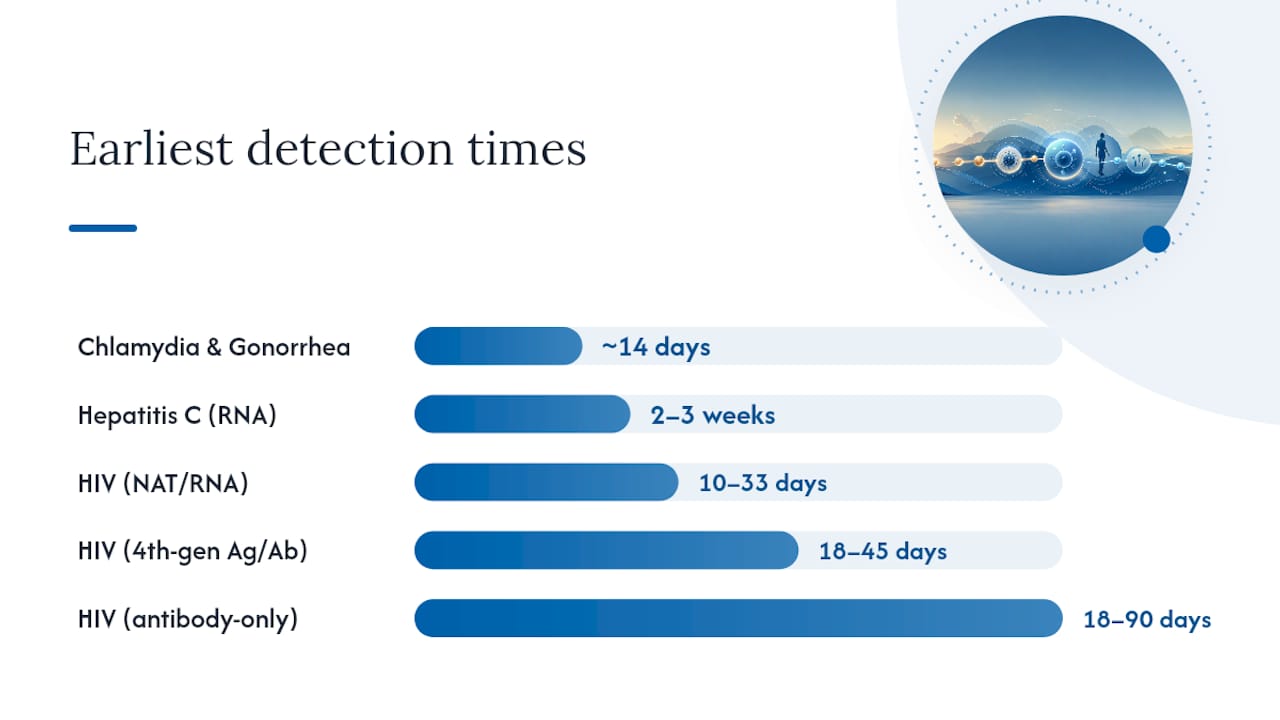
Detection timing depends entirely on which infection you’re worried about and which test you use. Chlamydia and gonorrhea NAAT tests typically become reliable around two weeks after exposure; HIV RNA tests can detect infection approximately 10 to 33 days after exposure, and 4th-generation antigen/antibody tests become reliable after about 18 to 45 days. If you have symptoms or experienced a high-risk exposure, seek evaluation promptly, and within 72 hours if HIV post-exposure prophylaxis (PEP) might be applicable. For comprehensive confirmation, retesting at about three months is recommended.
TL;DR:
- The earliest reliable detection for chlamydia and gonorrhea is approximately two weeks after exposure, requiring NAAT testing from the exposure site.
- HIV RNA tests can detect infection between 10 and 33 days, while 4th-generation antigen/antibody tests become reliable after roughly 18 to 45 days.
- Retesting at about three months after exposure is essential to confirm results for most STDs due to variability in test sensitivity and pathogen load.
- Testing immediately is recommended only when symptoms are present or exposure occurred within 72 hours, particularly for herpes, discharge, or painful urination.
- Certified lab testing offers the most accurate results, especially when testing near the end of the window period, compared to rapid or at-home tests.
Table of Contents
- What Is the STD Test Window Period, and Why Does It Matter?
- STD Testing Timeline: When Each Infection Becomes Detectable
- Which Test Detects an Infection Earliest?
- Your Step-by-Step Testing Schedule After Exposure
- When to Skip the Wait and Test Immediately
- Reading Your Results: What a Negative Really Means
- PEP, PrEP, and How HIV Prevention Changes Your Testing Timeline
- Why Certified Lab Testing Closes the Gaps DIY Timing Can’t
- Get Tested With Confidence, Not Guesswork
- The One Thing Most Window-Period Advice Gets Wrong
- Sources
What Is the STD Test Window Period, and Why Does It Matter?
The window period is the stretch of time between exposure to an infection and the moment a test can reliably detect it. This is different from the incubation period, which is the time between exposure and when symptoms appear. You can be infected, contagious, and still test negative if you check too early. That gap between infection and detectability is why timing your test matters as much as taking one at all.
Here’s why the delay happens. Antibody tests wait for your immune system to produce detectable antibodies, a process that takes days to weeks. Antigen tests look for a piece of the pathogen itself, which shows up faster but still needs the organism to replicate to detectable levels. Nucleic acid tests (NAT or PCR) hunt for genetic material, catching infections earlier than antibody tests, but even these need the pathogen to multiply past a detection threshold first.
The CDC recommends basing testing frequency on risk, not on symptoms. That guidance matters because most STDs, especially chlamydia and gonorrhea, cause no symptoms in a large share of infected people. Waiting for a symptom that may never appear means you could carry and transmit an infection for months.
Key mechanics driving window periods:
- Pathogen load has to reach a detectable threshold before any test picks it up.
- Antibody production typically takes one to several weeks to reach measurable levels.
- Test sensitivity varies by technology, with NAT and PCR detecting genetic material earlier than antibody-based tests.
- Exposure site (oral, genital, rectal) changes which samples actually contain detectable pathogen.
STD Testing Timeline: When Each Infection Becomes Detectable
Every infection has its own timeline, and mixing them up is the single biggest reason people misread a negative result. The table below gives the earliest reliable detection range, the recommended testing window, the test type to request, and when to retest for each major STD.
| Infection | Earliest Reliable Detection | Recommended Testing Window | Test Type to Request | Retest Recommendation |
|---|---|---|---|---|
| Chlamydia | reliable after about two weeks | two weeks post-exposure | NAAT (urine or swab) | follow-up testing advised if risk continues |
| Gonorrhea | reliable after about two weeks | two weeks post-exposure | NAAT (urine or swab) | follow-up testing advised if risk continues |
| HIV (NAT/RNA) | detectable roughly 10 to 33 days after exposure | two to four weeks for high-risk/recent exposure | RNA/NAT test | follow-up testing recommended after about three months |
| HIV (4th-gen Ag/Ab) | detectable approximately 18 to 45 days after exposure | 3 to 6 weeks | Antigen/antibody combo | follow-up testing recommended after about three months |
| HIV (antibody-only) | detectable from about 18 days up to 90 days after exposure | 6 to 12 weeks | Antibody test | follow-up testing recommended after about three months |
| Syphilis | detectable about 3 to 6 weeks after exposure | around 6 weeks post-exposure | Treponemal antibody test | clinical follow-up recommended |
| Herpes (lesion present) | detectable immediately at symptom onset | at symptom onset | PCR/NAAT swab of lesion | follow-up generally not needed if lesion present |
| Herpes (no lesion) | detection by blood test requires 12 to 16 weeks | 3 to 4 months | IgG serology | repeat testing advised if exposure continues |
| Hepatitis B | typically detectable by around 3 months | about 3 months post-exposure | HBsAg/antibody panel | follow clinician advice for high-risk exposure |
| Hepatitis C | RNA detectable within 2 to 3 weeks; antibodies detectable by 3 months | 2 to 3 weeks for RNA; 3 months for antibody | HCV RNA or anti-HCV antibody | antibody confirmation advised around 3 months |
| Trichomoniasis | detectable about 7 days after exposure | 1 to 2 weeks | NAAT | repeat testing if symptoms continue |
A few things jump out once you line these up side by side. First, no STI is reliably detectable within one to two days of exposure, no matter how anxious you are to know. Even the fastest RNA-based tests need over a week to catch an infection with confidence. Second, the 90-day mark functions as the great equalizer. Regardless of which infection you’re screening for or which test you used first, testing again at three months gives you conclusive reassurance for most STIs, because it accounts for antibody and antigen variability across test types.
Hepatitis C deserves a special note. RNA testing can detect the virus within two to three weeks, which is useful if you had a known high-risk exposure like a needle-stick, but antibody testing still needs the full three months to be considered reliable. And herpes splits into two completely different pathways depending on whether you have visible sores, which the next section covers in more detail.
Which Test Detects an Infection Earliest?
Not all tests are created equal, and the technology behind each one determines how soon it can catch an infection. Understanding these differences helps you ask for the right test instead of settling for whatever’s offered first.
NAT/PCR tests detect the actual genetic material (RNA or DNA) of a pathogen, which makes them the earliest detection option for HIV and hepatitis C. HIV RNA testing can flag infection in 10 to 33 days, well ahead of antibody-based methods. These tests cost more and aren’t stocked at every clinic, so RNA testing is usually reserved for very recent, high-risk exposures where early detection changes how a patient is managed.
NAAT (nucleic acid amplification tests) are the standard for chlamydia, gonorrhea, and trichomoniasis. Site matters enormously here. If your exposure involved oral or rectal contact, a urine-only test misses infections sitting in your throat or rectum entirely. You need a swab from the actual exposure site, not just whatever sample is easiest to collect.
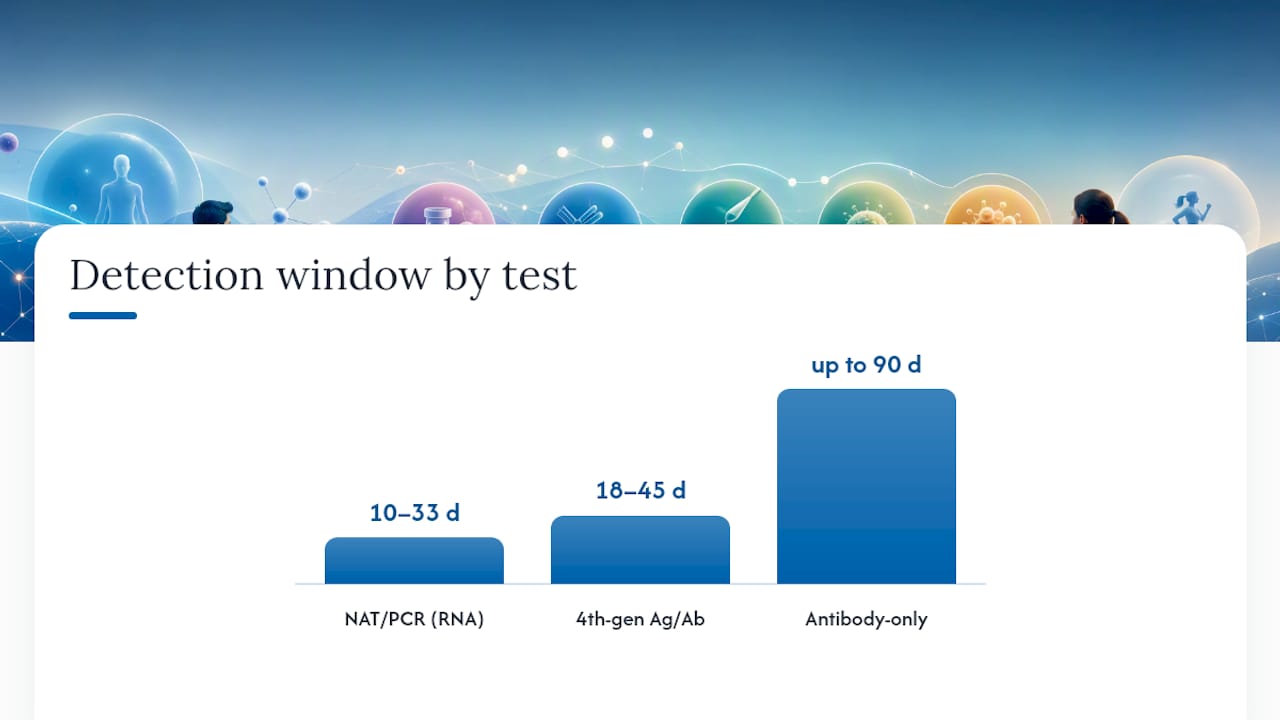
4th-generation antigen/antibody combo tests look for both the p24 antigen and HIV antibodies simultaneously, shortening the window to 18 to 45 days compared to antibody-only tests, which can take up to 90 days.
Rapid antibody-only tests are convenient and fast to run, but they’re the slowest to turn positive after exposure, since they depend entirely on your immune system catching up.
- NAT/PCR: earliest detection, higher cost, limited availability
- NAAT: standard for bacterial STIs, requires correct exposure-site swabbing
- 4th-gen Ag/Ab: shortens HIV window versus antibody-only
- Rapid antibody: convenient but slowest window
Pro Tip: If you had oral or anal sex during a potential exposure, tell your provider explicitly. Genital-only testing after non-genital exposure is one of the most common reasons people get a false sense of security from a “clean” result. Our HIV home test window guide breaks down which HIV test technology fits which exposure timeline in more detail.
Your Step-by-Step Testing Schedule After Exposure
Turning a chart into an actual plan is where most people get stuck. Here’s the sequence to follow, mapped to the days and weeks after exposure.
- Right away: If you have symptoms, or your exposure happened within the last 72 hours and involved a partner with known or suspected HIV, go to a clinic or telehealth provider immediately. PEP evaluation is time-sensitive and testing should not delay that conversation.
- Week 1 to 2: Get a NAAT test for chlamydia and gonorrhea. If your exposure was very recent and high-risk, ask whether HIV RNA testing is available at this stage.
- Week 3 to 6: Return for 4th-generation HIV testing and a syphilis antibody test, timed to your specific exposure date.
- Month 3 (90 days): Complete confirmatory testing across the board. This is your conclusive checkpoint for HIV, syphilis, and hepatitis B and C.
Book that 90-day follow-up appointment on the same day you take your first test. It’s easy to feel reassured by an early negative and simply forget to go back, which defeats the entire purpose of a window-period strategy.
When you call or walk into a clinic, give the staff three specific details: the exact date of exposure, the type of contact (oral, anal, or genital), and any symptoms you’ve noticed. That information determines which swabs get taken and which tests get ordered, so vague answers lead to incomplete testing.
Pro Tip: Write down the exposure date the same day it happens. A week later, “sometime last weekend” becomes a genuine guess, and that guess can throw off your entire testing schedule by days that actually matter.
When to Skip the Wait and Test Immediately
Window periods exist for asymptomatic screening, but symptoms change the calculation entirely. If something feels wrong, don’t wait for a theoretical detection date.
- Visible sores or blisters: A lesion swab PCR test can detect herpes at the moment symptoms appear, no matter how recent the exposure was. This is far faster and more accurate than waiting for blood-based IgG serology, which needs 12 to 16 weeks to be reliable.
- Discharge or painful urination: These symptoms warrant a NAAT or culture test of the affected site right away rather than waiting for a calendar-based window to close.
- Any new or unusual symptom: Tell the tester exactly when symptoms started and where. That detail determines which samples get collected and can be the difference between a useful test and a wasted one.
Mayo Clinic’s guidance is direct on this point: symptomatic patients should seek prompt evaluation regardless of the theoretical window period for their suspected exposure.
Reading Your Results: What a Negative Really Means
A negative test taken during the window period isn’t proof you’re infection-free. It means the test didn’t detect anything yet, which is a meaningfully different statement. Testing too early produces false negatives because antibody or antigen levels simply haven’t risen high enough to register, and that’s true no matter how accurate the test is under normal conditions.
Positive results work differently and almost always require confirmation. A positive rapid HIV test needs a confirmatory laboratory assay before diagnosis. A positive syphilis screening test needs a treponemal confirmatory test to rule out a false positive from unrelated conditions.
- Negative during the window: Schedule the recommended retest, don’t treat it as final.
- Positive screening result: Expect a confirmatory lab test before any treatment decision is finalized.
- Confirmed positive: Start treatment promptly, notify partners, and get connected to ongoing care.
- Early negative with continued risk: Retest at the 90-day mark regardless of how you feel.
If a negative result during a window period feels unsettling, that reaction is common, and patient advocacy resources on handling uncertain results can help you figure out what questions to ask your provider next. The takeaway that matters most: one early negative is a data point, not a verdict.
PEP, PrEP, and How HIV Prevention Changes Your Testing Timeline
If you had a high-risk HIV exposure, testing takes a back seat to a more urgent decision. PEP (post-exposure prophylaxis) only works if started within 72 hours of exposure, and no amount of testing accuracy changes that deadline. If you’re inside that window, get to a clinic or emergency room immediately. Testing can happen alongside the PEP evaluation, not instead of it.
Once PEP starts, your clinician will typically order a baseline HIV test before treatment and schedule follow-up testing at set intervals afterward, since the medication itself can influence early results. People on PrEP (pre-exposure prophylaxis) follow a different, ongoing rhythm: routine testing every three months is standard practice, catching any breakthrough infection early and keeping the prevention regimen on track.
Why Certified Lab Testing Closes the Gaps DIY Timing Can’t
Timing your test correctly only gets you halfway there. The other half is making sure the sample itself gets processed with real accuracy, which is where lab certification matters. Countrywidetesting works with laboratories holding CLIA, CAP, SAMHSA, and ISO certifications, the standards that govern sample handling, testing protocols, and result accuracy across the industry.
That distinction shows up in practice. A certified lab testing service processes samples under the same quality controls hospitals rely on, while a home test that skips lab confirmation leaves you guessing about sensitivity at the edges of your window period. Countrywidetesting offers both at-home STI test kits that route to certified labs and direct lab-testing services, so you can choose based on how confident you need to be and how soon you need an answer. For anyone testing near the edge of a window period, where sensitivity matters most, lab-based testing is the more defensible choice over a purely consumer-grade device.
Get Tested With Confidence, Not Guesswork
Countrywidetesting exists for exactly this moment: when you know the exposure happened and you need a testing plan that actually holds up, not a guess dressed up as reassurance. Whether you need an at-home STI test that routes to a certified lab or a full lab-testing service for a specific exposure scenario, matching the test to your window period is the whole game. Start with our STI testing options or explore full lab testing services to build a schedule around your actual exposure date, not a generic calendar.
The One Thing Most Window-Period Advice Gets Wrong
Most guidance on this topic treats the window period like a single number, as if one date applies to every infection and every test. That framing sets people up to either test too early and panic over a meaningless negative, or test once and stop, assuming they’re cleared. Neither instinct matches how these tests actually work.
The 90-day retest is the piece conventional advice buries. Everyone remembers to test after exposure. Almost nobody schedules the follow-up, and that’s precisely the test that turns a tentative negative into a real answer. If you take one thing from this article, make it this: book your 90-day appointment the same day you take your first test.
The other overlooked detail is exposure site. Genital-only testing after oral or rectal exposure isn’t incomplete, it’s frequently useless for catching what’s actually there. A precise timeline paired with the wrong sample site still produces a false sense of security. Get the day range right, but get the site right too.
— Alan
This article is general information, not a substitute for advice from a qualified doctor. Consult a qualified healthcare professional about your own circumstances before acting on anything here.
Sources
- Getting tested for STIs | CDC
- STD symptoms and testing | Mayo Clinic
- How does STD testing work? | Planned Parenthood