
Examples of Lab Accreditation Standards for QA Managers
The main examples of lab accreditation standards are ISO/IEC 17025 (testing and calibration), ISO 15189 (medical laboratories), the College of American Pathologists Laboratory Accreditation Program or CAP LAP (clinical pathology), TNI standards (environmental testing), ISO/IEC 17020 (inspection bodies), ISO 17034 (reference material producers), and ISO/IEC 17043 (proficiency testing providers). Bodies like A2LA, ANAB, and other ILAC signatories assess labs against these standards.
Each standard fits a distinct lane:
- ISO/IEC 17025 — testing and calibration labs across nearly every industry
- ISO 15189 — medical and clinical diagnostic laboratories
- CAP LAP — clinical pathology labs, with CMS deeming authority in the United States
- TNI standards — environmental and state-regulated testing programs
- ISO/IEC 17020 — inspection bodies (not testing per se, but evaluation and judgment)
- ISO 17034 — producers of certified reference materials
- ISO/IEC 17043 — providers running proficiency testing schemes
Accreditation and certification are not interchangeable terms. Accreditation is a technical competence assessment tied to a specific scope of work, while certification generally confirms a management system like ISO 9001 meets a set of process requirements.
Key Takeaways
Lab accreditation confirms technical competence for a defined scope, and choosing the right standard, ISO/IEC 17025, ISO 15189, CAP LAP, or TNI, depends entirely on what your lab actually does.
| Point | Details |
|---|---|
| Match standard to activity | ISO/IEC 17025 covers testing and calibration; ISO 15189 and CAP LAP cover medical and clinical pathology work. |
| Accreditation is not certification | Accreditation confirms technical competence for specific tests; certification usually covers management systems. |
| Traceability and evidence matter most | Most audit failures stem from missing objective evidence, not lack of technical skill. |
| Budget realistic time | Accreditation timelines run roughly 3 to 12 months depending on scope size and readiness. |
| Confirm ILAC MRA status | International acceptance of your results depends on your accreditation body being an ILAC MRA signatory. |
Table of Contents
- What Is Lab Accreditation and Why Does It Matter?
- Which Lab Accreditation Standards Apply to Your Discipline?
- What Requirements Do Most Accreditation Standards Share?
- How Long Does Lab Accreditation Take, and What Does It Cost?
- How Do You Choose the Right Standard and Accreditation Body?
- What Does Accreditation Look Like in a Drug and Alcohol Testing Lab?
- An Editor’s Take: Where to Focus First When Pursuing Accreditation
- Where to Read the Full Standards and Guidance Documents
- Frequently Asked Questions
- Sources
What Is Lab Accreditation and Why Does It Matter?
Lab accreditation is an independent, third-party attestation that a laboratory can competently perform specific tests, calibrations, inspections, or reference measurements against a defined scope. It’s not a blanket seal of approval. Accreditation bodies evaluate exactly which methods, matrices, and measurement ranges a lab has demonstrated it can handle, and the resulting certificate lists that scope in detail.
The system holds together internationally through ILAC, which coordinates peer evaluations among national accreditation bodies and administers the ILAC Mutual Recognition Arrangement. When two accreditation bodies are both ILAC MRA signatories, a lab accredited under one is generally trusted by the other’s home market without a second technical audit. That arrangement is why a calibration certificate issued by an A2LA-accredited lab in Ohio carries weight with a customer in Germany.
Three benefits make accreditation worth the investment for most labs:
- Market and regulatory confidence — clients and regulators can rely on your results without independently verifying your methods.
- Fewer duplicate audits — accredited status often satisfies customer and regulatory technical reviews that would otherwise require separate site visits.
- Demonstrated competence for specific tests — the scope statement itself becomes marketing collateral, proving exactly what you can do and to what standard.
Pro Tip: Write your scope statement in the same technical language your assessor will use during the audit, and keep a live traceability chain document for every piece of equipment on that scope. Vague scope language and broken traceability records are two of the most common reasons labs get hit with nonconformities during initial assessment.
Accreditation also reduces friction for buyers. Our own guide to compliant lab testing covers how that trust translates into fewer disputes over test results down the line.
Which Lab Accreditation Standards Apply to Your Discipline?
Here’s where the standards stop being abstract and start mapping to real lab operations. Each one below covers a different corner of the testing and measurement world, and most labs only need one or two.
1. ISO/IEC 17025 — testing and calibration laboratories
ISO/IEC 17025 is the standard most commonly cited as the international benchmark for laboratory competence, covering accuracy, reliability, and consistency across testing and calibration work. It applies to nearly any lab that runs quantitative or qualitative tests: environmental chemistry, food safety, forensic toxicology, materials testing, and calibration houses that certify scales, thermometers, or pressure gauges.
Assessors under this standard focus heavily on method validation, measurement uncertainty budgets, and equipment traceability to national or international standards. A typical scope snippet might read: “Determination of ethanol in whole blood by headspace gas chromatography, range 0.010 to 0.500 g/dL.” That level of specificity is the norm, not the exception.
2. ISO 15189 — medical laboratories
ISO 15189 governs medical testing labs, from hospital clinical chemistry departments to standalone diagnostic facilities. It borrows heavily from ISO/IEC 17025’s technical backbone but layers on requirements specific to patient care: specimen handling, turnaround time monitoring, and clinical interpretation of results. The IAS AC780 criteria document ties its medical lab accreditation program directly to ISO 15189 and references ILAC guidance for implementation details. A sample scope entry: “Quantitative determination of glucose in serum by enzymatic photometric method.”
3. CAP Laboratory Accreditation Program (CAP LAP)
CAP LAP is the sector-specific route many clinical pathology labs choose instead of, or alongside, ISO 15189. It uses peer-based on-site inspections roughly every two years, conducted by working laboratory professionals rather than generalist auditors. In the United States, CAP holds CMS deeming authority, meaning accredited status can satisfy certain federal CLIA oversight requirements without a separate government inspection. That deeming status is a major reason hospital and reference labs gravitate toward CAP over a purely international standard.
4. TNI standards — environmental testing
The NELAC Institute maintains a modular set of standards covering chemical and microbiological testing, built specifically for environmental labs working under state and federal programs. TNI standards function almost like an ISO/IEC 17025 implementation guide tailored to water, soil, and air testing, with added program modules for specific analyte classes. Labs pursuing state environmental certification in the U.S. often find TNI accreditation is a prerequisite, not an option.
5. ISO/IEC 17020 — inspection bodies
ISO/IEC 17020 covers organizations that inspect rather than test, think structural inspections, pre-shipment cargo checks, or equipment safety reviews. The distinction matters: inspection involves professional judgment against defined criteria, while testing produces a measured value. A construction materials inspector checking rebar placement against a building code operates under 17020 logic, even if the same firm also runs an ISO/IEC 17025 testing lab down the hall.
6. ISO 17034 — reference material producers
ISO 17034 applies to organizations that produce certified reference materials, the calibrated substances labs use to verify their own instruments and methods are working correctly. Without accredited reference material producers, the entire traceability chain that underpins ISO/IEC 17025 and ISO 15189 has nowhere to start.
7. ISO/IEC 17043 — proficiency testing providers
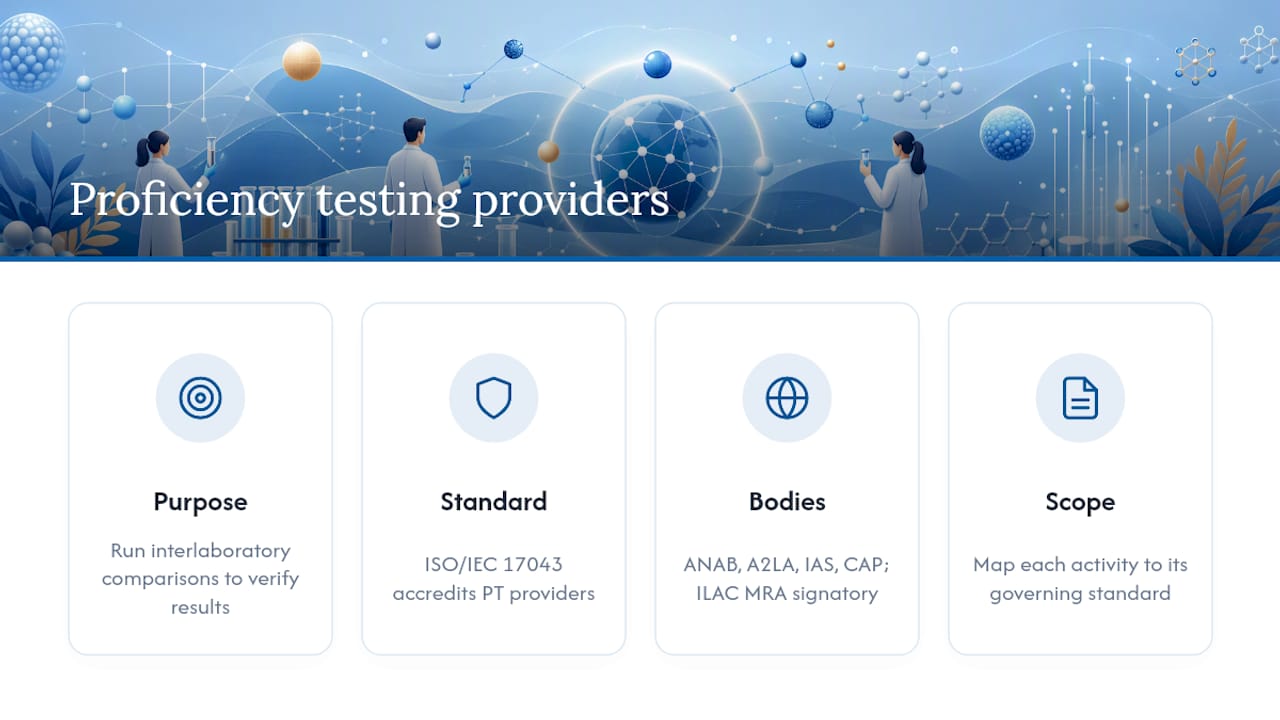
Proficiency testing providers run the interlaboratory comparison programs that let accredited labs prove, on a recurring basis, that their results match a known reference or a peer-group consensus. ISO/IEC 17043 accredits these providers themselves. Nearly every standard on this list requires the lab being accredited to participate in proficiency testing, so a 17043-accredited provider is a quiet but essential piece of the whole system.
National accreditation bodies to know: In the United States, ANAB accredits a wide range of program types, including forensic, calibration, and medical testing laboratories, using ISO/IEC 17025 and ISO 15189 as its foundational standards. A2LA and IAS run comparable programs, and CAP operates its own sector-specific track for clinical pathology. All of the major U.S. bodies maintain ILAC MRA signatory status, which is what makes their accreditation portable internationally.
One practical wrinkle: labs with mixed activities often need more than one standard. A hospital lab running routine chemistry under ISO 15189 might also perform specialized calibration work that falls under ISO/IEC 17025. The fix isn’t picking one standard over the other. It’s structuring your scope documents so each activity maps clearly to the standard that governs it, and making that mapping obvious to whichever assessor walks through the door.
What Requirements Do Most Accreditation Standards Share?
Strip away the sector-specific language, and most accreditation standards ask for the same underlying discipline. Building one quality program that satisfies several standards at once is realistic, because the overlap is substantial.
Here’s the shared baseline nearly every standard expects:
- Method validation or verification — proof that each test method performs as claimed, before it’s used on real samples.
- Measurement uncertainty — a documented, defensible estimate of how much a result could vary.
- Equipment calibration and traceability — every measuring device traced back to a recognized reference standard.
- Staff competence and training records — documented evidence that each analyst is qualified for the specific tests they perform.
- Documented procedures — written methods that match what actually happens on the bench, not an idealized version.
- Record retention — raw data, calculations, and corrective actions kept for a defined period.
- Sampling protocols — where applicable, documented chain-of-custody or sampling plans.
- Proficiency testing participation — regular interlaboratory comparisons proving ongoing competence.
These map fairly cleanly onto specific ISO clauses covering personnel competence, technical records, and metrological traceability. If you’re preparing for an initial audit, run this quick internal check first:
- Pull three recent test records and confirm every calculation step and reviewer signature is documented.
- Check that every instrument on your equipment list has a current calibration certificate traceable to a national standard.
- Confirm each analyst’s training file shows sign-off for the specific methods they’re currently running.
- Verify your last two proficiency testing results were reviewed, signed, and any corrective actions closed out.
Labs that fail this internal check usually aren’t lacking technical skill. They’re missing the paper trail that proves the skill is applied consistently.
How Long Does Lab Accreditation Take, and What Does It Cost?
Accreditation follows a fairly consistent sequence regardless of which standard you’re pursuing:
- Application and document review — you submit your quality manual, procedures, and scope request; the accreditation body checks completeness before scheduling anything on-site.
- Pre-assessment (optional) — some bodies offer a gap analysis visit to flag major issues before the formal audit.
- Full assessment or on-site audit — technical assessors review records, witness testing, and interview staff against the standard’s requirements.
- Nonconformity resolution — you submit corrective action evidence for any findings; assessors verify closure.
- Formal decision and scope issuance — the accreditation body’s technical committee approves the scope and issues the certificate.
Timelines run from a few months up to about a year depending on how ready your quality system already is, how broad the requested scope is, and how many nonconformities surface during the audit. A lab with a mature quality system pursuing a narrow scope can move through in a few months; a lab building its program from scratch with a wide scope should plan for the longer end.
Budget for these primary cost drivers:
- Scope size — more test methods mean more assessor time and higher fees.
- Number of technical assessors required — specialized disciplines may need multiple subject-matter experts on-site.
- Travel and on-site fees — assessor travel costs add up for larger or multi-site scopes.
- Proficiency testing fees — ongoing, not one-time, and required for maintaining accreditation.
- Internal labor — staff time spent closing nonconformities is often underestimated.
- Surveillance and renewal assessments — accreditation isn’t permanent; most bodies conduct periodic surveillance visits and full reassessments on a cycle.
Reserve extra calendar time for proficiency testing results specifically. PT rounds run on fixed schedules set by the provider, and you can’t rush a result you’re still waiting on.
How Do You Choose the Right Standard and Accreditation Body?
Start with what your lab actually does, not what sounds most prestigious. Run through this checklist:
- Identify your core activity — testing, calibration, medical diagnostics, inspection, reference material production, or proficiency testing. That answer usually points to one standard immediately.
- Check for a sector-specific program — clinical pathology labs often benefit more from CAP LAP’s deeming status than a generic ISO 15189 accreditation alone, particularly given CMS oversight requirements in the U.S.
- Confirm ILAC MRA signatory status — this determines whether your results will be accepted internationally without additional scrutiny.
- Ask about domain expertise — a body with assessors experienced in your specific discipline will spot real problems faster and waste less of your time on irrelevant questions.
- Ask about scope expansion procedures — you’ll likely add test methods over time, and a body with a clunky expansion process will slow you down later.
- Ask about pre-assessment or gap analysis services — worth the extra fee for a first-time applicant.
For clinical pathology, CAP’s deeming authority is often the deciding factor over a general ISO 15189 route. For environmental labs, TNI accreditation frequently is the state requirement, not a choice. For everything else, a general ISO/IEC 17025 program through an ANAB, A2LA, or IAS accreditation, all ILAC MRA signatories, tends to serve broad testing and calibration needs well.
What Does Accreditation Look Like in a Drug and Alcohol Testing Lab?
Drug and alcohol testing labs sit at an interesting intersection. The analytical work, screening immunoassays and confirmatory mass spectrometry, falls squarely under ISO/IEC 17025. But when testing supports clinical or medical decision making, CLIA and CAP considerations often come into play as well, particularly for labs handling specimens tied to health insurance or medical necessity documentation. Our breakdown of CLIA certification and lab accreditation programs covers how those two frameworks interact in practice.
A defensible drug-testing program typically documents:
- Chain-of-custody procedures for every specimen, with signatures at each handoff point.
- Validated assays for each drug class, with documented cutoff concentrations.
- Proficiency testing participation specific to the drug panels being run.
- Training records for every collector and analyst.
- Calibration records tied to traceable reference standards for confirmatory testing equipment.
A realistic scope fragment for this sector might read: “Quantitative confirmation of amphetamines in urine by liquid chromatography tandem mass spectrometry, cutoff 500 ng/mL.” That precision is exactly what makes results legally defensible if a test outcome is ever challenged, a point covered in more depth in our analysis of ISO certification’s legal impact on drug testing.
Pro Tip: If your organization is choosing a lab partner rather than building one, ask directly which standard and accreditation body they hold, and request a copy of their current scope statement. A vague answer here is a red flag worth taking seriously.
Employers building or auditing a testing program don’t need to become accreditation experts themselves. Countrywidetesting works with laboratories that operate under these recognized frameworks, giving HR teams and compliance officers a reliable option without needing to vet an accreditation certificate line by line.
An Editor’s Take: Where to Focus First When Pursuing Accreditation
Most labs get the priority order backwards. They start with documentation, building a quality manual that reads beautifully, before they’ve stabilized the methods and traceability chain the documentation is supposed to describe. That’s building the roof before the foundation is poured.
Stabilize your methods and equipment traceability first. Everything else, procedures, records, internal audits, is downstream of whether your actual bench work is consistent. Documentation second. Internal audits and management review last, because those exist to catch drift in a system that’s already functioning.
The most common failure mode isn’t a lack of technical skill. It’s missing objective evidence that a procedure was actually followed the way it’s written down. Labs get tripped up by inconsistent application, where the written procedure and the practiced procedure have quietly diverged, and by underestimating how much staff time corrective actions eat up.
Treat accreditation as a continuous improvement cycle, not a project with a finish line. The labs that struggle at renewal are almost always the ones that treated the initial audit as the destination instead of the starting point.
Where to Read the Full Standards and Guidance Documents
Start with the standard that matches your lab type: ISO/IEC 17025 for general testing and calibration, ISO 15189 for medical laboratories, and TNI standards for environmental programs.
- ILAC’s guidance documents offer practical implementation help for applying ISO standards in real lab settings.
- ANAB’s laboratory accreditation page outlines program types and eligibility for ISO/IEC 17025 and ISO 15189 applicants.
- CAP’s Laboratory Accreditation Program page details the inspection cycle and CMS deeming authority for clinical labs.
- The IAS AC780 criteria PDF lists normative references for medical laboratory accreditation.
- TNI’s standards page covers environmental testing program modules.
Frequently Asked Questions
What are the most common examples of lab accreditation standards?
The standards professionals encounter most often are ISO/IEC 17025 for testing and calibration, ISO 15189 for medical laboratories, CAP LAP for clinical pathology, TNI standards for environmental testing, ISO/IEC 17020 for inspection bodies, ISO 17034 for reference material producers, and ISO/IEC 17043 for proficiency testing providers.
How is lab accreditation different from certification?
Accreditation confirms a lab’s technical competence for a specific, defined scope of tests or measurements. Certification generally applies to management systems, like ISO 9001, and doesn’t evaluate whether a lab can actually produce accurate technical results.
Do I need multiple accreditation standards for one lab?
Possibly, if your lab runs mixed activities. A hospital lab performing routine diagnostics under ISO 15189 might also run calibration work under ISO/IEC 17025. Map each activity to its governing standard rather than forcing everything under one umbrella.
How long does it take to become accredited?
Most labs take roughly 3 to 12 months, depending on how mature their quality system already is, how broad the requested scope is, and how many nonconformities need corrective action before the accreditation body issues a decision.
Why does CAP accreditation matter specifically for clinical labs in the United States?
CAP holds CMS deeming authority, meaning accredited status can satisfy certain federal CLIA oversight requirements instead of a separate government inspection, reducing regulatory redundancy for clinical pathology labs.
Does accreditation from a U.S. body get recognized internationally?
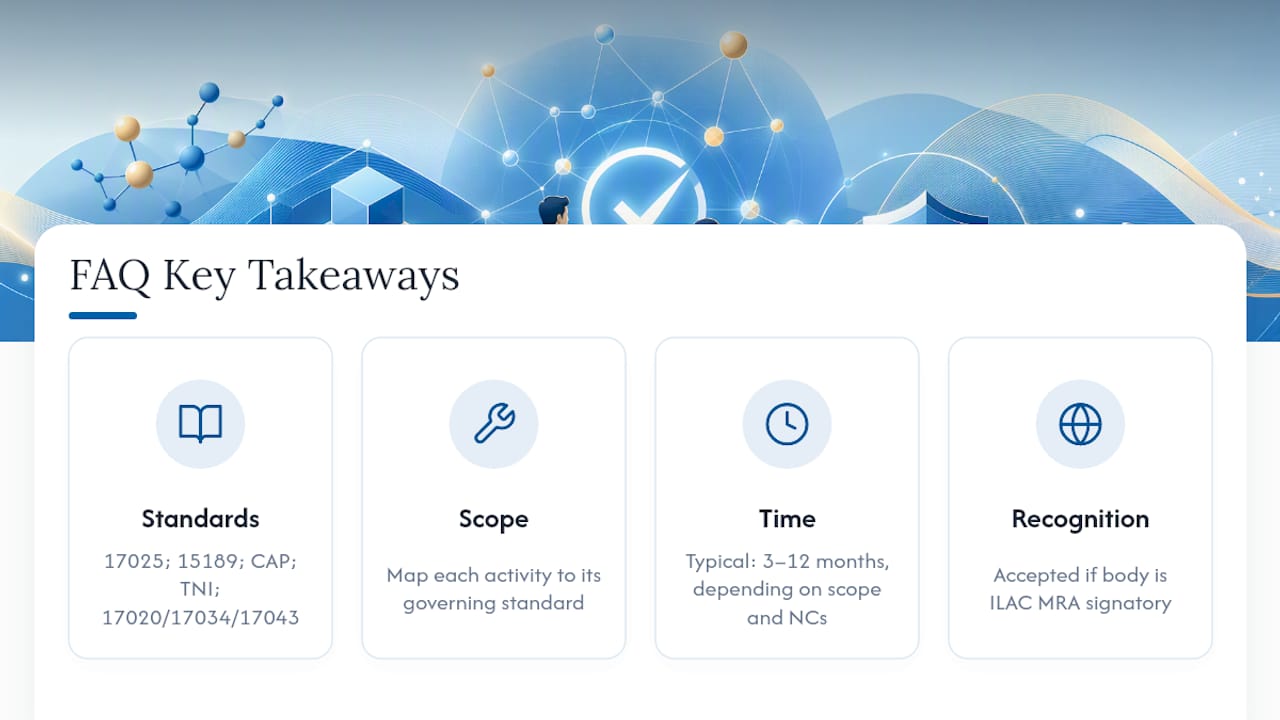
Yes, as long as the accreditation body is an ILAC MRA signatory. The ILAC Mutual Recognition Arrangement is specifically designed so accredited results from one signatory country are accepted in another without duplicate technical audits.
Sources
- What is Laboratory Accreditation? - A2LA
- Laboratory Accreditation Program - CAP
- Laboratory – ANAB
- IAS AC780: Medical Laboratory Accreditation Criteria (AC780 PDF)
- Key Facts: ISO Accreditation | Food Safety and Inspection Service