
Will Buprenorphine Show Up on a Drug Test?
BLUF: Routine 5, 7, and 10-panel drug screens usually will not detect buprenorphine. It only shows up when a test specifically targets buprenorphine, when an expanded opioid panel is ordered, or when a positive screen goes to chromatographic confirmation. That distinction trips up more patients and employers than any other part of the process.
If you’re trying to figure out what a specific result means, the numbers matter more than the panel name. Labs typically flag a positive interpretation at buprenorphine ≥5.0 ng/mL or norbuprenorphine ≥2.5 ng/mL, with screening assays reflexing automatically to LC-MS/MS confirmation once a sample crosses that line.
Before you accept any result at face value:
- Ask the lab or program exactly which analytes the panel tests for.
- Confirm whether norbuprenorphine (the active metabolite) is included alongside the parent drug.
- Request confirmatory testing if a result contradicts what you expect, in either direction.
Key Takeaways
Buprenorphine detection depends entirely on ordering the right test, since routine opiate panels miss it while dedicated assays and LC-MS/MS confirmation catch it reliably.
| Point | Details |
|---|---|
| Routine panels miss it | Standard 5, 7, and 10-panel screens typically don’t include buprenorphine as a named analyte. |
| Know the cutoffs | Labs commonly flag positive at buprenorphine ≥5.0 ng/mL or norbuprenorphine ≥2.5 ng/mL. |
| Windows vary by use | Urine detects a single dose for 1 to 3 days, regular use for 7 days, hair up to 90 days. |
| Confirm unexpected results | Request LC-MS/MS or GC-MS confirmation before treating a screen as final, especially with CYP3A4-interacting medications involved. |
| Match the tool to the need | Countrywidetesting offers QuickScreen dipcards for on-site screening and certified lab services for reflex confirmation and chain of custody. |
Table of Contents
- Which Buprenorphine Drug Test Panels Actually Detect It?
- How Long Does Buprenorphine Stay in Your System?
- How Buprenorphine Urine Tests Actually Work
- Why a Buprenorphine Drug Test Can Come Back Negative Unexpectedly
- Ordering the Right Test: Confirmation, Chain of Custody, and Cost
- How Countrywidetesting Supports Buprenorphine Screening and Confirmation
- What Patients and Clinicians Get Wrong About Buprenorphine Testing
- Get Buprenorphine Screening and Confirmation Done Right
- Sources
Which Buprenorphine Drug Test Panels Actually Detect It?
A standard 5-panel workplace screen looks for amphetamines, cocaine, marijuana, opiates, and PCP. None of those categories reliably catch buprenorphine, because it’s a synthetic opioid with a molecular structure that most opiate immunoassays don’t recognize. The same goes for most 7-panel and 10-panel kits sold for general workplace or pre-employment use, according to guidance from Drugs. A 12-panel that lists “opioids” as one category still might not catch it unless buprenorphine is named as its own analyte.
The tests that will detect it fall into a few categories:
- Dedicated buprenorphine immunoassay (the BUPS or BUPR test format) built specifically to catch buprenorphine and norbuprenorphine.
- Expanded or targeted opioid panels that list buprenorphine as a named analyte rather than lumping it under generic opiates.
- Medication-assisted treatment (MAT) monitoring panels, used by addiction treatment programs to confirm adherence.
- Chromatographic confirmation (LC-MS/MS or GC-MS), which identifies and quantifies the exact compound rather than screening for a drug class.
Different people order these for different reasons. Treatment programs use MAT monitoring panels to confirm patients are taking their prescribed dose and not diverting it. Courts and probation officers often specify a dedicated buprenorphine test as a condition of supervised release. Clinicians managing a patient on Suboxone or Subutex order it to track compliance over time.
If you’re unsure what a panel covers, ask directly: “Does this panel include buprenorphine and norbuprenorphine, and what are the cutoffs?” That single question, aimed at HR, a testing lab, or a prescribing clinician, resolves most confusion before it becomes a dispute. Countrywidetesting’s overview of drug testing panels breaks down why panel names alone are unreliable shorthand for what’s actually being screened.
How Long Does Buprenorphine Stay in Your System?
Detection windows depend heavily on the matrix tested and how long someone has been taking the drug. A single dose typically clears a urine screen within one to three days, but regular use extends that window to roughly seven to fourteen days, according to patient-facing guidance from Porch Light Health. Buprenorphine’s long half-life and its persistent metabolite, norbuprenorphine, both push that window out longer than shorter-acting opioids.
| Matrix | Typical detection window | Common use case |
|---|---|---|
| Urine (single dose) | 1 to 3 days | Standard screening |
| Urine (regular use) | 7 days | MAT compliance monitoring |
| Blood | Hours to 1 to 2 days | Emergency or acute clinical settings |
| Saliva | 1 to 4 days | Point-of-care or roadside-style testing |
| Hair | several weeks | Long-term use history, legal cases |
Extended-release formulations complicate this further. Sublocade and Brixadi, both injectable depot products, release buprenorphine slowly over weeks, which means patients on these formulations can test positive well beyond what oral dosing would predict. A patient who switched from daily sublingual film to a monthly injection may show detectable levels for an extended stretch even after stopping, simply because the depot keeps releasing medication.
Assay sensitivity, the specific cutoff a lab uses, dose history, and individual metabolism all shift these windows in either direction. Two patients on the same dose can produce meaningfully different results depending on how their bodies process the drug.
How Buprenorphine Urine Tests Actually Work
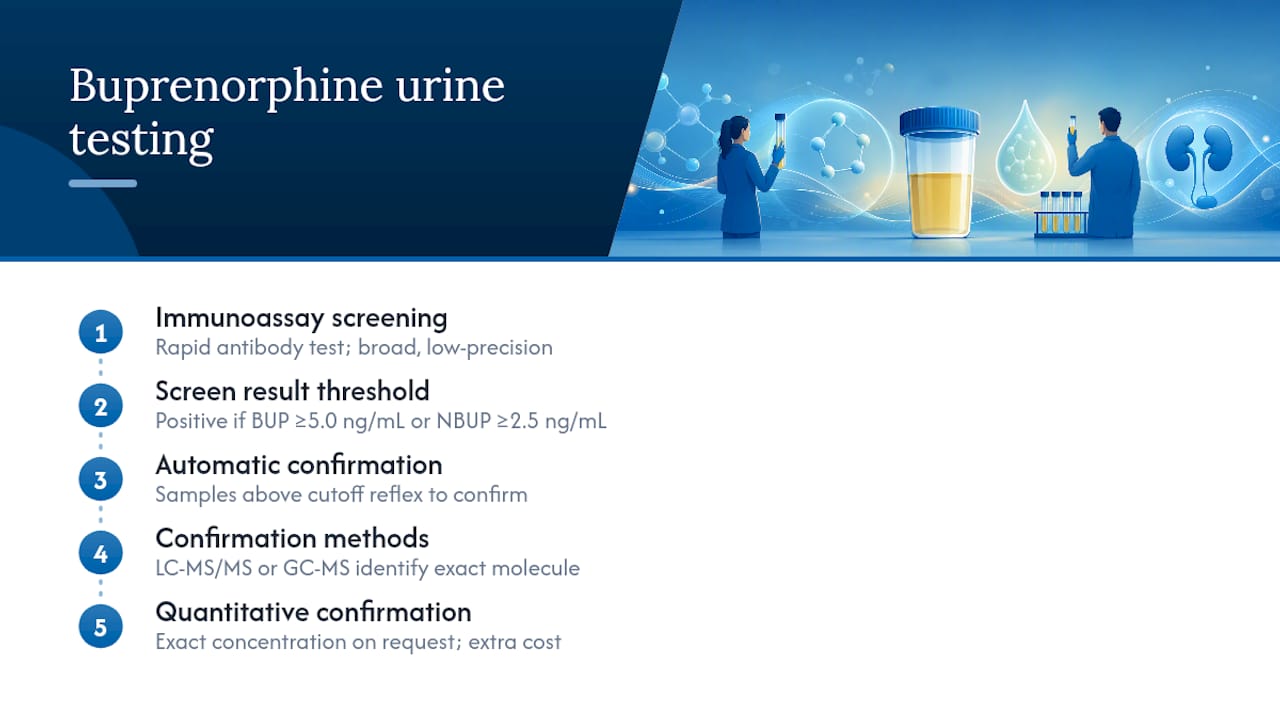
Most buprenorphine drug screening starts with an immunoassay, a rapid chemical test that flags the presence of a drug class using antibody reactions. It’s fast, inexpensive, and works well for high-volume screening, but it isn’t built for precision. Immunoassays are designed to catch a broad signal, not confirm an exact compound, which is exactly where problems start.
A positive screen is a starting point, not a verdict. The whole reason confirmation testing exists is that immunoassays trade precision for speed, and that tradeoff occasionally produces results that don’t match what’s actually happening in the patient’s body.
When a screen comes back positive, most labs automatically reflex to LC-MS/MS (liquid chromatography tandem mass spectrometry) or GC-MS (gas chromatography mass spectrometry) for confirmation. These methods identify the exact molecule present and measure its concentration, removing the guesswork that comes with antibody-based screening.
Cutoffs matter here. Mayo Clinic Laboratories lists a positive interpretation at buprenorphine ≥5.0 ng/mL or norbuprenorphine ≥2.5 ng/mL, with the screen reflexing to confirmation automatically once a sample crosses that threshold. Below those numbers, a result reads negative even if trace amounts are technically present.
Quantitative confirmation, which reports the exact concentration rather than a simple positive/negative call, is available for cases that need it, typically at additional cost and with a longer turnaround. Courts, employers involved in disputes, and clinicians managing complex cases usually request it specifically rather than relying on the initial screen alone.
Why a Buprenorphine Drug Test Can Come Back Negative Unexpectedly
This is where a lot of confusion, and a lot of unnecessary panic, comes from. A retrospective study of patients on supervised buprenorphine treatment found that immunoassay screens sometimes failed to detect the drug even when dosing was directly observed. Researchers linked much of this nondetection to co-prescribed medications that interact with the CYP3A4 liver enzyme, which metabolizes buprenorphine and can alter how quickly it clears the body.

A separate review reinforces the same point: assay sensitivity, individual metabolism, and drug interactions all influence whether buprenorphine shows up as expected on a given screen. A negative result doesn’t automatically mean noncompliance, and a positive one doesn’t automatically mean something’s wrong.
Common causes of an unexpected negative include:
- Recent dose timing that falls outside the detection window for that specimen type.
- CYP3A4-interacting medications altering metabolism speed.
- A screening cutoff set too high to catch a low but genuine concentration.
- Specimen dilution, whether accidental or intentional.
Formulation adds another wrinkle. Naloxone-combined products like Suboxone are designed to deter misuse, not to change detection, but patients and clinicians sometimes assume the naloxone component itself will register, which it typically won’t on a buprenorphine-specific assay. Depot injections, as covered earlier, can do the opposite and produce a positive result longer than expected.
Pro Tip: If a result doesn’t match the clinical picture, don’t treat the screen as final. Request LC-MS/MS confirmation, share a full medication list with the medical review officer, and document the clinical context in the chart before anyone acts on the result.
Treatment programs generally use buprenorphine testing to confirm adherence and catch other substance use that could complicate care, not to punish patients, and interpreting a stray result with that framing in mind tends to produce better outcomes for everyone involved.
Ordering the Right Test: Confirmation, Chain of Custody, and Cost
Choosing the right test upfront saves time, money, and disputes later. Mayo Clinic’s test catalog lists several ordering paths: BUPS for a straightforward screen, BUPR for a screen with automatic reflex confirmation, and quantitative or chain-of-custody codes for cases where the result needs to hold up legally.
- Decide the purpose first. Clinical monitoring, employment screening, and court-ordered testing all call for different rigor and documentation.
- Confirm the analyte list and cutoffs with the lab before the sample is collected, not after.
- Choose chain-of-custody handling whenever a result might end up in a legal, custody, or employment dispute; it maintains a documented handling trail from collection to result.
- Decide on confirmation and quantification upfront if precision matters, since adding it after the fact takes longer and sometimes requires a fresh sample.
- Factor in turnaround and cost. Rapid screens return results in minutes; LC-MS/MS confirmation typically takes days and costs more, but it’s the standard when accuracy is non-negotiable.
Countrywidetesting’s guide on interpreting lab results walks through how to work with a medical review officer once results come back, which matters most in employment and compliance settings.
How Countrywidetesting Supports Buprenorphine Screening and Confirmation
Countrywidetesting sells the QuickScreen Dipcard 9901T Buprenorphine (BUP) for fast, point-of-care screening, along with a 25-pack option built for clinics and treatment programs running regular compliance checks. For anything that needs to go further, its lab testing services connect to certified laboratories that meet SAMHSA, ISO, CLIA, and CAP standards.
- On-site dipcards flag a likely result in minutes, ideal for routine MAT check-ins.
- Positive or unexpected screens route to certified lab confirmation for LC-MS/MS accuracy.
- Chain-of-custody handling is available for employer, legal, or custody-related orders.
Pro Tip: Pair on-site screening with lab confirmation as standard practice, not just when something looks off. It catches the false negatives that immunoassays alone tend to miss.
What Patients and Clinicians Get Wrong About Buprenorphine Testing
The biggest misconception isn’t about the drug at all. It’s the assumption that a panel name tells you what’s being tested. A “12-panel” sounds comprehensive, but comprehensive doesn’t mean it includes buprenorphine unless the analyte is named explicitly. That single misunderstanding causes most of the false alarm calls I’d expect a clinic or HR office to field.
The second thing conventional advice underplays is how much a negative result can mean nothing at all. The CYP3A4 research isn’t a footnote. It’s a real reason a compliant patient can screen negative while doing everything right, and treating that negative as evidence of noncompliance without confirmation is a genuine clinical and legal risk.
If I had to prioritize one habit for both patients and providers, it’s this: never let a single immunoassay result stand alone when the stakes are real. Confirm it, document the medication list, and treat the screen as the first data point, not the last word.
— Alan
Get Buprenorphine Screening and Confirmation Done Right
Countrywidetesting gives you both ends of the process in one place instead of juggling a dipcard vendor and a separate lab. For clinics and MAT programs that need routine, low-cost compliance checks, the QuickScreen Dipcard 9901T Buprenorphine delivers a result in minutes at the point of care.
When a result needs to hold up clinically or legally, Countrywidetesting’s lab testing services connect you to certified laboratories meeting SAMHSA, ISO, CLIA, and CAP standards, with reflex confirmation and chain-of-custody handling built into the process. That combination means you’re not stuck choosing between speed and accuracy. If you’re setting up a compliance program, managing a caseload of MAT patients, or just need a confirmed answer on one unexpected result, start by reviewing the lab testing options and picking the workflow that matches your situation.
This article is general information, not a substitute for advice from a qualified doctor. Consult a qualified healthcare professional about your own circumstances before acting on anything here.
Sources
- BUPR - Buprenorphine Screen with Reflex, Random, Urine (Mayo Clinic Laboratories)
- Buprenorphine not detected on urine drug screening in supervised treatment (PubMed)
- Drugs
- Does Suboxone show up on a urine test? (Porch Light Health)
- Factors affecting detection of buprenorphine on urine testing (PubMed)