
Only 24 Hours: Lab Tests Detect Psilocybin Drug Use for U.S. Employers
Standard 5-panel and 10-panel drug screens don’t test for psilocybin, so a routine workplace or probation urine test almost never flags mushroom use. Specialized labs can detect psilocin, the active metabolite, using LC-MS/MS, but the window is short, often within about 24 hours of use. Federal workplace panels, including the DOT 5-panel standard, simply don’t include it on the target list.
TL;DR:
- Routine drug tests, including federal panels, almost never detect psilocybin because they do not include it or calibrated tests for psilocin.
- Psilocybin or psilocin detection in urine typically only lasts about 24 hours after a single dose, with heavier use extending slightly but rarely beyond 72 hours.
- Confirmatory testing with LC-MS/MS is necessary for reliable detection, as standard immunoassays rarely detect psilocybin or psilocin accurately.
- Expanded testing for psilocybin occurs mainly in forensic, legal, military, or research contexts, not in standard workplace screenings.
- Hydration, detox remedies, or home tests offer little effect on psilocybin detection risk; timing and lab choice are critical for accurate results.
Table of Contents
- Why Routine Screens Usually Skip a Psilocybin Drug Test
- How Long Does Psilocybin Stay Detectable by Specimen Type
- The Lab Science Behind Detecting Psilocin
- When Courts, Employers, or the Military Order Expanded Testing
- What Actually Changes Your Detection Risk
- What to Expect From Certified Psilocybin Lab Testing
- What Surprises People Most About Psilocybin Testing
- Getting a Certified Answer Instead of a Guess
- Sources
Why Routine Screens Usually Skip a Psilocybin Drug Test
Most drug tests aren’t built to catch everything. They’re built to catch what an employer, court, or regulatory body has decided matters most, and psilocybin rarely makes that list.
Federal workplace testing follows a defined panel structure. The DOT-mandated 5-panel checks for marijuana, cocaine, opiates (including fentanyl), phencyclidine, and amphetamines. Expanded 10-panel versions add a few more common drugs of abuse, but psilocybin isn’t part of the federal baseline.
Rapid immunoassay screens, the cheap, fast strip or cup tests used in most workplaces, work by detecting antibody reactions to specific drug classes. They’re not built to flag psilocin unless a lab specifically calibrates for it, which almost none do for routine screening.
Targeted psilocybin testing shows up in narrower circumstances:
- Forensic toxicology labs investigating a death, overdose, or crash
- Court-ordered testing tied to a specific legal case
- Certain military drug-testing programs with expanded panels
- Research or clinical settings monitoring supervised psilocybin use
If you’re not in one of those situations, a psilocybin drug test almost certainly isn’t part of your routine screening.
How Long Does Psilocybin Stay Detectable by Specimen Type
Detection windows for psilocybin drug screening are short compared to drugs like THC or benzodiazepines, and they vary a lot by specimen type.
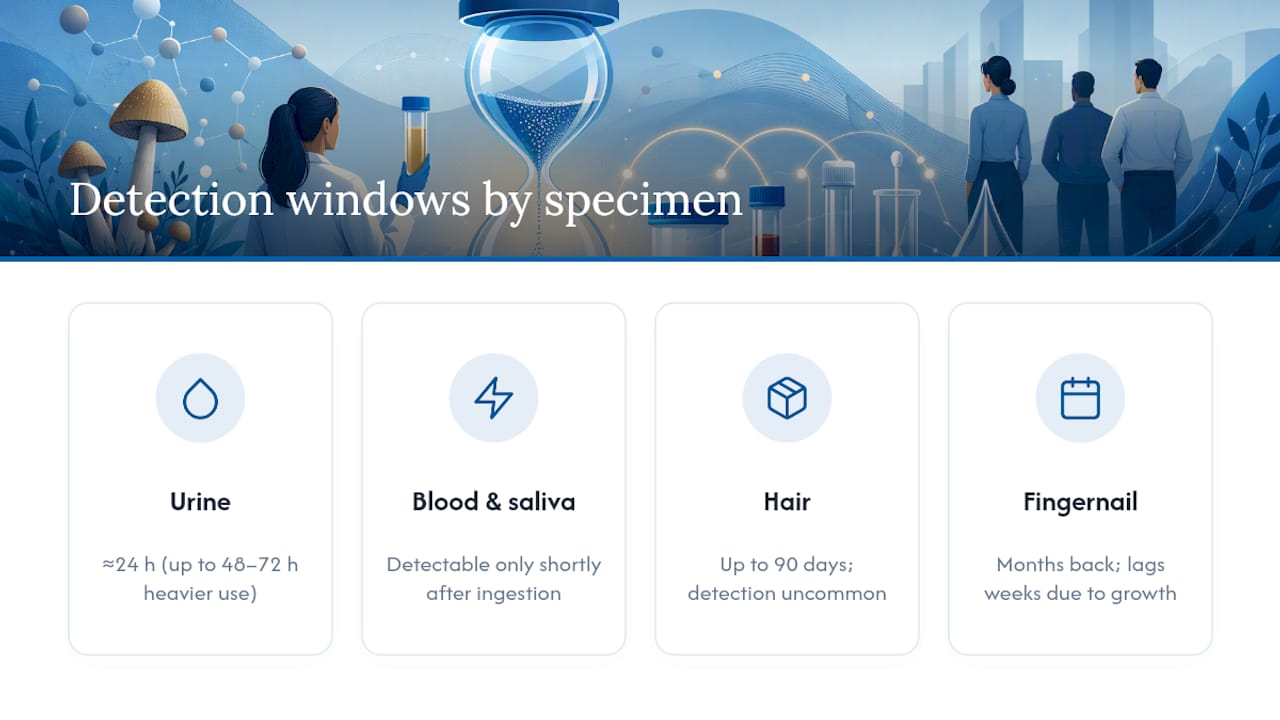
Urine is the most commonly tested specimen, and it’s also where the window closes fastest. Psilocin typically clears within about 24 hours after a single dose, according to pharmacokinetic research. Heavier or repeated use may extend that to 48 to 72 hours in some cases, but conservative estimates stick closer to the one-day mark.
Blood and saliva detection windows are even tighter. Psilocin metabolizes quickly, so blood or saliva testing is only useful if collected shortly after ingestion.
Hair testing offers the longest theoretical window, up to 90 days in a standard 1 to 1.5 inch segment, but psilocin concentrations in hair are low and detection is uncommon even when researchers specifically look for it.
Fingernail testing can theoretically stretch months further back, tracking growth over that period, but it’s rarely used for psilocybin specifically and results lag behind actual use by weeks due to nail growth rates.
The core figure to remember: roughly 24 hours is the realistic urine detection window most labs and reviewers cite for a single dose.
The Lab Science Behind Detecting Psilocin
Detecting psilocin isn’t as simple as running a standard immunoassay. It requires targeted, sensitive laboratory methods that most rapid screens don’t use.
- LC-MS/MS and GC-MS are the accepted confirmatory tools for psilocin, offering the sensitivity and specificity immunoassays lack.
- The body converts psilocin into psilocin-O-glucuronide for excretion, meaning urine mostly contains the conjugated form, not free psilocin.
- Labs must perform enzymatic hydrolysis to convert that glucuronide back into detectable psilocin before analysis, a step that’s historically been inconsistent.
- Recent forensic method development using recombinant β-glucuronidases has improved hydrolysis efficiency, giving labs a more reliable path to detecting psilocin in urine.
Without that hydrolysis step, a lab could miss psilocin entirely even when it’s technically present in the sample. This is precisely why psilocybin urine test results depend so heavily on which lab method gets used, not just when the sample was collected.
When Courts, Employers, or the Military Order Expanded Testing
Expanded psilocybin testing isn’t random. It shows up when someone specifically needs an answer beyond the standard panel.
Courts order it in child custody disputes, criminal probation cases, and forensic investigations tied to postmortem exams or vehicle crashes. Probation officers sometimes request expanded panels when a case history suggests hallucinogen use specifically.
The Department of Defense has broadened certain testing programs to include psilocin, a policy shift worth knowing about if you’re in a safety-sensitive military role, since random testing risk can extend further than civilian workplace norms.
Employers can also order expanded panels, particularly after an incident or when reasonable suspicion exists. Consequences of a confirmed positive result depend heavily on context:
- Job termination or disciplinary action under company policy
- Custody or probation violations tied to court conditions
- Legal weight given specifically to confirmatory lab reports, not initial screens
Psilocybin remains a Schedule I controlled substance under federal law, even where state-level policies have shifted, and that federal status still governs many testing and employment consequences.
What Actually Changes Your Detection Risk
Detection risk isn’t fixed. A few practical factors move the needle more than most people expect.
Dose and frequency matter most. A single small dose clears faster than repeated or heavy use, which can push urine detection windows toward the 48 to 72 hour range instead of 24. Individual metabolism, including age, kidney function, and liver function, shifts the window slightly in either direction.
Hydration tricks and detox remedies have little reliable effect on psilocin clearance. Abstinence is the only dependable way to guarantee a clean psilocybin drug test.
Pro Tip: Timing matters more than any home remedy. If a test is scheduled and you know roughly when exposure occurred, the gap between use and sample collection is the single biggest factor in whether psilocin shows up at all.
What to Expect From Certified Psilocybin Lab Testing
Not every testing situation calls for the same tool. At-home screening kits are built for common drug classes and fast results, not psilocybin specifically. Confirmatory lab testing is the route for anyone who genuinely needs a defensible answer.
Reputable labs carry certifications that matter for legal and employment purposes:
- SAMHSA certification for federal workplace testing standards
- CLIA compliance for clinical laboratory quality
- CAP accreditation for pathology and lab practices
- ISO standards for consistent international testing protocols
Countrywidetesting provides access to certified lab services for readers who need psilocybin-capable testing rather than a rapid screen. When ordering lab-based testing, expect clear guidance on accepted sample types, defined turnaround times, and a confirmatory report built on proper lab methodology rather than a preliminary screen alone. That distinction, screening versus confirmation, is exactly what holds up in legal or employment disputes.
What Surprises People Most About Psilocybin Testing
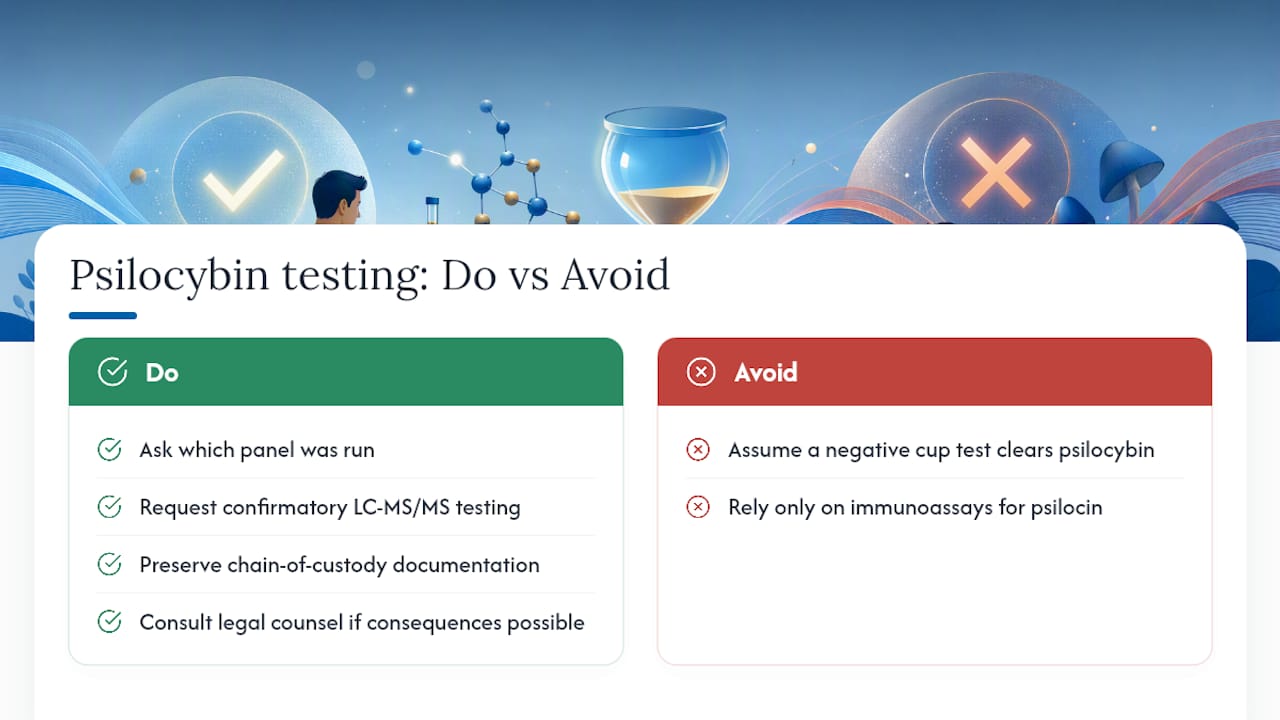
The biggest misconception I run into constantly: a negative result on a routine drug test does not mean someone is psilocybin free. It usually just means nobody looked for it. Standard panels were built around a handful of common drugs, and psilocybin has simply never been part of that list at the federal level.
If you’re facing a situation where psilocybin use might actually matter, legally or professionally, don’t assume a standard cup test settled the question. Ask what panel was actually run. If results are contested, request confirmatory LC-MS/MS testing specifically, since immunoassays alone can’t reliably detect psilocin. Preserve chain of custody documentation from the start, and if legal consequences are on the table, talk to counsel before assuming a lab report tells the whole story. For a broader sense of how detection windows compare across substances, it’s worth reviewing how different drugs clear the body over time.
— Alan
Getting a Certified Answer Instead of a Guess
A rapid cup test won’t answer a psilocybin question, and guessing at detection windows isn’t a strategy when a court date, custody case, or job depends on the outcome. Certified lab analysis offers a direct path instead of a preliminary screen that was never built to catch psilocin in the first place.
The process is straightforward: order the appropriate lab testing service, submit your sample through the specified collection method, and receive results processed through certified lab partners using confirmatory methods like LC-MS/MS where applicable. That means a report built for scrutiny, not just a quick yes or no. Turnaround times vary by test type and lab volume, so check current estimates when you order.
If you’re weighing a probation requirement, a custody matter, or simply want a defensible answer, start with Countrywidetesting’s lab testing services and get the specific test that actually matches your situation, not a generic panel that was never designed to look for psilocybin.
Sources
- Studies on enzymatic hydrolysis of psilocin‑O‑glucuronide for screening of psilocin in human urine (Journal of Analytical Toxicology, DOI)
- Pharmacokinetics of psilocybin: a systematic review (PMC)
- DEA factsheet: psilocybin
- MedlinePlus: lab tests for drug testing