
24–48 Hours to 10 Days: U.S. Pre Employment Drug Test Timeline
Most negative pre-employment drug test results come back within 24 to 48 hours after the lab receives the specimen, and rapid onsite screens can deliver a preliminary answer the same day. A non-negative result adds time. Confirmatory testing and Medical Review Officer review typically stretch the timeline another two to five business days. Where you land on that spectrum depends on the specimen type, the lab’s location, and how the sample behaves during screening.
TL;DR:
- Urine tests typically return negative results within 24 to 48 hours, with confirmation adding two to four additional business days.
- Hair analysis takes five to ten business days or more due to the extensive processing required for detecting patterns over 90 days.
- Distant lab locations and weekend collections can delay results by a full day or more, especially when specimens must be shipped across state lines.
- Lower cutoff thresholds increase the likelihood of confirmation, extending the overall turnaround time on results.
- Clear communication with labs and scheduling early in the week can significantly reduce delays for both employers and applicants.
Table of Contents
- Understanding the Pre-Employment Drug Test Timeline by Specimen Type
- What Actually Speeds Up or Slows Down Your Results
- What Happens After a Non-Negative Screen
- How to Avoid Unnecessary Delays on Either Side
- Why Certification Standards Shape Your Timeline
- Where to Verify the Details Yourself
- The Timeline Question Most Applicants Ask Wrong
- Skip the Guesswork With a Certified Lab Partner
- Sources
Understanding the Pre-Employment Drug Test Timeline by Specimen Type
The pre-employment drug test timeline isn’t one fixed number. It shifts depending on which specimen a lab collects and how that specimen gets processed. Urine, oral fluid, hair, and blood each move through different equipment and different confirmation steps, so the wait varies more than most applicants expect.
Urine testing remains the workplace standard, and for good reason: it’s fast, inexpensive, and well understood by labs across the country. A standard immunoassay screen usually clears in 24 to 48 hours once the lab receives the sample. If that initial screen flags something, the specimen moves to confirmatory testing using gas chromatography-mass spectrometry (GC-MS) or liquid chromatography-mass spectrometry (LC-MS), which adds roughly two to four business days.
Oral fluid (saliva) testing has grown popular because it’s harder to adulterate and easier to observe during collection. Lab-based saliva panels commonly return negative results within 24 to 72 hours. Point-of-care oral swabs, the kind used for onsite or rapid screening, give an immediate visual result. That speed comes with a tradeoff: any non-negative reading still needs lab confirmation before an employer can act on it.
Hair testing operates on an entirely different timeline. Instead of detecting recent use, hair analysis can reveal patterns going back roughly 90 days, which makes it useful for safety-sensitive roles or extended background checks. That longer detection window comes at a processing cost. Hair samples commonly take five to ten business days or more, since the lab has to break down the hair shaft and run more involved extraction methods before analysis even starts.
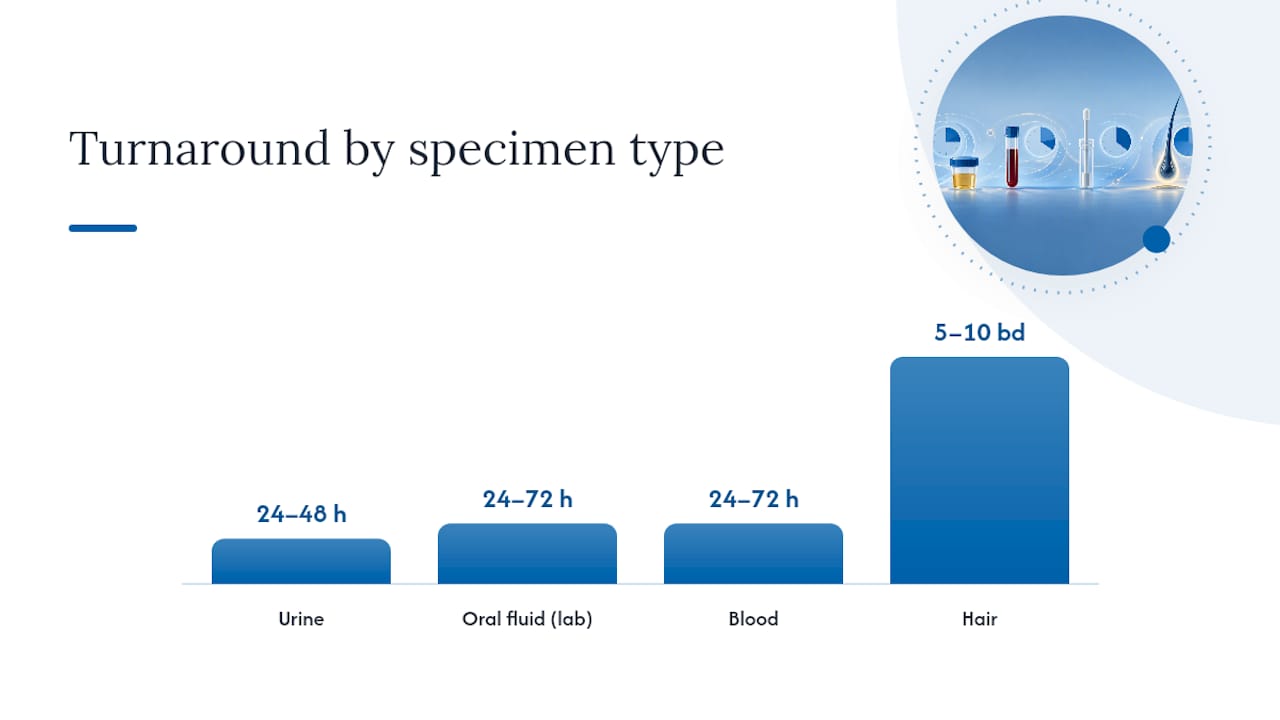
Blood testing shows up far less often in pre-employment screening, mostly because it’s invasive and expensive relative to urine or saliva. When employers do use it, usually for specific medical or legal circumstances, turnaround often falls in the 24 to 72 hour range depending on the analyte panel.
Rapid point-of-care screens trade certainty for speed. They’re built for same-day answers, and a negative result is often treated as final. A non-negative reading is a different story. It almost always heads to a certified lab for confirmation, which resets the clock and adds the same two to five business days you’d see with a standard lab screen. Point-of-care devices are a useful first filter, not a substitute for a certified lab result on anything that comes back non-negative.
- Urine: negative in 24–48 hours; confirmation adds 2–4 business days
- Oral fluid: lab-based negative in 24–72 hours; point-of-care gives instant preliminary results
- Hair: 5–10 business days or more due to extended processing
- Blood: often 24–72 hours, used selectively
- Rapid screens: instant preliminary result; non-negatives require lab confirmation
What Actually Speeds Up or Slows Down Your Results
Two people can take the same test on the same day and get results a week apart. The gap usually comes down to logistics and biology, not luck.
Transport distance matters more than people assume. A local lab with a courier route can process a sample same-day. A specimen that has to travel across state lines to reach a certified facility loses a day or more before testing even begins. Weekends and holidays compound this: a sample collected Friday afternoon may not reach the lab until Monday, and confirmatory testing rarely runs on weekends.
Panel size changes processing time too. A basic 5-panel screen checks for a handful of common substances and moves quickly through standard equipment. A 10 or 12-panel test, or one that screens for designer drugs and synthetic compounds, requires additional reagents and sometimes a different testing protocol, which extends the window.
Non-negative results trigger extra scrutiny beyond confirmation. Labs check for dilution, adulteration, and chain-of-custody consistency before finalizing anything. A dilute specimen might require a retest entirely, starting the clock over.
Cutoff thresholds affect how often confirmation gets triggered. Workplace programs that use a 50 ng/mL cutoff for THC will flag fewer borderline cases than programs using a lower threshold, which means fewer specimens escalate to the slower confirmatory pathway.
- Same-city labs process faster than national reference labs requiring shipment
- Larger drug panels and specialty confirmations add processing days
- Weekend and holiday collections delay both transport and lab review
- Lower cutoff thresholds trigger confirmation more often, extending average turnaround
- Dilution or adulteration flags can require a full recollection
Pro Tip: Ask the testing site whether your specimen goes to a local or national lab before you schedule. A same-city lab with daily courier pickup can shave a full day off your result, especially if you’re collecting later in the week.
What Happens After a Non-Negative Screen
A non-negative initial screen doesn’t mean a failed test. It means the sample needs a second, more precise look, and that process follows a predictable sequence.
- Laboratory confirmation. The lab runs GC-MS or LC-MS on the same specimen. These methods are more sensitive and specific than the initial immunoassay, and labs typically batch confirmatory runs, which is part of why this step commonly adds two to five business days to the total timeline.
- Medical Review Officer review. A certified MRO examines the confirmed lab result alongside any prescription documentation the candidate has disclosed. This step, which usually adds one to three business days, exists specifically to distinguish a legitimate prescription from an unexplained positive.
- Final determination. The MRO issues one of several outcomes: confirmed positive, verified negative (when a valid prescription explains the result), or cancelled/invalid (often tied to a dilution or specimen integrity issue that may require a retest).
- Employer notification. Results go to the employer through a secure report, typically without disclosing the specific medication or condition behind a verified negative, protecting candidate privacy while still giving HR what it needs to make a decision.
Rapid screens are genuinely useful for speed, but a non-negative preliminary result almost never stands as final without this confirmatory sequence backing it up.
How to Avoid Unnecessary Delays on Either Side
Applicants and employers both have room to shave time off the process, and most of it comes down to preparation rather than luck.
If you’re the candidate, confirm the specimen type and lab before your appointment so you know roughly what to expect. Bring documentation for any prescribed medication that could show up on a screen. Follow collection-site instructions closely. Drinking excessive water beforehand, for instance, is a common way specimens get flagged as dilute, which forces a recollection and adds days you didn’t need to lose.
If you’re managing hiring, schedule collections early in the week whenever possible. A Monday or Tuesday collection gives the lab a full business week to process and confirm, rather than sitting idle over a weekend. Working with a certified lab that offers a candidate portal lets both HR and the applicant track status without a string of phone calls. Rapid onsite screens can help when a hiring decision is time-sensitive, but they work best as a first filter, not the final word.
- Confirm specimen type and expected turnaround before the appointment
- Bring valid prescription documentation to the collection site
- Schedule collections Monday through Wednesday to avoid weekend delays
- Communicate expected timelines to candidates in writing to reduce follow-up calls
Pro Tip: If your offer is contingent on a clean result and timing is tight, ask HR whether a rapid screen combined with lab confirmation is an option. You get a preliminary answer fast while the certified result still processes behind it.
Why Certification Standards Shape Your Timeline
Certifications aren’t just paperwork. CLIA (Clinical Laboratory Improvement Amendments), CAP (College of American Pathologists), and ISO accreditation each set specific standards for accuracy and chain-of-custody handling, and SAMHSA’s workplace guidance shapes cutoff levels many employer programs rely on. Labs that meet these standards tend to have fewer recollections and cleaner reporting, which keeps your timeline closer to the expected range instead of stretching into unexplained delays.
Countrywidetesting works with labs that meet these certification standards and offers both at-home screening kits and full lab-based testing services built for pre-employment needs.
- CLIA and CAP certification reduce processing errors that trigger retests
- ISO accreditation standardizes lab procedures across facilities
- SAMHSA guidance informs cutoff levels used in many employer testing programs
Where to Verify the Details Yourself
For federal cutoff standards and program guidance, consult SAMHSA’s workplace drug testing resources. Employers can also review Countrywidetesting’s lab testing services page for ordering details.
The Timeline Question Most Applicants Ask Wrong
Most people ask “how long will my test take” when the more useful question is “what could push my result outside the normal range.” The 24 to 48 hour negative window is real and well documented, but it’s a median, not a guarantee. What actually determines your experience is whether your specimen hits a delay trigger: a weekend collection, a distant lab, a borderline cutoff value.
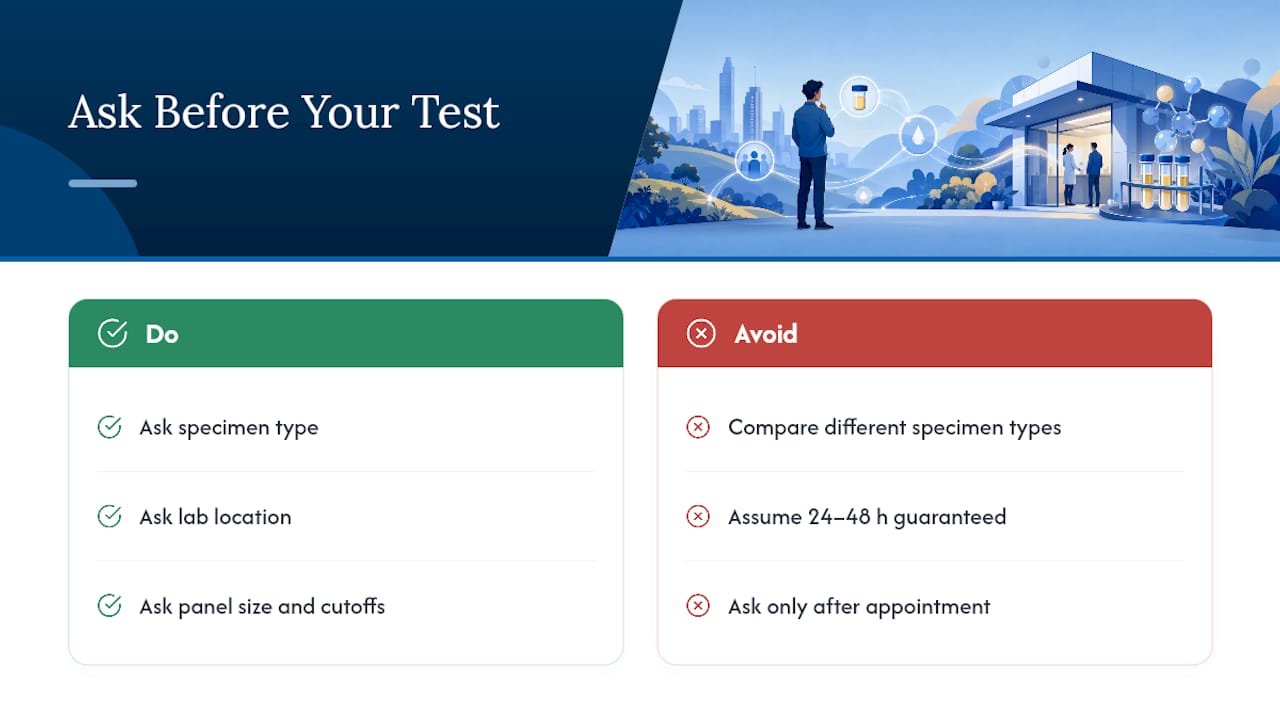
Conventional advice tends to treat every drug screen as identical, which sets unrealistic expectations for candidates taking a hair test and quietly comparing their wait time to a friend’s 48 hour urine result. That comparison is meaningless. The specimen type sets the baseline, and everything else, panel size, transport, cutoff levels, adjusts it from there.
If you take one thing from this, prioritize asking about specimen type and lab location before your appointment, not after. That single question tells you more about your realistic timeline than anything else in the process, and it costs you nothing to ask.
— Alan
Skip the Guesswork With a Certified Lab Partner
A certified lab partner gets you a straight answer faster than piecing together timelines from a hiring manager who’s guessing too. Where general advice leaves you estimating, This service connects you directly to certified lab processing and at-home options built specifically for pre-employment scenarios.
Whether you’re an HR team managing multiple candidates or an applicant who wants to check your own status before an official collection, Countrywidetesting’s lab testing services give you access to labs that meet CLIA, CAP, and ISO standards, the same certifications that keep confirmation delays to a minimum. If you want a preliminary check before your official appointment, the 12-panel at-home urine test lets you self-screen ahead of time. Visit Countrywidetesting to request lab testing services or order a screening kit today, and get a realistic timeline instead of a guess.
Sources
- SAMHSA workplace drug testing resources
- How Long Does Pre-Employment Drug Screening Take? (Cisive)
- How Long Do Drug Test Results Take? A Complete Guide