
What Is a Non-DOT Drug Test and How It Differs From DOT Testing
A non-DOT drug test is any workplace drug or alcohol screening performed outside 49 CFR Part 40, the federal rulebook that governs testing for transportation workers. Employers design these programs themselves, choosing panels, specimens, and procedures, but the policy still has to line up with state law.
If you’re an employer, that flexibility comes with a catch: you’re on your own for the legal groundwork. There’s no federal template to hide behind.
If you’re an employee, your rights largely depend on what your employer’s written policy actually says and what protections your state offers.
- Employers: you control the program design, but state law, not DOT rules, sets your legal boundaries.
- Employees: your recourse after a disputed result depends on your employer’s policy and your state’s specific protections.
Key Takeaways
A defensible non-DOT drug testing program depends on written policy clarity, accredited lab use, and MRO review, not just panel selection.
| Point | Details |
|---|---|
| Non-DOT covers most workers | Everyone outside DOT-regulated transportation roles falls under employer-designed non-DOT policy. |
| DOT rules can’t be overridden | A non-DOT result can never substitute for a required DOT test under 49 CFR Part 40. |
| Specimen choice drives detection | Urine, oral fluid, and hair each offer different detection windows and cost points. |
| State law shapes legality | Cannabis protections and discrimination statutes vary by state and require policy-level review. |
| MRO review reduces risk | Routing positives through an MRO verifies prescriptions and limits wrongful action claims. |
| Countrywidetesting supports implementation | Accredited lab partnerships and expanded panel kits help employers build compliant programs. |
Table of Contents
- What Is a Non-DOT Drug Test and Who Does It Cover?
- How Non-DOT Testing Works: Specimens, Panels, and the MRO’s Role
- DOT vs Non-DOT Drug Test: The Differences That Actually Matter
- When Employers Use Non-DOT Testing
- State Law, Cannabis Protections, and Discrimination Risk
- How to Build a Defensible Non-DOT Testing Program
- What Employees Should Expect and How to Respond to a Positive
- Why Employers Turn to Countrywidetesting for Non-DOT Programs
- Editorial Take: What Actually Separates a Good Non-DOT Program From a Weak One
- Get Your Non-DOT Testing Program Off the Ground
- Frequently Asked Questions
- Sources
What Is a Non-DOT Drug Test and Who Does It Cover?
Non-DOT testing covers every workplace screening that falls outside 49 CFR Part 40. A substantial share of U.S. workers fall under DOT-regulated testing, largely truck drivers, pilots, rail employees, and other safety-sensitive transportation roles, while everyone else who gets tested at work falls into the non-DOT category.
That’s the majority of the American workforce: retail employees, office staff, warehouse crews, healthcare workers, and construction teams who aren’t operating under federal transportation authority.
Employers gravitate toward non-DOT testing because it lets them build a program around actual risk rather than a fixed federal template. Want to screen for fentanyl? Add it. Want oral fluid instead of urine for a faster, observed collection? Your call.
There’s one rule that trips people up constantly: if your company employs DOT-regulated workers, you can run a separate non-DOT program for other employees, but you can never use a non-DOT result to satisfy, replace, or override a DOT testing requirement for a covered employee.
- Non-DOT testing applies outside 49 CFR Part 40 and covers most non-transportation workers.
- Employers choose their own panels, specimens, and cutoffs.
- DOT test results and non-DOT test results stay legally separate, even within the same company.
How Non-DOT Testing Works: Specimens, Panels, and the MRO’s Role
The process starts with a choice most employers don’t think hard enough about: which specimen actually fits the job?
- Urine is the workhorse. It’s inexpensive, has a moderate detection window (typically a few days for most substances), and is the specimen most labs are built around.
- Oral fluid detects recent use, often within the last 24 to 48 hours, and collections are nearly always directly observed, which cuts down on tampering without the awkwardness of observed urine collection.
- Hair testing reaches back 90 days or more, but it costs more and won’t catch very recent use, since it takes time for drug metabolites to show up in new hair growth.
- Blood testing is rare outside clinical or post-accident investigations, mostly due to cost and invasiveness.
- Breath testing exists solely for alcohol and gives an immediate result.
Panel selection is where non-DOT programs really diverge from DOT’s fixed structure. Beyond the standard five-panel screen, employers routinely add fentanyl, benzodiazepines, or expanded opioid coverage, especially in industries where prescription drug misuse is a known risk.
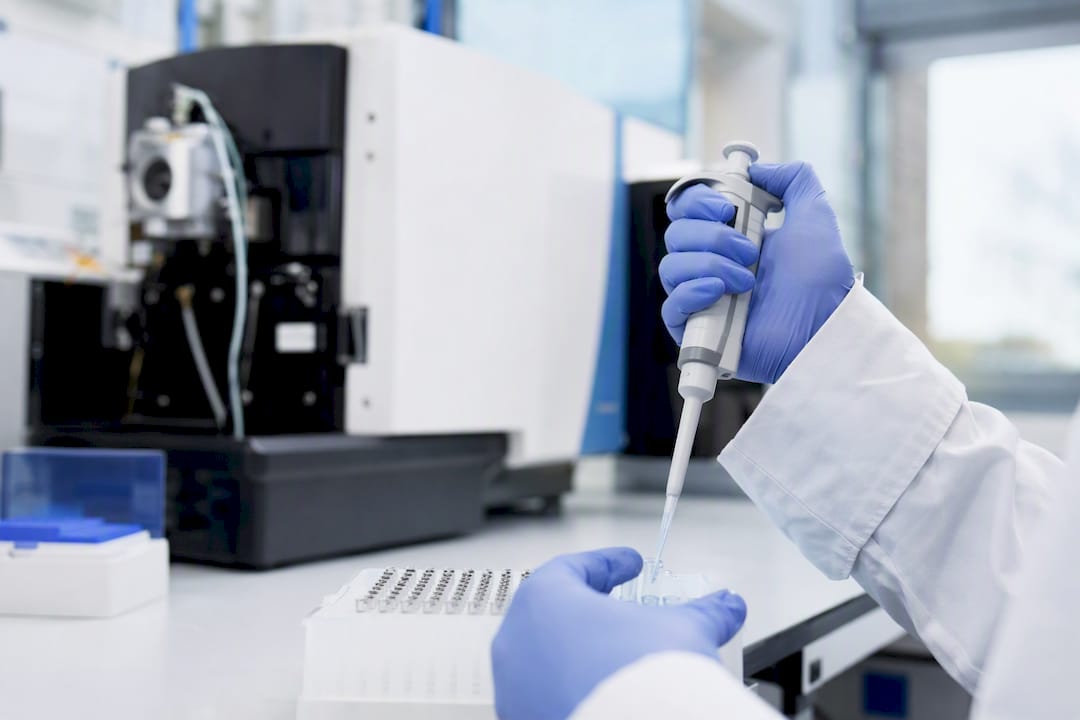
At the lab, screening runs through an immunoassay first, and any presumptive positive gets confirmed with gas chromatography mass spectrometry, or GC-MS. Screens typically turn around in 24 to 48 hours, with confirmatory testing adding another day or two.
Many employers still bring in a Medical Review Officer for non-DOT programs even though nothing requires it. The MRO reviews positive results, verifies legitimate prescriptions, and gives employers a documented, defensible reason before taking action against an employee.
Pro Tip: If your non-DOT program skips MRO review to save money, you’re trading a small line item for a much bigger legal exposure problem the first time a valid prescription triggers a positive.
DOT vs Non-DOT Drug Test: The Differences That Actually Matter
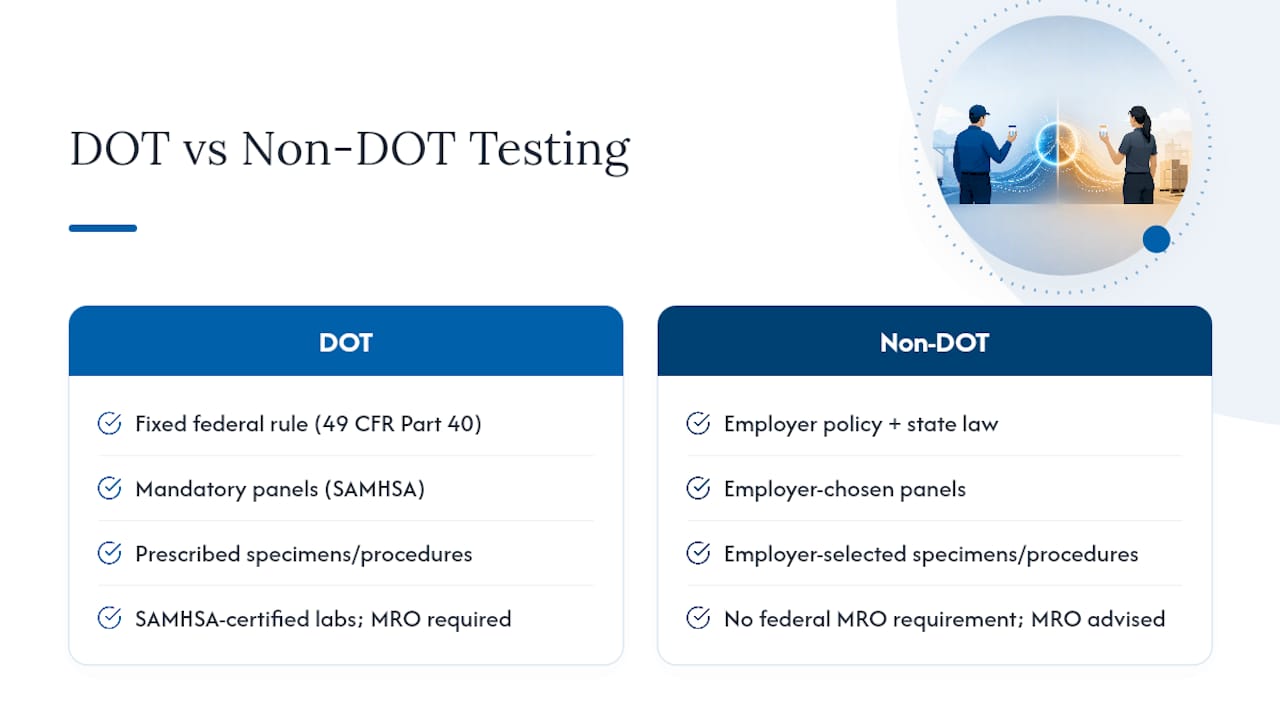
The DOT vs non-DOT drug test question boils down to one thing: who writes the rules. DOT testing is governed entirely by 49 CFR Part 40, a federal regulation with no room for employer customization. Non-DOT testing is governed by whatever your company writes into policy, layered under state law.
That difference cascades into everything else:
- Panels: DOT mandates testing for five specific drug classes, marijuana, cocaine, opiates, amphetamines/methamphetamines, and PCP, with no employer discretion to add or remove. Non-DOT employers choose their own panel, from a basic 5-panel drug test vs 10-panel comparison up through 12 or even 14-panel screens.
- Specimen: DOT requires urine for drug testing. Non-DOT employers can choose urine, oral fluid, or hair based on their needs.
- Lab requirements: DOT mandates SAMHSA-certified labs and strict split-specimen procedures. Non-DOT programs can use certified labs too, but nothing federally forces the split-specimen step, though it’s a smart practice to borrow anyway.
- MRO involvement: DOT requires MRO review of every non-negative result. Non-DOT programs can skip it, but doing so raises legal risk.
- Company authority testing: DOT explicitly allows separate non-DOT programs for the same employer, as long as they’re clearly labeled as independent of DOT rules.
The operational caution here is non-negotiable: a non-DOT result can never substitute for a required DOT test, even for the same employee on the same day. If you need a refresher on building the DOT side correctly, this DOT drug testing employer guide walks through the compliance mechanics.
When Employers Use Non-DOT Testing
Most non-DOT programs run on four triggers, each with its own logistics.
Pre-employment testing usually happens after a conditional job offer, not before. Build in enough lead time, since screens take a day or two and confirmatory testing on a positive adds more.
Random testing works best with a documented, statistically neutral selection method, drawn quarterly or annually so no single employee or department feels targeted.
Post-accident and reasonable-suspicion testing demand tight documentation. Supervisors need specific, observable facts, not a hunch, and the post-accident testing guidance covers what qualifies as a testable incident.
- Cost: a standard urine 5-panel screen typically runs $30 to $80; expanded panels and hair testing cost more.
- Turnaround: most screens return in 24 to 48 hours, longer if confirmatory testing is triggered.
- Payer: employers almost always cover testing costs for employer-mandated programs.
State Law, Cannabis Protections, and Discrimination Risk
Non-DOT policy design lives or dies on state law, and this is where employers get burned most often. State cannabis laws vary widely, and some states now restrict pre-employment marijuana testing or protect off-duty cannabis use outright.
- Check whether your state limits testing for marijuana specifically, separate from other substances.
- Confirm whether safety-sensitive roles or federal contract obligations exempt you from state cannabis restrictions.
- Apply your policy uniformly across every employee in a given role, without exceptions based on tenure or department favoritism.
- Document every test, every reasonable-suspicion decision, and every disciplinary action tied to a result.
- Have employment counsel review your written policy before rollout, especially if you operate across multiple states.
Uniform application matters more than most employers realize. A policy applied inconsistently, testing one department but not another for the same infraction, is exactly the pattern that turns into a discrimination claim.
Pro Tip: Don’t assume your multistate operation can run one policy. What’s legally sound in Texas can trigger liability in California or New York, so build state-specific addenda instead of forcing a single national policy to fit everywhere.
How to Build a Defensible Non-DOT Testing Program
A defensible program isn’t complicated, but it does require sequencing.
- Write the policy first. Define scope (which positions are covered), panels, testing triggers, consequences for a positive, and whether you’ll offer split-specimen retesting.
- Match the specimen to the goal. Oral fluid for recent-use concerns like reasonable suspicion, urine for standard pre-employment and random screening, hair for long-window pre-employment checks in high-trust roles.
- Choose an accredited lab and decide your MRO arrangement. The most defensible non-DOT programs mirror DOT best practices wherever feasible, including chain of custody and split specimens, because those steps reduce liability even when they aren’t legally required.
- Train supervisors on reasonable suspicion. They need to document specific behaviors and physical signs, not vague impressions, before ordering a test.
- Route every non-negative result through MRO review before taking action. An MRO who verifies a legitimate prescription prevents a wrongful termination claim before it starts.
- Keep documentation airtight. Every policy acknowledgment, every test order, every result review needs a paper trail.
Pro Tip: Countrywidetesting’s lab testing services pair directly with this checklist, giving HR teams accredited lab access and MRO coordination without having to assemble each piece separately.
What Employees Should Expect and How to Respond to a Positive
Bring a list of your current prescriptions and over-the-counter medications to any screening. If a legitimate medication triggers a positive, the MRO needs that information to clear it.
Initial screens typically return in 24 to 48 hours. A presumptive positive automatically triggers GC-MS confirmatory testing, since screening alone isn’t accurate enough to justify a firing decision.
- A positive result reflects a substance above the lab’s cutoff level, not necessarily impairment at the time of testing.
- If you believe a result is wrong, ask about split-specimen retesting or your rights under your employer’s policy and state law.
- Consequences vary by state, and some jurisdictions treat a positive differently for unemployment or workers’ compensation purposes.
Why Employers Turn to Countrywidetesting for Non-DOT Programs
Building the checklist above requires lab access most HR teams don’t have in-house. Countrywidetesting works with laboratories accredited to SAMHSA, ISO, CLIA, and CAP standards, giving employers a credible foundation for both pre-employment screening and urgent post-accident collections.
- Kits and lab services cover urine, oral fluid, and expanded panels for pre-employment, random, and post-accident triggers.
- Accredited lab partnerships support the chain-of-custody and confirmatory testing steps that make results defensible.
- Employers can order standard panels or request a custom setup for multistate or industry-specific needs.
Editorial Take: What Actually Separates a Good Non-DOT Program From a Weak One
Most guidance on non-DOT testing treats it as an afterthought, a lighter version of DOT compliance that doesn’t need the same rigor. That’s backward. Non-DOT programs carry more legal exposure than DOT ones, not less, precisely because there’s no federal script to point to when a lawsuit lands.
The conventional advice tells employers to focus on panel selection first: pick your five-panel or ten-panel, pick urine or oral fluid, done. That’s the wrong starting point. The policy language and the MRO arrangement matter more than the panel, because a technically correct positive result with no MRO review and no documentation trail is a lawsuit waiting to happen.
What gets underestimated is state law variation. Employers assume their testing program is a workplace decision. Increasingly, it’s a legal one, shaped by cannabis protections and discrimination statutes that shift year to year. If you fix one thing first, fix the policy and the review process, not the drug panel.
Get Your Non-DOT Testing Program Off the Ground
If you’ve read this far, you already know that a solid non-DOT program needs three things working together: the right specimen and panel choice, an accredited lab, and a review process that holds up under scrutiny. Assembling all three from separate vendors is where most HR teams lose time and money.
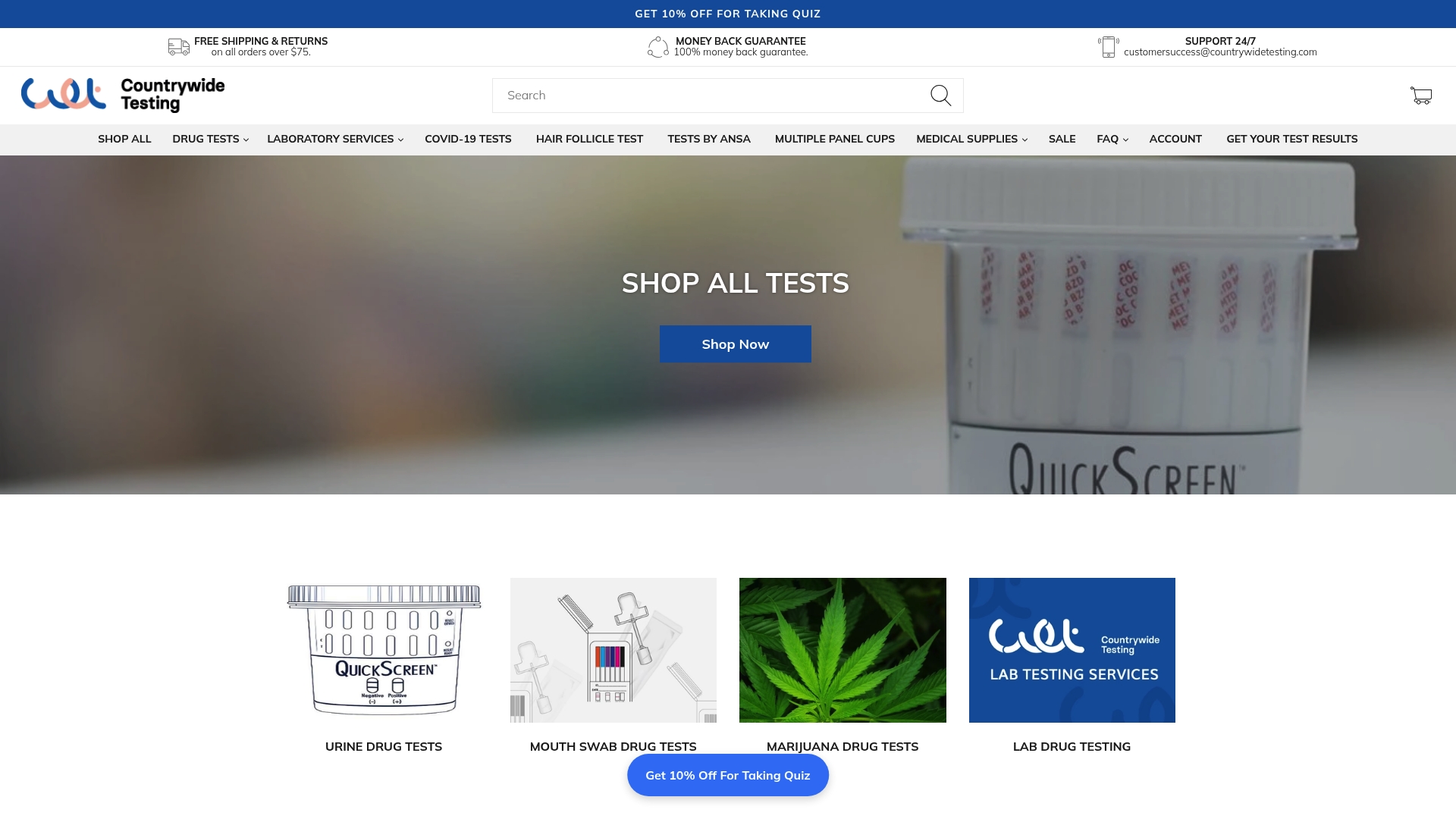
Countrywidetesting brings accredited laboratory testing services together with ready-to-order kits, so you’re not stitching together a lab contract, an MRO arrangement, and a supply chain separately. Whether you need a standard urine panel for pre-employment screening or an expanded 12-panel test for higher-risk roles, the ordering process works the same way: pick your panel, place the order, and get results routed through certified labs.
If you’re building or auditing a non-DOT program this year, start by requesting a quote for your specific panel and volume needs at Countrywidetesting.
Frequently Asked Questions
What is a non-DOT drug test? It’s any workplace drug or alcohol screening conducted outside 49 CFR Part 40, designed and controlled entirely by the employer’s own policy and applicable state law.
What’s the difference between DOT and non-DOT drug testing? DOT testing follows a fixed federal regulation with mandatory panels, SAMHSA-certified labs, and MRO review. Non-DOT testing lets employers choose their own panels, specimens, and procedures within state law.
Is a 5 panel drug test different from a 10 panel test? Yes. A 5-panel screen checks marijuana, cocaine, opiates, amphetamines, and PCP. A 10-panel test adds substances like benzodiazepines, barbiturates, and methaqualone, giving employers broader coverage for prescription drug misuse.
Can a non-DOT drug test result affect a DOT-regulated job? No. DOT and non-DOT results stay legally separate. A non-DOT test can never be used to satisfy or override a DOT testing requirement for a covered employee.
Do non-DOT employers have to use a Medical Review Officer? Not by federal law, but it’s strongly advised. MRO review verifies legitimate prescriptions before a positive result leads to disciplinary action, cutting down on wrongful termination risk.
This article is general information, not a substitute for advice from a qualified lawyer. Consult a qualified legal professional about your own circumstances before acting on anything here.
Sources
- 49 CFR Part 40 — U.S. Department of Transportation
- What substances are tested? | FMCSA
- Non‑DOT drug test: What it screens for and how it works — LegalClarity