
90 Day Window: Hair Drug Detection Times and Lab Reliability
A standard 1.5 inch (3.9 cm) scalp hair sample typically detects drug exposure across roughly the past 90 days. Body hair can push that window out toward about a year, though results grow less precise the farther back they reach. Hair testing confirms exposure over time. It doesn’t measure exact dose, and results shift depending on hair color, cosmetic treatments, and how the lab processes the sample.
TL;DR:
- Hair testing can detect drug use within approximately the past 90 days using a 1.5-inch scalp sample, with body hair extending that window to about a year.
- External factors like hair color, chemical treatments, and environmental contamination can influence detection accuracy and drug concentrations in hair samples.
- Confirmatory testing using GC-MS or LC-MS/MS is essential for reliable results, especially for legal or employment decisions, as initial screens are only preliminary indicators.
- Segmental analysis of long hair samples can help map drug exposure over time, but shaved head samples mainly reflect the most recent three months.
- Hair testing is better for identifying long-term use patterns than pinpointing exact timing or dose, with detection windows influenced by biological and cosmetic variables.
Table of Contents
- How Hair Drug Testing Works
- Detection Windows by Sample Type
- Which Drugs Show Up in Hair Testing
- What Skews Detection Times and Accuracy
- How Results Are Interpreted (and Their Limits)
- Hair Testing vs. Urine, Saliva, and Blood
- What to Expect During Collection and Turnaround
- Choosing a Lab You Can Trust With the Result
- Detection Times: What the Research Says vs. What Gets Overstated
- Sources
How Hair Drug Testing Works
Drugs reach the hair shaft through a few different routes, and understanding them explains why timing matters so much. The primary pathway is through the bloodstream: once a substance circulates in blood, it diffuses into the cells at the base of the hair follicle and becomes locked into the growing strand. Sweat and sebum (the oil your skin produces) can also deposit trace amounts of drug metabolites onto hair that’s already grown, and external contamination from smoke or handling can add a third layer of complexity labs have to sort through.
Scalp hair grows at an average rate of about half an inch per month. That’s why labs standardize on the first 1.5 inches (3.9 cm) closest to the scalp, which corresponds to roughly 90 days of history. Because it takes time for a strand to grow up past the skin surface, there’s a lag of about 5 to 10 days between use and when that exposure becomes detectable in the visible hair.
Laboratory analysis happens in two stages:
- Screening: An immunoassay quickly flags samples that may contain drug metabolites.
- Confirmation: Positive screens go through gas chromatography-mass spectrometry (GC-MS) or liquid chromatography-tandem mass spectrometry (LC-MS/MS), the gold-standard methods for confirming exactly which substance is present.
This two-step process, paired with supervised collection at the crown, is what makes hair testing far harder to game than a urine cup.
Detection Windows by Sample Type
The window a hair test can see into depends almost entirely on how much hair is available and where it comes from. A standard scalp sample gives roughly a 90-day retrospective view of drug exposure, based on research. Body hair grows more slowly and less predictably than scalp hair, so labs sometimes report body hair samples reflecting use over a longer period, possibly up to about a year, though that estimate is far less exact.
| Sample type | Typical detection window | Notes |
|---|---|---|
| Scalp hair, 1.5 in (3.9 cm) | About 90 days | The industry standard cut, taken close to the scalp for the most recent history |
| Scalp hair, longer sample | 90 days plus additional months per extra 1.5 in segment | Enables segmental testing to build a timeline |
| Body hair (arm, leg, chest) | Up to about a year | Slower, more variable growth makes exact timing harder to pin down |
| Very short or shaved hair | Reduced lookback | Less material means less history to analyze |
A few things worth pulling out of that table:
- Segmental testing, cutting a long sample into sequential sections, lets toxicologists map exposure onto a rough timeline rather than a single lump average.
- Shaving your head before a scheduled test doesn’t erase history so much as it shrinks the window; body hair sampling often becomes the fallback.
- Longer hair isn’t automatically tested in full. Most labs still analyze the first 1.5 inches unless a case specifically calls for extended chronological mapping.
If you want the deeper mechanics of how labs calculate that lookback period, our guide on how far back a hair follicle test can detect drugs breaks down the sampling math in more detail.
Which Drugs Show Up in Hair Testing
Hair panels typically screen for the same major drug classes covered in urine testing, though sensitivity varies by substance. Reliable targets include:
- Cocaine and its metabolites
- Opiates, including morphine, codeine, and heroin
- Amphetamines and methamphetamine
- MDMA
- PCP
- Benzodiazepines
Some laboratories now offer expanded panels that add fentanyl and other synthetic opioids, reflecting how quickly the illicit drug supply has shifted in recent years. THC is the notable exception to the “hair catches everything” assumption. Cannabis metabolites bind to hair less efficiently than stimulants or opioids do, which makes THC detection in hair meaningfully less sensitive and more inconsistent across labs. That inconsistency is one reason hair testing shows higher positivity for chronic, concealed use compared with urine, but not necessarily for every drug class equally.
What Skews Detection Times and Accuracy
Not every hair sample tells the same story for the same amount of drug exposure, and a handful of variables explain why.
- Melanin content. Darker, more pigmented hair tends to bind certain drugs, especially basic compounds like cocaine and methamphetamine, more readily than lighter hair. This has been a long-standing criticism of hair testing’s fairness across different hair colors and ethnic backgrounds.
- Cosmetic treatments. Bleaching and chemical dyeing can degrade or wash out embedded metabolites, sometimes lowering measured concentrations enough to affect results.
- External contamination. Secondhand smoke exposure or handling drug residue can deposit trace substances on the hair’s surface without any actual ingestion. Labs address this with washing protocols and metabolite-specific testing designed to distinguish surface contamination from what’s actually incorporated inside the shaft.
- Individual biology. Growth rate, metabolism, and how often or how much someone uses a substance all shift how much drug ends up embedded in a given hair segment.
Pro Tip: No shampoo or “detox” treatment reliably strips metabolites already bound inside the hair shaft. Supervised collection and, where needed, split-sample confirmation are the actual safeguards against tampering, not at-home remedies.
How Results Are Interpreted (and Their Limits)
A screening-positive result is never the final word. It has to be confirmed through GC-MS or LC-MS/MS before anyone treats it as reliable, and that confirmatory step is what separates a defensible result from a preliminary flag. Forensic reviews are consistent on this point: hair analysis is best treated as a qualitative indicator of exposure, not a precise measurement of dose or frequency. Overlapping concentration ranges between occasional and heavy users mean two people with very different usage patterns can sometimes produce similar numbers.
For anything with real stakes, employment, custody proceedings, or legal cases, documented chain of custody and review by a qualified toxicologist matter as much as the lab result itself. If you or someone you’re advising receives a non-negative result, a few concrete steps help:
- Request the full confirmatory report, not just the initial screen.
- Ask for a toxicologist’s written interpretation of the finding.
- Where policy allows, request split-sample or retesting through an independent lab.
Hair Testing vs. Urine, Saliva, and Blood
Each testing matrix answers a different question, and picking the wrong one is the most common mistake in test planning.
- Hair covers the longest lookback, roughly weeks to months, making it the strongest option for spotting long-term or historical patterns.
- Urine detects recent use within a window of days, the standard choice for routine or random workplace screening.
- Saliva narrows in on very recent use, often within hours to a couple of days, useful for post-incident or reasonable-suspicion testing.
- Blood shows what’s actively present in someone’s system at the moment of collection.
Hair also carries a practical advantage beyond timing: it’s substantially harder to adulterate or substitute than a urine sample, especially under supervised cutting. For pre-employment and periodic compliance screening where historical patterns matter more than a single incident, hair is often the better fit. For post-accident or reasonable-suspicion cases where “right now” is the question, urine or saliva usually makes more sense.
What to Expect During Collection and Turnaround
Getting a hair test done follows a fairly predictable sequence, even though the exact timeline varies by lab and by case type.
- Collection. A trained collector cuts a small sample, typically from the crown or vertex of the scalp, close to the skin. If scalp hair is too short or unavailable, body hair serves as an alternative, with the tradeoff of a less precise timeline.
- Screening and turnaround. Negative results typically come back within a few business days. Anything flagged for confirmation takes longer, since GC-MS or LC-MS/MS analysis is more involved than the initial immunoassay.
- Non-negative follow-up. A flagged screen triggers automatic confirmatory testing, often followed by a toxicologist’s review before the result is finalized and reported.
- Documentation. Every step, from the cut to the lab report, gets logged under chain-of-custody procedures, which matters enormously if the result ends up cited in an employment dispute or legal proceeding.
Choosing a Lab You Can Trust With the Result
Not all hair testing is created equal, and the accreditation behind a lab matters more than most people realize until a result gets challenged. Look for labs holding CLIA, ISO, or CAP accreditation, and confirm they follow documented chain-of-custody procedures from collection through reporting. For anything with legal or employment consequences, insist on confirmatory GC-MS or LC-MS/MS testing and a toxicologist’s interpretation rather than accepting a raw screening result at face value.

Some testing services work with accredited laboratories to arrange hair testing and confirmatory workflows that make a result defensible for compliance programs or individuals needing documented, chain-of-custody results. If your situation calls for lab-based testing rather than an over-the-counter kit, our laboratory drug testing services connect you directly with that process.
Detection Times: What the Research Says vs. What Gets Overstated
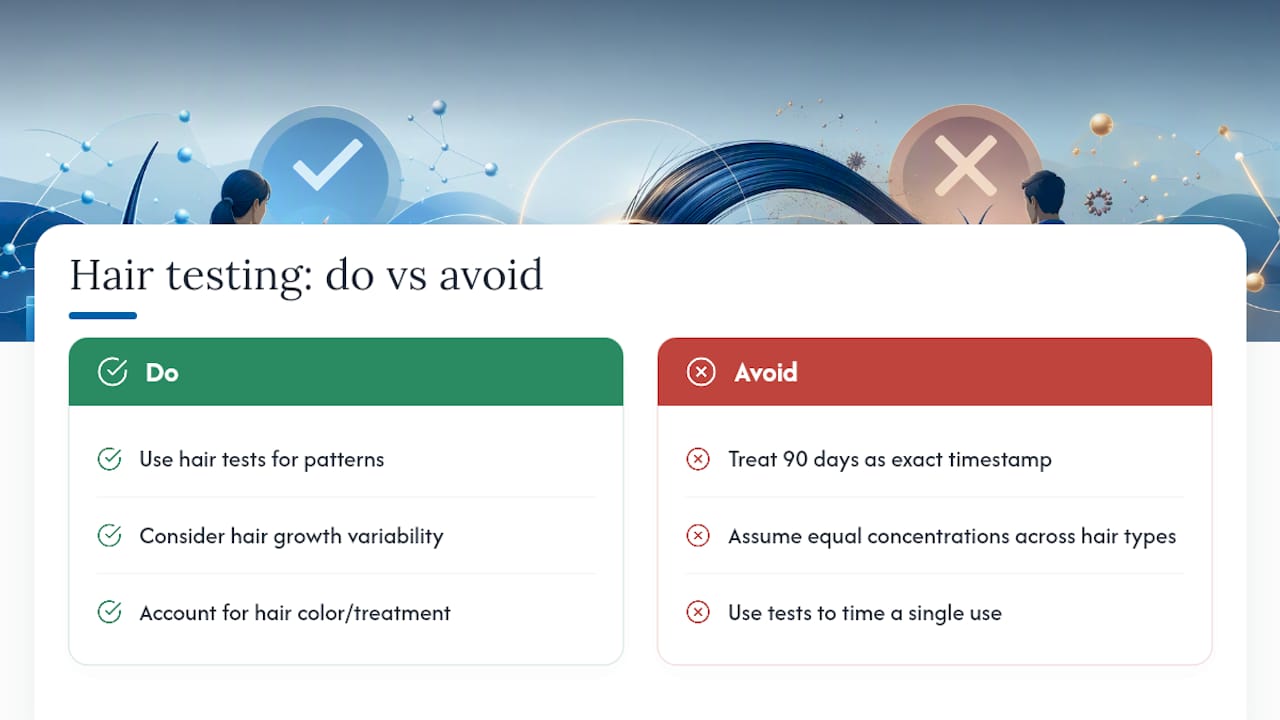
The biggest misconception floating around online forums is that hair testing works like a precise timestamp. It doesn’t. It tells you exposure happened somewhere in a window, not exactly when or how much. The 90-day figure gets treated as gospel, but it’s really a sampling convention built around average scalp growth rates, not a biological constant. Someone with slower hair growth might show a shorter true window than the math suggests; someone with faster growth might show a slightly longer one.
What gets underplayed is how much melanin and cosmetic treatment can swing a result. A person with dark, untreated hair and a person with bleached blonde hair could use the identical amount of the same drug and produce meaningfully different concentrations. That’s not a flaw anyone advertises, but it’s baked into decades of forensic literature on the topic. The honest takeaway is that hair testing is a genuinely powerful tool for spotting patterns of repeated use, especially in contexts like custody evaluations, where a single moment doesn’t matter nearly as much as a sustained pattern does. Treating it as a precision instrument for a single use, though, asks more of the science than it can deliver.
— Alan
Sources
For deeper verification, consult the PubMed review on hair testing’s forensic limits, the NIJ article on contamination versus use, and MedlinePlus’s drug testing overview.
This article is general information, not a substitute for advice from a qualified doctor. Consult a qualified healthcare professional about your own circumstances before acting on anything here.
- The forensic limits of hair drug testing: a critical assessment of dose–concentration relationships — PubMed
- Hair drug testing results and self-reported drug use among primary care patients with moderate-risk illicit drug use — PMC
- Detecting drugs in hair: Is it drug use or environmental contamination? — NIJ
- Hair versus urine drug testing in forensic populations: A systematic review
- Hair testing - FAQ — Quest Diagnostics