
Confirm Whether Delta‑8 Caused a Positive Drug Test With LC‑MS/MS
Yes, delta-8 THC can trigger a positive result on a standard cannabinoid drug screen. Most immunoassay urine tests aren’t built to tell delta-8 apart from delta-9 THC, so they flag both. Whether that screen holds up depends entirely on whether the lab runs a confirmatory test, like the LC-MS/MS panels Countrywidetesting offers, that specifically looks for delta-8 metabolites.
TL;DR:
- Most urine drug tests cannot distinguish delta-8 THC from delta-9 THC due to cross-reactivity, making positive screens unreliable without confirmatory testing.
- Detection windows in urine can range from 3 days for single use to over 30 days for heavy use, with metabolites accumulating in fat tissue and lingering after use.
- Confirmatory testing with LC-MS/MS can differentiate delta-8 from delta-9 metabolites, but not all labs have this capability, which affects test accuracy.
- Heavy, frequent delta-8 use, contaminated products with undeclared delta-9, and individual metabolism significantly extend detection times beyond standard estimates.
- The best course of action if concerned about testing is to cease delta-8 use early, retain product documentation, and pursue validated confirmatory testing to verify actual cannabinoid presence.
Table of Contents
- How Long Does Delta-8 Stay in Your System?
- Why Standard Screens Flag Delta-8 (and Why That’s Not the Final Word)
- What Actually Changes Your Detection Window
- Urine, Blood, Saliva, and Hair: What Each Test Actually Measures
- What to Do Before a Test (or After a Positive Result)
- Why Lab Confirmation Is the Only Reliable Answer
- The Gap Between “Positive” and “Proven” Is Where This Whole Issue Lives
- Order Confirmatory Testing Through Countrywidetesting
- Sources
How Long Does Delta-8 Stay in Your System?
The honest answer is: it depends heavily on how often you use it, but the ranges follow the same pattern as regular THC because delta-8 breaks down through a similar metabolic pathway.
Your body converts delta-8 into 11-hydroxy-delta-8-THC, then into 11-nor-9-carboxy-delta-8-THC, the metabolite that actually shows up on a delta 8 urine test. That compound is fat-soluble, which is why it lingers in body tissue long after the high wears off, and why detection windows stretch so much between casual and daily users.
Pro Tip: If you’ve used a delta-8 product more than once in the past month, assume you’re closer to the “moderate” or “chronic” end of these ranges, not the “single use” end. Frequency matters more than dose.
Detection windows by test type generally break down like this:
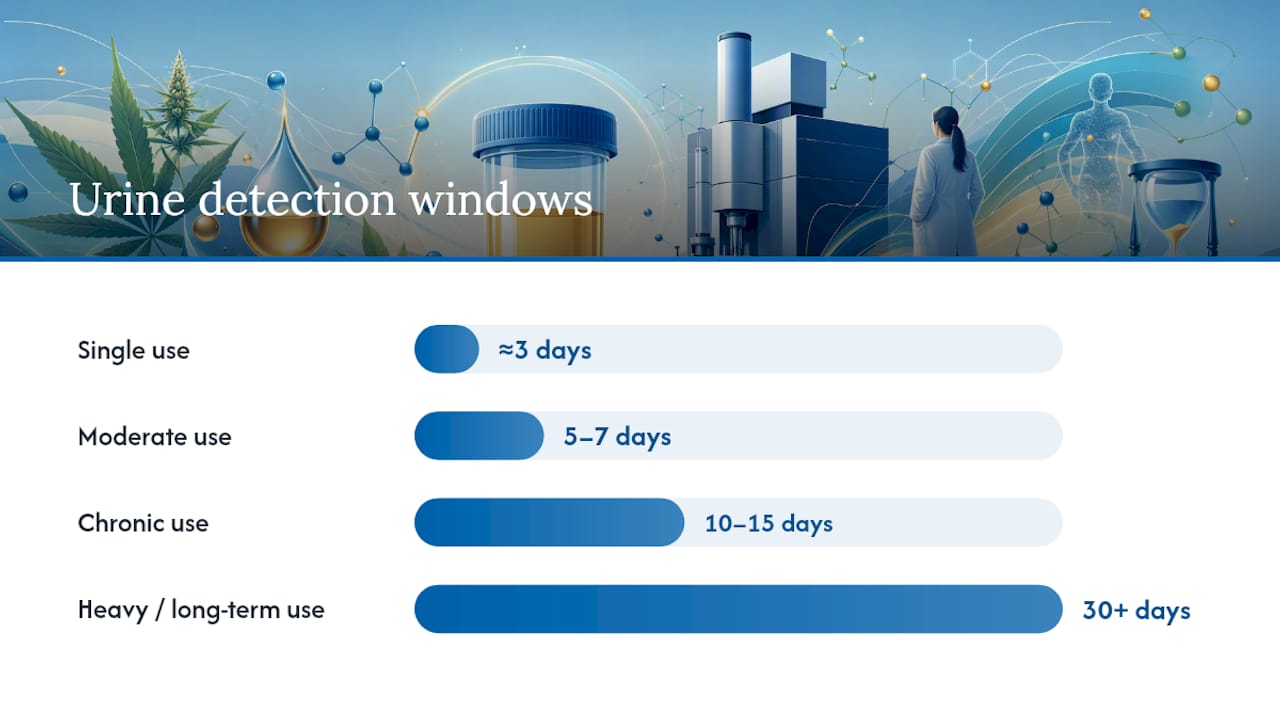
- Urine: the most common test type, and the one most likely to flag delta-8. Ranges vary from about 3 days for a single use up to more than 30 days for heavy, chronic use, according to a clinical review summarized by Healthline.
- Blood: detects recent use, typically within 1 to 2 days, since THC metabolites clear from blood plasma faster than they do from urine.
- Saliva: a short window, generally 24 to 72 hours, making it the test of choice for roadside or same-day impairment checks.
- Hair: the longest window by far, often up to 90 days, though hair testing is more prone to interpretation disputes and external contamination issues.
Here’s the range that matters most for anyone trying to gauge their own risk:
Urine detection windows for THC metabolites (including delta-8-derived carboxy-THC): single use, around 3 days. Moderate use, 5 to 7 days. Chronic use, 10 to 15 days. Heavy, long-term use, more than 30 days. (Healthline)
Those numbers were established for cannabis broadly, but they apply to delta-8 too, since the compound produces a structurally similar carboxy-THC metabolite that standard screens detect the same way. Heavy or daily use is the wild card here. The metabolite accumulates in fat tissue faster than your body clears it, so someone using delta-8 nightly for a month can test positive weeks after their last dose, long after any noticeable effects have faded.
Why Standard Screens Flag Delta-8 (and Why That’s Not the Final Word)
Immunoassay urine screening, the cheap, fast test used in most workplace and pre-employment settings, doesn’t identify individual cannabinoids. It works by detecting antibodies that bind to a broad class of THC-related molecules. Delta-8 and delta-9 share enough of their chemical structure that most screening kits can’t distinguish one from the other. This is called cross-reactivity, and it’s the reason a delta-8 product can cause a positive result on a test technically designed to catch delta-9.
A federally funded evaluation of six commercial urine immunoassays found that cross-reactivity with delta-8 and related cannabinoid analogs varied significantly by brand and by cutoff concentration, according to the NIJ technical report on cannabinoid cross-reactivity. Some kits flagged delta-8 readily at standard 20 to 50 ng/mL cutoffs. Others were less sensitive. That inconsistency is exactly why a screening result alone should never be treated as proof of delta-9 use.
This is where confirmatory testing comes in. Labs use GC/MS or LC-MS/MS, methods that separate and identify molecules by their exact mass and fragmentation pattern rather than a broad antibody reaction. A validated LC-MS/MS panel can distinguish 11-nor-9-carboxy-delta-8-THC from its delta-9 counterpart, but only if the lab’s calibrators are built to detect delta-8 specifically. Not every lab has that capability built into its standard THC confirmation panel.
Real-world evidence backs this up. A peer-reviewed case series covering four pediatric patients documented delta-8 exposure producing positive immunoassay cannabinoid screens. When labs ran LC-MS/MS confirmation targeted specifically at delta-8 metabolites, they confirmed 11-nor-9-carboxy-delta-8-THC in the samples, while delta-9 metabolites were not detected at all. That’s the clearest illustration available of the gap between a screening flag and a confirmed result.
- Immunoassay screens answer one question: “Is some cannabinoid present?”
- Confirmatory LC-MS/MS or GC/MS answers a much more specific one: “Which cannabinoid, and how much?”
- Without targeted confirmation, a positive screen from delta-8 use can look identical to one from delta-9 use on paper.
What Actually Changes Your Detection Window
Not everyone who uses delta-8 faces the same testing risk. A handful of variables push detection windows longer or shorter, and most of them are within your control.
Frequency and dose matter more than almost anything else. Someone who tries a delta-8 gummy once at a party has a dramatically shorter window than someone vaping delta-8 daily for stress relief. Metabolites build up in fat stores with repeated exposure, and your body needs more time to clear an accumulated reserve than a single dose.
Product purity is a bigger wildcard than most people realize. The FDA has warned that many delta-8 products are unregulated and may contain contaminants or undeclared delta-9-THC. Label accuracy in the hemp-derived product market is inconsistent enough that you can’t assume a product marketed as “pure delta-8” doesn’t also contain measurable delta-9. If it does, a screen isn’t cross-reacting at all. It’s detecting the real thing.
Individual metabolism plays a role too. Body fat percentage, hydration, metabolic rate, and even liver function all affect how quickly your body processes and excretes THC metabolites. Two people using the same product at the same dose can clear it on very different timelines.
Test cutoffs set by the specific lab or testing program also shift the picture. A test using a 50 ng/mL cutoff will miss trace amounts that a 20 ng/mL cutoff would catch, which is part of why comparing two different testing services’ results side by side rarely tells you much.
- Higher frequency of use extends detection windows most reliably.
- Undeclared delta-9 in delta-8 products can turn a “cross-reactivity” screen into a legitimate positive.
- Metabolism and body composition shift individual results by days, sometimes weeks.
- Lower cutoff concentrations catch smaller trace amounts than higher ones.
Urine, Blood, Saliva, and Hair: What Each Test Actually Measures
Different specimen types exist because employers, courts, and clinics need different information, not because one test is simply “better” than another.
- Urine immunoassay screening. This is the workhorse of workplace and pre-employment testing. It’s fast, inexpensive, and broad, but that breadth is exactly why delta-8 cross-reactivity is a real concern here more than anywhere else.
- Confirmatory urine testing via LC-MS/MS. When a screen comes back positive, a properly equipped lab can run a targeted panel that quantifies both delta-8 and delta-9 carboxy-THC metabolites separately, as described in Mayo Clinic Laboratories’ confirmation test catalog. This is the step that actually settles the question.
- Blood testing. Used far less often for routine screening, blood tests are the go-to when someone needs to establish recent use or possible impairment, such as after a workplace accident.
- Saliva testing. Increasingly common for roadside checks and same-day impairment assessments because it reflects use within the last day or two, not weeks.
- Hair testing. Used when an employer or legal proceeding needs a long look back, sometimes 90 days. It’s the least useful test for pinning down recent use and the most vulnerable to disputes over external contamination versus actual ingestion.
What to Do Before a Test (or After a Positive Result)
If you know a test is coming, the smartest move is also the simplest: stop using any delta-8 product well ahead of time, and don’t assume a “clean” label means a clean result.
Hold onto the product packaging, receipts, and batch or lot numbers if you’ve been using a commercial delta-8 product. If a screen comes back positive and you suspect the product actually contained undeclared delta-9, that documentation is what supports a request for reanalysis or a dispute with an employer’s medical review officer (MRO).
Skip the detox teas, cleanses, and “THC flush” kits. There’s no reliable evidence that these products speed up metabolite clearance in any meaningful way, and some workplace programs treat obvious attempts at tampering as a policy violation in their own right, sometimes worse than a positive result itself.
- Stop use as early as possible before a scheduled test; there’s no reliable shortcut once use has stopped.
- Disclose any legal medications or supplements to the MRO rather than letting a screen go unexplained.
- Request confirmatory testing that specifically targets delta-8 metabolites if you believe the product, not delta-9 use, caused the result.
- Keep documentation: packaging, receipts, and lot numbers, in case contamination is the real explanation.
Detection window reminder: urine tests can flag THC metabolites anywhere from 3 days after single use to more than 30 days after heavy, chronic use, per Healthline’s summary of clinical detection data. There’s no product that reliably shortens that window on demand, a point echoed in independent guidance on THC clearance methods.
Treatment courts and monitoring programs have largely stopped splitting hairs on this issue. Guidance for drug courts explicitly warns that delta-8 use is likely to produce a positive screen and complicates abstinence monitoring enough that many programs simply prohibit it outright, regardless of legality where it was purchased.
Why Lab Confirmation Is the Only Reliable Answer
A screening result is a starting point, not a verdict. Getting a real answer means routing the sample through a lab equipped to look for delta-8 metabolites specifically, not just generic cannabinoid markers.
Countrywidetesting works with laboratories that meet SAMHSA, CLIA, CAP, and ISO standards, the same certifications that govern federally regulated and forensic-grade drug testing programs. That matters because not every lab has validated calibrators for delta-8, and a confirmation run on the wrong panel gives you the same ambiguity as the original screen.
For anyone who tested positive and suspects delta-8 rather than delta-9 is the cause, or who simply wants certainty before a scheduled test, a few options apply:
- Zero-tolerance THC lab confirmation testing that runs a targeted LC-MS/MS panel rather than relying on a broad screen.
- Chain-of-custody mail-in collection kits for situations requiring a documented, defensible sample trail.
- At-home multi-panel screening for people who want a preliminary check before an official test date.
The Gap Between “Positive” and “Proven” Is Where This Whole Issue Lives
Most of the anxiety around delta-8 and drug testing comes from treating a screening result as a final answer. It isn’t. It’s a probability flag built on antibody cross-reactivity, and the NIJ’s own testing shows that flag behaves inconsistently across different commercial kits. That’s not a reason to assume you’re safe. It’s a reason to understand exactly what kind of test you’re looking at before you draw any conclusion.
The conventional advice, “just don’t use delta-8 before a test,” is correct but incomplete. It skips the part where product contamination is arguably the bigger threat: unregulated delta-8 items showing measurable delta-9 on lab analysis more often than most users assume. If you’ve already tested positive, your first move shouldn’t be panic or a detox kit. It should be finding out, through actual confirmatory testing, what was really in your system.
— Alan
Order Confirmatory Testing Through Countrywidetesting
If a screening result has you second-guessing whether delta-8 or delta-9 is behind a positive, guessing isn’t the answer, a validated lab confirmation is. Countrywidetesting connects you directly to certified laboratories running confirmatory LC-MS/MS testing built to separate delta-8 metabolites from delta-9, instead of leaving you stuck with an ambiguous screen.
The zero-tolerance THC lab confirmation test works through chain-of-custody collection, which means the sample trail holds up for employer, legal, or federal compliance needs, not just personal peace of mind. Turnaround times run on the lab’s standard processing schedule once your sample arrives, so you’re not left waiting indefinitely for an answer. Whether you need a full lab testing services package for workplace compliance or a single confirmation to settle a disputed result, start by selecting the test that matches your situation and get your sample into the pipeline.
This article is general information, not a substitute for advice from a qualified doctor. Consult a qualified healthcare professional about your own circumstances before acting on anything here.
Sources
- Delta-8-Tetrahydrocannabinol Exposure and Confirmation in Four Pediatric Patients — PMC
- The Cross-Reactivity of the Cannabinoid Analogs … in Urine of Six Commercially Available Homogeneous Immunoassays — NIJ technical report
- Does Delta-8 Show Up on a Drug Test? 12 Things to Know — Healthline
- 5 things to know about delta-8 tetrahydrocannabinol (delta-8-THC) — FDA
- Delta-8 and delta-9 carboxy-tetrahydrocannabinol confirmation (Mayo Clinic Laboratories test catalog)