
Best Countrywide-Testing.myshopify.com Alternatives 2026
TL;DR:
- Choosing the right drug testing provider depends on compliance requirements, sample types, and support needs.
- Most vendors focus on certified labs, collection networks, enterprise platforms, or at-home kits, each suited for different organizations.
The strongest alternatives to CountryWideTesting.com fall into four categories: certified lab partners (best for clinics and federally regulated employers), national collection networks with program management (best for DOT and multi-site employers), enterprise test-management platforms (best for high-volume HR operations), and vendor-assisted at-home kit programs (best for individuals and small non-DOT employers). Each route carries different compliance weight, cost structure, and operational support.
TL;DR
- Ask any candidate provider for their HHS-certified lab documentation before signing a contract.
- DOT employers: confirm the vendor supports 49 CFR Part 40 chain-of-custody and MRO review before committing.
- Individuals and small employers: match your sample type (urine, saliva, hair) to your detection window needs before ordering a kit.
Table of Contents
- How do countrywide-testing.myshopify.com alternatives compare at a glance?
- How do you choose the right alternative provider?
- What are your main alternative provider types?
- How does Countrywidetesting measure up on certifications and workflows?
- Which option fits your situation?
- What 2026 legal context should U.S. employers know?
- Key Takeaways
- The case for getting vendor selection right the first time
- Countrywidetesting covers kits, lab testing, and employer programs in one place
- Authoritative sources and next-step resources
How do countrywide-testing.myshopify.com alternatives compare at a glance?
The table below maps CountryWideTesting.com against the four main alternative provider types. For DOT situations, weight the regulatory certifications and collection options columns first. For non-DOT roles, pricing and turnaround often matter more.
| Dimension | CountryWideTesting.com | Certified Lab Partners | National Collection Networks | Enterprise Test-Management Platforms | At-Home Kit Programs |
|---|---|---|---|---|---|
| Service type | Kit sales + lab services | Lab testing only | Managed program + collection | Software + network coordination | Kit-only or kit + lab confirm |
| Regulatory certifications | SAMHSA, CLIA, CAP, ISO partnerships | SAMHSA/HHS certified | DOT/49 CFR Part 40 compliant | Varies; often DOT-capable | Non-DOT; CLIA-waived kits |
| DOT support | Employer program options | Yes, with MRO | Yes, full DOT workflow | Yes, with integrated MRO | No |
| Collection options | At-home, lab drop-off | Lab site or mobile | Observed, mobile, on-site | Network-dependent | At-home unobserved only |
| Sample types | Urine, saliva, multi-panel | Urine, oral fluid, hair | Urine, oral fluid | Urine, oral fluid, hair | Urine, saliva |
| Turnaround time | Rapid kits; lab varies | 24–72 hours | 24–72 hours | 24–72 hours | Rapid (kit); 2–5 days (lab confirm) |
| Pricing model | Per-kit or lab service fee | Per-test lab fee | Per-test + program fee | Subscription + per-test | Per-kit retail |
| Reporting/integrations | Online results | Lab portal | Electronic COC, HCM integrations | API, payroll/HCM integrations | Basic results notification |
| Employer support | Program options available | Limited account mgmt | Dedicated account management | Dedicated account management | Minimal |
| Best use case | Employers, clinics, individuals | Clinics, regulated employers | Multi-site DOT employers | High-volume HR operations | Individuals, small employers |
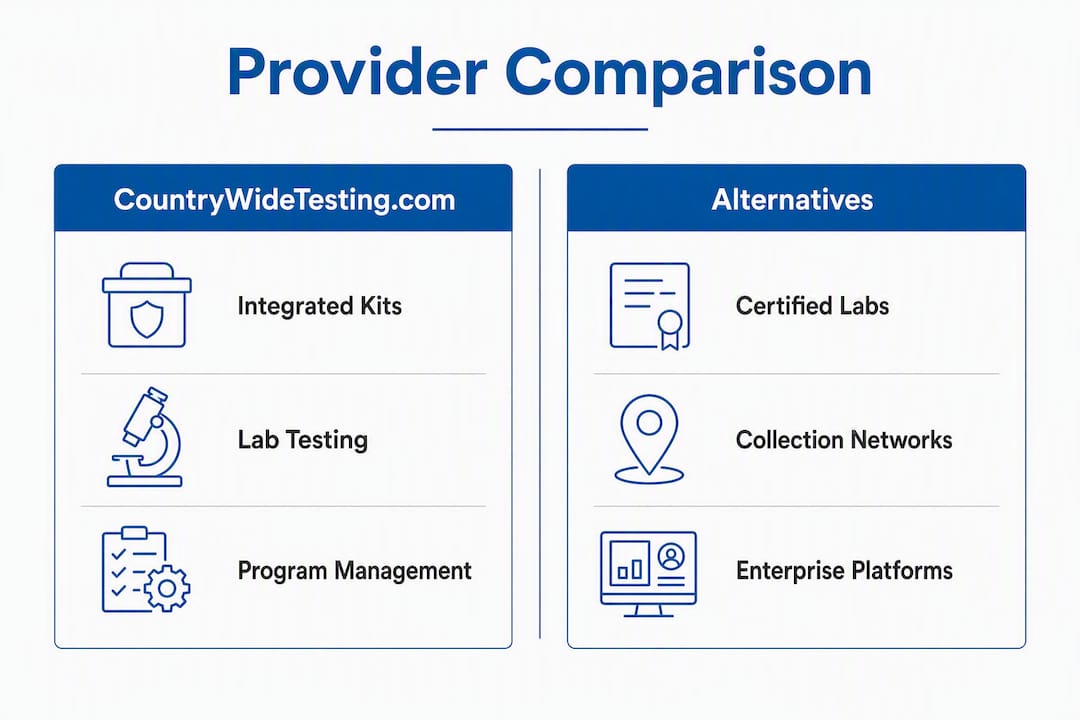
For high-risk safety-sensitive roles governed by 49 CFR Part 40, weight the regulatory certifications and DOT support columns above all others.
How do you choose the right alternative provider?
Prioritize regulatory fit first: confirm SAMHSA/DOT compliance, then match sample types to your workforce needs, then evaluate program management support. Price is the last filter, not the first.
Vendor question checklist
- Can you provide your current HHS/SAMHSA lab certification documentation?
- Do you offer MRO (Medical Review Officer) review for all positive results?
- What is your chain-of-custody workflow, and is it electronic?
- Can you support observed collections for DOT reasonable-suspicion testing?
- What are your turnaround times and sample retention policies?
- Do you integrate with HCM or payroll systems for reporting?
- How is pricing structured: per-test, subscription, or bundled?
- Can you provide employer references in my industry?
Red flags to watch for
- No documented SAMHSA, CLIA, or CAP certifications
- Opaque or bundled pricing with no itemized breakdown
- No MRO access or MRO referral process
- Inability to support observed collections for DOT programs
- No written guidance on state cannabis policy mapping
Sample cost breakdown
A realistic per-test cost includes four components: kit price + lab processing fee + collection site fee + account or program management fee. Comparing only kit prices across vendors produces misleading totals. Require itemized quotes from every candidate, then evaluate vendors holistically across compliance depth, not just unit cost.
Pro Tip: Ask vendors to show you a completed chain-of-custody form from a recent DOT test. A vendor who cannot produce one quickly has likely never run a compliant DOT program.
What are your main alternative provider types?
Certified lab partners
These providers focus exclusively on specimen analysis. They hold HHS/SAMHSA certification, process urine, oral fluid, and hair samples, and return results through a secure lab portal. Clinics and regulated employers benefit most because the certification chain is clear and auditable.
Strengths: Highest evidentiary standard, full MRO integration, broad panel options including expanded opioid panels.
Limitations: No kit fulfillment, no collection-site network, limited account management for small buyers.
Practical check: Request the lab’s current HHS certificate number and verify it against the SAMHSA certified lab list before signing.
National collection networks with program management
These vendors combine a nationwide network of collection sites with program administration: electronic chain-of-custody, MRO coordination, and employer reporting. DOT employers and multi-site operations get the most value here because program management features reduce missed documentation and administrative errors.
Strengths: Observed collection capability, DOT-compliant workflows, dedicated account management, HCM integrations.

Limitations: Higher per-test cost, less flexibility for one-off individual orders.
Enterprise test-management platforms
Software-led vendors that coordinate testing across a network of labs and collection sites through a single dashboard. API integrations with payroll and HR systems make them attractive for high-volume operations with complex reporting needs.
Strengths: Centralized reporting, scalable for hundreds of employees, audit-ready documentation.
Limitations: Setup time, subscription costs, and overkill for small employers or individuals.
At-home kit programs
Retail or online kit programs for unobserved, non-DOT screening. Standard 5-panel urine tests do not reliably detect fentanyl, many benzodiazepines, or synthetic cannabinoids unless those substances are added to the panel. Individuals and small non-DOT employers find these practical for pre-employment screening when regulatory documentation is not required.
Strengths: Low cost, fast results, no collection appointment needed.
Limitations: Unobserved collection is inadmissible for DOT purposes; limited panel options on basic kits.
| Feature | Certified Lab | Collection Network | Enterprise Platform | At-Home Kit |
|---|---|---|---|---|
| Cost predictability | Medium | Low | Low | High |
| Compliance support | High | High | High | Low |
| Scalability | Medium | High | High | Low |
| Speed | Medium | Medium | Medium | High |
| Sample type variety | High | High | Medium | Medium |
How does Countrywidetesting measure up on certifications and workflows?
Countrywidetesting partners with laboratories certified to SAMHSA, CLIA, CAP, and ISO standards, covering the core regulatory requirements for both employer and individual testing in the United States. The platform sells urine and saliva test kits directly, offers multi-panel options, and connects buyers to lab testing services for confirmed results.
Key workflow features include:
- At-home kit ordering for individuals and employers
- Lab testing services with certified lab partnerships
- Employer program options with chain-of-custody support
- Urine, saliva, and multi-panel sample types
- Educational resources on SAMHSA drug testing and compliance
Pro Tip: Before any federally regulated test, verify your lab partner’s current HHS certification number on the SAMHSA certified lab list and confirm MRO review is part of the workflow.
Which option fits your situation?
DOT employers: Use a certified lab partner combined with a national collection network that explicitly supports 49 CFR Part 40 observed collections and MRO review. Countrywidetesting’s lab partnerships and DOT employer guidance can support this workflow.
Multi-site non-DOT employers: A national collection network or enterprise platform with electronic chain-of-custody and HCM integrations reduces administrative overhead across locations. Bulk ordering through Countrywidetesting is a practical entry point before scaling to a full platform.
Clinics: Certified lab partners with SAMHSA/CLIA credentials and broad panel options are the primary fit. Countrywidetesting’s healthcare kit guidance helps clinics match kit type to clinical need.
Individuals: At-home kit programs with an optional lab confirmation step cover most personal screening needs. A 12-panel at-home cup test or saliva kit covers the most common substances without a clinic visit.
Edge cases to consider:
- Seasonal hiring spikes: Pre-order bulk kits and confirm your lab partner can handle volume surges without extending turnaround times.
- Unionized workforces: Federal law requires negotiating testing policies with unions; consult legal counsel before rolling out a new program per SAMHSA federal guidance.
- High-turnover hourly staff: Rapid oral fluid kits reduce collection friction and speed up pre-employment clearance.
What 2026 legal context should U.S. employers know?
Employers must reconcile state cannabis legalization with federal safety rules and choose vendors that actively map their services to state-specific requirements. Vendors advertising “universal” testing panels often fail to account for state employee-protection statutes, and written policy distinctions between safety-sensitive and non-regulated roles are now a baseline expectation, not a best practice.
DOT testing still centers on urine under 49 CFR Part 40’s five standard drug categories. Saliva testing for DOT programs remains on hold until HHS certifies laboratories for oral fluid, so employers should not commit to saliva-only DOT workflows yet.
Policy action list:
- Update written testing policies to distinguish safety-sensitive from non-regulated roles.
- Confirm your vendor provides state-level cannabis policy mapping in writing.
- Verify your testing panel covers your actual risk profile (add fentanyl or synthetic opioid panels where warranted).
- Document supervisor training on reasonable-suspicion procedures.
- Review MRO access and confirm positive-result review timelines meet your policy requirements.
Key Takeaways
Choosing the right drug testing provider in 2026 requires matching regulatory requirements, sample types, and program support to your specific buyer type before comparing prices.
| Point | Details |
|---|---|
| Regulatory fit comes first | Confirm SAMHSA, CLIA, or CAP certification and DOT compliance before evaluating any other feature. |
| MRO access is non-optional for DOT | Every federally regulated positive result requires Medical Review Officer review under 49 CFR Part 40. |
| Saliva DOT testing is not yet available | HHS has not yet certified labs for oral fluid DOT testing; urine remains the required specimen type. |
| State cannabis laws require written policy | Vendors must map services to state rules; distinguish safety-sensitive roles in your written policy. |
| Countrywidetesting covers multiple buyer types | Lab partnerships, multi-panel kits, and employer program options make it a practical option for employers, clinics, and individuals. |
The case for getting vendor selection right the first time
Most employers treat drug testing vendor selection as a procurement task: find the lowest per-test price, place the order, move on. That approach works until a positive result gets challenged in court or a DOT audit surfaces a chain-of-custody gap. The real cost of the wrong vendor shows up in legal exposure, not line items.
The 2026 regulatory environment adds another layer. State cannabis protections are expanding, and vendors that cannot demonstrate written state-level compliance mapping are a liability, not a convenience. The same applies to saliva testing: the technology is ready, but DOT employers who move to oral fluid before HHS certifies labs are running a non-compliant program regardless of how the vendor markets it.
What actually matters is vendor depth, not vendor breadth. A provider with SAMHSA-certified lab partnerships, documented MRO access, and a clear chain-of-custody workflow for your specific industry is worth more than a platform offering every sample type with no compliance support behind it. Countrywidetesting’s combination of certified lab partnerships, multi-panel kit options, and employer program support puts it in a strong position for buyers who need both convenience and compliance without managing multiple vendor relationships.
Countrywidetesting covers kits, lab testing, and employer programs in one place
Most buyers end up managing two or three vendor relationships to cover what Countrywidetesting handles in one: direct kit ordering, certified lab testing services, and employer program support backed by SAMHSA, CLIA, CAP, and ISO lab partnerships. That consolidation matters when you are tracking chain-of-custody documentation across multiple test types or managing pre-employment screening at volume.
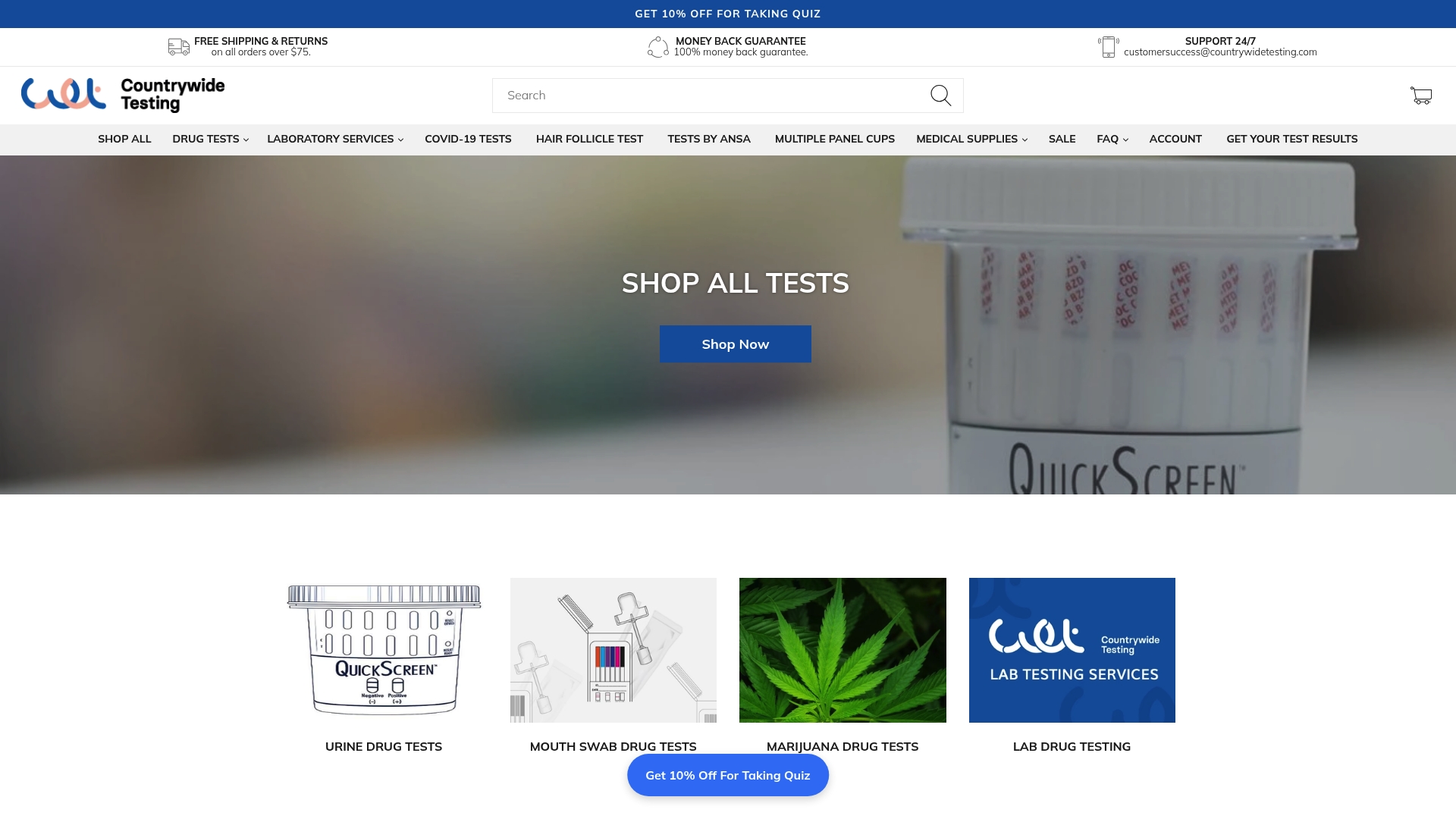
Whether you need a rapid saliva kit for a single hire, a confirmed urine lab result for a DOT file, or a full employer program with bulk ordering and documentation support, Countrywidetesting has a direct path to each. Visit Countrywidetesting’s lab testing services to request a program quote or place a lab order today.
Authoritative sources and next-step resources
- SAMHSA Certified Drug Testing Laboratory List — verify any lab partner’s HHS certification status
- SAMHSA Workplace Drug Testing Resources — electronic custody forms, specimen guidance, and lab requirements
- SAMHSA Federal Laws and Regulations for Employers — ADA, FMLA, Title VII, and Drug-Free Workplace Act guidance
- NSC Workplace Drug Testing Quick Guide (PDF) — supervisor and HR reference covering panels, sample types, and policy design
- Ogletree: Evolution of Workplace Drug Testing 2026 — legal analysis of DOT saliva timelines and state cannabis developments
- Countrywidetesting Lab Testing Services — primary page for employer and clinic lab orders
- Countrywidetesting Homepage — kit ordering, program inquiries, and general contact
This article provides general information about drug testing options and U.S. compliance considerations. It is not legal or medical advice. Confirm current regulatory requirements with SAMHSA, the DOT, or a qualified legal professional before implementing or changing a testing program.