
U.S. Law: Home Paternity Tests Won't Hold Up. How to Get Court Proof
At-home paternity tests are not admissible in U.S. courts. The DNA results themselves can be accurate, but the process is missing the one thing judges require: a documented chain of custody with verified identities at collection. If you need proof of paternity for a court case, custody dispute, or government benefit, skip the mail-in kit and start with a legal, court-admissible test instead.
TL;DR:
- Court-admissible paternity tests require a witnessed collection at an accredited site with verified IDs and a strict chain-of-custody process.
- Home kits are not legally valid because they lack documentation of sample handling, identity verification, and a verified chain of custody.
- Legal testing costs are higher due to supervised collection fees, but they are necessary for cases involving child support, custody, immigration, or benefit claims.
- New York law specifically requires court-ordered, witnessed testing to produce admissible results; rules vary by state.
- For legal proof, always choose an accredited lab and follow the proper collection procedures; private home testing is suitable only for personal curiosity.
Table of Contents
- At-Home Paternity Test Legal Questions: What Actually Separates the Two Tests
- How Does Court-Admissible Paternity Testing Actually Work?
- When Do You Actually Need a Legal Paternity Test?
- Does New York Have Different Paternity Testing Rules?
- What Do Paternity Tests Cost, and How Long Do They Take?
- How Do You Get a Court-Admissible Paternity Test?
- When Is a Home Paternity Test the Right Choice?
- Why Lab Accreditation Is What Makes a Paternity Result Hold Up
- A Practical Recommendation for Readers Weighing Their Options
- Where to Verify State Rules and Testing Standards
- Sources
At-Home Paternity Test Legal Questions: What Actually Separates the Two Tests
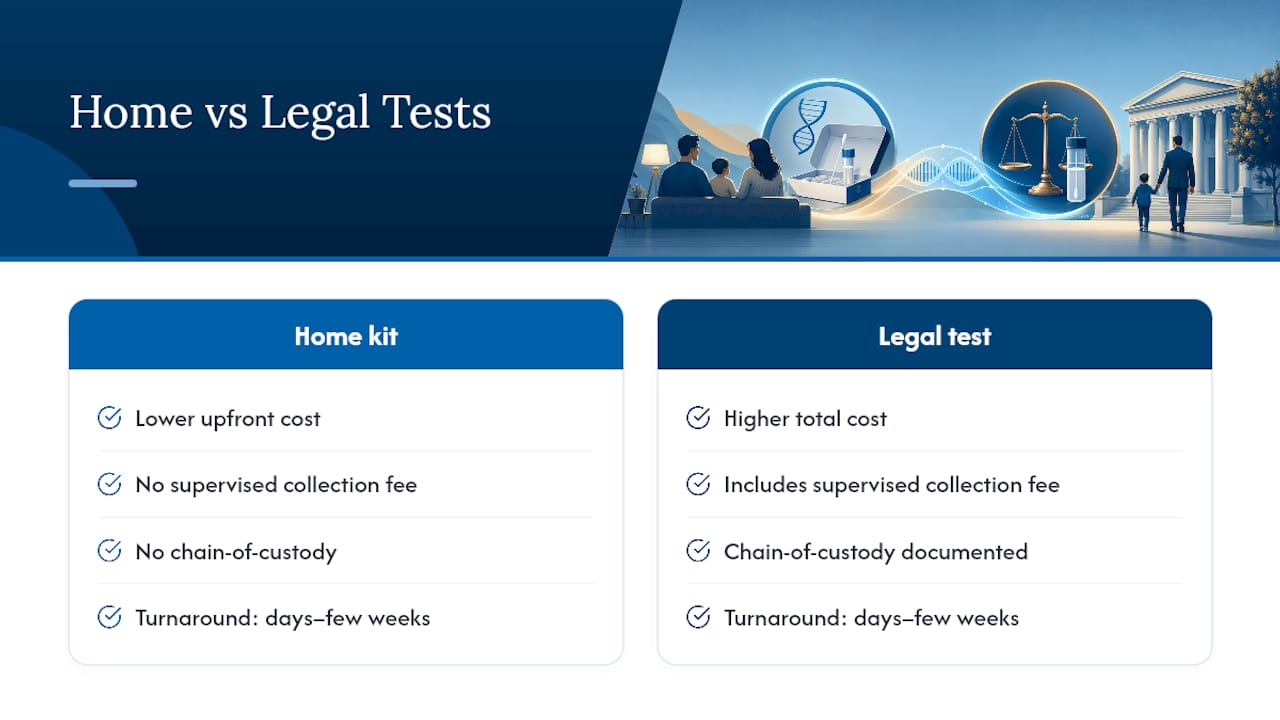
A home kit and a legal test can use the exact same lab technology. The molecular testing behind both is essentially identical; what differs is entirely procedural. Courts don’t reject home results because the science is weak. They reject them because nobody can verify who actually swabbed the cheek or spit in the tube.
That distinction shows up in a few concrete ways:
- Identity verification: Legal tests require government ID at collection; home kits take your word for it.
- Chain of custody: Legal samples are logged, sealed, and tracked from collector to lab, with signatures at every handoff.
- Report format: A legal report names each tested party and carries the collector’s signature; a home report is essentially anonymous.
- Neutral collection: A third party, not the participants, handles the sample in a legal test.
Lab accreditation matters most when a case might end up in front of a judge. A private curiosity test doesn’t need it. A test destined for a courtroom does, because the Cleveland Clinic notes that home kits are often accurate but generally inadmissible precisely because they skip these safeguards.
How Does Court-Admissible Paternity Testing Actually Work?
Legal paternity testing follows a set procedure designed to survive scrutiny in a courtroom. Here’s the typical sequence:
- Schedule a witnessed collection at an approved clinic, hospital, or third-party collection site rather than at home.
- Verify identity with a government-issued photo ID for every person being tested, including the child.
- Complete a chain-of-custody form, which a neutral collector signs and seals along with the sample.
- Ship the sample directly from the collection site to the lab, bypassing the participants entirely.
- Receive a certified report naming each party, dated and signed, ready for legal or administrative use.
Accreditation bodies like AABB, along with CLIA and CAP certification, confirm that a lab follows accepted procedures for sample handling and reporting. Courts recognize these standards as a baseline for trustworthy results. Once a properly collected sample reaches an accredited lab, processing typically takes several days to a few weeks, depending on the lab’s workload and whether the case is court-ordered.
Pro Tip: Ask upfront whether the collection site handles the chain-of-custody paperwork or expects you to bring your own. Some clinics only process ordered tests, not walk-in requests.
When Do You Actually Need a Legal Paternity Test?
Not every paternity question needs to hold up in court. But certain situations only accept results from a properly chain-of-custody-verified test:
- Child support cases, where a court or state agency needs enforceable proof of biological parentage.
- Custody and visitation disputes, where parentage is contested as part of a larger family court proceeding.
- Immigration petitions, where U.S. Citizenship and Immigration Services requires documented biological relationships.
- Birth certificate amendments, adding or removing a parent’s name on the official record.
- Social Security and other benefit claims, where a child’s eligibility depends on proven parentage.
In every one of these, a mail-in kit result gets you nowhere administratively, no matter how accurate the DNA match is.
Does New York Have Different Paternity Testing Rules?
State rules vary more than most people expect, and New York is the clearest example. Under New York Family Court Act Section 532, genetic testing generally requires authorization tied to a court proceeding, with samples collected under a documented, witnessed process rather than through a standard consumer kit. Major testing providers routinely flag New York as an exception for this reason.
Rules differ by state, so before you order anything, check your state’s family court or health department guidance directly. A quick call to your local court clerk can save you from having to redo a test later.
What Do Paternity Tests Cost, and How Long Do They Take?
Home kits generally run cheaper upfront, often in the range of a basic DNA test price, while legal tests cost more because they include a supervised collection fee on top of lab processing. That collection fee, not the lab work itself, is the main price difference between the two.
Turnaround for both types is often similar once the sample reaches the lab, typically a matter of days to a couple of weeks. Accuracy depends partly on the number of genetic markers tested. Higher marker-count panels, common in legal-grade tests, reduce ambiguity in cases involving closely related potential fathers. A home kit is reasonable for private curiosity. It’s the wrong tool the moment a court, agency, or benefit decision is in play.
How Do You Get a Court-Admissible Paternity Test?
Follow this sequence if you know or suspect you’ll need legal proof of paternity:
- Confirm you actually need legal evidence. If you’re unsure, ask a family court clerk or a family law attorney before ordering anything.
- Find an accredited collection site or lab that performs witnessed, chain-of-custody testing rather than mail-in kits.
- Schedule the appointment and bring valid government ID for every party being tested, including the alleged father, mother, and child.
- Sign the chain-of-custody form at collection; this paperwork is what makes the sample legally traceable.
- Request certified copies of the final report, and follow your court’s procedure for filing or formally acknowledging the results.
A guide on DNA testing services and your options walks through this decision in more detail, and a chain-of-custody form walkthrough is worth reading before your appointment so nothing on the form catches you off guard.
Pro Tip: If one parent is uncooperative, a private test won’t solve that problem; a court-ordered process can compel testing in a way a mail-in kit never will. A court-ordered process can compel testing in a way a mail-in kit never will.
When Is a Home Paternity Test the Right Choice?
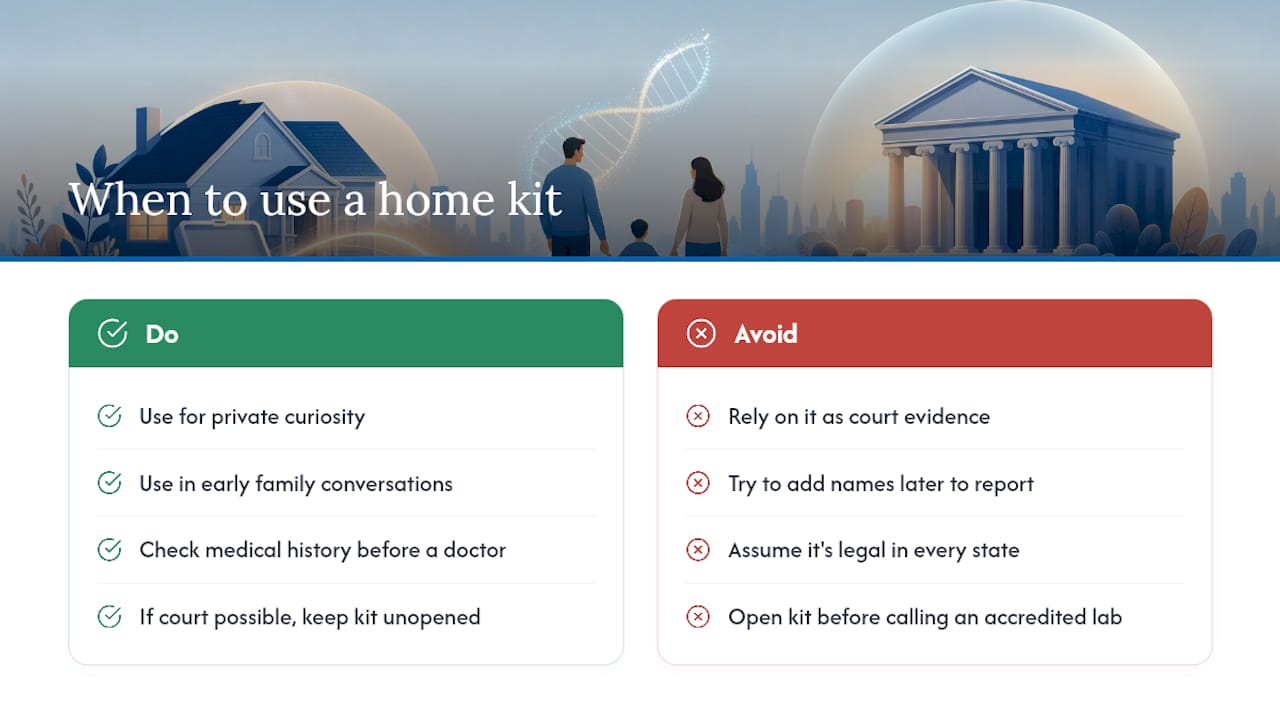
Home kits make sense when you want a private answer and have no plan to involve a court. That covers curiosity, early family conversations, or a personal medical history question before a doctor’s visit.
The risk shows up later, if circumstances change. A home result can’t be retrofitted into legal evidence, names can’t be added to a report after the fact, and some states restrict or ban unsupervised testing outright. If there’s any chance you’ll need enforceable proof down the road, keep the kit unopened and call an accredited lab first. Testing once, correctly, beats paying twice.
Why Lab Accreditation Is What Makes a Paternity Result Hold Up
Accreditation isn’t paperwork for its own sake. Standards like SAMHSA-aligned protocols, ISO, CLIA, and CAP certification exist so a lab’s chain-of-custody handling and reporting can survive a legal challenge. That’s the practical link between accreditation and a report a court will actually accept.
Some labs follow these standards for sample handling and reporting. If you’re weighing your options, some lab testing services pages outline how accredited collection and processing works, and some paternity test product pages explain what to expect from a properly documented testing process.
A Practical Recommendation for Readers Weighing Their Options
If there’s any realistic chance a court, agency, or attorney will need the result, get a legal test from the start. It costs more upfront but saves you from retesting under pressure later. If you’re unsure which category your situation falls into, call the court clerk or a family law attorney before you buy anything. When privacy is genuinely all you need, a home kit is a reasonable, low-stakes choice, but know its limits going in.
— Alan
Where to Verify State Rules and Testing Standards
Check your state’s family court or health department site for local requirements, review AABB’s accreditation standards for what a legitimate lab should offer, and consult the Cleveland Clinic’s explainer for a plain-language accuracy overview.
This article is general information, not a substitute for advice from a qualified lawyer. Consult a qualified legal professional about your own circumstances before acting on anything here.
Sources
- DNA Paternity Test: Procedure, Accuracy & Results — Cleveland Clinic
- Standards & Accreditation — AABB
- Parentage testing overview — NCBI