
Best AmericanScreeningCorp.com Alternatives for Employers
TL;DR:
- Integrated lab-network platforms are the best for employer drug testing, providing compliance, centralized management, and rapid results. Countrywidetesting combines certified lab partnerships with online ordering, making it ideal for organizations needing legal or DOT-regulated testing with minimal administrative burden. Prioritizing compliance over cost ensures results are defensible and aligned with regulatory standards.
For most employer use cases, integrated lab-network platforms are the strongest category of Americanscreeningcorp.com alternatives, and Countrywidetesting is the publisher’s recommended pick for businesses that need compliance-ready testing without managing physical inventory. If your organization requires DOT/SAMHSA compliance, chain-of-custody documentation, and a straightforward ordering process, an integrated lab-network platform with certified lab partnerships covers all three in a single relationship.
Here is a quick snapshot of how the main alternative categories compare on the dimensions that matter most to procurement teams:
| Category | Best For | Accreditation | Chain-of-Custody | Pricing Shape | Program Management |
|---|---|---|---|---|---|
| Integrated lab-network platforms | Employers, clinics, DOT-regulated roles | SAMHSA, CLIA, CAP | eCCF supported | Per-test or bulk | Centralized dashboard, ATS/HRIS |
| Lab-access services | Individuals, small businesses | CLIA, CAP (Quest/Labcorp) | Physician-reviewed | Per-test | Limited |
| Bulk-kit retailers | High-volume, on-site screening | Varies | Paper CCF only | Per-kit, volume tiers | Minimal |
| At-home single-test vendors | Personal use, pre-screening | Varies | None | Per-kit | None |
| Specialized forensic/DOT vendors | Federal, court, DOT-regulated | SAMHSA, DOT-certified | Full eCCF | Contract-based | Full program support |
Pro Tip: If your organization runs DOT-regulated testing or needs results that hold up in legal or federal proceedings, skip bulk-kit retailers and at-home vendors entirely. Integrated platforms and specialized forensic vendors are the only categories that reliably support eCCF and SAMHSA-certified lab confirmation.
Table of Contents
- How do the top alternative categories compare for employer procurement?
- What does each alternative actually offer, and who does it fit?
- How we evaluated and scored alternative providers
- How do you pick the right alternative for your organization?
- What testing types and chain-of-custody rules actually affect your results?
- Why Countrywidetesting is a strong alternative for employers
- Key Takeaways
- The case for prioritizing compliance over convenience
- Getting started with Countrywidetesting as your testing partner
- Sources and authoritative references
How do the top alternative categories compare for employer procurement?
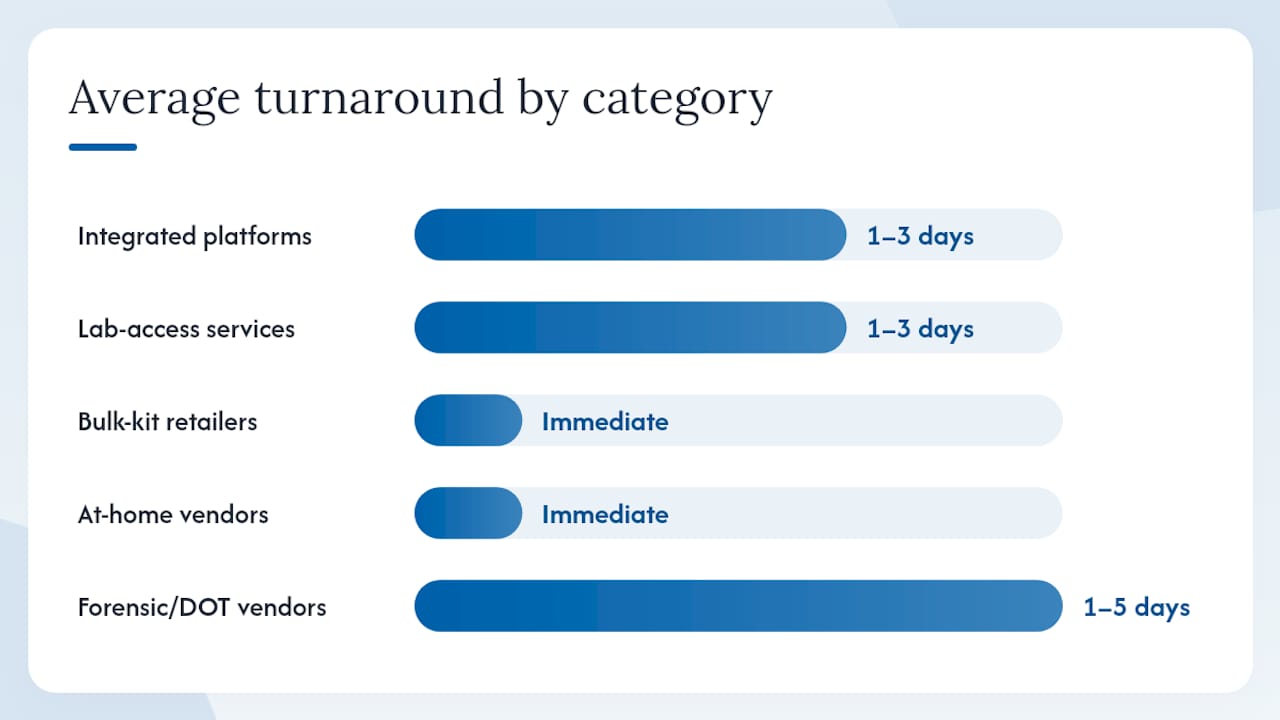
Choosing among comparable screening services comes down to four practical dimensions: compliance coverage, turnaround speed, pricing transparency, and how much administrative work lands on your team. Each category handles these differently.
| Category | Compliance | Avg. Turnaround | Pricing Transparency | Admin Overhead |
|---|---|---|---|---|
| Integrated lab-network platforms | SAMHSA/CLIA/CAP/DOT | 1–3 business days | Published or quoted | Low (centralized) |
| Lab-access services (Quest/Labcorp routing) | CLIA/CAP | 1–3 business days | Per-test, clear | Low to medium |
| Bulk-kit retailers | Varies | Immediate (on-site) | Per-kit, volume tiers | High (inventory mgmt.) |
| At-home single-test vendors | Varies | Immediate | Per-kit | High (no reporting) |
| Specialized forensic/DOT vendors | SAMHSA/DOT | 1–5 business days | Contract-based | Low to medium |
Integrated lab-network platforms are the strongest fit for most employers. Integrated platforms reduce the need to manage on-site inventory and typically provide physician review, eCCF, and centralized reporting in a single system. The trade-off is that per-test pricing is higher than bulk-kit rates, but the reduction in administrative overhead usually offsets that difference for organizations running more than occasional testing.
- Pros: eCCF, ATS/HRIS integration, centralized dashboards, DOT/SAMHSA compliance, physician oversight
- Cons: Higher per-test cost than bulk kits, requires vendor onboarding
Lab-access services (those routing specimens to Quest Diagnostics or Labcorp) offer physician-reviewed orders and rapid results without requiring you to hold inventory. They suit small businesses and individuals who need occasional lab-confirmed testing.
- Pros: Trusted national lab networks, clear per-test pricing, no inventory
- Cons: Limited program management, less suited to high-volume employer programs
Bulk-kit retailers work well for organizations that already have a trained collection staff and need to screen large numbers of employees on-site at low per-unit cost.
- Pros: Lowest per-kit cost, immediate on-site results
- Cons: Paper CCF only, no centralized reporting, high inventory management burden
At-home single-test vendors serve personal pre-screening or low-stakes use cases. They are not appropriate for employment or legal purposes because passing an at-home drug test does not guarantee passing a lab-based confirmation, which remains the standard for employment and legal use.
- Pros: Convenient, low cost, no scheduling
- Cons: No chain-of-custody, not admissible for employment or DOT use
Specialized forensic/DOT vendors (such as First Advantage and eScreen) handle federal, court-ordered, and DOT-regulated programs with full eCCF and SAMHSA-certified lab confirmation. They are the right choice for transportation, government contractors, and safety-sensitive industries.
- Pros: Full regulatory compliance, court-admissible results, dedicated program management
- Cons: Contract-based pricing, less flexible for small or infrequent programs
Pro Tip: For employers switching from a bulk-kit model, moving to an integrated lab-network platform typically reduces administrative work and improves result interpretation, since lab-confirmed results come with physician review rather than a line on a test strip.
What does each alternative actually offer, and who does it fit?
Understanding the operational model behind each category helps you match the right vendor to your organization’s size, regulatory exposure, and internal capacity.
Integrated lab-network platforms (Countrywidetesting, eScreen)
These platforms connect employers directly to certified labs through an online ordering system, eliminating the need to stock physical kits or manage collection logistics in-house. Countrywidetesting, for example, partners with licensed laboratories that meet SAMHSA, CLIA, CAP, and ISO standards, and offers both urine and mouth swab kits alongside full lab testing services. eScreen operates a nationwide collection site network with eCCF and DOT-compliant workflows built in.
Who it fits: Mid-size to large employers, occupational health clinics, HR departments running ongoing programs, and any organization with DOT-regulated roles.
Typical pricing: Per-test or bulk pricing, quoted on request for enterprise programs. Countrywidetesting publishes product-level pricing and offers custom quoting for volume orders.
Turnaround: 1–3 business days for lab-confirmed results.
Accreditations: SAMHSA, CLIA, CAP (lab partners); ISO where stated.
Integration level: API access, ATS/HRIS compatibility, centralized dashboards.
Lab-access services (Personalabs, USHealthTesting)
Services that route specimens to national laboratory networks like Quest Diagnostics and Labcorp offer physician-reviewed orders, clearer pricing, and results within a few business days. Personalabs and USHealthTesting both operate this model, giving individuals and small businesses access to trusted lab infrastructure without a long-term contract.
Who it fits: Small businesses, individuals, and organizations that need occasional lab-confirmed testing without managing inventory.
Typical pricing: Per-test, published on the vendor’s site.
Turnaround: 1–3 business days.
Accreditations: Dependent on the routing lab (Quest/Labcorp are CLIA- and CAP-certified).
Integration level: Minimal; primarily web-based ordering.
Bulk-kit retailers (American Screening Corporation model)
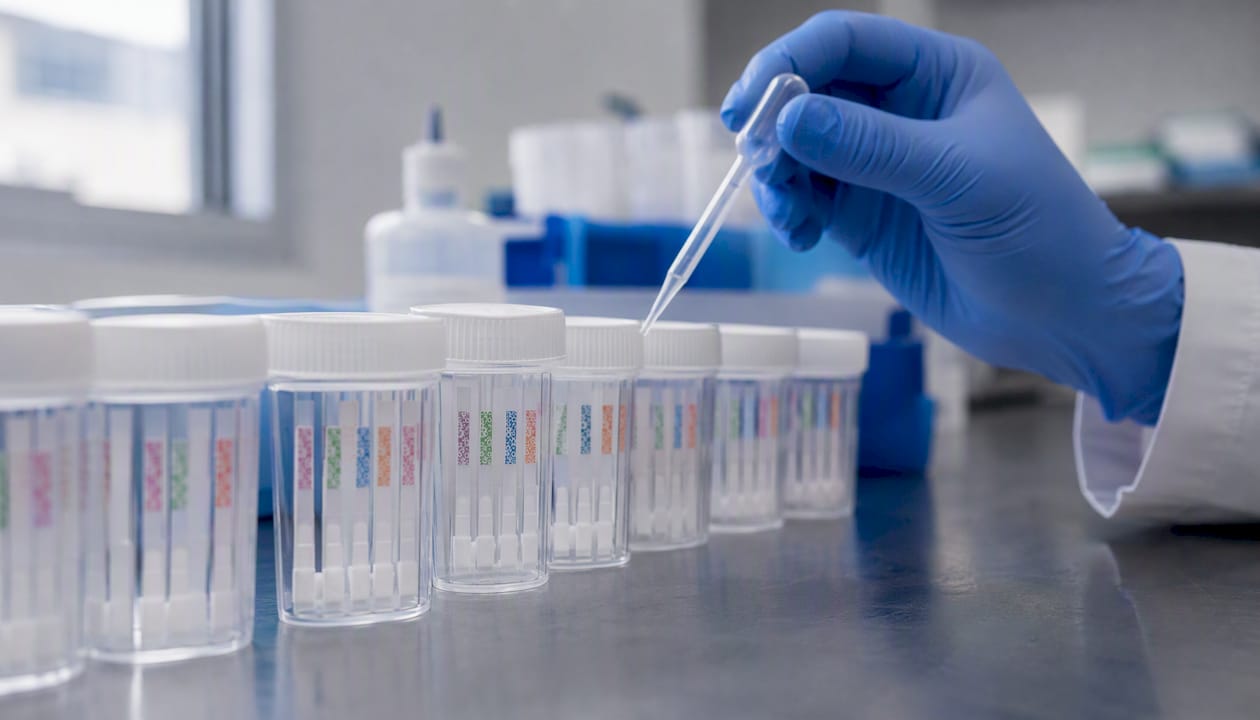
American Screening Corporation’s core model is high-volume kit sales, primarily urine-based multi-panel cups and strips. This works for organizations with trained on-site collectors and a need for rapid, immediate results at low per-unit cost. The limitation is that paper chain-of-custody and no centralized reporting make this model difficult to defend in DOT audits or legal proceedings.
Who it fits: Large on-site programs with trained staff, pre-employment screening at high volume where speed matters more than legal defensibility.
Typical pricing: Per-kit, with volume discounts at higher quantities.
Turnaround: Immediate (on-site).
Accreditations: Varies by kit manufacturer; not lab-confirmed by default.
Integration level: None.
Specialized forensic and DOT vendors (First Advantage, Quest Diagnostics, Labcorp)
First Advantage provides background screening and drug testing with full eCCF, DOT compliance, and a nationwide collection network. Quest Diagnostics and Labcorp operate as both lab partners for other platforms and as direct testing services for employers who want to work with the lab directly. These vendors are the gold standard for safety-sensitive industries.
Who it fits: Transportation companies, federal contractors, government agencies, and any employer subject to DOT 49 CFR Part 40 regulations.
Typical pricing: Contract-based; negotiated rates for volume programs.
Turnaround: 1–5 business days depending on specimen type and confirmation requirements.
Accreditations: SAMHSA-certified (Quest, Labcorp), DOT-compliant, CLIA, CAP.
Integration level: Full program management, eCCF, candidate self-scheduling.
At-home single-test vendors (Psychemedics, personal-use kits)
Psychemedics specializes in hair follicle testing, which offers a longer detection window than urine but requires lab processing. Generic at-home single-test vendors sell point-of-care strips for personal use. Neither category is appropriate as a standalone employment testing solution without lab confirmation.
Who it fits: Individuals conducting personal pre-screening, or employers using hair testing as a supplemental method alongside lab-confirmed urine testing.
Red flags to watch in vendor terms:
- Hidden shipping minimums that inflate per-kit cost at lower order volumes
- Bulk pricing rules that are not published and require a sales call to access
- No published dispute resolution process for contested results
- Unclear or absent chain-of-custody documentation
- Vendor history of regulatory actions or FTC judgments related to deceptive business practices, which should trigger a procurement-level review
Pro Tip: Before signing with any lab-affiliated vendor, ask for a sample chain-of-custody form and a specimen result report. A vendor that cannot produce these on request has not operationalized the compliance it claims.
How we evaluated and scored alternative providers
The scoring framework below reflects the priorities of HR, compliance, and occupational health buyers. Each dimension was weighted based on its operational impact for employer programs.
| Scoring Dimension | Weight | Why It Matters |
|---|---|---|
| Compliance (SAMHSA/DOT/CLIA/CAP) | — | Non-compliant results cannot be used for DOT or legal purposes |
| Integration (ATS/HRIS/API) | — | Reduces manual entry, errors, and time-to-hire |
| Pricing transparency | — | Hidden costs are a common procurement pitfall |
| Turnaround time | — | Directly affects hiring velocity and program efficiency |
| Customer support | 10% | Dispute resolution and responsiveness affect program continuity |
| Reputation and track record | 10% | Documented regulatory issues are disqualifying |
Sources used in this evaluation:
- Vendor documentation and published product pages
- Lab affiliation verification against SAMHSA’s certified laboratory list
- Industry reference sites covering drug testing compliance and employer programs
- Platform capability assessments based on published feature sets and integration documentation
- Published regulatory records and FTC enforcement actions where relevant
The compliance dimension carries the highest weight because a result that cannot withstand legal or regulatory scrutiny has no value to an employer, regardless of how fast or cheap it was to obtain. Integration ranks second because a platform’s ability to connect with ATS and HRIS systems is a critical differentiator that directly reduces administrative workload and hiring errors.
How do you pick the right alternative for your organization?
The right vendor depends on your regulatory exposure, testing volume, and internal capacity. Work through these steps before committing to a contract.
- Verify lab accreditations. Confirm that the vendor’s lab partners appear on SAMHSA’s certified laboratory list if you need DOT-compliant results. Ask for the lab’s CLIA and CAP certification numbers.
- Confirm eCCF and DOT chain-of-custody support. Paper CCF is acceptable for non-regulated testing, but DOT 49 CFR Part 40 requires electronic chain-of-custody for federal programs. Ask whether the vendor supports eCCF natively or through a third-party collector network.
- Ask about ATS and HRIS integration. Request documentation of native integrations or API access. A vendor that requires manual data entry for every result will create bottlenecks at scale.
- Request published bulk pricing. If a vendor cannot share a pricing schedule without a sales call, that is a transparency problem. Published rates or a clear quoting process are the baseline expectation.
- Ask about turnaround SLAs and dispute resolution. Get the vendor’s committed turnaround time in writing and ask specifically how contested results are handled, including who bears the cost of a confirmation retest.
Decision triggers by use case:
- Choose an integrated lab-network platform if you need ATS integration, centralized dashboards, and DOT/SAMHSA compliance in a single vendor relationship.
- Choose a lab-access service if you want physician-reviewed lab testing for occasional use without holding inventory or signing a long-term contract.
- Choose a specialized forensic/DOT vendor if your organization is subject to federal regulations (DOT, NRC, HHS) and needs full program management with eCCF.
- Choose a bulk-kit retailer only if you have trained on-site collectors, a high daily testing volume, and no DOT compliance requirement.
Pro Tip: Run a vendor-sampling step before full deployment. Order a single test kit or request a pilot lab order, then track the actual turnaround time, the quality of the result report, and how responsive support is when you have a question. Operational claims are easy to make; the pilot reveals what the vendor actually delivers.
Vendor-qualification questions to require answers to:
- Which SAMHSA-certified laboratory processes your specimens, and can you provide the lab’s certification number?
- Does your platform support eCCF for DOT-regulated testing?
- What is your committed turnaround time for lab-confirmed results, and what is your SLA for contested results?
- Do you offer native ATS or HRIS integrations, or API access for custom workflows?
- What is your published bulk pricing schedule, and are there shipping minimums or volume thresholds that affect per-unit cost?
What testing types and chain-of-custody rules actually affect your results?
The specimen type you choose determines detection windows, accuracy, and whether results hold up in legal or regulatory proceedings. Each has a distinct operational profile.
Urine testing is the most widely used method for workplace drug screening. It covers the broadest panel of substances, is accepted by DOT and SAMHSA, and is the default for most employer programs. Detection windows vary by substance and individual metabolism. Some prescription barbiturates, for example, may be detectable in urine for several days, though exact windows vary with dose and individual metabolism.
Oral fluid (saliva) testing detects recent use more precisely than urine, with a shorter detection window that typically reflects use within the past 24–48 hours. DOT finalized rules allowing oral fluid testing for federally regulated programs, making it a growing option for safety-sensitive employers who want to detect impairment closer to the time of the test.
Hair follicle testing provides the longest detection window, typically up to 90 days, by analyzing drug metabolites deposited in the hair shaft. It cannot detect very recent use (within the past 7–10 days) and requires lab processing, so it is not a point-of-care option. Psychemedics specializes in this method.
Blood testing is rarely used for routine workplace screening due to cost and invasiveness, but it is the most accurate measure of current impairment and is used in post-accident investigations.
Breath testing is specific to alcohol and is the standard for DOT alcohol testing under 49 CFR Part 40, conducted by a Breath Alcohol Technician (BAT) using an Evidential Breath Testing (EBT) device.
Chain-of-custody: why eCCF matters for employers
Chain-of-custody documentation tracks a specimen from collection through lab analysis, creating a legally defensible record that the sample was not tampered with or mislabeled. For DOT-regulated programs, electronic chain-of-custody (eCCF) is required because it eliminates the transcription errors common with paper forms and creates a timestamped audit trail. Integrated platforms with eCCF, candidate self-scheduling, and broad collection site networks are often the single biggest operational improvement for enterprises switching vendors.
Pro Tip: For employment testing, always require lab-based confirmation (GC-MS) for any non-negative result from a point-of-care screen. A positive strip result is a screening result, not a confirmed positive. Acting on an unconfirmed screen exposes your organization to legal liability.
Why Countrywidetesting is a strong alternative for employers
Countrywidetesting operates as a direct alternative to bulk-kit retailers and lab-access services by combining an e-commerce ordering platform with partnerships with licensed laboratories that meet SAMHSA, CLIA, CAP, and ISO standards. That combination covers the two things most employer programs actually need: compliant lab processing and a straightforward way to order.
Compliance and lab affiliations:
- Lab partners certified to SAMHSA, CLIA, CAP, and ISO standards
- Support for employer and federal drug testing programs
- Government-approved lab collaboration for regulated testing needs
Product and service portfolio:
- Urine drug test kits (multi-panel cups and strips)
- Mouth swab (oral fluid) test kits
- Laboratory drug testing services for confirmed, physician-reviewed results
- At-home medical testing options (sexual health, women’s health, genetics)
- Custom and enterprise ordering with bulk options
Who Countrywidetesting fits best:
- Employers and HR departments that want a single vendor for both point-of-care kits and lab-confirmed testing
- Clinics and occupational health providers needing a compliant kit portfolio alongside lab services
- Organizations that want to order online without a long-term contract or a sales-cycle commitment
- Businesses that need drug testing kits designed for healthcare providers and clinical settings
Countrywidetesting also publishes comparative resources, including evaluations of alternative providers, which reflects a buyer-focused approach to the category rather than a purely transactional one.
Pro Tip: If you are evaluating Countrywidetesting for an enterprise program, request a custom quote for bulk orders and confirm which specific lab partners process your specimens. The lab’s SAMHSA certification number is the verification step that matters most for DOT-regulated roles.
Key Takeaways
For most employer use cases, integrated lab-network platforms with SAMHSA/CLIA/CAP-certified lab partners and eCCF support are the most defensible and operationally efficient alternatives to American Screening Corporation.
| Point | Details |
|---|---|
| Integrated platforms win for compliance | SAMHSA, CLIA, and CAP certification plus eCCF are non-negotiable for DOT-regulated and legal-use testing. |
| Lab confirmation beats point-of-care screens | At-home and bulk-kit results must be confirmed by a certified lab before any employment action is taken. |
| Integration reduces hiring friction | ATS and HRIS integration eliminates manual data entry and speeds time-to-hire for high-volume programs. |
| Vendor vetting requires proof, not claims | Ask for SAMHSA certification numbers, sample CCF forms, and result reports before signing any contract. |
| Countrywidetesting covers both kit and lab needs | Countrywidetesting combines online kit ordering with certified lab testing services, suiting employers who want one vendor for both. |
The case for prioritizing compliance over convenience
The most common mistake procurement teams make when evaluating screening service alternatives is treating per-kit cost as the primary decision variable. It is not. A test result that cannot withstand a DOT audit, a legal challenge, or an MRO review has no value, regardless of what it cost to produce.
The vendors that tend to win long-term employer relationships are not always the cheapest or the most recognizable. They are the ones that can produce a SAMHSA certification number on request, show you a completed eCCF, and explain their dispute resolution process in plain language. Those three things separate a compliance-ready vendor from a kit seller.
There is also a reputational dimension that procurement teams underweight. Documented regulatory actions against a vendor, including FTC enforcement related to deceptive business practices, are not minor footnotes. They are signals about how a vendor operates under pressure, which is exactly when you need them to perform correctly.
The shortlist in this article reflects that priority order: compliance first, integration second, pricing third. Countrywidetesting earns its position on that list because it combines certified lab partnerships with a practical online ordering model, which is the combination most employer programs actually need.
Getting started with Countrywidetesting as your testing partner
Countrywidetesting gives procurement and HR teams a direct path to compliant drug testing without the overhead of a traditional vendor contract. The platform covers both point-of-care kits and certified lab testing services, so you are not managing two separate vendor relationships for screening and confirmation.
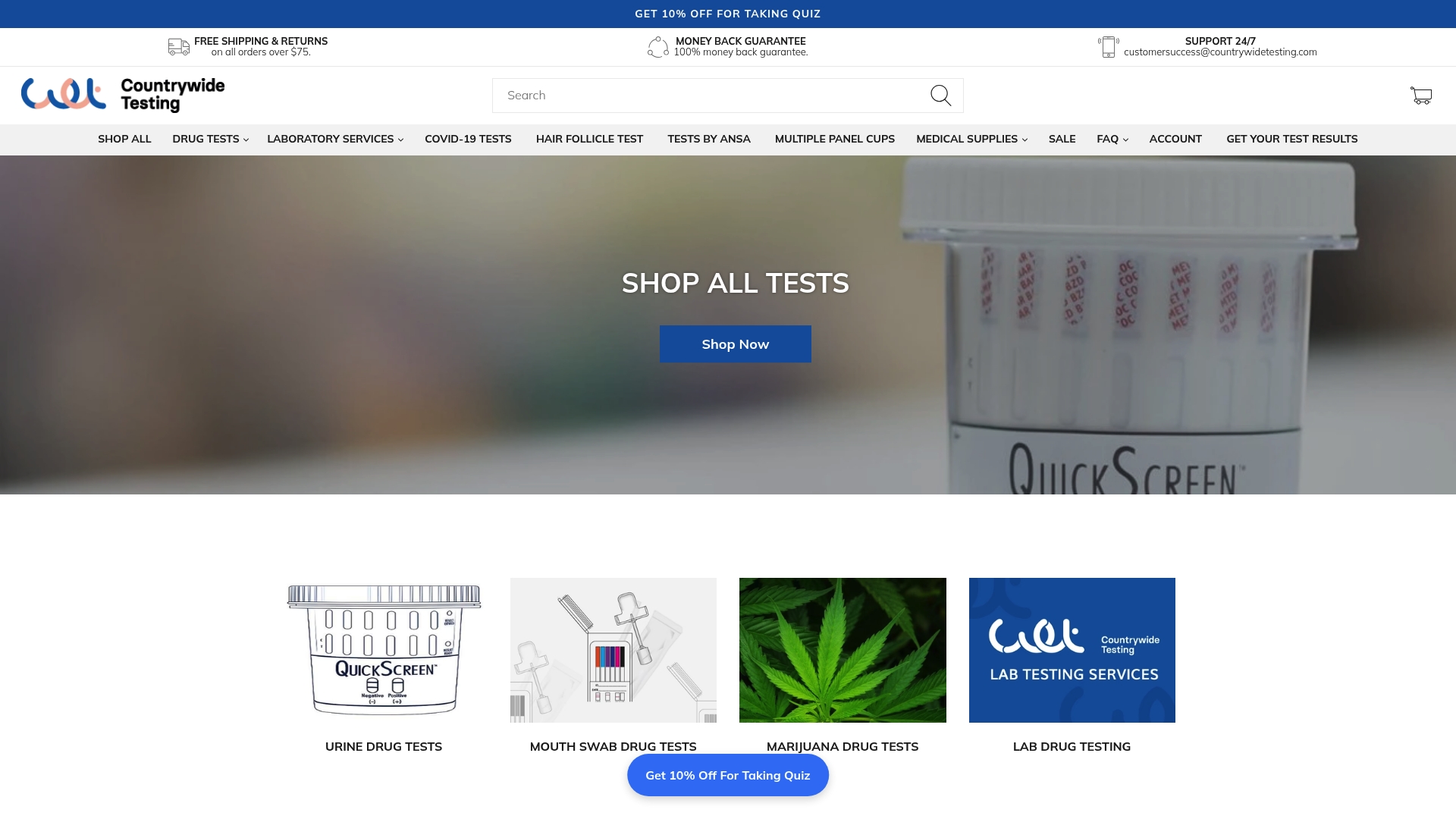
The practical starting point for most employer programs is the lab testing services page, where you can review the full scope of lab-confirmed testing options and request a custom quote for enterprise or bulk orders. For organizations evaluating multi-panel kits, the 12-panel at-home cup test is a concrete reference point for per-kit pricing and panel composition.
The recommended sequence for new enterprise accounts: request a custom quote specifying your testing volume and any DOT or SAMHSA compliance requirements, confirm the lab partner’s certification credentials, then run a pilot order to validate turnaround time and report quality before full deployment. Countrywidetesting’s B2B ordering model is built for exactly this kind of phased evaluation, without requiring a long-term commitment before you have verified the operational fit.
Sources and authoritative references
The factual claims in this article draw on the following authoritative sources, verified as of mid-2026:
- SAMHSA Certified Laboratory List — the primary verification source for federally certified drug testing laboratories
- Quest Diagnostics — national laboratory network referenced for CLIA and CAP accreditation standards
- Labcorp — national laboratory network referenced for CLIA and CAP accreditation standards
- First Advantage — background screening and DOT-compliant drug testing platform
- Countrywidetesting lab testing services — publisher’s primary lab testing service page, used for brand proof points
- Personalabs vs. American Screening Corporation comparison — independent comparison covering lab-access service advantages and vendor risk signals
- At-home vs. lab drug test accuracy — source for the accuracy and confirmation standard claims
- Detection window variance by substance — illustrative source for urine detection window variability
Key industry standards referenced:
- SAMHSA Mandatory Guidelines for Federal Workplace Drug Testing Programs
- DOT 49 CFR Part 40 (Procedures for Transportation Workplace Drug and Alcohol Testing)
- CLIA (Clinical Laboratory Improvement Amendments) — federal certification for laboratory quality
- CAP (College of American Pathologists) — laboratory accreditation program recognized by CMS